
Business
China Merchants Group chairman visits HIP

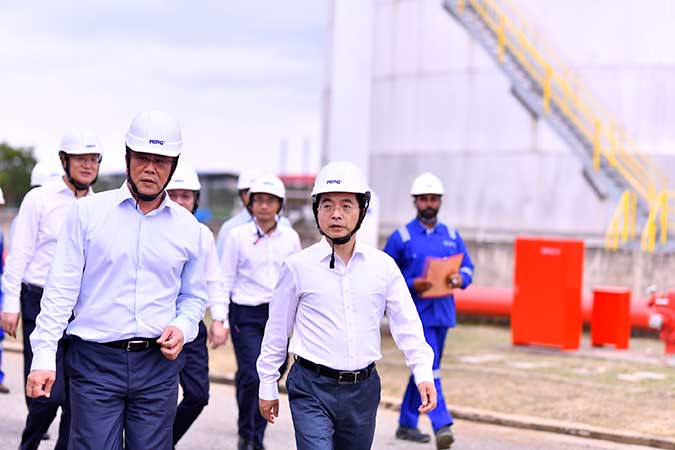
The highest ranking official from the China Merchants Group (CMG) visited the Hambantota International Port on an inspection tour of the facility last week. Chairman Miao Jianmin was welcomed by Johnson Liu, CEO of Hambantota International Port Group (HIPG) and staff of the port.
CMG is the parent company of CMPort which has a public private partnership with the Sri Lanka Ports Authority (SLPA) for Hambantota International Port. Founded in 1872 as China’s first commercial corporation, CMG is the pioneer of national industry and commerce in China. The Group continues to play a significant role in modern China’s economic and social development, pushing China forward in many historic moments.
CMG’s Chairman Miao Jianmin’s visit included a tour of the port’s tank farm, oil jetty, RORO terminal, and the newly opened duty free shopping complex. Speaking at the event, he said that the China Merchants Group, through its two major projects, CICT and Hambantota International Port, will continue to make further investments in the South Asian region. The Group plans to actively promote cooperation with international high-quality enterprises such as Sinopec and focus on RORO, bulk cargo, oil and gas, development of container handling, industrial park, and maritime services. It is the Group’s mission to build a world-class comprehensive port, with continuously improving supply chain services.
CMG has now extended its operations globally to emerging sectors such as big health and testing services. The Group’s major indicators grew steadily, with annual operating revenue reaching 959.01 billion yuan by the end of 2022, up by 3.2% year on year. Total profits were 219.28 billion yuan, up 3.3% year on year; net profits were 179.61 billion yuan, up 5.9% year on year; and total assets were 12.4 trillion yuan, up 8.1% year on year. The Chairman attributed these achievements to the contribution and efforts of every frontline employee of CMG and its subsidiary companies.
Today, the China Merchants Group has over 280,000 employees worldwide. Chairman Miao Jianmin emphasised that employees are a most critical resource of an enterprise, and CMG, across all its subsidiary companies has provided all-round and multi-level support to ensure employee development. In 2022, the Group identified four priorities, i.e. strategy of talent resources, talent structure, talent investment, and talent system innovation, with the aim of comprehensively promoting the construction of its talent teams. The platform of China Merchants Group, allows opportunity, encourages hard work, within an environment that is conducive for achieving excellent results, the chairman further said.
He also spoke of the importance CMG as a group places on employee safety, especially in terms of HIP’s oil terminal and tank farm operations. Research and exploration of safety management are vital to continuously improve safety systems and security measures to ensure a safe work environment.
HIPG’s global partner, China Merchants Ports Holdings Company Limited (CMPort), has a growing presence in South Asia, Africa, the Mediterranean and South America with a network of 42 ports spanning 25 countries and regions.
Chairman Miao Jianmin’s entourage included CMG Vice Presidents Deng Renjie and Feng Boming, and Wang Xiufeng, CEO of CMPort. Johnson Liu, CEO of HIPG and Ravi Jayawickreme, CEO of HIPS were also in attendance at the event.


HNB FINANCE PLC has strengthened its Board with the appointment of four Independent Non-Executive Directors, effective September 8, 2026.
The new directors are Renuke Wijayawardhane, Shanti Gnanapragasam, Nabiha Mohamed and Dr. Thisuri Wanniarachchi, who collectively bring extensive experience in financial regulation, banking, risk management, corporate finance, investment strategy, development finance and public policy.
Wijayawardhane, an Attorney-at-Law and capital market professional, retired in July 2025 as Chief Regulatory Officer of the Colombo Stock Exchange after more than 31 years with the Exchange. His experience covers securities regulation, corporate governance, market infrastructure and compliance.
Gnanapragasam has over four decades of banking experience spanning treasury, risk management, credit and trade finance. She currently serves as an Independent Non-Executive Director of Cargills Bank, Wealth Trust and Vision Fund Lanka.
Mohamed is a corporate finance and investment professional who previously served as Lead Transaction Advisor at the State-Owned Enterprise Restructuring Unit of the Ministry of Finance, where she led five divestiture transactions worth over US$600 million.
Dr. Wanniarachchi brings over a decade of experience in development finance, institutional reform and social protection, including work with the World Bank and the Government of Sri Lanka.

Prime Lands Residencies PLC has completed and officially handed over The Palace Gampaha, described as the largest planned gated residential community in Gampaha, to its homeowners.
The development, which commenced construction in 2021, is located two kilometres from Gampaha town and 100 metres from the Colombo-Kandy main road.
Spread across 13.5 acres, The Palace Gampaha comprises 480 two- and three-bedroom apartments in a ground-plus-three-floor development, with prices starting from Rs. 27.5 million.
The project allocates about 80% of its land to landscaped areas and common facilities, while the remaining 20% is used for apartment development. Facilities include a swimming pool, gymnasium, clubhouse, library, community kitchen, laundry, mini-mart and a daycare centre managed by the Lyceum Group.
The fully gated community also incorporates solar power for common areas, underground electricity cabling and a sewage treatment plant with water recycling facilities.
Prime Residencies said all statutory approvals required for the handover had been secured, including certifications from the Condominium Management Authority and registration of the Condominium Plan and Deed of Declaration.
Prime Group Chairman Premalal Brahmanage said the project reflected the company’s vision of creating large-scale residential communities designed to enhance the quality of life of Sri Lankan families.
The project is the latest addition to Prime Group’s portfolio of more than 70 gated community and apartment developments.

Sri Lanka’s Non-Vessel Operating Common Carrier (NVOCC) sector is losing ground despite the expansion of the industry in several regional markets, Sri Lanka Association of NVOCC Agents (SLANA) Chairperson Swabha Wickramasinghe said.
Wickramasinghe, re-elected for a third consecutive term at SLANA’s ninth Annual General Meeting last week said the continued difficulty in collecting Colombo Terminal Handling Charges (THC) as a separate land-based cost was among the key challenges facing the industry.
She said the practice placed Sri Lanka at a competitive disadvantage as principals consider the overall economics of operating through Colombo.
“When Sri Lanka becomes less commercially attractive compared with other regional destinations, the consequences eventually reach our members,” she said.
Wickramasinghe said a committee had been proposed at a recent meeting with the Minister and Deputy Minister to evaluate the THC issue, urging the authorities to expedite its appointment and review.
She also called for an early solution to the problem of uncleared salt containers at the Port of Colombo, which has resulted in delays in releasing empty containers.
With more than 75 NVOCC lines operating in Sri Lanka, she stressed the sector’s importance to regional trade, particularly links with India and China.
Ports Minister Anura Karunathilaka said Sri Lanka should expand regional business while exploring areas such as bunkering, freight forwarding and e-commerce logistics.

Death toll from Philippines ferry fire rises to 76, with more still missing

Anthropic boss Dario Amodei calls for AI development to slow down

It’s spin vs spin as India and Sri Lanka battle for Asia Cup title

Atmospheric conditions are favorable for afternoon thundershowers in most parts of the Island today [13]

Gnanasara Thero absconding after SC ruling

House to debate 22A, Judicature Bill next week

‘Dates have the highest sugar content to fight Coronavirus’

Sunday Island 27 December – Headlines

#SundayIsland 17th December – Headlines

Sunday Island – 28th March

Sunday Island Headlines – 21 March

Sunday Island – 21st February – Headlines
-

 Sports2 days ago
DDS set to lose Test captaincy
-

 Features6 days ago
After the parade: What a traffic OIC’s walk-out tells us
-

 Editorial6 days ago
Arrests as theatre
-

 News5 days ago
Thailand shuts door on undesirables from Sri Lanka
-

 Latest News6 days ago
Harshitha’s composed knock seals Sri Lanka’s semi-final berth
-

 Business5 days ago
CEB successor company breaks into top three in competitive BESS tender
-

 News6 days ago
‘Choka Malli’ slips out of country before travel ban
-

 News2 days ago
Sri Lanka faces new grid challenge as rooftop solar surges: former CEB GM