
Sports
Chatara, Ervine and Raza lead Zimbabwe into Super 12s


Zimbabwe had not played in a major ICC tournament in six years coming into this T20 World Cup, but they announced themselves as a team on the comeback trail as they marched into the Super 12s. Craig Ervine led with bat and in the field, as he anchored the Zimbabwean chase after managing his bowlers with pinpoint precision to keep Scotland to a gettable score, while Tendai Chatara and Sikandar Raza also made their experience count with telling contributions. This was only the 11th time in 55 attempts that Zimbabwe had won a T20I while chasing.
Asked to field first, Zimbabwe never allowed Scotland to get away from them. Chatara set the tone with a wicket in his first over and finished with figures of 2 for 14 in his four overs. He was well supported by Zimbabwe’s spin trio, who conceded only 46 runs in the eight overs they bowled. George Munsey’s half-century held Scotland together but their highest partnership was just 40 runs – for the third-wicket. Scotland also lacked the sort of turbocharged innings that Raza played to break the back of the chase.
Zimbabwe were nervy in reply and were 7 for 2 and 42 for 3 before Ervine and Raza put on 64 for the fourth wicket. Ervine dropped anchor and scored his sixth T20I fifty, and his first at a World Cup, and by the time he was dismissed in the 17th over, Zimbabwe were within touching distance of a win.
If Scotland sensed an opening when Ervine fell with 14 needed off the last three overs, Milton Shumba and Ryan Burl shut the door, rotating the strike calmly and finishing the job in just nine balls. Burl hit the winning runs in the 19th over when he lofted Safyaan Sharif over mid-on for four Victory with more than an over remaining ensured Zimbabwe topped their group. They will join Group 2 in the Super12s, which includes their neighbours South Africa, India and Pakistan.
Zimbabwe’s fielding has not always held up in pressure moments but they were committed to cause in this match. When Michael Jones sliced the last ball of Chatara’s opening over over cover, Raza ran back from the ring and took the catch over his shoulder as he tumbled onto the turf, to give Zimbabwe their first incision. Three overs later, Matthew Cross pulled a Richard Ngarava short ball in the direction of Wessly Madhevere at midwicket. Madhevere had to launch himself to his left and took the catch in full flight to leave Scotland 24 for 2 in the fifth over.
Later in the innings, Milton Shumba was down on his haunches to take a thigh-high catch off a slog-sweep to dismiss Richie Berrington and got low down on the boundary to take the catch that ended George Munsey’s painstaking innings. And Luke Jongwe plucked a chance out of the sky in the final over to send back Calum MacLeod.
Scotland were held together by Munsey, who struck seven fours in the first 22 balls he faced with an array of strokes around the wicket. Munsey brought out the flick and the pull, the cut, and three exquisite drives off the Zimbabwean seamers. He hit over pitched deliveries from Blessing Muzarabani through mid-off with power and then smoked Richard Ngarava past extra-cover.
After scoring 33 runs off his first 22 balls, Munsey scored only 21 runs off his next 29 as Zimbabwe’s bowlers squeezed through the middle overs and made it difficult for Scotland to get them away. Zimbabwe bowled nine boundary-less overs as Raza used the variations he has developed in tandem with Sean Williams’ left-arm spin and then Madhevere’s offspin. Chatara and Muzarabani, who were also used in that period, stuck to back-of-a-length balls that did not present any opportunities for big hitting. Between the eighth and 16th overs, Scotland scored only 48 runs.
With a small total to defend, Scotland could not have asked for a better start, though Zimbabwe’s technique was to blame for their early losses. Regis Chakabva shuffled across and played down the wrong line to Brad Wheal’s third delivery and was given out lbw. He reviewed but ball-tracking showed the impact was in line and the ball would have gone on to clip the bails. In the next over, Madhevere was presented with a juicy half-volley but swung hard with no footwork and played onto his own stumps. Zimbabwe were 7 for 2 in the second over.
Scotland did not hit a single six in their innings, and there were none in the first 31.5 overs of the match before Raza, the man who seems to be able to do almost anything at the moment, sent MacLeod over the midwicket boundary and barely broke a sweat. Two overs later, he did it again when he sent Michael Leask over the covers. Before Raza’s first six, Zimbabwe required 63 runs off 49 deliveries; after his second one 43 runs off 41 balls, which is how much his innings allowed pressure to evaporate from Zimbabwe’s effort.
Brief Scores:
Scotland 132/6 in 20 overs (George Munsey 54, Callum MacLeod 25; Tendai Chatara 2-14, Richard Ngarava 2-28) lost to Zimbabwe 133/5 in 18.3 overs (Craig Ervine 58, Sikandar Raza 40; Josh Davey 2-16) by 5 wickets.


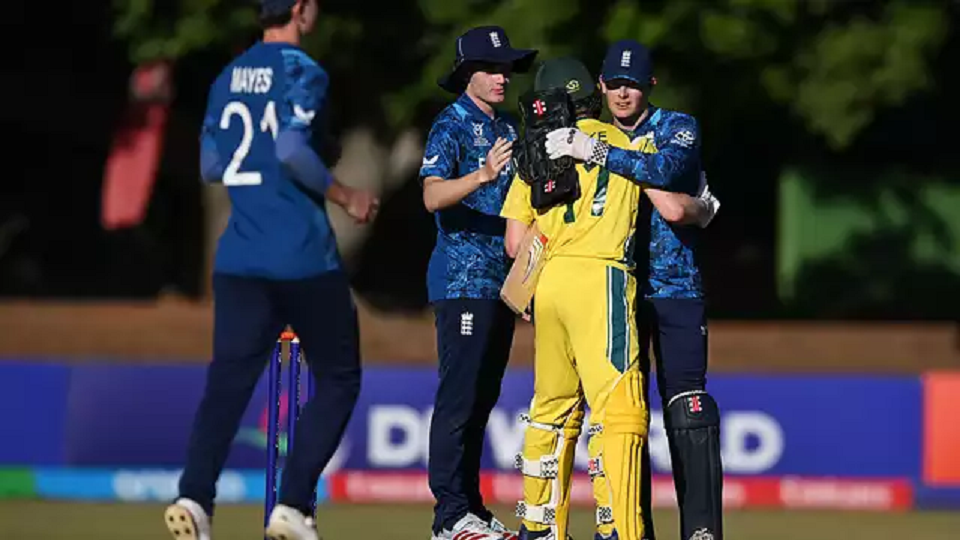
England 277/7 in 50 overs (Thomas Rew 110, Caleb Falconer 40; Hayden Schiller 2-31) beat Australia 250 in 47.3 overs (Oliver Peake 100; James Minto 2-30, Sebastian Morgan 2-33) by 27 runs.
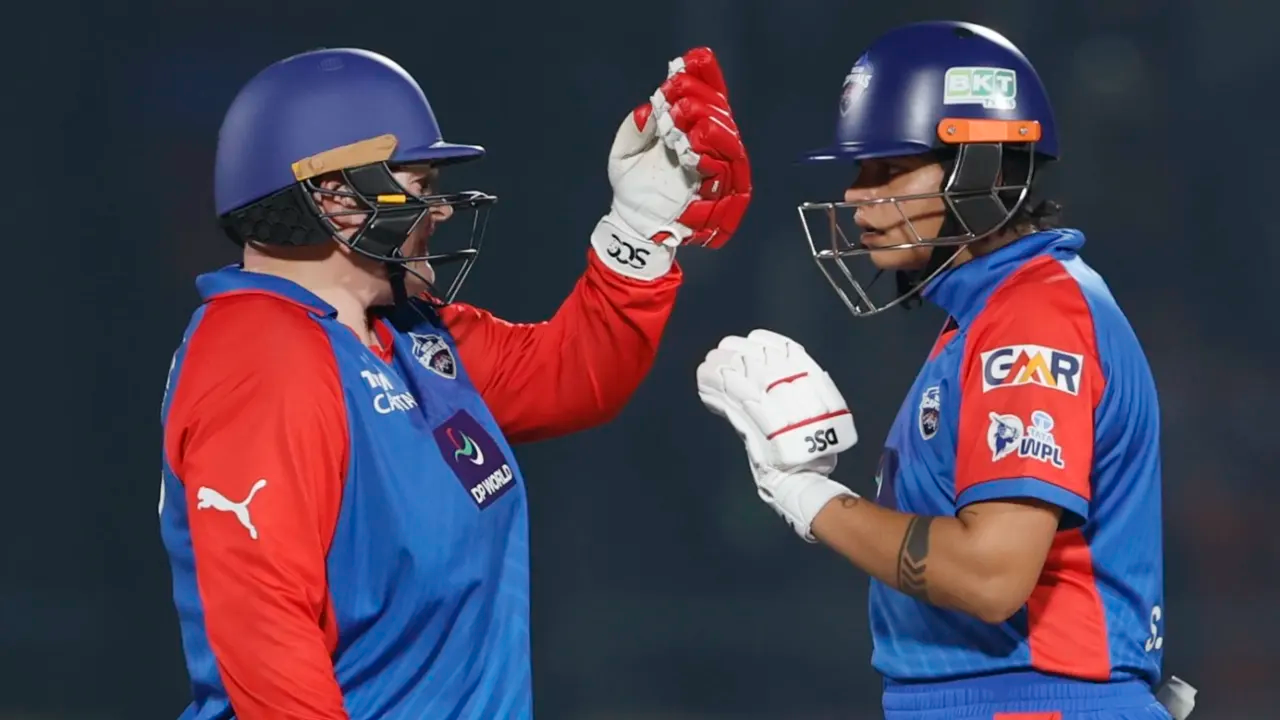
An explosive opening stand from Lizelle Lee and Shafali Verma combined with an excellent bowling effort from Chinelle Henry propelled Delhi Capitals (DC) past Gujarat Giants (GG) in the Eliminator, securing their fourth straight WPL final. DC will now face Royal Challengers Bengaluru in the final in Vadodara on February 5.
In the 169 chase, Lee and Shafali laid the platform, clearing off more than half the target with an 89-run opening stand. Jemimah Rodrigues and Laura Wolvaardt then combined for a 68-run partnership, as DC completed the chase with 26 balls remaining.
Put in to bat, GG had historically thrived in this scenario, winning all their five games this season batting first. But their innings never got off the ground., starting with Sophie Devine, their most impactful player this season, departing in the second over. After being squared up by a Henry delivery that curved away late, Devine went for a big shot against a back-of-a-length ball outside off, only to edge it to Lee, who took a sensational one-handed catch to her right.
Nandani Sharma then inflicted more damage, removing Anushka Sharma and Ashleigh Gardner off back-to-back deliveries in the sixth over. With that, Nandani went past Saika Ishaque for most wickets by an Indian in a WPL edition. She now has 16 wickets, just one shy of Devine’s 17, the most this season. Minnu Mani then struck to leave GG tottering at 59 for 4.
GG found their footing despite the early damage with Beth Mooney, who had been a spectator as wickets tumbled at the other end, taking control. After GG went 33 balls without a single boundary, she broke free by hitting N Shree Charani for a four.
Georgia Wareham offered timely support, rotating the strike and picking off the occasional boundary, before providing a momentum boost by striking the first six of the match, a crisp flick over mid-off, again off Charani. The pair carried GG’s total past 100 and brought up a 50-run partnership. But Henry returned to bowl the 17th over and Wareham sliced her straight to Wolvaardt at deep cover, and Bharti Fulmali was then bowled for a duck.
Mooney, though, batted on, and alongside Kashvee Gautam, struck six boundaries in the final three overs to lift GG to 168. Her 62 not out off 51 balls, spanning from first ball to last, once again underlined her value under pressure.
DC’s opening pair of Lee and Shafali had fired in isolation this season, but in the Eliminator, they clicked in tandem. Giants thought they had Lee caught behind in the second over and burned a review, only for UltraEdge to show a flat line as the ball passed the bat. Within the first three overs, the duo had clattered four boundaries.
Shafali then capitalised on a chaotic over from Devine, which swung the momentum DC’s way. After swinging and missing at a full delivery that raced away for four byes, Devine then sprayed one down the leg side to concede five wides. Shafali made them pay soon after, first easing a slot ball through the covers, and then, driving another over mid-off. Then followed a 21-run over, with Shafali and Lee hitting a combined five boundaries off Renuka Singh. They took DC to 64 in five overs – a stark contrast to Giants’ 64 for 4 at the 10-over mark.
Lee kept the tempo high, taking Rajeshwari Gayakwad for a four and a six, as DC surged to 75 in the powerplay. The openers continued to find the fence, until Wareham struck in the eighth over, removing both in quick succession to finally halt Giants’ momentum.
Wolvaardt and Rodrigues then made sure there were no more hiccups. Wolvaardt got going immediately, with a fluent drive through the covers, as the duo played one classy shot after the other, getting DC’s equation down to less than run-a-ball.
When Gardner served one right into the slot outside off, Rodrigues unfurled her arms and sent it over mid-off for a massive six. Wolvaardt also joined in on the fun, producing a moment of pure elegance against Gayakwad, skipping down the track to a flighted delivery and swinging cleanly to send it over long-on for a six.
By the time Rodrigues got out, after scoring 41 off 23, DC needed just nine runs off 31 balls. Marizanne Kapp finished it off in the 16th over, launching Wareham back over her head for four to send Capitals into yet another final.
Brief scores:
Delhi Capitals Women 169 for 3 in 15.4 overs (Lizelle Lee 43, Jemimah Rodrigues 41, Laura Wolvaardt 32*, Shafali Verma 31; Rajeshwari Gayakwad 1-33 Georgia Wareham 2-28) beat Gujarat Giants Women 168 for 7 in 20 overs (Beth Mooney 62, Anushka Sharma 16, Georgia Wareham 35, Kashvee Gautam 18; Chinelle Henry 3-35, Nandani Sharma 2-44, Minu Mani 1-23) by seven wickets
[Cricinfo]
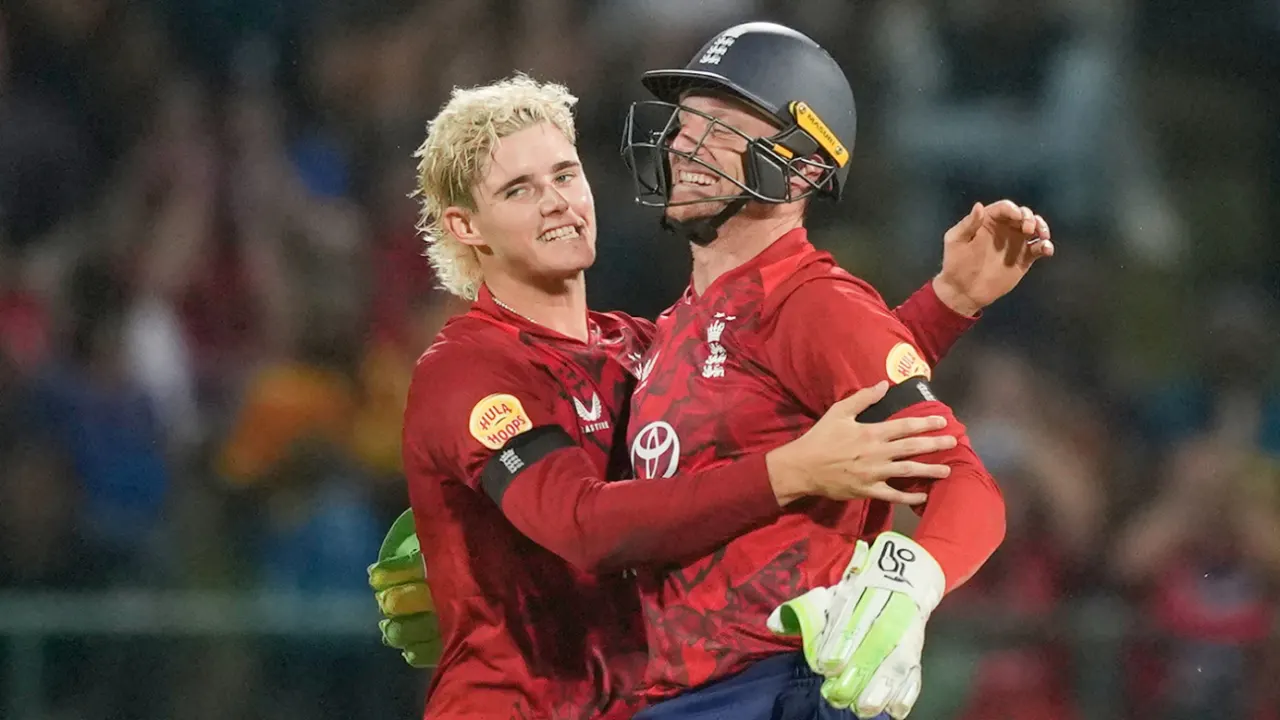
Will Jacks led the way before Jacob Bethell sealed the deal with a career-best haul of 4 for 11, as England closed out a 3-0 series win over Sri Lanka with a remarkable spin strangle on a turning track at Pallekele.
Their defence of a sub-par target of 129 was their lowest in T20I history, and in the end they did it with room to spare, as Bethell rounded up the tail with all four of his wickets coming from his final eight balls, including the winning moment – a skied slog from Maheesh Theekshana to Liam Dawson at short third.
The performance, and the hard-fought nature of it, confirmed that England will head to next week’s T20 World Cup with confidence high, after a three-match series that has drawn on all facets of their game, with bat and ball alike.
On this occasion, they were indebted to a battling half-century from Sam Curran, whose nous at the back-end of the innings revived a performance that had been flat-lining at 60 for 6 in the 11th over. Dushmantha Chameera was the main man of Sri Lanka’s bowling display, with his own career-best figures of 5 for 24, but Curran’s 58 from 48 balls proved the ultimate difference between the teams.
England started their day on the back foot when Phil Salt succumbed to a back spasm while warming up. Though Ben Duckett is, on the face of it, a like-for-like replacement at the top of the order, his form of late has been far removed from the buccaneer who began last year as a first-choice pick across formats. After missing much of the tour with a finger injury, he fell for a first-ball lbw, as Chameera pinned him on the back foot and extracted three reds on review (2 for 1).
Bethell is another whose poise with the bat has been lacking a touch on this trip, certainly compared to that magnificent Ashes hundred at Sydney. He failed to pick Matheesha Pathirana’s slower ball, and snicked a wild drive to the keeper for 3, before Tom Banton was done all ends up by Dunith Wellalage. Though he’s probably still done enough to earn a World Cup starting berth after his matchwinning fifty on Sunday, Banton was this time lured into a huge wipe through the line, only for the ball to dip and grip, and clip the top of his leg bail for a run-a-ball 7.
England were a ropey 28 for 3 after five overs when their captain arrived at the crease. Harry Brook knows only one response to adversity, and it doesn’t involve him backing down to rebuild. When it works, it’s magnificent; this, on the other hand, was somewhat predictable. Pathirana returned for a second over, and once again that sticky slower ball came up trumps. Brook was through his shot twice over before the ball arrived, and Janith Liyanage in the covers collected the simplest of lobbed slogs.
Jos Buttler endured through the chaos, though his own stay could hardly be described as serene. He so nearly lost his leg stump while inside-edging England’s first boundary (in the third over) off Pathirana, and the same bowler then skinned his off stump for good measure with the final ball of the powerplay. Buttler shrugged off that indignity to club Wellalage over extra cover for England’s first six, but then Theekshana bowled him through the gate for 25.
Pace off the ball was clearly the way to go, as Jacks discovered before England could pull out of their nosedive. Chameera’s second over induced a flimsy plink to midwicket, with the batter once again too far through his stroke, and at 60 for 6 in the 11th over, it was time for England’s fabled depth to come to the party.
In a measure of his lack of opportunity at this level, Curran’s 58 from 48 balls was his highest T20I score, and only his second fifty. However, anyone who witnessed his play-off-sealing half-century for Sydney Sixers last month, let alone his title-winning 74 not out for Desert Vipers in the ILT20 can vouch for his current form with the bat.
His response to England’s adversity was a pugnacious rearguard, studded with six fours and a six over long-on. He found a doughty ally in Dawson, who held up his end for 14 from 20 balls, and as they pieced together a 47-run stand in seven overs, England briefly harboured hopes of a 140-plus total.
Chameera, however, had other ideas. Dawson slapped another slower ball to long-on, before Jamie Overton was outfoxed by a trio of legcutters – his second was caught at long-on but had to be parried back into play by Wellalage, but the third did the needful, via a slog to point.
And, with Curran in his sights for the final over of the innings, he landed his wide yorkers with conviction, inducing a slice to deep third to seal his career-best figures, and keep England to their lowest total in T20Is against Sri Lanka.
Luke Wood made his presence felt in his first outing of the series. He prised out Kamil Mishara for a duck in his first over and so nearly made it two in two when Pathum Nissanka swatted him to deep square leg, only for Bethell’s attempted relay catch to end up on the wrong side of the ropes.
That let-off was the cue for a brief explosion from Nissanka – he struck two more sixes in his next four balls, but when he skewed a leading edge off Dawson to cover for 23 from 11, the stage was set for Adil Rashid entered the attack with his familiar ragging turn.
Pavan Rathnayake had no response to a wonderful googly that did him in flight to rip into his leg stump, and one ball later, Kusal Mendis top-edged Jacks straight to short backward square to depart for a run-a-ball 26.
At 62 for 4 in the 10th, Sri Lanka were now in a scrap. Though Dawson’s third over was picked off for a boundary apiece, Jacks’ leaping offbreaks proved the perfect foil to Rashid’s habitual class. After pinning Kamindu Mendis on the back leg for 14, Jacks should have made it two lbws in his third over, but England opted not to review an appeal against Wellalage that would have been hitting leg.
In the end, it didn’t matter. With 32 runs to defend from 30 balls, Jacks closed out a fine spell of 3 for 14 with the crucial scalp of Liyanage, whose slog-sweep picked out Bethell at deep midwicket. And then, after nudging a priceless boundary down through deep third, Wellalage launched into a slog-sweep off Bethell, under-edged into his leg, and Buttler scrambled round from behind the stumps to cling onto a brilliant, opportunistic catch.
It was the moment for England to move in for the kill. Bethell claimed his second in three balls as Chameera poked nervously to cover for a duck, then effectively sealed the contest with his third in the over – a beauty that dipped and straightened from round the wicket to leave Dasun Shanaka stranded as Buttler whipped off the bails. He returned with 14 to defend in his final over, and by then it was no longer in doubt.
Brief scores:
England 128 for 9 in 20 overs (Joss Buttler 25, Sam Curran 58, Liam Dawson 14; Dushmantha Chameera 5-24, Matheesha Pathirana 2-27,Dunith Wellalage 1-28, Maheesh Theekshana 1-16) beat Sri Lanka 116 in 19.3 overs (Pathum Nissanka 23, Kusal Mendis 26, Pavan Rathnayake 13, Kamindu Mendis 14, Janith Liyanage 17; Luke Wood 1-13, Liam Dawson 1-25, Adil Rashid 1-25, Jacob Bethell 4-11, Will Jacks 3-14) by 12 runs
[Cricinfo]

Seven million cancers a year are preventable, says report

Spain announces plans to ban social media for under-16s

Join hands in unity, determination and brotherhood to build the beautiful shared dream of ‘A Thriving Nation – A Beautiful Life’ – President

Stand united with renewed confidence and determination, and to join in the shared task of shaping a new era of national renewal – PM

Rew ton trumps Peake’s as England reach U19 World Cup final

Lee, Shafali and Rodrigues fire Delhi Capitals into their fourth straight final

‘Dates have the highest sugar content to fight Coronavirus’

Sunday Island 27 December – Headlines

#SundayIsland 17th December – Headlines

Sunday Island – 28th March

Sunday Island Headlines – 21 March

Sunday Island – 21st February – Headlines
-
 Opinion5 days ago
Sri Lanka, the Stars,and statesmen
-

 Business6 days ago
Climate risks, poverty, and recovery financing in focus at CEPA policy panel
-

 Business4 days ago
Hayleys Mobility ushering in a new era of premium sustainable mobility
-

 Business24 hours ago
SLIM-Kantar People’s Awards 2026 to recognise Sri Lanka’s most trusted brands and personalities
-

 Business4 days ago
Advice Lab unveils new 13,000+ sqft office, marking major expansion in financial services BPO to Australia
-

 Business4 days ago
Arpico NextGen Mattress gains recognition for innovation
-

 Business3 days ago
Altair issues over 100+ title deeds post ownership change
-

 Business3 days ago
Sri Lanka opens first country pavilion at London exhibition