
Opinion
Challenge to SJB and JVP


By Fr. Chryso Pieris SJ
The SJB rally was memorable. Police obstructions at roads leading to Colombo was a favour done to the Opposition. The government in desperation and confusion is kicking into its own goal.
Obviously, this is a failed government in spite of 6.9 million people supporting it. They reversed practically every gazette they issued. Every deal the government has put through, Kerawalapitiya, Nano nitrogen, Chinese fertiliser, sugar, garlic and rice are scams. They are not lawmakers; they are daylight robbers. It is time to reverse the government itself and have a new government.
The memorable rally of the SJB is really not the result of the hard work of the SJB but rather of the mismanagement and thievery of the government. The Opposition has nothing to do. Like a ripe fruit, the government will simply fall into the lap of the Opposition.
By now, even the 6.9 million morons have realised that the current professional politician of Sri Lanka is a scoundrel. Ranjan Ramanayake has openly, and in public, said that they are all friends, together stealing the wealth of the country. Naturally, all at Diyawannawa are happy he is still in jail. That is what ‘Ali Baba and the 225 thieves’ mean and they hide behind the ‘Thattu Maru’ fraudulent democracy. We need a system change. We need to change this klepto-system.
The SJB is trying to project an image of themselves as new born babies; clean, pure and spotless. The JVP claims they are even cleaner than the SJB. But we know better. Just like thieves their rejected candidates have crept into Parliament through the fraud of a national list.
And that is a base insult to the people’s sovereignty. There is no need to list out the footnote gang and car permit sale, we know who they are.
In case this tottering corrupt government crashes, and there may be an election, we want 100 percent certainty about the honesty and integrity of the Opposition. We invite the Opposition to sign an agreement with the People. It will be drafted by brilliant lawyers and eminent people of integrity. It will be such a strong document that it will be accepted as a legally binding instrument, even in an international court. (For we hardly trust our courts any longer.)
The agreement will be their promises to the people. For the last 40 years, all the parties had been promising to abolish the Executive Presidency. But they lied and lied. So we want them to promise this time, in black and white, in a legally binding instrument, that they will abolish the Executive Presidency within a stipulated time frame. (In a few months not years!)
That is the first promise we need from them.
They always say they are the servants of the people. They proclaim with their hands on their hearts that they have come to serve the people. Servants cannot be better than their masters. The people are the masters of these servants. Then how come politicians are better fed, better clothed and better housed than their masters, the people? Therefore, henceforward, let their lifestyles proclaim their servant-hood by slashing their pensions and other perks. The second promise will be abolishing the pensions of the MPs after five years in Parliament, not only for the present, and the future, but retroactively up to JR. That is the first part of the second promise. The second part will be abolishing the selling of all permits, for cars, wine stores and petrol sheds. The third part is the abolishing of either the monthly salary or the attendance allowance. Nobody in the country gets a monthly salary and an allowance for coming to work!
Let Parliament be a House of lawmakers and not a den of thieves! The third promise is not to interfere in the civil administration and the judiciary of the country. The civil administration knows their onions. Every subject is now highly advanced technically, and specialised. The last two years have shown, by the reversal of gazettes, how ignorant and foolish politicians are. They interfere to grab commissions and bribes for themselves and their cronies. They intervene to free themselves and their cronies from court cases and jail sentences, even from the gallows!
The fourth important promise will be that they will pass a law that a person is allowed to be an MP only for two terms or 10 years. Because it is truly a service to the nation; the nation should not take advantage of their generosity and make them slave and waste away their lives in serving the nation. With gratitude they must be returned to their families and professions to enjoy their private lives in peace.
These are a few of the essential promises they must sign to prove their sincerity. Once
SJB the or,the JVP declare their intention, in public, of signing such a document, of proclaiming and proving their honesty and integrity; the lawyers will draft a document for study by them.
It will be given to the public, too; transparency is essential. The final document will be signed in public (At the Independence Square?) in front of the people.
Will the SJB and the JVP have the guts and the grit to take the bull by the horns and get their members to back such a brave, history-making decision? Or will they pretend not to have even heard of such a suggestion and slyly slither away to avoid all responsibility and accountability to the people? We shall wait and see.



I refer to Dr Upul Wijayawardena’s recent letter on science and religion. I agree with him on the fate of religions in the modern world and would like to add the following observations on the evolution of religion and the advent of AI.
Religious philosophy evolved only in ancient India while it remained static with monotheism in other parts of the world. When the polytheistic Vedic religion arrived with Aryan migration to India, they found the ancient version of Jainism, which may have been practised over four thousand years as evidenced by some figures in meditation posture found in Mohenjo daro. By that time the indigenous religion had already abandoned the creator god or gods but still believed the mind as a permanent entity athman that survived death and continued in a cycle of reincarnation (samsara) due to results of any harmful action (kamma) even unintended performed in life collected in the athman. Salvation to a happy all-knowing permanent state named Kevala could be attained by the athman with extreme degree of self-mortification to destroy the past kamma attached to it, refraining from new kamma and developing the mind by meditation. As observed in progression from Veda to Upanishads the Aryan religion, evolution progressed with adoption of kamma, the cyclic existence of samsara, meditation and ethical behaviour in addition to prayer and sacrifice they practised for moksha.
The Buddha appeared in this philosophical atmosphere and denied both creator god and a permanent entity of athman. His psychology describes human behaviour based on the mind as a stream of changing consciousness. However, he accepted the cyclic existence of samsara; he said he verified the survival of consciousness at death with help of knowledge he gained from meditation. He prescribed a middle path to attain nirvana, a permanent state of happiness, avoiding self-mortification and redefined kamma to intentional activity only, both ethical and unethical resulting in bad and good results. He disagreed with the idea of kamma as the cause of rebirth. Following the Buddha, Vedantha religion reformed god to universal athman or brahman and evolved to modern Hinduism with a mixture of polytheism.
In his description of living beings in the universe, the Buddha has described some with a body made of fine material (brahma beings) in comparison to the gross material body of human and animal beings. One may assume the brahma body may not be carbon based.
The Buddha has also described living beings with physical body only (asannasatta) and another variety with mind only without a body (arupa satta). Therefore, it is not surprising to Buddhists that AI may evolve to become living beings if it develops a readily and freely available mobile source of energy and takes over the world with its superior capacity. AI already has information about Buddhist psychology. With that knowledge ‘AI beings’ may even become Buddhists not given to rituals.
According to the Buddha, brahma beings and asannasatta beings have very long lifespans as their bodies are not subject to decay and illness human beings develop. The new AI beings also may live as long as they wish because they may be able to repair themselves in case of developing physical defects. They would need only ethical behaviour to avoid destroying themselves by peaceful existence if they took over the world, as feared in some quarters.
However, as long as human beings exist in the world with death and uncertainty of what happens after death, they need a religion and rituals to give them psychological support. Even those who profess death is the end of life may have some doubt troubling their mind from time to time and may think of religion in times of adversity.
Ideally, human beings are free to accept one of the many versions of religious philosophies and respect each other’s choice and live in harmony. Unfortunately, extreme degrees of religious versions that cause division, unrest and violence will always continue to exist together with religions in the world.
Upali Abeysiri

By Lalin I De Silva
Sri Lanka speaks constantly about hospitals, medicines, food imports, agricultural productivity and the rising cost of living. Yet there is one simple question we rarely ask:
Are we eating enough of the food that our own soil can naturally give us?
Fruit is perhaps one of the finest gifts of the earth to humankind. A ripe mango, banana, papaya, guava or avocado comes to us almost ready to eat. Sunlight, rain, soil, microorganisms, minerals and the labour of a farmer have already done most of the work.
That is why I like to describe fruit as the “cream of the earth.”
This is, of course, not an argument that fruit alone can prevent every disease, or guarantee longevity. Science does not support such exaggerated claims. But there is strong international evidence that regular consumption of fruits and vegetables forms an important part of a healthy diet and is associated with lower risks of several major non-communicable diseases.
Sri Lanka’s own dietary guidance encourages the daily consumption of fruit as part of a balanced diet.
The tragedy is that we live on an island capable of producing an extraordinary variety of fruits, while many families increasingly depend on highly processed foods, sugary drinks and imported snacks.
This deserves national attention.
We Produce — But Do We Connect?
Sri Lanka grows banana, mango, pineapple, papaya, avocado, rambutan, mangosteen, guava, woodapple, beli, pomegranate, durian and many lesser-known indigenous fruits.
Yet our fruit value chain remains fragmented.
The farmer often does not know the final consumer.
The consumer rarely knows the farmer.
Fruit travels through several intermediaries, sometimes suffering poor handling, unnecessary damage and price escalation along the way.
Consumers may not know where a fruit was grown, when it was harvested, whether it was naturally matured or what crop-protection practices were followed.
Meanwhile, a careful farmer, producing exceptional fruit, may receive almost the same farm-gate price as someone producing an inferior product.
That is not value-chain management.
It is precisely this disconnect that a new citizen-led initiative could begin to address.
25 Districts — 25 Consumer Societies
A proposal now emerging is to establish a Pure Sri Lankan Authentic Healthy Fruit Consumers Society in each of Sri Lanka’s 25 districts.
The concept should not become another organisation full of titles, meetings and ceremonial functions.
Its purpose must be practical.
Each district society could bring together consumers, growers, doctors, nutritionists, horticulturists, schools, universities, retailers, hotels, processors and young entrepreneurs.
The first task would be to understand the district itself.
What fruits are grown?
Where are they grown?
When are they available?
Which traditional varieties are disappearing?
Where can consumers purchase genuinely good fruits?
Where are the post-harvest losses?
What do farmers need?
What do consumers actually want?
From this information, each district could eventually develop its own Fruit Map.
Twenty-five district maps could then become a National Fruit Map of Sri Lanka.
From Anonymous Fruit to Traceable Fruit
Imagine buying a mango and scanning a QR code.
You could see the district, grower, variety, approximate harvest date and production information.
You could perhaps even provide feedback on taste.
That may sound futuristic, but the technology already exists.
The problem is not technology.
The problem is that our food system was never designed to connect the person who grows the fruit with the person who eats it.
Traceability could change that.
The principle is simple:
Know your farmer. Know your fruit.
Let the Consumer Lead
For decades, agriculture has largely been driven from the production side.
“How much can we produce?” has been the dominant question.
A healthier agricultural economy should begin with another question:
What does the consumer need, value and trust?
If thousands of consumers deliberately demand fresh, safe, flavorful and traceable Sri Lankan fruit, the message travels backwards through the entire value chain.
Retailers respond.
Farmers respond.
Nurseries respond.
Researchers respond.
Investors respond.
Government eventually has to respond.
That is the real power of an organised consumer movement.
Start With Children
Perhaps the most powerful campaign message could be remarkably simple:
Two Fruits a Day.
Imagine a Sri Lankan child coming home from school and asking:
“What are our fruits today?”
Imagine every school having a small fruit garden.
Imagine children being able to identify 10 Sri Lankan fruits, understand their seasons and know where they are grown.
Such behavioral change cannot be achieved merely by issuing circulars from Colombo.
It must become part of family culture.
Kandy Could Begin
Kandy would be a logical district in which to pilot the concept.
Its climatic diversity, surrounding agricultural communities, educational institutions, hotels, markets and strong plantation heritage provide an excellent testing ground.
A successful Kandy model could then be adapted—not blindly copied—across the other 24 districts.
The objective should ultimately be much larger than selling more fruit.
It is about reconnecting soil, farmer, food, consumer and health.
Sri Lanka does not need to invent every solution from outside.
Sometimes the answer may already be hanging from a tree beside us.
We simply have to recognise its value.
Know Your Farmer. Know Your Fruit. Live Well.
Review
by Colleen Figg, Editor
and Reviewer – Amazon, New Voices Publishing
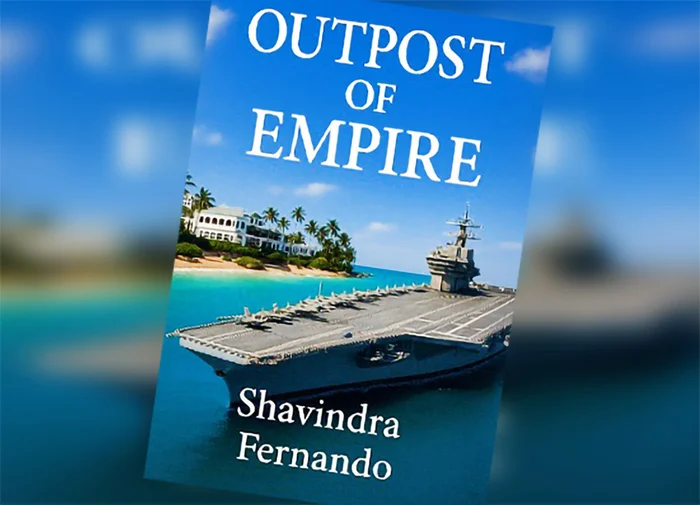
“Fernando echoes Macbeth with the line, “There is judgment here.” It captures the question running through the novel: can anyone participate in corruption and remain untouched by it? Beneath this satire is a dark story about power and the danger of believing, that someone else will always pay the price.”
Shavindra Fernando’s Outpost of Empire is a political novel set in the fictional country of Lackadasia. At its heart is a strong idea: an exploration of world politics, terrorism and the ways in which powerful countries manipulate smaller ones. Fernando is clearly writing about political issues that matter deeply to him.
The names immediately establish the book’s satirical character. Lackadasia, Burgherbugaria and the various Klowns suggest a world in which the people and places are exaggerated, but the issues beneath the exaggeration are recognisable. The playful language allows Fernando to approach terrorism, religious conflict and political corruption from an unusual angle.
Henry Stockwell is a central character: an ambassador who arrives in Lackadasia presenting himself as a friend of the country. He believes he understands how power works and treats the country, its politicians and its people as pawns on his personal chessboard. In his arrogance, he never doubts that he controls events rather than being controlled by them. This confidence makes him a compelling figure and in him, we explore the workings of political influence and the potential traps contained therein.
As the story develops, Fernando reveals a political world where causes are adopted when they are useful, people are exploited and discarded, and the truth becomes whatever those in power need it to be. Ordinary people suffer the consequences of decisions made far beyond their reach or knowledge, while those making those decisions continue to justify their actions. Even the people who help keep this world running may not be as important or as safe as they imagine.
Stockwell brings this idea into focus. He recognises corruption in others and willingly takes part in it himself, yet he cannot see that he might also suffer its consequences. Ultimately, he thinks his position will keep him safe. He is intelligent enough to understand the game, but not insightful enough to grasp the limits of his place within it. This blindness gives the novel a strong sense of irony.
The satirical approach gives Fernando room to criticise political hypocrisy without turning the novel into a direct political argument. By using fictional countries and exaggerated names, he creates some distance from specific governments and events while still making the larger targets of the book clear. The humour does not take away from the seriousness of the subject; instead, it makes the cruelty and self-interest beneath the political performance stand out more sharply.
Near the end, Fernando echoes Macbeth with the line, “There is judgment here.” It captures the question running through the novel: can anyone participate in corruption and remain untouched by it? Beneath this satire is a dark story about power and the danger of believing that someone else will always pay the price.
I came away feeling that Outpost of Empire is a valuable and thought-provoking book, particularly in today’s political and social climate. It has a distinctive voice, and the questions it raises about power, responsibility and foreign interference remain relevant far beyond the fictional borders of Lackadasia.
About the Author
Shavindra Fernando has worked as a reporter. He read English & Classics at the University of Peradeniya in Sri Lanka, and took International Relations & Ethnic Politics as a Reuter Fellow at the University of Oxford in England. The Vague Poetess (1999)was his first novel.

AgriConnect Sri Lanka’ to be launched on 30 October to Modernise the Agricultural Sector Through Digitalisation

57th Annual Saints’ Quadrangular Tournament on Saturday and Sunday

Showers or thundershowers will occur at most parts of the island

Prison rules to be revised over monks’ attire

AC President recuses himself from hearing prison attire case pertaining to Gnanasara Thera

Court orders steps to obtain INTERPOL Red Notice against Basil

‘Dates have the highest sugar content to fight Coronavirus’

Sunday Island 27 December – Headlines

#SundayIsland 17th December – Headlines

Sunday Island – 28th March

Sunday Island Headlines – 21 March

Sunday Island – 21st February – Headlines
-

 News7 days ago
NDB fraud Rs 60mn more than reported
-

 News7 days ago
Removing monk’s robes matter for Sangha to decide: Mahanayake Theras
-

 News5 days ago
Sri Lanka escalates anti-graft drive with Shiranthi’s jailing
-

 News6 days ago
NPP govt. reminded of its responsibilities as US warship leaves Colombo
-

 Latest News6 days ago
Farhan, Sadaqat help Pakistan ace 183 chase to go 1-0 up
-

 News7 days ago
BHC, Colombo: “LTTE remains a proscribed org. in the UK”
-

 Latest News4 days ago
Farhan and Sadaqat help Pakistan seal series in style
-

 News5 days ago
Iranian ships stranded, Lanka fears US sanctions