
Business
Ceylinco Life reverts to ‘Savari’ theme with ‘Family Savari’ 16


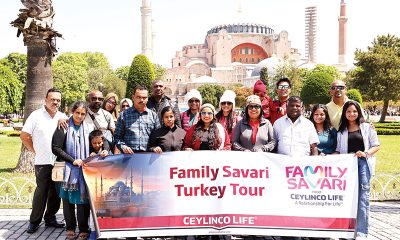
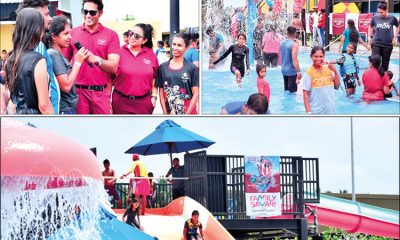
Ceylinco Life has announced a return to its much-loved ‘family vacation’ theme to reward the winners of the next edition of the company’s ‘Family Savari’ mega promotion with the diminishing concerns about COVID-19, and has unveiled a new prize scheme that includes hotel stays for the top tier winners.However, in a continuing acknowledgement of the economic pressures on the populace, the country’s life insurance market leader said it will continue to present attractive cash prizes and valuable supermarket shopping vouchers to the majority of winners in ‘Family Savari 16.’
A total of 1,155 policyholders will be selected at five draws that will take place between December 2022 and August 2023 for this edition of the promotion. At each draw, three policyholder families will each win a full-board vacation at top-notch hotels rated ‘Premier’ while another three families will each win a vacation package at hotels in the ‘Deluxe’ category, the Company said. Additionally, five policyholders will win cash prizes of Rs 100,000 each, another 20 policyholders Rs 50,000 each, and a third set of 50 policyholders will be rewarded with Rs 25,000 each. Furthermore, 150 policyholders will walk away with supermarket shopping vouchers worth Rs 10,000 each, at every draw.
In total, Ceylinco Life will have, at the culmination of ‘Family Savari 16,’ presented 30 family vacations, Rs 13.75 million in cash prizes and supermarket vouchers to the value of Rs 7.5 million, ensuring there is no diminution in the value of the prize purse.
Commenting on the launch of the new ‘Family Savari’ edition, Ceylinco Life’s General Manager – Marketing Samitha Hemachandra said: “We are delighted to put the ‘Savari’ back in ‘Family Savari’ after a two-year hiatus. The promotion has always been about creating opportunities for families to relax and spend quality time together. We know that this is becoming difficult to do for many people due to the economic situation, and felt it is time to revert to the family vacations theme that will also help alleviate some of the stress families are experiencing.”
Since the beginning of the Covid-19 pandemic in 2020, ‘Family Savari’ has rewarded winners with gold instead of overseas holidays and local excursions, and subsequently with cash rewards to the full value of the prize purse in response to the foreign exchange crisis in the country.
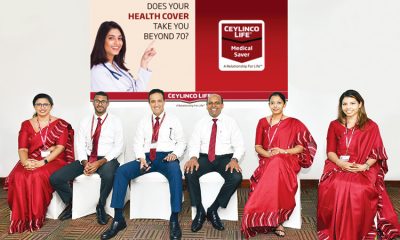
‘Family Savari 16’ was launched in the presence of representatives of Ceylinco Life’s senior management and was livestreamed via Zoom to all Ceylinco Life branches around the country. As ambassadors of the mega promotion, celebrities Roshan Ranawana and his wife Kushlani too were present at the event.
To be eligible to win hotel stays, cash prizes, and vouchers at the draws, all Ceylinco Life policyholders have to do is to continue their existing policies with the Company or maintain a minimum account balance in their retirement plans during the promotion period. Additional winning chances would be given to customers who pay their premiums directly to the company and further chances will be assigned corresponding to the time they have been Ceylinco Life customers.
Intended to stimulate interest in life insurance and encourage policyholders to keep their policies active, the ‘Family Savari’ programme has benefitted more than 27,650 people to date. Grand-prize winning families at previous Family Savari promotions have visited Australia, Italy, England, Germany, Switzerland, Japan, and France, while other winners have toured China, Dubai, and Singapore.
Adjudged the ‘Most Valuable Life Insurance Brand in Sri Lanka’ by Brand Finance and certified a ‘Great Workplace’ in Sri Lanka for the third consecutive year in 2022, Sri Lanka’s Service Brand of the Year by the Sri Lanka Institute of Marketing (SLIM) in 2021 and the winner of the SLIM Kantar Peoples Award as the Most Popular Life Insurance Company in Sri Lanka for the 16th consecutive year, Ceylinco Life has been the country’s leading life insurer for more than half of the 34 years it has been in existence. Other accolades won in respect of 2021 include the ‘Most Popular Service Provider’ in Sri Lanka’s Life Insurance industry in 2021 by LMD, the ‘Most Valuable Life Insurance Brand’ in Sri Lanka by Brand Finance, and one of the 10 Most Admired Companies in Sri Lanka by the International Chamber of Commerce Sri Lanka (ICCSL) in collaboration with the Chartered Institute of Management Accountants (CIMA) and one of the 10 Best Workplaces in Sri Lanka’s Banking, Financial Services and Insurance (BFSI) sector by Great Place to Work.
Ceylinco Life has close to a million lives covered by active policies and provides innovative life insurance solutions which offer protection while de-risking the goals and ambitions of the Company’s policyholders.








By Ifham Nizam
A USD 57.4 million investment package is set to reshape the economics of electricity for small and medium-sized businesses, while creating a stronger platform for private investment in rooftop solar and other distributed renewable-energy projects.
The financing package—comprising a USD 35 million concessional loan from the Asian Development Bank (ADB), a EUR 15.4 million grant from the European Union (EU), equivalent to USD 16.94 million, and a USD 5.5 million grant from the Japan Fund for the Joint Crediting Mechanism (JFJCM)—will finance a five-year programme to modernise the electricity distribution system from 2026 to 2030.
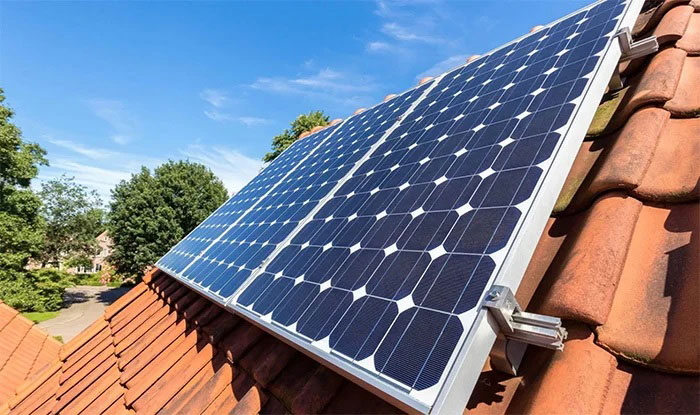
For the business community, one of the most significant elements is the planned introduction of Virtual Net Metering (VNM), which will be implemented in the country for the first time.
The EU-funded component will support 25 MW of aggregated rooftop solar PV capacity, specifically aimed at helping reduce the electricity-bill burden of small and medium-scale entrepreneurs.
The move could open a new investment channel for SMEs that have traditionally faced difficulties in absorbing high energy costs and making the upfront investment required for renewable-energy systems.
Rather than viewing rooftop solar simply as a household energy solution, the programme positions distributed solar as an important business-cost management tool.
For SMEs, which operate with considerably tighter margins than many large corporates, electricity expenditure can have a direct impact on competitiveness, cash flow and the ability to expand operations.
By allowing electricity generated from qualifying rooftop solar installations to be applied through a virtual net-metering arrangement, the programme is expected to broaden the economic benefits of solar power beyond individual premises.
The financial significance of the scheme extends beyond the initial 25 MW.
By establishing the infrastructure and regulatory framework required to manage aggregated distributed generation, the project could help create greater investor confidence in the development of decentralised renewable-energy assets.
The investment therefore has the potential to leverage additional private capital into the renewable-energy sector rather than functioning solely as a government-funded infrastructure programme.
The financing package is particularly notable because a substantial portion comes in the form of grants and concessional funding, reducing the cost of financing technologies that would otherwise require significant upfront capital.
The ADB loan will support the wider modernisation programme, while the EU and Japanese grant components will help finance renewable-energy integration and technologies designed to strengthen the grid.
At EDL, the investment will upgrade the existing CEBAssist platform with Advanced Metering Infrastructure (AMI), a Distributed Energy Resource Management (DERM) system and distribution control centres supported by an Advanced Distribution Management System (ADMS).
These systems will give the utility real-time visibility of electricity consumption and distributed generation, allowing it to manage an increasingly decentralised power system more efficiently.
That digital infrastructure is critical to the business case for expanding rooftop solar.
As more SMEs and other consumers generate their own electricity, the distribution network needs to know where generation is taking place, how much electricity is entering the grid and how those flows are affecting local network conditions.
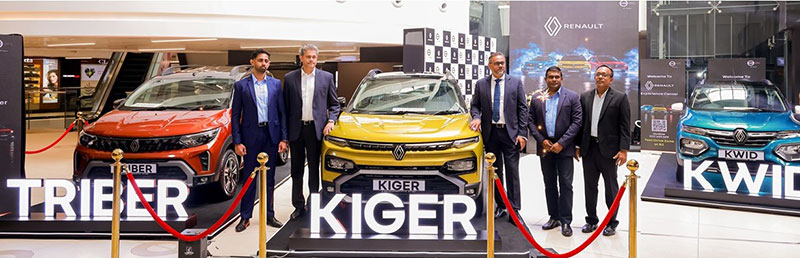
Renault has taken another significant step in its return to the Sri Lankan market with the opening of the Renault Experience Centre at Majestic City, Colombo, offering customers an opportunity to discover the brand and experience its latest models.
The Centre was officially declared open by Jawahar Ganesh, Group Managing Director of Associated Motorways (Private) Limited, accompanied by Prasanna de Silva, Director – Sales, AMW. The occasion was attended by AMW management and staff, members of the media, customers, well-wishers and other invited guests.
Located at the lobby of Majestic City, the Centre features three Renault models being introduced to the Sri Lankan market – the Renault Kwid, Renault Kiger and Renault Triber. Visitors can explore the vehicles, learn about their features and specifications, and take advantage of test drives available at the location.
Adding to the convenience for customers, AMW has ample stocks of Renault vehicles available in Sri Lanka, allowing customers to take delivery of their chosen vehicle without having to wait for months for it to arrive. Subject to completion of the necessary documentation and registration, customers can look forward to driving away in their new Renault within as little as one day, making the purchase experience faster and more convenient.
Customers can also enjoy greater peace of mind with a three-year manufacturer warranty, supported by dedicated Renault aftersales facilities to provide professional service and support throughout their ownership journey.
Commenting on the opening, Jawahar Ganesh, Group Managing Director of AMW, said, “We are delighted to welcome Renault back to Sri Lanka and to open the Renault Experience Centre at Majestic City. Renault is a brand with an exceptional heritage, a strong global presence and a reputation for innovation and distinctive automotive design. Through AMW, we are bringing that heritage and experience closer to Sri Lankan customers”.
Business
Dialog and Indira Cancer Trust continue breast cancer awareness initiative through Yeheli.lk
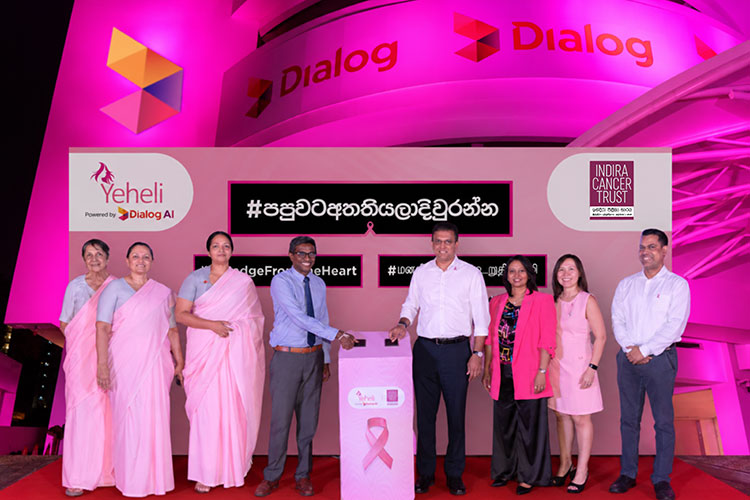
Dialog Axiata PLC, Sri Lanka’s #1 connectivity provider, marked the beginning of Breast Cancer Awareness Month by illuminating its Corporate Head Office in pink, in partnership with the Indira Cancer Trust, to stand in solidarity with individuals and families affected by breast cancer and encourage greater awareness, regular screening and early detection.
Building on previous breast cancer awareness campaigns conducted through Dialog’s Yeheli.lk platform in collaboration with the Indira Cancer Trust, this year’s initiative will continue throughout October under the theme, ‘A Pledge from the Heart’. As part of the campaign, members of the public can visit yeheli.lk to register for a free monthly SMS reminder and take their pledge for early detection throughout Breast Cancer Awareness Month.

Showers or thundershowers will occur in most part of the island after 1.00 p.m.

Removing monk’s robes matter for Sangha to decide: Mahanayake Theras

NDB fraud Rs 60mn more than reported

President orders review of laws on treatment of imprisoned monks

BHC, Colombo: “LTTE remains a proscribed org. in the UK”

Sri Lanka runs out of essential anti-TB medicines, India comes to rescue

‘Dates have the highest sugar content to fight Coronavirus’

Sunday Island 27 December – Headlines

#SundayIsland 17th December – Headlines

Sunday Island – 28th March

Sunday Island Headlines – 21 March

Sunday Island – 21st February – Headlines
-

 Features5 days ago
The first woman in the foreign service or Ceylon Overseas Service it was then called
-

 Editorial6 days ago
Fuelling discontent and protest
-

 News4 days ago
Geneva takes up Sallay’s case and govt. ignores opportunity to answer accusations
-
 Foreign News6 days ago
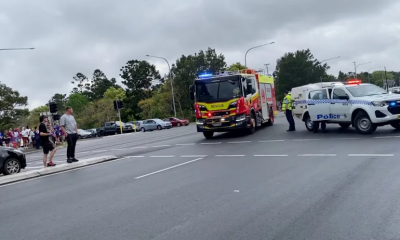
Ten injured after car crashes into rugby supporters in Australia
-

 Latest News6 days ago
Tharindu Rathnayake, bowlers secure Asian Games Bronze for Sri Lanka
-

 News5 days ago
Nearly 20 Iranian tankers stranded off Lanka amid US sanctions
-

 Features4 days ago
Sri Lanka Cricket Bill: Governance reform is not yet a cricket strategy
-

 News5 days ago
Lanka enters new phase of prosecutions as hurdles clear