
News
Celebrating International Youth Day 2022

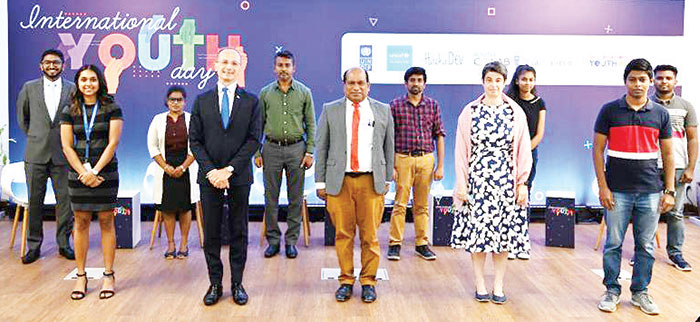
UNDP Sri Lanka launches two programmes calling young innovators to act on climate change
International Youth Day (IYD) advocates for the participation of young people in actioning chang around the world.
To commemorate the significance this year and to provide a platform to young leaders in Sri Lanka, the United Nations Development Programme (UNDP) in Sri Lanka launched two new calls for young innovators to act on climate change and conservation in the country; the ‘HackaDev Green Innovation Challenge’ and the ‘Movers4Climate’ programme. The two programmes were launched at the commemorative IYD 2022 webinar and youth-led discussion centred around advocating for Youth Climate Action for a socially inclusive recovery, in collaboration with partners including the Ministry of Sports and Youth Affairs, the United Nations Children’s Fund (UNICEF) in Sri Lanka, Youth Co:Lab co-led by Citi Foundation and UNDP, and Citra Social Innovation Lab.
Speaking at the event, Dr. Amal Harsha de Silva, Secretary, Ministry of Sports and Youth Affairs noted, ” I hope that this collaboration and celebration of International Youth Day alongside all youth in the world will make our task easier at the Ministry. Our youth have also become champions in the commonwealth, and we celebrate their achievements in Sri Lanka. I hope this partnership with the UN will bring about positive results for the youth in the country with equal representation, leaving no youth behind as we strive to create a better future for all.”
Both the ‘HackaDev Green Innovation Challenge’ and the ‘Movers4Climate’ programme were launched through UNDP Sri Lanka’s flagship youth platform ‘HackaDev’.
The former was introduced to crowdsource innovative solutions to build a greener and sustainable economy in Sri Lanka and the latter as part of introducing the regional Asia and Pacific movement to enhance awareness on acting on climate change and broadly on the Sustainable Development Goals (SDGs) in the Sri Lankan context.
The steady decline of climate resilience due to the impact of global warming and related issues has been a cause for concern in many social innovation programmes. In line with this, the ‘HackaDev Green Innovation Challenge’ invites all young women and men in Sri Lanka to address the challenge in achieving the environment-related Sustainable Development Goals (SDGs) through designing innovative solutions, whilst creating sustainable social enterprises to contribute toward both the environment and economy of the country.
‘Movers4Climate’ is a climate awareness-raising and skills development programme that equips young people with the tools and skills needed to become effective climate advocates and leaders, working at the national level to influence climate-related decisions. The programme is designed to enhance young global citizenship skills, improve leadership skills and increase future job prospects.
Both programmes are supported by Youth Co:Lab, an initiative co-led by UNDP and the Citi Foundation.
The launch of the two programmes by UNDP Sri Lanka comes from an increased focus on Green Development, and speaking to the key role young people play, Mr. Christophe Bahuet, Deputy Regional Director for Asia and the Pacific and Director, UNDP Bangkok Regional Hub highlighted that, “Sri Lanka is at crossroads, at which the youth have a crucial role to play and a contribution to make to build a better future for the nation; a future of economic rebound to be filled by young entrepreneurs, innovative economic activities; a future of inclusive governance and social harmony with transparency, accountability and the participation of all, including the youth, and a future of sustainable development for the country and the world.”
The event also created a platform for four young climate champions, who were given centre-stage for their efforts in Youth Climate Action through their organizations- ‘Lassana Kolonnawa Wetland Conservation Youth Network’, ‘Thuru’, ‘Zero Trash’ and ‘Ecohub.lk’. The session which took place in a hybrid format was moderated by Ms. Anuradha Withanachchi, Programme Coordination Associate, Climate and Environment, UNDP in Sri Lanka and saw the participation of close to 100 young people joining virtually to mark the day. While promoting youth-led action, the discussions brought to light the importance of bridging forces between generations in accordance with this year’s International Youth Day theme, ‘Intergenerational Solidarity: Creating a World for All Ages’, and to amplify the message that urgent action is needed from all generations to achieve the 2030 Agenda.

Latest News
Sun directly overhead Mannar, Periyamadu, Puliyankulam, Welioya and Pulmoddai about 12.11 noon today (30)


The sun is going to be directly over the latitudes of Sri Lanka from 28th of August to 07th of September due to its apparent southward relative motion.
The nearest places of Sri Lanka over which the sun is overhead today (30) are Mannar, Periyamadu, Puliyankulam, Welioya and
Pulmoddai about 12.11 noon.


(AFP) Sri Lanka’s maritime authorities were monitoring a fleet of 11 US-sanctioned Iranian oil tankers just off the island’s southern coast, the foreign minister said Wednesday.
The tankers were spotted close to the Galle harbour where an Iranian frigate, IRIS Dena, was sunk by a US submarine in March, killing 104 sailors. Sri Lanka’s navy rescued 32 Iranian sailors from that frigate.
Iranian vessels have been in limbo, unable to return to their home port because of a US blockade.
Sri Lanka’s Foreign minister Vijitha Herath said the tankers were in international waters where they had freedom of navigation.
“These ships are away from our territorial waters… we have no hold on them, nor have we facilitated them,” Herath told AFP.
The military deployed reconnaissance aircraft and patrol boats to monitor the vessels outside Sri Lanka’s 12-nautical-mile territorial waters, a military official told AFP on condition of anonymity.
“There is no indication of any ship-to-ship transfer of oil or illegal discharge of pollutants, so there is no basis for Sri Lankan authorities to take action against them,” the official said.
Many Iranian merchant vessels moved east towards the Strait of Malacca and Singapore due to US sanctions, while several remained near Sri Lankan waters, authorities said.
Sri Lankan officials said Washington had not formally notified Colombo about sanctioned Iranian-flagged vessels
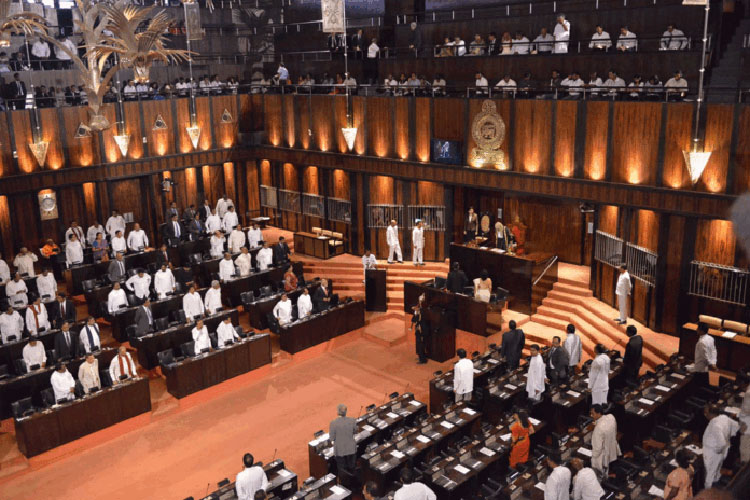
Parliament is to debate next Wednesday the Government’s proposal to abolish the post of Chief of Defence Staff (CDS), with the Second Reading of the Chief of Defence Staff (Repeal) Bill scheduled for September 9.
The Bill seeks to repeal the Chief of Defence Staff Act No. 35 of 2009, which was introduced shortly after the end of the armed conflict.
According to Secretary General of Parliament Kushani Rohanadeera, Parliament will meet from September 8 to 11, with the business for the week approved by the Committee on Parliamentary Business chaired by Speaker Dr. Jagath Wickramaratne.
The debate on the Chief of Defence Staff (Repeal) Bill is scheduled to take place from 11.30 a.m. to 5 p.m. on Wednesday, following questions to the Prime Minister and other parliamentary business.
The CDS post was established under the 2009 Act as part of the country’s higher defence command structure.
On Tuesday, September 8, the House will consider two Orders published in Extraordinary Gazettes under the Motor Traffic Act from 11.30 a.m. to 5 p.m., followed by an Opposition motion at the adjournment.
On Thursday, September 10, Parliament will debate a Resolution under the Women’s Empowerment Act.
The final sitting day of the week, Friday, September 11, has been allocated from 11.30 a.m. to 5.30 p.m. for several Private Members’ Motions.
The motions will cover issues including regulation of the petroleum, fuel and water industries, measures to increase the birth rate, protection of the Diyagama Forest, pension deductions affecting Pirivena teachers, food-crop cultivation in mountainous areas, development of the Kithul industry and the establishment of a Faculty of Medicine at South Eastern University.
Questions at the adjournment will be taken up at the end of each sitting day.

Voting closes in Iceland’s knife-edge EU referendum

Showers in the Sabaragamuwa, Western and North-western provinces and in Galle, Matara, Kandy and Nuwara-Eliya districts

Sun directly overhead Mannar, Periyamadu, Puliyankulam, Welioya and Pulmoddai about 12.11 noon today (30)

Lanka tracks 11 US-sanctioned Iranian tankers off coast

House to debate abolition of Chief of Defence Staff post

Mass graves tragic evidence of failed states – Rathnayake

‘Dates have the highest sugar content to fight Coronavirus’

Sunday Island 27 December – Headlines

#SundayIsland 17th December – Headlines

Sunday Island – 28th March

Sunday Island Headlines – 21 March

Sunday Island – 21st February – Headlines
-

 News5 days ago
Missing doctor’s body found in Mahiyanganaya
-
 News5 days ago
Australia declines to release Finance Secy Suriyapperuma’s citizenship details
-
 News5 days ago
22A: BASL suggests CJ recuse himself from hearing petitions
-

 News2 days ago
Eight politicians in drug kingpin probe
-

 Editorial6 days ago
Govts. drag feet as undergrads age
-
 Features4 days ago
Insights from Chieftains of Uva: Genealogy of two Kandyan Families – Part II
-

 Features4 days ago
Export diversification: Missing the wood for the trees – Part I
-

 Business2 days ago
Sri Lanka opens up: A new season of direct connectivity