
Sports
CEA halts development at Mandativu grounds until EIA completion


Sri Lanka’s environmental regulator has formally instructed the country’s cricket authorities that no development work is permitted at the Mandativu cricket grounds until the Environmental Impact Assessment (EIA) process is fully completed, underscoring growing scrutiny over development projects in ecologically sensitive coastal regions.
Director General of the Central Environmental Authority, Kapila Mahesh Rajapaksha, told ‘The Island’ that the Authority had issued an official notification last week to the cricket authorities, clearly stating that any form of physical development on the Mandativu site would be a violation of environmental regulations until the mandatory environmental clearance is granted.
“We have officially informed the cricket authorities last week that no development activities are permitted on the Mandativu grounds until the Environmental Impact Assessment process is completed and approved,” Rajapaksha said. “This instruction has been communicated formally, and it must be strictly adhered to in keeping with the provisions of the National Environmental Act.”
Mandativu, an island off the coast of Jaffna, lies within a fragile coastal ecosystem characterised by lagoons, mangroves, intertidal zones, and rich marine biodiversity. Environmentalists have long warned that large-scale infrastructure projects in such areas could disrupt natural drainage patterns, damage habitats, and accelerate coastal degradation.
The proposed development of cricket infrastructure at Mandativu has drawn increasing attention not only because of its scale but also because of its location in an environmentally sensitive zone.
According to environmental regulations in Sri Lanka, any major development project in coastal, island, or ecologically vulnerable areas must undergo a comprehensive Environmental Impact Assessment to evaluate potential environmental, social, and ecological consequences before approval is granted.
Rajapaksha stressed that the EIA process is not merely a procedural requirement but a critical scientific and legal safeguard designed to ensure that development does not irreversibly damage ecosystems.
“The Environmental Impact Assessment is essential to evaluate the possible environmental consequences of the proposed development,” he explained. “Only after a thorough review, including technical assessments and public consultation where necessary, can a decision be made on whether such a project may proceed, and under what conditions.”
He noted that the Authority is committed to ensuring that development in Sri Lanka proceeds in a sustainable manner, balancing national infrastructure ambitions with environmental protection.
Sri Lanka has witnessed several controversial development projects in recent years, particularly in coastal and island regions, where concerns have been raised about habitat destruction, loss of biodiversity, and increased vulnerability to climate change impacts such as sea-level rise and storm surges.
Mandativu itself is part of a delicate ecological network in the northern coastal belt, where mangrove systems act as natural buffers against erosion and storms while also serving as vital nurseries for fish and other marine species that sustain local livelihoods.
Environmental experts say that unregulated land filling, construction, or alteration of coastal terrain could disrupt hydrological flows, affect fisheries, and undermine the ecological balance that communities depend upon.
Rajapaksha emphasised that the Central Environmental Authority will continue to monitor the situation closely and ensure full compliance with environmental law.
“Our responsibility is to safeguard the environment while enabling responsible development,” he said. “No project, regardless of its nature or sponsor, can proceed without fulfilling environmental requirements.”
The Authority’s directive signals a firm regulatory stance at a time when Sri Lanka is increasingly seeking infrastructure development to boost regional economic growth, including sports infrastructure aimed at nurturing talent and expanding facilities.
However, environmental governance frameworks require that such development must not come at the cost of ecological sustainability.
Under Sri Lanka’s National Environmental Act, projects that fall within prescribed categories or are located in environmentally sensitive areas must undergo rigorous environmental review before implementation. The EIA process typically involves baseline environmental studies, identification of potential impacts, mitigation measures, and opportunities for stakeholder input.
Failure to comply with these requirements can result in suspension of projects, legal action, and penalties.
Rajapaksha reiterated that environmental compliance is not optional.
“The law is clear. Until the Environmental Impact Assessment is completed and the necessary approvals are granted, no development activity can take place at the Mandativu site,” he said.
The directive serves as a reminder that Sri Lanka’s environmental regulatory framework, when enforced, has the power to pause even high-profile development initiatives in order to ensure that the country’s fragile ecosystems are protected for future generations.
By Ifham Nizam

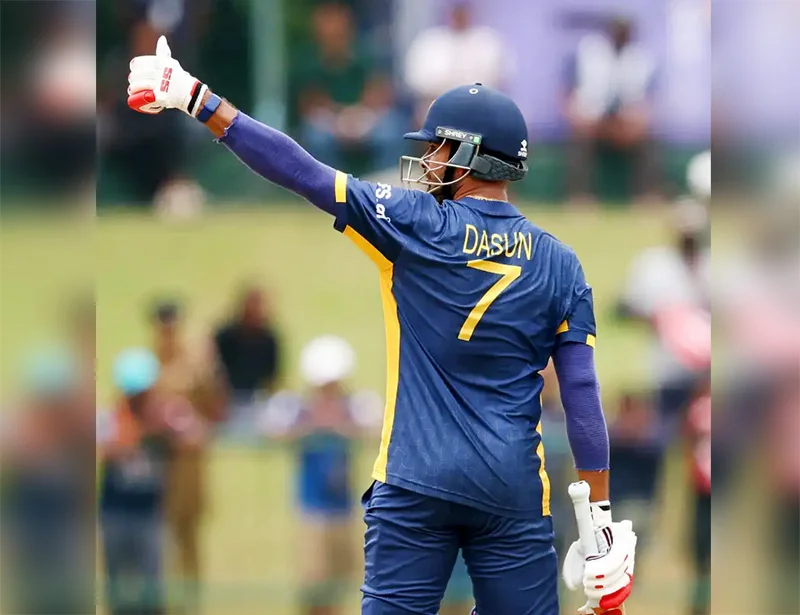
One day they were kings of the hill, brushing aside mighty Australia with two overs to spare and sending the faithful into raptures. The next, they were brought crashing down to earth, unable to bat out their 20 overs as England handed them a sobering reality check. Cricket, as ever, proved to be the great leveller, lifting you to the heavens on Monday and reminding you of your frailties by Sunday.
The same fans who had burnt the midnight oil celebrating Australia’s exit turned restless when Sri Lanka ate humble pie. The wheel turns quickly in this fickle game. Applause morphs into angst in the space of little time.
Kandy’s supporters, passionate as they are, must tread carefully. Their behaviour in recent years has not always been up to scratch and the last thing the city needs is a clampdown on international cricket. Disappointment is part and parcel of sport. But hurling abuse and worse, objects onto the field, crosses the boundary rope of decency. That is simply not cricket.
There were positives amid the rubble. A depleted bowling attack did a commendable job to restrict England to under 150, no mean feat given modern T20 batting excesses. On another evening, that total might have been hunted down with calculated aggression. Instead, Sri Lanka’s chase never quite got out of second gear.
The over-reliance on Pathum Nissanka and Kusal Mendis is becoming glaring. Once the top order’s twin pillars are dislodged early, the middle order appears to play catch-up cricket, swinging between caution and desperation. It is a dangerous tightrope.
Conditions, too, played their part. After incessant rain in Kandy, the pitch had been under covers for more than 48 hours. Surfaces suffocated that long tend to wear a different face once unveiled, gripping, stopping, turning. The return catches that accounted for Kusal and Kamindu Mendis told their own tale. They weren’t able to get the timing right.
Selection, meanwhile, has raised more than a few eyebrows. The omission of seasoned campaigner Kusal Janith Perera after two outings begs explanation. The recall of Kamil Mishara has left many scratching their heads. And Charith Asalanka, arguably one of Sri Lanka’s more assured players of spin, remains on the sidelines as the team grapples with slow surfaces. At this level, such calls can make or break campaigns.
Questions, too, swirl around leadership. Sliding down the batting order while wickets tumble is rarely the hallmark of strong captaincy. When the ship is taking on water, the skipper must be seen on deck. Leaders shoulder the burden; they do not pass the parcel.
Now Sri Lanka face a classic Hobson’s choice. Win their remaining two games and book a ticket to Calcutta for the semi-finals. Slip up once more, and it will be curtains. In tournament cricket, there is no room for half-measures. It is time to either hold their nerve or pack their bags.
by Rex Clementine
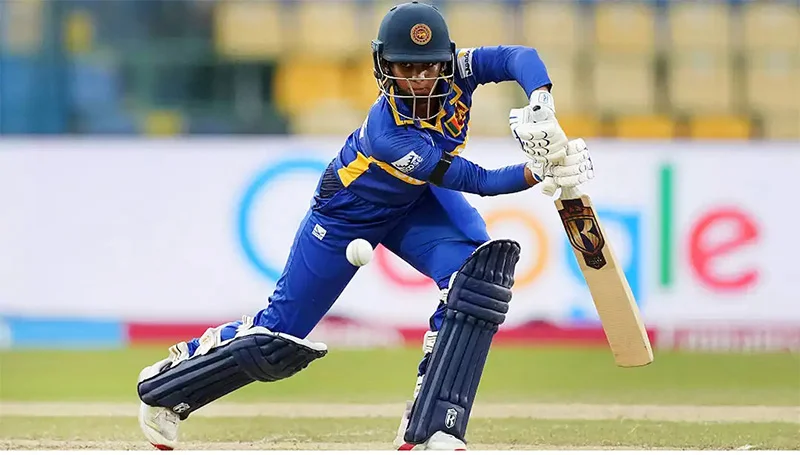
Sri Lanka Women took a 2-0 lead with another tight victory over the West Indies at St George’s on Sunday (February 22).
The second ODI carried a script similar to the first game: West Indies chasing a sub-250 total, an exact 50 by Jannillea Glasgow from No.7, and a narrow win for Sri Lanka.
The West Indies, who fell short by 10 runs in pursuit of 241 in the first ODI, had a smaller total to chase this time, bundling out the tourists for 208. At 166-4 in the 36th over, Sri Lanka looked set for much more, but lost their way, even as Vishmi Gunaratne kept one end occupied with a fighting fifty.
In response, West Indies, just like in the first ODI, had their top five sent back inside 100, leaving the lower order to push them close to the finish.
The talking point, though, was Deandra Dottin’s dismissal, out obstructing the field.
The incident occurred in the 30th over, with West Indies needing 94 at that point. Facing Chamari Athapaththu, Dottin went for a sweep, but missed the wide ball. It ricocheted off the keeper’s pads and flew back towards Dottin, who bizarrely tapped the ball with her bat and caught it with one hand. The Sri Lanka fielders went up in appeal straight away, claiming obstruction.
After consultation between the umpires and a referral upstairs, Dottin was given out. Next over, Aaliyah Alleyne was caught at backward point, pushing West Indies further into trouble.
But Glasgow stayed put, briefly finding company in Shawnisha Hector, but the partnership was broken by a brilliant diving catch in the deep by Nilakshika Silva, falling inches from the boundary.
Glasgow kept finding boundaries, targeting the area down the ground, forging a crucial stand with Afy Fletcher for the ninth wicket. With 18 needed off 22 though, Fletcher perished trying to take on Inoka Ranaweera, succumbing to another sharp catch by the Sri Lankans.
Even as she ran out of partners, Glasgow kept them in the hunt. However, off the last ball of the 48th over, her resistance ended, slapping one straight to cover, where Kavisha Dilhari took a fine catch on the second attempt. Glasgow crouched in despair, held up by her bat and consoled by Ramharack, even as the Sri Lankan fielders around celebrated the series win.
Sugandika Kumari took a three-wicket haul, as did Ranaweera, adding to her four wickets in the first game.
It’s the second bilateral ODI series win in a row for Sri Lanka over West Indies, having broken a streak of four straight series defeats to them until 2024.
Brief scores:
Sri Lanka 208 all out in 47.1 overs
(Vishmi Gunaratne 58, Harshitha Samarawickrama 35; Karishma Ramharackh 3-26)
West Indies 194 in 48 overs
(Jannillea Glasgow 50, Sugandika Kumari 3-38, Inoka Ranaweera 3-44)
(Cricbuzz)

Inter International Schools Athletics Championship
Gateway College Kandy sprinter Saad Faleel stood out prominently among the rising stars of International Schools at the Inter International Schools Athletic Championship concluded at Diyagama on Sunday.
The athlete trained by Asanka Rajakaruna delivered a performance that not only earned him top honours but also established him as one of the most promising young athletes of the meet as he produced a record breaking feat in the 100 metres.
Competing against some of the finest athletes of the international schools arena, Saad demonstrated remarkable sprinting prowess to clock 10.44 seconds to win the Under 20 age category event.
Saad not only shattered the record held by Dineth Weerarathne (10.62 sec) but also reached qualifying standads for the World Junior Athletics Championship. His outstanding performance earned him the Best Athlete title of the meet as well.
Yahanu Ranasinghe of Lyceum Inyernational School, Panadura was the only other athlete to clock sub 11 seconds in the Under 20 100 metres.
Saad was also the winner of the 200 metres of his age category returning a remarkable time of 21.71, just four miliseconds shy of Weerarathne’s 2024 meet record.
From the very outset of the championship, Saad showed he was in exceptional form. His event performances reflected meticulous preparation and disciplined training. Whether it was his commanding presence at the start or his composed execution during crucial moments, Saad maintained a high standard throughout the competition winning the 100m heats in 19.67 seconds and 200m heats in 21.72 seconds.
In the girls category, Risansa Silva won the best athlete title for her outstanding feat in the Under 20 100 metres. The Lyceum International Wattala athlete broke the meet records in the 100m and the 200 m with feats of 11.88 and 24.25 respectively
A milestone achievement
Saad Faleel’s accomplishment at ISAC 2026 marks an important milestone in his athletic journey as he has now earned qualifying standards to represent Sri Lanka at the August 5-9 event at Hayward Field at the University of Oregon.
As expected, topping the points table was Lyceum International School Wattala, amassing an impressive 960 points to emerge as overall champions. Their consistent excellence across events ensured a commanding lead.
Finishing in second place was Gateway College – Colombo with 686 points. Gateway’s strong all-round performances kept them competitive throughout the championship.
Third position went to Lyceum International School Nugegoda, who collected 513 points, while OKI International School secured fourth place with 405 points.
Close behind in fifth place was Lyceum International School Ratnapura with 400 points, demonstrating commendable determination and team spirit. Horizon College International finished sixth overall with 239 points.
by Reemus Fernando

Families of those sentenced to death for killing MP Atukorale seek AKD’s intervention

OPV leaves Baltimore, expected in Colombo in May

Unions sound alarm over coal procurement and power sector restructuring

MAS Group moving to India: CP asks NPP govt. to act

Steps leading to the achievement of SL’s national interest in IOR

Why so unbuddhist?

‘Dates have the highest sugar content to fight Coronavirus’

Sunday Island 27 December – Headlines

#SundayIsland 17th December – Headlines

Sunday Island – 28th March

Sunday Island Headlines – 21 March

Sunday Island – 21st February – Headlines
-

 Features2 days ago
Why does the state threaten Its people with yet another anti-terror law?
-

 Features2 days ago
Victor Melder turns 90: Railwayman and bibliophile extraordinary
-

 Features2 days ago
Reconciliation, Mood of the Nation and the NPP Government
-

 Features1 day ago
LOVEABLE BUT LETHAL: When four-legged stars remind us of a silent killer
-
 Features2 days ago
Victor, the Friend of the Foreign Press
-

 Latest News3 days ago
New Zealand meet familiar opponents Pakistan at spin-friendly Premadasa
-

 Latest News3 days ago
Tariffs ruling is major blow to Trump’s second-term agenda
-

 Latest News3 days ago
ECB push back at Pakistan ‘shadow-ban’ reports ahead of Hundred auction