
Midweek Review
‘Catholic Action!’:

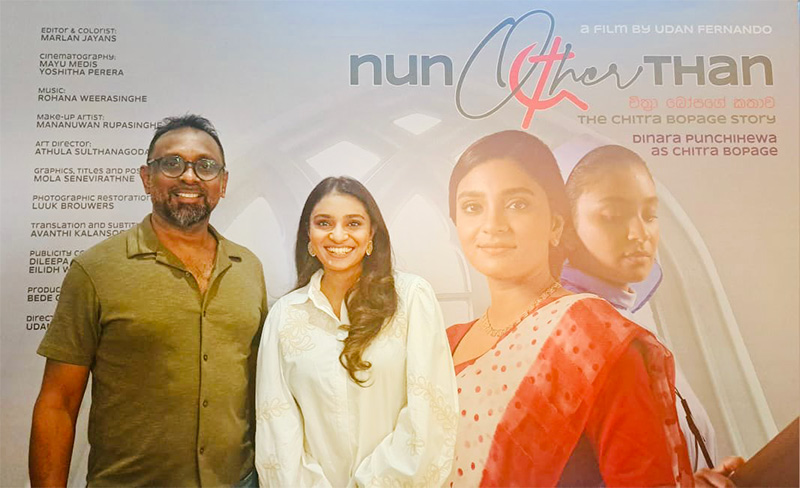
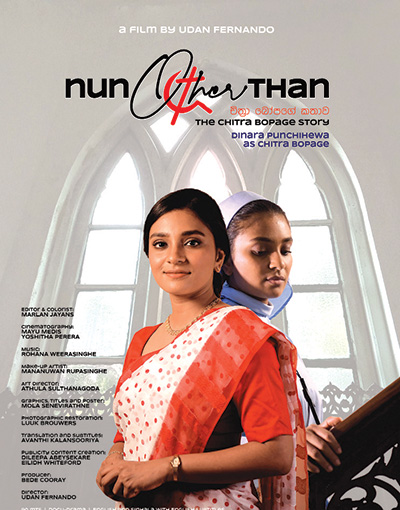
Nun Other Than; The Chithra Bopage Story by Udan Fernando
Reviewed by Laleen Jayamanne
Udan Fernando, though unknown to me, wrote to ask if I would write a piece on his new film, adding that it was about a Lankan woman who was once a nun and also involved with the JVP, now living in Australia. As a lapsed Roman Catholic, living in Australia, taught by nuns (both Irish and Lankan), with friends who were enthusiastic nuns, I was intrigued, but to write I had to be moved in some way by the film, I said.
I found the archival photos and images documenting the era of the JVP in the 70s and 80s, and also the family photographs moving, as they now carry memory-traces of a deep history of religious and political idealism and historical violence in Lanka within living memory.
‘Nun Other than; The Chithra Bopage Story’ has been screening in different forums in Colombo and Jaffna just before the presidential election. I have just watched it alone on my computer. There is something a little sad about not being able to see this film with other Lankans well disposed towards its rather unusual ambitions. After all, in a Sinhala-Buddhist majoritarian country how many would find a ‘nun’s story’ interesting! Hollywood of course made A Nun’s Story with Audrey Hepburn working in Africa, which was a hit. I recall having seen it with my parents at the Liberty. Then, there is the great British director, Michael Powell’s magnificent technicolour classic of the tragic emotional turmoil among white nuns, set in a remote convent perched precariously high up on a Himalayan crag, called Black Narcissus (‘47). A Catholic priest, I think Father Noel Cruz, made a lively 16mm film set in the slums about a bicycle, I think, in the 60s. Apart from that and of course, the Catholic, Lester James Peiris’ contribution to the Lankan cinema, the internal spiritual-ethical social values of Christianity and its modern institutional ethos (post Vatican 2 reforms), have not been material for cultural production in Lanka, as far as I am aware. I am thinking here about the 60s, and a part of the 70s, when I lived there or visited regularly for research on the Lankan cinema.
Nun Other Than; The Chithra Bopage Story is a ninety-minute Docu-Drama in English and Sinhala by Udan Fernando, who has made several documentary films and has lived and worked overseas for many years. The documentary part is structured on the central figure of Chithra (Mudalige) Bopage, now living in Melbourne, Australia with her husband, Lionel Bopage, who was, between 1978 and 1984, the General Secretary of the Janatha Vimukthi Peramuna (JVP) in its second iteration. Chithra recounts her life in Lanka as a young girl and how she decided to become a Roman Catholic nun, having observed as a patient herself, foreign (white), nursing-nuns working in the General hospital with a great sense of care and kindness to the patient. I remember these nuns well and the last of them who worked with dedication at the ‘Leprosy-asylum’ at Hendala, with its very high walls.
The dramatic re-enactment consists of Chithra’s life as a young novice and nun and her early married years after she left the religious order. The film is basically in the genre of ‘Talking-Heads’ with key figures in Chithra’s life, like her elder sister Rohini and brother Kingsley Mudalige and wife Shyama and a delightful nun, Sr Noel Christine Fernando, who was a confident, conveying a vivid sense of Chithra as a spirited and highly focused young girl and woman with a strong sense of social justice and a passion for singing, with a voice to match it.
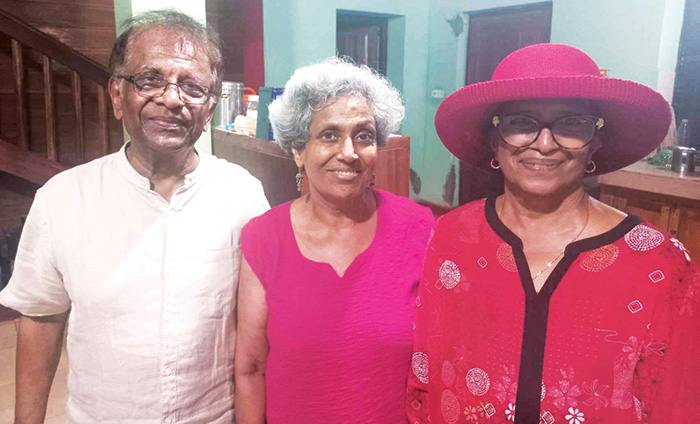
Lionel and Chithra Bopage with Nirmala Rajasingham at the Jaffna screening
Importantly for me, through these reminiscences, we come to know not only Chithra, but also the liberal ethos of her Roman Catholic family, their easy bilingualism, their openness to the world, a certain Humanist ‘Catholicism’, which means ‘Universal’, not narrowly parochial. I found the absence of any residue of feudal attitudes in Chithra’s family an eye-opener, as I myself come from a Catholic family, with deep roots in Catholic villages, which had some deplorable feudal values, despite being bilingual and my parents also having been educated by religious clergy. The way Chithra’s mother agrees to her becoming a nun (though her clear preference was for her to get married), is one example of this liberalism, and the other being, her attitude to Chithra leaving the religious order to marry Lionel.
It’s not to her liking either and is willing to find another ‘suitable’ person for her, but accepts it, respecting Chithra’s choice. However, her mother is fully there to help out when she takes up the care of her granddaughter, so as to lessen the burden on Chithra at the time when Lionel is unlawfully held in custody without cause. This tolerant and open-minded attitude of Chithra’s Catholic family from Avissawella is a remarkable aspect in our Lankan culture and a real tribute to her parents and siblings. Her siblings and sister-in-law who lovingly talk about Chithra on camera, also have very open attitudes to interpersonal relations between the sexes and are remarkably non-judgemental about Chithra’s choices and admire her courage and her considerable singing talent. I find all of them thoughtful, exemplary Lankans.
In the context of the Sinhala cinema, where ‘sexual promiscuity’ is often coded as Christian (e. g. Hansa Vilak, Dekala Purudu Kenek…), in a censorious manner, this relaxed liberalism, openness to differences, focused on in this film, is a breath of fresh air.
This, one might say, is the real, enlightening “Catholic Action,” – to use that screaming political headline of the 60s differently here. I remember its use well, when there were organised protests against the ‘Take-Over of Christian Schools’, by the government. My family was involved in the so-called ‘Catholic Action’, fearing that Christian religious education and values would not be taught when they were incorporated into the government school system. It is ironic that when Lionel decided to leave the JVP for good in ’84, the JVP also called it ‘Catholic Action’, no doubt blaming Chithra’s influence on him.
I find the wedding photos of Chithra and Lionel very moving, especially the one of both of them seated with Lionel’s mother, in a white Kandyan sari, looking directly at the camera with a grave expression. I wonder what she thought of her son’s marriage and politics. The photos of the group of friends all seated eating their rice packets, a modest wedding feast, conveys a sense of community feeling. Lionel’s progressive attitude within the JVP context is seen in his choice of the signatories at their marriage; a Tamil and a Sinhala brother in the party. This multi-ethnic-cultural gesture corresponds to his position on the “National Question’, on which he deviated from the official JVP line, having worked in the North and the East.
Apart from the ‘Talking- Heads’, the film also presents an array of photographs, the most remarkable being those of the JVP in their second phase, after Rohana Wijeweera, Lionel Bopage and the rest were released from prison in 1977. They also include news photos of mass murder and mutilation of bodies in the period of 88-89 terror, in the bloody confrontation between the UNP and the JVP. Some of these images evoke strong feelings while also being informative, given their historical resonances. The timing of the release of this film during the days leading up to the Presidential elections on 21/9/24 will also resonate deeply with many Lankans who lived through the 70s and 80s J. R. Jayewardene era, when the current President, Ranil Wickremesinghe was the Minister of Education during July ‘83.
The interplay between the contemporary Chithra at 77, wearing a mauve straw hat, talking to the camera directly in large close-ups, in Melbourne, Australia and her younger self, slowly gathers a rhythm of sorts, a hesitation there and light-sorrow felt here, thoughtfulness and regret that she can’t remember everything well enough. She wishes that she had written down everything, and so do I. But I do wish that Udan had varied a little the mise-en-scene (i. e. the compositions of the shots) so that we might have been able to see Chithra in her ‘new’ context, Australia, her home for over three decades. The same continuous shot of her in close-up meant that we never got the chance to see her in the country which offered her and her family refuge in the 80s. Apart from the opening establishing-shot of her walking down a tree-lined street full of large white Galah birds typical of Australia, she could have been anywhere. This is a missed opportunity because one is curious to see this remarkable woman in her new context, her adopted, generous country, Australia, which has been very hospitable especially to Lankan intellectuals, scholars, artistes and activists over the years and many, others, too. The discursive information provided of the work Chithra did in Australia doesn’t create a milieu and its rhythms, which would have enriched the film and informed Lankans who might still be rather snooty about Australia and how its egalitarian ethos and values work.
-
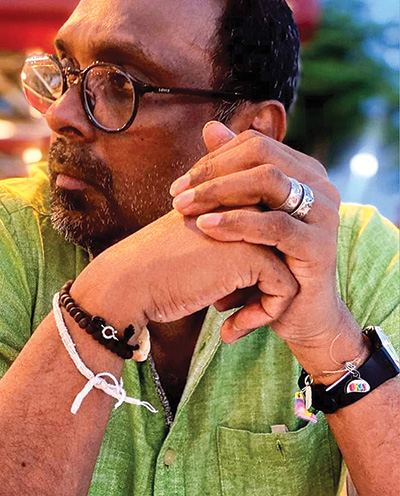
- Director Udan Fernando
One sometimes feels that the director was carried away, enjoying watching the young nun in her crisp pastel blue habit and the sari clad Chithra so much, that the camera lingers on her for a little too long, (cinematically speaking), just enjoying looking at her lovely appearance, in tastefully matching saris, though we hear that Chithra had only two or three saris and that too threadbare. Or more generously, it can be viewed as a nice ‘Brechtian touch! A glimpse of the young Dinara Punchihewa as an actress enjoying her role as Chithra, or so I thought, trying to find an excuse for the duration of these scenes. But then again, they do capture the young Chithra’s quite normal enjoyment of clothes, jewellery and hairstyles, in the life of a fun loving young middle-class girl. Dinara is a very watchable, fresh cinematic presence, in that she conveys through her quietly expressive face and capacity for stillness, a quality of intelligence, which I see as a capacity for introspection, self-reflexivity, which are also linked to Chithra’s religious vocation as a nun.
As young Sisters of Perpetual Help, Chithra showed intellectual interests and was chosen to be trained in working with young people in underprivileged backgrounds. During her training at Aquinas University College, she was expected to research the reasons for the devastating 1971 JVP uprising, and massacre of so many young educated youth of the country. We see her reading a book on it in her room. And it’s this exposure, in a proud Lankan Catholic Higher Education Institution (also my Alma Mater), that makes Chithra question her own privileged life in the convent with three square meals and a pleasant environment. She questioned why people rushed to give her a seat in buses and other such preferential treatment to clergy. It is these thoughts that led her to leave the convent and join the JVP. While Lionel’s presence in her life by then appears to have facilitated this radical move, she asserts that the decision was due to her own firm convictions. Her marriage to Bopage, without informing her own family, was felt as a big upheaval by her brother who added lightly that, ‘it’s something you see in the movies or in a novel, not in normal life!’
The post ‘77 JVP appears as a different organisation from that which led to the April ’71 uprising. Women convened a ‘Conference of Socialist Women’s Union’, at which delegates from Iraq and Palestine were present. Also, a striking difference was the creation of a repertoire of Vimukthi Gee (Songs of Liberation) of the JVP, which drew Chithra to it even before she left the convent. It was a lovely surprise to see a photograph of my late friend Sunila Abeysekera in the group and hear Chithra talk about her with affection.
But the abiding emotional impact of the film comes from the reflective, steadfast consciousness at its heart, Chithra herself at 77, a quietly wonderful presence. That she can talk about the importance of her work as a nun and of her complex feelings so lucidly with ease is again linked, I think, to the ‘Westernised’, bilingual attitudes in her ethos and also at the convent where she was free to confide in a friendly nun who admired Chithra’s decision to leave the convent and also of her ease with the priest who she considered a good friend with whom she felt free to discuss her decision.
These are urbane aspects of a Catholic institutional ethos, after the Ecumenical Council of the 60s. Buddhists unfamiliar with this aspect of Christianity can learn about an ethos free of feudal ideologies. Sinhala- Buddhist ideology appears to re-feudalise institutions and practices (even secular ones) of Lanka, in an alarming way now, thus betraying the universal avihinsa, rational values of Buddhist philosophy itself. In this sense too, the film shows a progressive church with considerable freedom for women to choose alternative ways of living and behaving. Udan himself as a Protestant (Methodist), appears to be fascinated by the institutional architectural richness of the Catholic church interiors, their ritual ornamentation, which Protestantism eschewed with Luther’s Reformation.
Chithra and Lionel’s quite considerable social and religious differences would have become, in a Sinhala genre film, the stuff of melodrama and tragedy. But in Udan’s film we see them age together with grace, as their children grow up in a foreign country, which offered them refuge from the political violence of Lanka. Thus, Australia also shines in having offered refuge and hope to this remarkable couple and their two children.
As I see it, the film is also a tribute to the Ecumenical values (broad sympathy and interests), of the Catholic Church in Lanka, in that it facilitated a rare and happy (romantic), love story of personal steadfastness to each other and to the political and ethical values they stood for, at a time of great danger in Lanka.
One wonders if the film might create a public discourse on the history of the JVP (the role of women and ethnic and religious minorities), in its several iterations.

Midweek Review
Legacy of enforced disappearances: Vital facts conveniently forgotten to whitewash LTTE and India
Those demanding accountability from Sri Lanka for war crimes allegations are strangely silent on atrocities committed by the LTTE. On the orders of its leader Velupillai Prabhakaran, the LTTE killed hundreds of members belonging to rival terrorist groups. It assassinated President Ranasinghe Premadsasa, almost succeeded in assassinating President Chandrika Bandaranaike Kumaratunga and made attempts on President Mahinda Rajapaksa. But, the indiscriminate use of children as cannon fodder went unnoticed. How many children, forcibly recruited into their ranks, perished in fighting? And, lastly, shouldn’t the Tamil community hold the Illankai Thamil Arasu Kadchi (ITAK)-led now defunct Tamil National Alliance, that recognised the LTTE in 2001 as the sole representative of the Tamil speaking people, responsible for death and destruction caused since 2001?
By Shamindra Ferdinando
Working Group on Enforced or Involuntary Disappearances (WGEID) representative Ana Lorena Delgadillo Pérez, and head of the Association of Relatives of Enforced Disappearances (ARED) Yogarasa Kanagaranjini, on 30 August, opened an exhibition at the Thanthai Selva Auditorium in Jaffna. The exhibition, appropriately named ‘Long Road for Justice,’ coincided with the International Day for Victims of Enforced Disappearances.
Pérez later addressed a conference held therein where the responsibility on the part of Sri Lanka was stressed.
Civil society activist Sunanda Deshapriya, in an article titled ‘Sri Lanka’s Disappeared: Where Do We Go from Here?’ carried in Jaffna Monitor, dealt with missing persons issue. Deshapriya focused on the North-East war (https://www.jaffnamonitor.com/sri-lankas-disappeared-where-do-we-go-from-here/)
The ICRC, Colombo, issued a statement regarding the International Day of the Disappeared. When the writer sought the number of missing persons in the country, Ruwanthi Jayasundare, Head of Communications, said that they had a caseload of 15,000 registered tracing requests (1983-2009) but she asserted that the actual number of missing was far bigger (https://island.lk/icrs-sustained-and-collective-efforts-critical-to-address-issue-of-missing-persons/)
Perhaps, many people wouldn’t know that the ICRC arrived here in 1989 during the second Janatha Vimukthi Peramuna (JVP) terror campaign in the wake of Indian military intervention here. The much discussed issue of disappearances must be appropriately dealt with, taking into consideration the relevant factors. At the time of their deployment here, President Ranasinghe Premadasa had been engaged in direct talks with the Liberation Tigers of Tamil Eelam (LTTE) and the Geneva-headquartered body never expected a gruesome outbreak of violence. It would be pertinent to mention that within weeks after the ICRC’s arrival here, the JVP was crushed with brute force as it, too, resorted to senseless violence. The counter violence unleashed by the state apparatus was such that the then Marxist group’s top leadership was killed, except for Somawansa Amarasinghe, who escaped, with Indian help, in February 1990, and remained in exile till late 2001.
The ICRC deployment took place in mid October, 1989, and JVP leader Rohana Wijeweera was captured in the second week of November, at Ulapone, and shot in custody, and was allegedly cremated alive at the Borella cemetery.
In fact, at the time the ICRC arrived here, the JVP was on its last legs. The UNP government never bothered to hand over the bodies of slain JVP cadres to their families. Those who had been listed missing at that time were no longer in the land of the living, by the time the ICRC brought its operation in the South to an end.
What the country never expected was a fresh flare-up in the northern and eastern regions. The LTTE resumed large-scale hostilities, in June, after the Indian Army pulled out from Sri Lanka in late March 1990. Interestingly, some of those demanding justice for the missing/disappeared are conveniently silent about the disappearances during the Indian Army deployment here (July 1987 to March 1990).
Soon after hostilities erupted in the northern and eastern regions, following a 14-month truce between President Ranasinghe Premadasa and LTTE leader Velupillai Prabhakaran (May 1989 to June 1990), the ICRC was invited to open offices in that region. There had been excesses on the part of the military and law enforcement authorities as the government battled the LTTE, the world’s most ruthless terrorist organisation as assessed by none other than the US Federal Bureau of Investigation.
Yet Sri Lanka must earnestly address accountability issues and take meaningful measures to compensate the families of the innocents.
However, the Tamil community must come to terms with the reality that the vast majority of dead were members of the LTTE. The LTTE enjoyed considerable firepower as it literally wielded a conventional fighting capability, which even included a fledgling air force and directly challenged the government, and the armed forces had no option but to fight back. Obviously, the LTTE, that achieved significant battlefield successes over the years, never expected the almost non-stop three-year-long offensive that brought the war to an end in May 2009. Disappearances became exceptionally an important issue in the overall agenda pursued by the Tamil Diaspora and Tamil speaking political parties here only after the LTTE’s eradication.
Multiple reasons
In September 1990, several months after the Indian Army was literally forced to pull out from Sri Lanka as Tigers fought back the mighty IPKF to a standstill, while President Premadasa, too, made it clear that they were no longer welcome here, Amnesty International (AI) documented 43 cases of disappearances. According to the London headquartered AI, the majority of these disappearances happened in the Jaffna peninsula, following the outbreak of fighting in October 1989. The Indian Army launched ‘Operation Pawan’ meant to disarm the LTTE in line with the Indo-Lanka Accord, signed on 29 July, 1987.
During the Indian Army deployment here (1987 July to 1990 March), the Sri Lankan armed forces were confined to their barracks in the North and East. The AI accused the Indian Army of torture, extrajudicial executions and disappearances. The deaths of nearly 1,500 Indian officers and men, and injuries to approximately 3,000 others during the Indian deployment here, underscored the ferocity of the situation.
The Indian Army carried out reprisals, following LTTE attacks in both provinces. The Indian Army was also accused of sexual violence. Perhaps, the August 1989 Valvettithurai orgy of violence, during which Indian soldiers killed civilians, tortured detainees, committed sexual violence, and systematically destroyed homes and businesses, while the town was under curfew, was the worst case.
In October, 2025, the International Truth and Justice Project (ITJP) presented a detailed reparations claim, in association with the Valvettithurai Citizens’ Committee, to the Sri Lankan Office for Reparations, requesting USD $15 million (LKR 4.5 billion) for victims of a 1989 orgy of violence committed by the IPKF where at least 66 civilians were killed and 34 injured.
There hadn’t been a previous instance of a comprehensive compensation claim for such a wartime crime. Thousands of LTTE cadres, some of them trained in India, and civilians, perished in Indian Army action. The Indian Peace Keeping Force (IPKF) earned such a bad reputation it came to be dubbed the Indian People Killing Force.
The war in Sri Lanka, or whatever one chooses to call it, should be examined in the context of a high profile Indian destabilisation project ordered by Premier Indira Gandhi. Over a year after the Indian Army pullout, the LTTE assassinated Rajiv Gandhi, by then out of power, but he was the person Velupillai Prabhakaran held responsible for the Indian Army deployment in Sri Lanka. Following Gandhi’s assassination, India hunted down the LTTE team, involved in the operation, carried out by a female suicide cadre.
The LTTE forgot the Indian role in the transformation of the Tamil separatist terrorist movement to a deadly conventional threat. If not for the despicable Indian action, Sri Lanka wouldn’t have been hauled up before the Geneva-based United Nations Human Rights Council (UNHRC). That is the unpalatable truth.
How many Sri Lankan Tamils disappeared during weapons training in India? Did India investigate such disappearances as well as deaths caused by fighting among rival Tamil terrorist groups operating in India at that time? Among the groups that had been armed by India were PLOTE (People’s Liberation Organisation of Tamil Eelam), EPRLF (Eelam People’s Revolutionary Liberation Front) and TELO (Tamil Eelam Liberation Organisation) responsible for quite a significant number of killings and human rights violations.
India never accepted responsibility for the PLOTE raid on the Maldives on a contract to topple the then Maldivian PM Gayoom’s government given by a domestic rival in early November, 1988. Shouldn’t New Delhi at least apologise for the sea borne raid on the Maldives that resulted in deaths of Maldivians, as well as raiders? The Indian Navy sank a ship commandeered by the attackers fleeing the Maldives after air borne Indian troops brought the situation under control.
The Indian and global media praised swift Indian intervention but ignored two key factors, namely (i) the operation targeting Maldivian President Maumoon Abdul Gayoom was mounted by one of the groups trained, armed and deployed by India and (ii) two trawlers carrying the raiding party left the northern part of Sri Lanka, at that time held by the Indian Army.
The writer had the opportunity, in November, 2011, to interview the Maldivian businessman, Abdullah Luthufee, who convinced the PLOTE leader Uma Maheswaran to carry out the operation. (Male plot leader speaks out 3 November, 2011, Rajiv saved us from Gayoom-Male coup leader 4 November 2011 and How Luthufee moved SAARC venue from Male to Addu 11 Nov 2011) dealt with the operation that should have drawn international attention to the Indian destabilisation project. Let me stress that some PLOTE cadres perished when the Indian Navy sank the vessel commandeered by the fleeing PLOTE cadres. They were among those who had been listed missing during the conflict.
Australian and US interventions
One-time top JVPer Kumar Gunaratnam secret arrival in Sri Lanka as an Australian Citizen Noel Mudalige, in early September, 2011, emphasised the issuance of foreign passports in assumed names to Sri Lankans under controversial circumstances. The writer exclusively reported how the head of the breakaway JVP faction, known as the Frontline Socialist Party (FSP), arrived here. The Australian High Commission in Sri Lanka acted swiftly and decisively when Gunaratnam disappeared after entering the country, using Australian passport bearing number N 1016123 on September 4, 2011 (https://dbsjeyaraj.com/dbsj/?p=43914). The writer dealt with the same issue again in August 2016 (https://dbsjeyaraj.com/dbsj/?p=47936).
Among thousands of Sri Lankans, now having foreign citizenship, there can be many people listed here as “missing/forcibly” disappeared. Western governments never helped Sri Lanka to establish the real identities of Sri Lankans living abroad, under assumed names. If Gunaratnam never acted in a manner inimical to the JVP, he could have easily lived a comfortable life in Australia as Sinhala Buddhist Noel Mudalige.
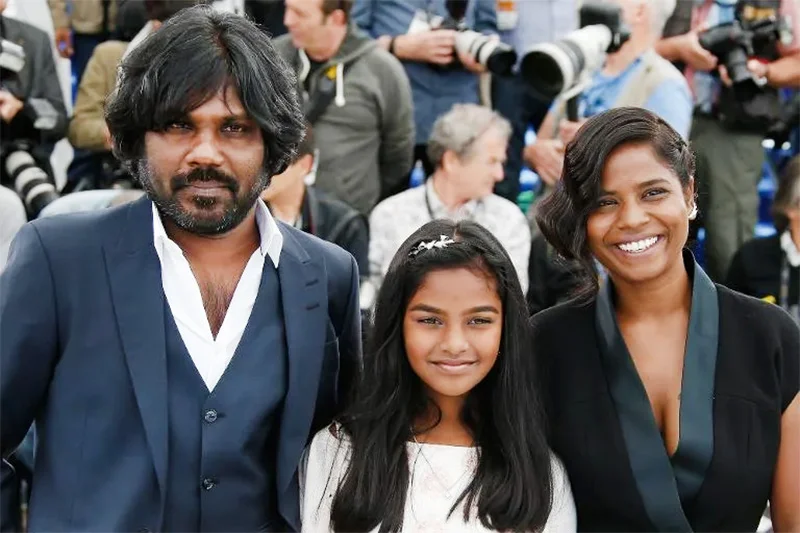
There had been many interesting stories of those categorised as missing/dead turning up in the West, under new identities. One of the most intriguing ones, is about an ex-LTTE terrorist turned Frenchman Antonythasan Jesuthasan, the lead actor in Dheepen that won the prestigious Palme d’Or at the 2015 Cannes Film Festival.
Internationally acclaimed Jacques Audiard directed the movie about three Sri Lankans who formed a fake family to escape the war and to secure asylum in France. Antonythasan Jesuthasan’s performance in Dheepan earned him a Best Actor nomination at the 2016 César Awards (the French equivalent of the Oscars). Jesuthasan is the only ex-LTTE terrorist to receive international acclaim as an actor.
In an interview with Tom Seymour (Dheepan’s Antonythasan Jesuthasan: from Tamil Tiger to star of a Palme d’Or winner in The Guardian) posted online on March 31, 2016, transformed Frenchman Jesuthasan, unwittingly revealed how he deceived the United Nations High Commissioner for Refugees (UNHCR) to secure political asylum. Seymour reported that Jesuthasan, after having shown him a dense lattice of scars on his forearm, declared: “I did those to myself. I was 22, and I had spent years trying to come to the west. I wanted to get a fake French passport, but I had to be accepted as a refugee. I went to the UNHCR [the UN High Commissioner for Refugees], but they wouldn’t believe my story. So I cut myself, and held up my arm, and said to them: ‘Look at my blood. This is my word.”
Jesuthasan is just one among thousands who obtained political asylum on false claims. Jesuthasan ended up as the star of Dheepan, directed by Jacques Audiard, possibly France’s most celebrated modern director. There cannot be a better example than Jesuthasan to highlight the web of deceit pertaining to the vast majority of those who successfully secured political asylum. But, the Sri Lanka Foreign Ministry never bothered to set the record straight. Born in Allaipiddy, on the Velanaitivu islet, Jesuthasan claimed he fought the Sri Lanka Army in August 1990 and subsequently fled the country and managed to reach France.
But, the case of Kathiravel Thayapararajah is one of the most controversial cases. Thayapararajah had been involved in a Tamil Diaspora funded project in Kilinochchi during Eelam war IV. He couldn’t have secured the Diaspora assignment without the approval of the LTTE and remained in the Vanni during the war. He disappeared in September 2009.
His disappearance prompted a section of the media, as well as some international NGOs, to accuse the Directorate of Military Intelligence (DMI) of executing him. No less a person than the then US Assistant Secretary of State for South Asian Affairs and one-time US Ambassador in Colombo, Robert O. Blake, inquired about the missing person.
The University Teachers for Human Rights (Jaffna), the Australian Government Refugee Review Tribunal, Tamilnet and the European Centre for Constitutional and Human Rights among others blamed the Sri Lankan intelligence for the disappearance. However, the Indian media, in May, 2014, revealed Thayapararajah’s arrest though they didn’t know at the time that he was the person who was supposed to have been killed by the Sri Lankan Intelligence. At the time Indian police apprehended Thayapararajah, at Arichamunai off Dhanuskodi, after arriving there in a boat from Sri Lanka, he had been with notorious female human smuggler Uthayakala. She claimed Thayapararajah was her second husband.
That chance detection exposed a blatant lie propagated over the years. The then Head of Missing Persons Commission, retired High Court Judge Maxwell Paranagama, is also on record as having called for international cooperation to trace persons living overseas under new identities. Paranagama told the writer that at that time both the international community, including the ICRC, had declined to help Sri Lanka identify those taking cover behind new identities.
Chemmani mass graves
Sri Lanka needs to investigate war crimes allegations, particularly the high profile Chemmani mass grave. The country cannot ignore the continuing accusations with the international media taking advantage of the situation to tarnish the country, especially the Rajapaksa rule. It must be a way of the West taking revenge from the Rajapaksas for going against their wish to save the bold thirsty Tigers. It is like their logic that Israel can do no wrong!
The CNN dealt with the Chemmani issue while the International Commission of Jurists (ICJ), in July last year, called for what it claimed as victim-centred investigation into the alleged mass graves in compliance with international law and standards.
Tamil political parties, too, repeatedly demanded tangible action against the perpetrators. The Chemmani mass grave site drew national and international attention in 1998 following the confession of a soldier implicated in the rape and murder of schoolgirl Krishanthy Kumaraswamy. Chemmani has become a powerful and painful symbol of the country’s war-torn past.
Krishanthy Kumaraswamy was raped and killed by soldiers on the 7th of September, 1996. The same group of soldiers later killed her mother, her younger brother and a family friend who went out searching for the teenager.
An excavation, in 1999, led to the recovery of 15 sets of remains, and then the matter was allowed to rest for about a quarter of a century. On the orders of the Jaffna Magistrate’s court, a fresh excavation was ordered last year, following the chance recovery of some skeletal remains and so far nearly 600 sets of human remains have been found, among them children and infants. Tamil media have declared Chemmani as the largest mass grave found in Sri Lanka.
It would be pertinent to mention that some time back the Army was accused of the Mannar mass graves but investigations undertaken by the Office of Missing Persons (OMP), with international expertise, proved the claims false. Bone fragment samples were submitted to Beta Analytic, a specialised US radiocarbon-dating laboratory. This happened during the Yahapalana administration (2015-2019) Later, the lab indicated that the tested bone samples dated back to the period between 1499 and 1719 AD (the 15th to 18th century). That brought an end to the Mannar mass graves hoax.
Whatever the circumstances, the government cannot remain silent regarding the Chemmani mass graves. The area that had been under Security Forces Headquarters, Jaffna continues to receive public attention, both here and abroad. The Army will have to address the issue without further delay. Let me stress the importance of investigating the atrocities perpetrated by others, namely the Indian Army for which the responsibility lies with the government of India as well as the LTTE, and over half a dozen other terrorist groups that subsequently entered the political mainstream.
The formation of Tamil National Army (TNA) by India before the Indian Army pullout by March 1990, too, must receive the attention of Sri Lanka as well the concerned international community. Having totally destabilised the smaller neighbouring county by arming scores of terrorist groups, New Delhi went a step further by the formation of the TNA meant to protect Varatharaja Perumal’s North-East provincial administration.
In spite of President Ranasinghe Premadasa drawing strong criticism for arming the LTTE against the Indian Army, in hindsight, if not for his controversial decision, India’s proxy, TNA may have taken root. Whatever various parties say today, the TNA had been formed to ensure the continuation of the deeply unpopular Perumal’s administration that went to the extent of forcible conscription. India can never absolve itself of responsibility for what it did in Sri Lanka. The destabilisation project, largely influenced by the then Premier Indira Gandhi’s concerns over the developing situation in Tamil Nadu, caused massive death and destruction. No less a person than J.N. Dixit, who served as their High Commissioner in Colombo (1985 to 1989), and later appointed National Security Advisor (2004 to 2005) disclosed in his memoirs ‘Makers of India’s Foreign Policy: Raja Ram Mohun to Yashwant Sinha’, Indira’s Gandhi’s intervention. The late Dixit in no uncertain terms blamed her for Indian intervention in Sri Lanka.
By Ifham Nizam
Pictures by Nishan S Priyantha and Kamal Bogoda
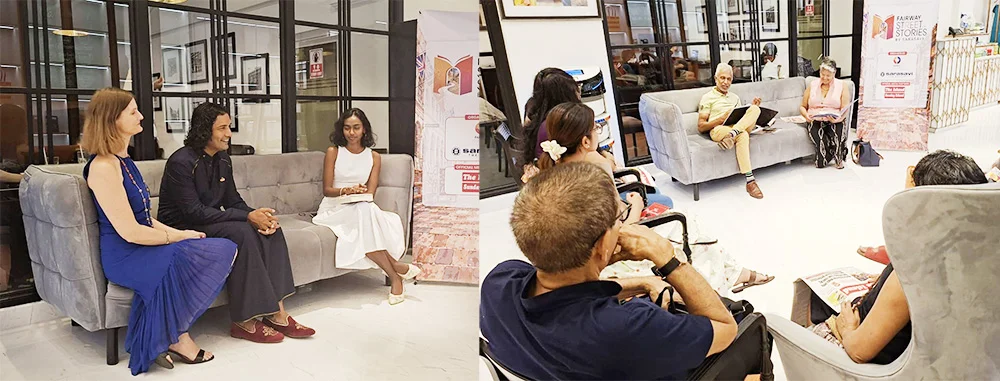
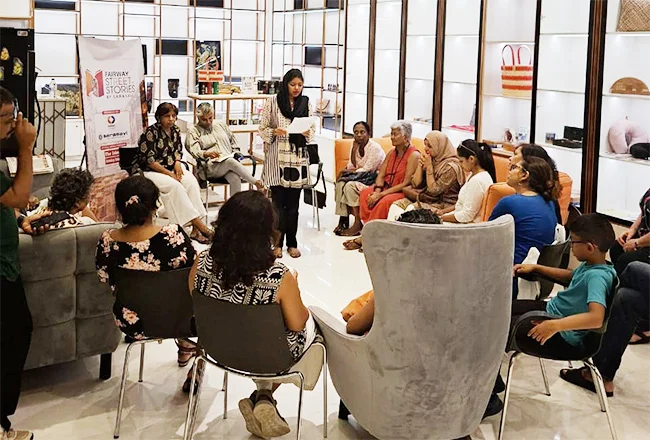
Ashok Ferrey took readers into an older Colombo through Colpetty People. Vivimarie Vanderpoorten opened the door to the personal stories behind her poetry. Andrew Fidel Fernando brought cricket, culture and the distinctive world of Sri Lankan school cricket into the conversation, while Ramya Jirasinghe spoke candidly about the long and often difficult road from writing a manuscript to seeing it published.
Then came Margaret Richardson and Asanka de Mel, whose conversation moved from literature to the question of where Sri Lanka should be by 2048.
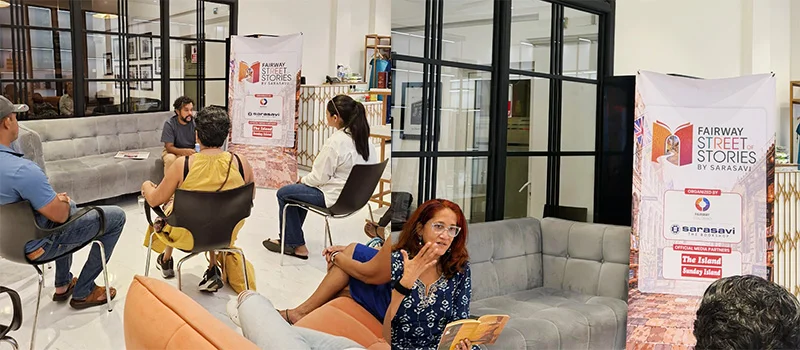
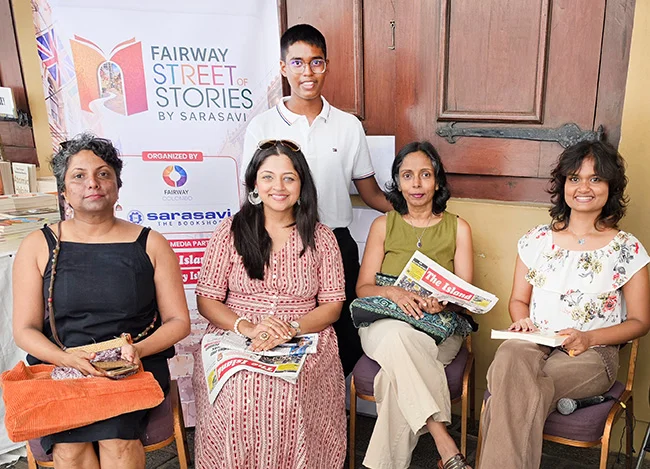
These were among the voices that gave life to Fairway Street of Stories, a new initiative that sought to bring Sri Lankan English-language writers closer to their readers.
But behind the gathering of authors, readers, books, children, book clubs and aspiring writers was a bigger idea—the brainchild of Amendra Haputhanthri, Director of Sarasavi Bookshop (Pvt) Ltd.
For Haputhanthri, Fairway Street of Stories is not merely another literary event. It is part of a much larger attempt to create a marketplace for Sri Lankan talent and to persuade readers to discover stories that are unmistakably their own.
“Usually, when we have exhibitions, such as the Colombo Book Fair, we always think about what sells the most. Here, we wanted to create a niche market for people who want to read Sri Lankan writing,” she said.
And the first event demonstrated just how wide that literary world can be.
Stories from a Sri Lanka we know
Haputhanthri believes one of the greatest strengths of Sri Lankan English writing is its sense of place.
A thriller set in an unfamiliar foreign city may be entertaining. But a thriller unfolding at the Galle Face Hotel or Mount Lavinia Hotel carries another kind of intimacy for a Sri Lankan reader.
“You have familiar words and actual real-world places that we have been to. There will be a connection with the book,” she said.
That connection can be even more powerful when the story takes readers into places and experiences that are disappearing.
This is one reason she admires Ferrey’s work.
During his Fairway session, Ferrey, together with Tanya de Mel, offered readers an engaging glimpse into the world behind Colpetty People and the Colombo it captures.
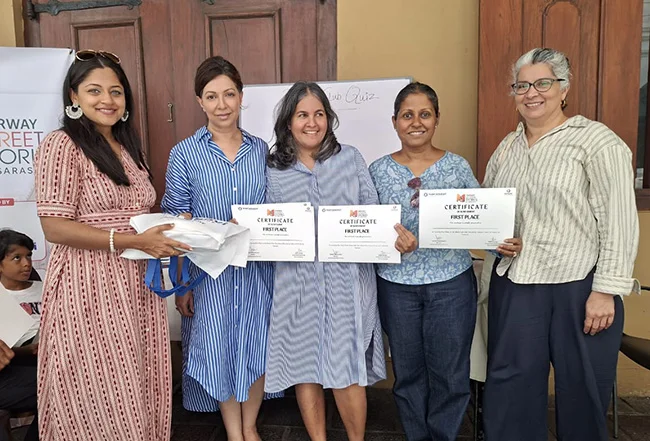
Amendra Haputhanthri (extreme left) with winners
For Haputhanthri, Ferrey’s writing is also a record of a rapidly changing city.
“Even Sri Lanka is changing very rapidly. Within Colombo also, the environment is rapidly changing, and that is being addressed nicely in the books of Ashok Ferrey,” she said.
Literature, in that sense, becomes more than entertainment.
It becomes memory.
The stories behind the poems
Vivimarie Vanderpoorten offered a very different literary experience.
Haputhanthri describes her as one of the country’s outstanding contemporary talents, particularly because of the personal histories embedded in her poetry.
A poem on a page may be only a few lines long. But behind those lines can lie an entire life.
Vanderpoorten spoke about those experiences at Fairway, including deeply disturbing events she had witnessed during her university years.
For Haputhanthri, hearing those stories transformed the poems.
“All her stories, there is a back story. All her poems, there is a back story,” she said.
She believes such conversations are precisely what literary events should create—a space where readers can move beyond the printed page and understand the human experience that produced it.
She also encouraged people to read poetry, even if only one poetry collection a year.
Poetry, she believes, forces readers to think beyond what is immediately presented.
“It gives you the ability to think out of the box,” she said.
Cricket is more than a score
Andrew Fidel Fernando brought yet another dimension to the event.
For someone who writes and comments on international cricket, his work naturally takes readers into the world of the game. But Haputhanthri noted that Fernando’s writing also captures the culture surrounding cricket in different countries.
And Sri Lanka has a particularly richstory to tell.
Andrew Fidel Fernando / Dr. Vivimarie Vanderpoorten
For Haputhanthri, the island’s school-cricket culture is something the world should know more about.
“We are the best in the world when it comes to having a culture for school cricket. It is something very unique to our country,” she said.
She even suggested that writers interested in Sri Lankan cricket should explore this largely distinctive phenomenon in greater depth.
Because literature can sometimes reveal what statistics cannot.
A schoolboy walking onto a cricket ground carries with him a school, a city, friendships, rivalries, family expectations and an entire culture.
From manuscript to book
Ramya Jirasinghe’s contribution was particularly relevant to aspiring writers.
She spoke about her own journey and the realities of getting a book published.
Her experience demonstrated that literary success rarely happens overnight.
Winning recognition is one thing. Turning a manuscript into an internationally published book is another.
For emerging writers listening to her, the message was clear: writing requires patience, revision and persistence.
Haputhanthri knows that process well.
Writers, she said, can be rejected repeatedly—even at international level.
And translations create another layer of difficulty.
Sometimes an author reads a translation of his or her work and says: “This doesn’t have my voice.”
That, Haputhanthri acknowledged, illustrates how complex the journey from an original manuscript to another language can be.
A speech from the future
Carmel Miranda
Asanka de Mel and Margaret Richardson brought another perspective to Fairway.
De Mel’s 2048: A Speech from 2048 looks towards the centenary of Sri Lanka’s independence and asks why the country has not yet become a developed nation.
But his message, as Haputhanthri interpreted it, was not one of resignation.
Sri Lanka should not allow its small geographical size to become a psychological limitation.
De Mel’s own journey—from two decades in Silicon Valley to returning to Sri Lanka and embarking on entrepreneurial ventures—was offered as an example of what persistence and confidence can achieve.
For Haputhanthri, it reinforced one of the central lessons of both writing and life.
“There is no shortcut in life,” she said.
Stories that preserve a country
Fairway Street of Stories also reflected Haputhanthri’s belief that literature can preserve aspects of Sri Lankan identity that are increasingly vulnerable.
She spoke about Angampora, Beeralu weaving, traditional culture and historical stories.
Even the country’s royal heritage can become a gateway for a new generation to understand the island’s past.
She recalled seeing foreign visitors browsing books about Sri Lankan kings.
Those books were doing more than recounting history. They were presenting the story of a country with a long and complicated heritage.
Haputhanthri believes Sri Lankan literature can perform a similar role internationally.
“Our stories should also reach people in the same way our food and cultural experiences have reached the world,” she said.
She recalled meeting two foreigners who had visited Sri Lanka around 156 times.
Their extraordinary attachment to the country reminded her that Sri Lanka’s culture has an ability to attract people repeatedly.
The stories of the country, she believes, deserve the same reach.
The problem is not the e-book
Ramya Jirasinghe (third from left)
Yet while Haputhanthri is passionate about books, she is equally concerned about the future of reading.
She does not believe e-books are necessarily the enemy.
“If people are reading an e-version, as long as they are reading something valuable, that will add something to you,” she said.
The bigger threat, in her view, is the endless scrolling culture of the smartphone.
“Scrolling on the phone reduces your attention span and you can’t do any sort of deep work,” she said.
She has observed this challenge among young people entering the workplace and believes sustained concentration is increasingly difficult.
But her answer is not to blame young people.
It is to begin much earlier—with parents and teachers.
“Whatever the parents read, the children also will read,” she said.
‘Readers Are Not Born, They Are Created’
That belief is now developing into another initiative.
Haputhanthri is working on a programme titled ‘Readers Are Not Born, They Are Created’, which she hopes to take from school to school and community to community.
The target will be parents as much as children.
The message is that reading habits are cultivated. They are demonstrated, encouraged and nurtured.
She also hopes to involve children who have themselves developed through reading, allowing them to share their experiences with others.
For Haputhanthri, the issue is deeply personal.
“I would credit everything that I have today, and everything I am today, because of reading,” she said.
She believes avid readers develop empathy, creativity and critical thinking—qualities that are increasingly valuable in a world dominated by information but often short on attention.
Beyond one literary weekend
Fairway Street of Stories, therefore, is not intended to remain a once-a-year literary celebration.
Haputhanthri wants to see activities connected with reading and books continue throughout the year.
A bargain book sale is among the ideas being considered, making use of books from Sarasavi’s extensive network of branches that may have suffered minor damage or discolouration while remaining on shelves.
The next major event will be the book fair, followed by further initiatives.
But the larger ambition goes beyond sales.
It is about discovery.
A reader discovering a Sri Lankan writer.
A child discovering poetry.
An aspiring author discovering that rejection is not the end.
A foreign visitor discovering that Sri Lanka’s stories are as rich as its food, landscapes and traditions.
And a country discovering itself in its own books.
That is perhaps the most significant contribution of Fairway Street of Stories.
Because the authors who gathered there did more than talk about their books.
They demonstrated the many ways in which Sri Lanka can be written, remembered and imagined.
And behind that gathering was Amendra Haputhanthri’s conviction that these stories deserve not only a place on a bookshelf, but a place in the minds of readers—and eventually, a place in the wider world.
By Lynn Ockersz
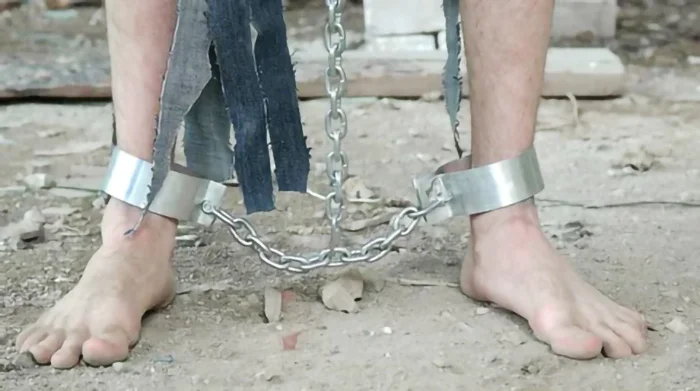
Just for a fleeting moment is this sense of relief,
As he eases himself heavily into his airline seat,
Hoping to leave no trace behind of his criminal self,
But he’s dragged down by a guilty conscience,
Which will dog him at heel from now onward,
And this is verily a cast-in-stone life sentence.

England Women appoint Leah Poulton as managing director

Bangladesh bank on bowlers in bid to bring India down

Avindu makes history with first World University gold for Sri Lanka

Establishment of National Trade Negotiation Committee (NTFC) and Trade Policy Consultation Committee.

Showers will occur in the Western and Sabaragamuwa provinces and in Galle and Matara districts

Justice Minister hits back at CLA

‘Dates have the highest sugar content to fight Coronavirus’

Sunday Island 27 December – Headlines

#SundayIsland 17th December – Headlines

Sunday Island – 28th March

Sunday Island Headlines – 21 March

Sunday Island – 21st February – Headlines
-

 News7 days ago
Denied of promotion to SC despite vacancies, justice Gurusinghe retires
-

 News7 days ago
22A: SC urged to suspend hearing, appoint full bench
-
 News5 days ago
Namal remanded until Sept. 18 over Airbus deal investigation
-

 Latest News4 days ago
Tharanga creates history with Diamond League crown in Brussels
-
 News7 days ago
Govt. seeks NATO assistance
-

 Editorial7 days ago
Strange arithmetic goes unchallenged
-

 News4 days ago
Dispute which triggered listed company director being detained at BIA resolved
-

 Features3 days ago
After the parade: What a traffic OIC’s walk-out tells us