
2026-05-09


By Sanath Nanayakkare
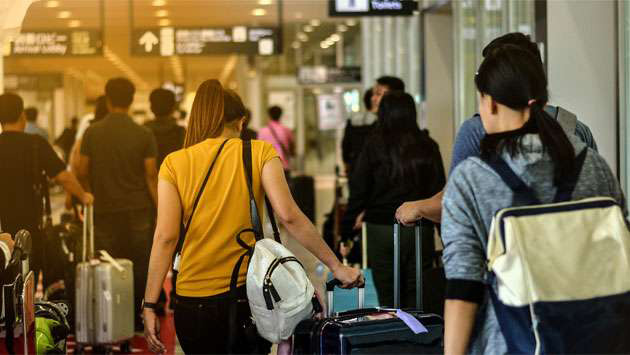
As Sri Lanka experiences a surge in visitors from its largest tourist market, India, a modern administrative hurdle has emerged at Bandaranaike International Airport (BIA).
While nations like India and Pakistan have successfully transitioned to fully digital driving licences and cashless ecosystems, Sri Lanka’s Department of Motor Traffic counter still requires a physical card to issue temporary local permits, The Island Financial Review learns.
This mismatch creates significant friction for independent travelers who rely entirely on smartphones and cloud-stored credentials. Tourists turned away at the airport – and sometimes redirected to the Werahera office in vain – find themselves unable to legally rent and drive vehicles. Consequently, this policy gap harms local car rental operators, causes tourist frustration, and deprives the government of valuable permit revenue.
The situation highlights a distinct irony: Sri Lankan motorists easily travel abroad using International Driving Permits that are readily accepted in India and Pakistan, yet local infrastructure cannot reciprocate due to outdated verification systems.
Recognizing the problem, Department of Motor Traffic officials have noted that upgrades and new equipment are currently in the works to integrate foreign digital platforms.
For a nation aggressively pursuing a national digitalisation drive, rapidly modernising these transport protocols is essential to keeping pace with global travelers and unlocking the full potential of its tourism economy.
Business
International Afro-Latin Dance Festival in Colombo to grow into a larger regional tourism draw

ALIF-SL, Sri Lanka’s first-ever international Afro-Latin dance festival, returns for its 4th edition from 25 to 27 September 2026 at the Galle Face Hotel, Colombo. The festival will bring together over 30 international and national artists and 175–200 participants from more than 20 countries, reaffirming its place as the region’s leading platform for Salsa, Bachata and Kizomba.
This year’s edition is headlined by Tropical Gem, the world’s No. 1 salsa team, travelling from Italy to perform and teach alongside a stellar international line-up. Attendees can also look forward to the ALIF Cup Sri Lanka Open, a keenly contested competition judged by an international panel, giving local dancers a rare opportunity to compete and connect with world-class talent.
“Every year, ALIF connects Sri Lanka to the world. With this year’s artist line-up and the ALIF Cup competition, we’re not just hosting a festival, we’re putting Sri Lanka on the map as a top destination for dance,” said JD Ruban, Founder and Director of ALIF-SL
Beyond the dance floor, ALIF-SL continues to support Sri Lanka’s tourism sector, drawing dancers, judges and enthusiasts from across the globe to Colombo and positioning the capital as an emerging regional hub for social dance. Organizers plan to grow the festival into a larger regional tourism draw, introduce new competition categories, and bring in even bigger headline acts in future editions.
Stability on its own cannot deliver the sustained improvement in living standards that Sri Lankans need. As Advocata Research highlights, growth must take centre stage.
Following its recent economic crisis, Sri Lanka has made commendable progress in restoring macroeconomic stability. Yet, stability alone is not a destination; it is merely a foundation. As recent data from the Department of Census and Statistics shows, the economy grew by 4.2% in the second quarter of 2026, moderating slightly from the 5.1% recorded in the first quarter. While headline recovery numbers are encouraging, growth is the most powerful tool available to reduce poverty, create better jobs, and raise household incomes.
Furthermore, it is central to debt sustainability, as a nation’s ability to service its debt depends on the overall size and productivity of the economic base generating that income. Advocata emphasizes that poverty reduction cannot rely on redistribution alone; a sustainable reduction requires an expanding economy that creates high-productivity employment.
However, a closer look at the latest numbers reveals an uneven recovery. In the second quarter, industrial activity expanded by 7.3% – bolstered by construction and mining – and services grew by 2.7%, while agriculture contracted by 2.3%. Even within manufacturing, key sectors like textiles and apparel faced contractions. This divergence is a clear reminder that a cyclical rebound is not the same as economic transformation.
To move beyond stabilisation, Sri Lanka requires structural, evidence-based reforms. Advocata notes that growth does not happen by accident; it requires an enabling environment where capital and labor flow efficiently. By tackling crucial factor market reforms – such as land, labour, and competition policy – Sri Lanka can unlock its true potential, transforming short-term stability into long-term, broad-based prosperity.

Bridging the digital divide: Sri Lanka’s airport licence challenge

International Afro-Latin Dance Festival in Colombo to grow into a larger regional tourism draw

Beyond stabilisation, growth must take centre stage, research highlights

Commercial Bank crowned Sri Lanka’s Best Bank and Best ESG Bank by Euromoney

Hasaranga dismissal raises eyebrows

DSI joins Dialog Pay merchant ecosystem

‘Dates have the highest sugar content to fight Coronavirus’

Sunday Island 27 December – Headlines

#SundayIsland 17th December – Headlines

Sunday Island – 28th March

Sunday Island Headlines – 21 March

Sunday Island – 21st February – Headlines
-

 Opinion7 days ago
From Galkissa (Mount Lavinia) to Tambuttegama
-

 News4 days ago
US embassy won’t comment on IGP’s probe into joint drug raid
-
 Features6 days ago
The emptying university: why are academics leaving?
-

 News3 days ago
Bid for Basil’s extradition nears final stage: Police
-

 Features7 days ago
Sri Lanka’s university crisis: Brain drain and union action demand urgent reform
-

 Business4 days ago
All-new Bolero MaXX unveiled in Sri Lanka
-

 Editorial7 days ago
Muscle flexing, astroturfing and dog-and-pony shows
-

 Opinion7 days ago
Ashraff: From the SLMC towards the National Unity Alliance