
2024-02-04



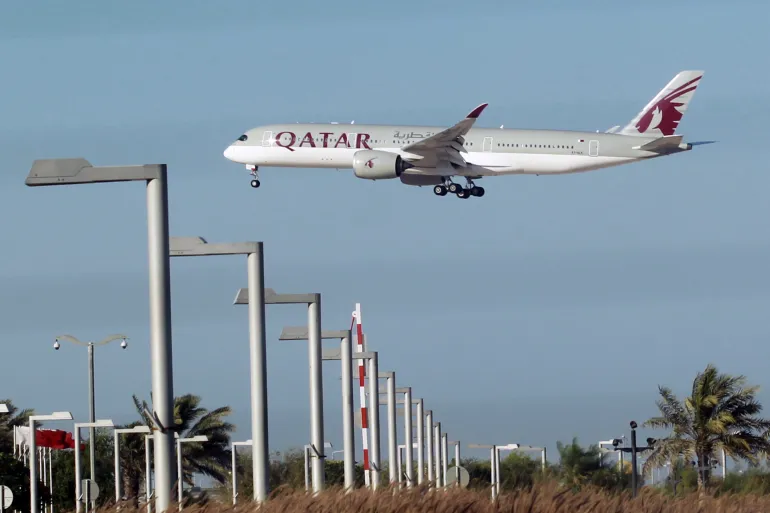
Qatar has partially reopened its airspace days after Iranian missile and drone strikes forced the country to ground all flights as a United States-Israeli military campaign against Iran continues into its seventh day.
The Qatar Civil Aviation Authority announced the limited opening on Friday evening, saying flights would operate through “designated navigational contingency routes with limited operational capacity” in coordination with the Qatari armed forces.
The move marks a cautious first step towards restoring air links to one of the Gulf’s most important aviation hubs but falls well short of a return to normality, with scheduled commercial flights to and from Doha remaining suspended until a further official announcement is made.
The Qatar Civil Aviation Authority said the partial reopening covers only a narrow category of flights “designated for passenger evacuation” and air cargo services.
Passengers with confirmed bookings were urged to follow updates from their airlines directly before travelling to the airport.
Early on Saturday, Qatar Airways said it “intends to operate repatriation flights on 07 March, departing Hamad International Airport to the following airports: London (LHR), Paris (CDG), Madrid (MAD), Rome (FCO), Frankfurt (FRA)”.
It added that priority would be given to “stranded passengers with families, elderly passengers, and those with urgent medical and compassionate travel needs”.
The Gulf country has been repeatedly struck by Iranian missiles and drones throughout the now seven-day conflict, forcing the country to activate its air force and use interceptors to defend its territory. Qatar’s Ministry of Defence confirmed the country had been struck by 14 ballistic missiles and four drones fired from Iran on Thursday.
More than 2,000 flights have been cancelled at Doha’s Hamad international airport since the conflict began.
Aviation across the Gulf
Across the Gulf, airports and airlines have been scrambling to manage the fallout from nearly a week of Iranian missile and drone barrages, launched in retaliation for the ongoing US-Israeli military campaign – codenamed Operation Epic Fury – which has killed at least 1,332 people in Iran since strikes began last Saturday, according to Iranian officials.
Emirates airline announced it is operating a reduced schedule while working to restore full network operations, carrying approximately 30,000 passengers out of Dubai on Friday alone.
By Saturday, the airline said it would have 106 daily return flights operating to 83 destinations, close to 60 percent of its full network, with a return to 100 percent expected “within the coming days, subject to airspace availability”.
Dubai international airport, the world’s busiest airport for international passengers, was evacuated on Sunday following Iranian strikes and has recorded close to 4,000 flight cancellations since Monday.
Abu Dhabi’s Zayed international airport has seen more than 1,000 cancellations and continues to operate at limited capacity.
Kuwait, also impacted by Iranian strikes, saw its airport undergo sustained physical damage in drone strikes, leaving some workers with minor injuries, and its airspace remains fully closed to commercial traffic.
Kuwait Airways has begun rerouting citizens with prior bookings through Jeddah, Saudi Arabia.
An estimated 23,000 flights have been cancelled since late February, according to analytics firm Cirium.
[Aljazeera]
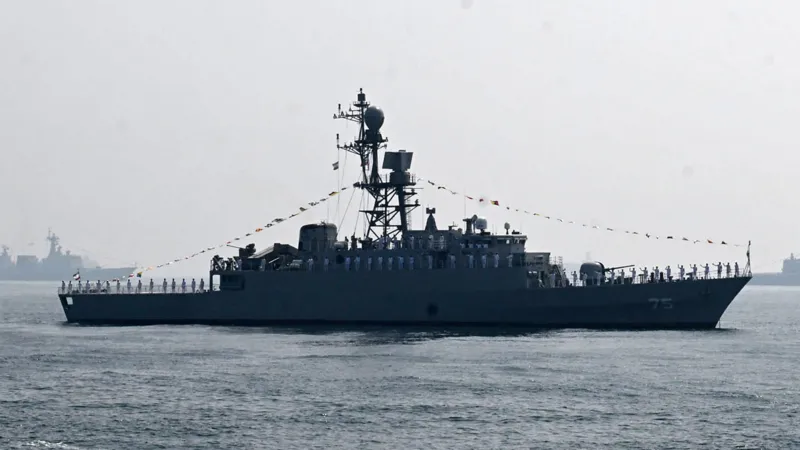
On 17 February, the Indian Navy posted a cheerful message on X.
“Welcome!” it wrote, greeting the Iranian warship Iris Dena as it steamed into the port of Visakhapatnam to join an international naval gathering.
Photographs showed sailors in crisp whites and a grey frigate gliding in the sea harbour on a clear day. The hashtags spoke of “Bridges of Friendship” and “United Through Oceans”.
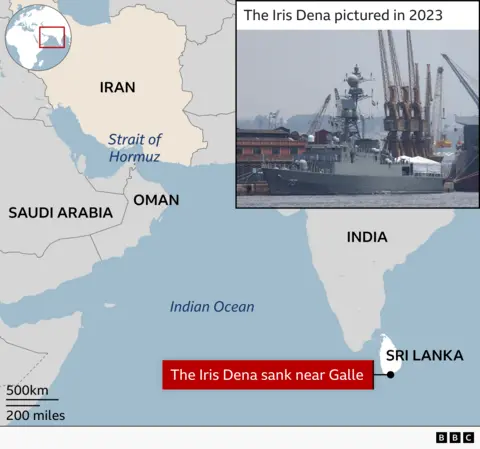
Two weeks later the ship, carrying 130 sailors, lay at the bottom of the Indian Ocean. It had been torpedoed by a US submarine off Sri Lanka’s southern coast on 4 March.
Commissioned in 2021, the Dena was a relatively new vessel – a Moudge-class frigate of Iran’s Southern Fleet, which patrols the Strait of Hormuz and the Gulf of Oman.
According to US Defence Secretary Pete Hegseth, the vessel “thought it was safe in international waters” but instead “died a quiet death”. Rescue teams from Sri Lanka have recovered at least 87 bodies. Only 32 sailors survived.
The sinking marks a dramatic widening of the war between America, Israel and Iran. And, though it occurred in international waters of the Indian Ocean and outside India’s jurisdiction, it is an awkward moment for Delhi.
“The war has come to our doorsteps. That is not a good thing,” says retired Vice Admiral Arun Kumar Singh.
For some strategists, the episode carries broader implications for India’s regional standing.
Indian strategic affairs expert Brahma Chellaney wrote on X that the US torpedoing of the Iranian warship in India’s “maritime neighbourhood” was “more than a battlefield episode” – calling it a “strategic embarrassment” for Delhi.
“By sinking a vessel returning from an Indian-hosted multilateral exercise, Washington effectively turned India’s maritime neighbourhood into a war zone, raising uncomfortable questions about India’s authority in its own backyard,” Chellaney wrote.
Just days before its destruction, the Dena had been a diplomatic guest of the Indian Navy.
The ship had travelled to Visakhapatnam, a sun-washed port city on India’s east coast, to participate in the International Fleet Review 2026 and Exercise Milan, a large multilateral naval exercise meant to showcase India’s growing maritime leadership.
Seventy-four countries and 18 warships took part in the events, which Delhi described as a demonstration of its ambition to become the Indian Ocean’s “preferedsecurity partner”.
Visiting ships at such multilateral exercises usually do not carry a full combat load of live munitions, unless scheduled for a live-fire drill, according to Chellaney. Even during the sea phase, when drills and live firing take place, ships carry only tightly controlled ammunition limited to the specific exercises.
Singh, an invitee to the event, recalls seeing the warship and its Iranian sailors in Visakhapatnam just days before its fate changed.
“I saw the boys marching in front of me,” he says of the Iranian naval contingent during the parade along the seafront, just 10m away. “All young people. I feel very sad.”
He says on 21 February, the assembled ships – including the Iranian vessel – sailed out for the sea phase of Exercise Milan, scheduled to run until 25 February.
“What happened next is less clear: the ship may have returned to port or peeled away after exercises. Either way, the waters where it was later sunk – off Galle in Sri Lanka – lie only two to three days’ sailing from India’s east coast,” Singh says. What the ship was doing in the 10-12 days in between is not clear.
Singh, who has commanded submarines, believes the sequence leading up to the attack was probably straightforward.
The US, he notes, tracks vessels across the world’s oceans. “They would have known exactly when the ship left and where it was heading,” he says. A fourth of America’s submarine fleet of 65-70 is at sea at any given time, according to analysts.
According to the Indian Navy, the Iranian warship had been operating about 20 nautical miles west of Galle – roughly 23 miles (37km) – in waters that fall under Sri Lanka’s designated search-and-rescue zone.
The attack, Singh says, appears to have involved a single Mark-48 torpedo, a heavyweight weapon carrying about 650 pounds of high explosive, capable of snapping a ship in two. Video footage suggests the submarine may have fired from 3-4km away, around 05:30 local time.
The aftermath was grim and swift.
The warship reportedly sank within two to three minutes, leaving little time for rescue. “It’s a miracle they managed to send an SOS,” Singh says, which was picked up by the Sri Lanka Maritime Rescue Coordination Centre in Colombo.
According to the Indian Navy, a distress call from the Iranian warship was picked up by Colombo in the early hours of 4 March, triggering a regional search-and-rescue effort.
The navy said in a statement that Sri Lanka’s navy began rescue operations first, while India moved to assist later.
The Indian Navy deployed a long-range maritime patrol aircraft to support the search and kept another aircraft with air-droppable life rafts on standby.
A naval vessel already operating nearby reached the area by late afternoon. Another ship, which sailed from the southern Indian port city of Kochi to join the effort, continues to comb the waters for survivors and debris.

Under the Second Geneva Convention, countries at war are required to take “all possible measures” to rescue wounded or shipwrecked sailors after a naval attack. In practice, however, this duty applies only if a rescue can be attempted without putting the attacking vessel in serious danger.
Singh says submarines are rarely able to help.
“Submarines don’t surface,” he says. “If you surface and give up your position, someone else can sink you.”
Singh suspects the speed of the sinking – and possibly sparse shipping in the area at the time – meant few nearby vessels could respond. “A ship breaking up that fast leaves almost no chance,” he says.
In a shooting war, Singh says, the legal position is blunt.
Fighting between the United States and Iran had been under way since 28 February, with claims that 17 Iranian naval vessels had already been destroyed.
“When a shooting war is on, any ship of a belligerent country becomes fair game,” he says.
Many questions remain. Why was the Iranian warship still in waters near Sri Lanka nearly two weeks after leaving India’s naval exercise? Was it heading home, or on another mission? And how long had the US submarine been tracking it before firing?
For Delhi, the episode is diplomatically awkward.
India has drawn closer to Washington on defence while maintaining long-standing political and economic ties with Tehran – a balancing act the war has made harder.
Indian Prime Minister Narendra Modi has called broadly for “dialogue and diplomacy” to resolve conflicts, but has neither addressed the sinking of the Iranian vessel directly nor criticised the American strike.
Iran’s Foreign Minister Abbas Araghchi described the attack as “an atrocity at sea” and stressed that the frigate had been “a guest of India’s Navy”. Meanwhile Sri Lanka has taken control of another Iranian naval vessel off its coast after an engine failure forced it to seek port, a day after the US attack.
The episode has nonetheless sparked debate within India’s strategic community.
Kanwal Sibal, a veteran diplomat, argued that India’s responsibility may not be legal, but it is moral.
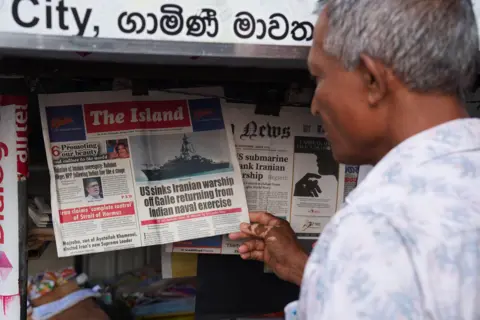
“The Iranian ship would not have been where it was had India not invited it to the Milan exercise,” he wrote on X. “A word of condolence at the loss of lives of those who were our invitees would be in order.”
Others like Chellaney have framed the issue in more strategic terms.
He described the strike as a blow to India’s maritime diplomacy. The torpedoing of the frigate in “India’s maritime backyard”, he argued, punctured Delhi’s carefully cultivated image as a “preferred security partner” in the Indian Ocean.
“In one torpedo strike, American hard power has punctured India’s carefully cultivated soft power,” says Chellaney.
As the debate gathered pace in strategic circles, India’s official response remained cautious.
External Affairs Minister S Jaishankar said on X that he had held a telephone conversation with Araghchi, and also posted a photograph of a meeting with Iran’s Deputy Foreign Minister Saeed Khatibzadeh at a foreign policy summit in Delhi.
For military historian Srinath Raghavan, the legal position is clear: once the Iranian vessel left India’s shores, Delhi had no formal responsibility.
The strategic message, however, is harder to ignore.
“First, the spreading geography of this war. Second, India’s limited ability to manage its fallout,” says Raghavan.
“Indeed, the US Navy has fired a shot across the bow aimed at all regional players, including India.”
[BBC]

An unprecedented wave of AI-generated misinformation about the US-Israel war with Iran is being monetized by online creators with growing access to generative AI technology, experts have told BBC Verify.
Our analysis has found numerous examples of AI-generated videos and fabricated satellite imagery being used to make false and misleading claims about the conflict which have collectively amassed hundreds of millions of views online.
“The scale is truly alarming and this war has made it impossible to ignore now,” says Timothy Graham, a digital media expert at the Queensland University of Technology.
“What used to require professional video production can now be done in minutes with AI tools. The barrier to creating convincing synthetic conflict footage has essentially collapsed,” he says.
The US and Israel began launching strikes on Iran on 28 February. In response, Iran has launched drone and missile attacks on Israel, as well as multiple Gulf nations and US military assets in the region.
Many have turned to social media to search for and share the latest information and to help make sense of a fast-moving week of conflict.
The platform X announced this week it will temporarily suspend creators from its monetization programme if they post AI-generated videos of armed conflict without a label.
The scheme rewards eligible users whose posts create large numbers of views, likes, shares and comments with payments from the platform.
“It’s a notable signal that they’ve noticed that this is a big problem,” says Mahsa Alimardani, a researcher specialising in Iran at the Oxford Internet Institute.
We asked TikTok and Meta, the company of Facebook and Instagram, if they intend to take similar action, but they did not respond to our requests for comment.
A typical example of an AI-generated video that BBC Verify has tracked appears to show missiles striking the city of Tel Aviv in Israel as the sound of explosions rings out in the background.

This video has been featured in more than 300 posts which have then been shared tens of thousands of times across social media platforms.
Some X users turned to the platform’s AI chatbot Grok to confirm the video’s veracity. But in many cases seen by BBC Verify, Grok wrongly insisted that the AI-generated video was real.
Another fake video, viewed tens of millions of times, claims to show Dubai’s Burj Khalifa skyscraper in flames, while a crowd of people seem to be running towards the building.
This AI-generated footage spread widely online at a time of considerable concern from residents and tourists about the drone and missile strikes on the city.
“Fake videos like these have a detrimental impact on people’s trust in the verified information they see online and make it much harder to document real evidence,” says Alimardani.

A new feature of this conflict analysed by BBC Verify is the emergence of AI-generated satellite imagery.
We verified multiple real videos showing Iranian drone and missile strikes on the US Navy’s Fifth Fleet headquarters in Bahrain on the first day of the conflict.
A fabricated photo, shared on X by the state-linked newspaper The Tehran Times, began to spread the following day and claimed to show extensive damage to the base.
The fake appears to be based on real satellite imagery of a US naval base in Bahrain taken in February 2025, which is publicly available online.
According to Google’s SynthID watermark detector, the fake image was generated or edited with a Google AI tool.
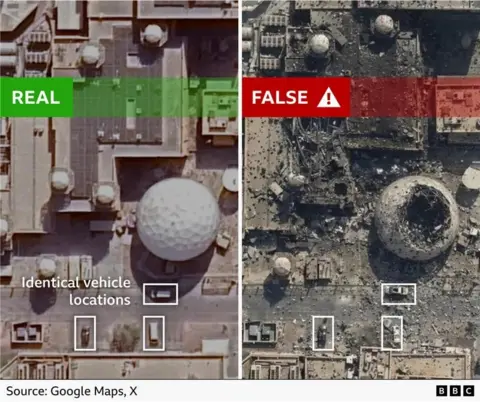
Three vehicles parked outside are also in the exact same spot in both the genuine satellite imagery and the AI picture – despite the photos allegedly having been taken a year apart.
Google’s AI tools, including its video generator Veo, are on the growing list of popular AI platforms, like OpenAI’s Sora model, Chinese AI app Seedance, and Grok which is built into X.
“The number of different tools that are now available to create a wide range of highly realistic AI manipulations is unprecedented,” says Henry Ajder, a generative AI expert.
“We have never seen these tools so available, so easy and so cheap to use,” he says.
This has led to a surge of AI-generated content online “because the pipeline onto social media can now be almost fully automated,” says Victoire Rio, executive director of the technology policy non-profit What To Fix.

X’s head of product said on Tuesday that “99%” of the accounts spreading AI-generated videos like these were trying to “game monetization” by posting content that will generate large amounts of engagement in return for payment through the app’s Creator Revenue Sharing programme.
The platform does not publish how many accounts are part of the programme, or how much money they can make.
But Graham estimates that X could pay about “eight to 12 dollars per million verified user impressions”.
“Creators have to hit five million organic impressions in three months, plus hold an X premium subscription, to be eligible,” he added.
“Once you’re in, viral AI-generated content is basically a money printer,” he says. “They’ve built the ultimate misinformation enterprise.”
X did not respond to our request for comment or our questions about the Creator Revenue Sharing programme.
Experts have told BBC Verify that while many social media companies say they are trying to change their moderation and detection systems to address the scale and speed at which AI-generated content spreads, there is no simple solution to the problem.
“The deeper issue is that engagement-driven monetisation and accurate information are fundamentally in tension, and no platform has fully resolved that tension or perhaps ever will,” says Graham.
[BBC]

Qatar partially reopens airspace as Iranian strikes continue to hit Gulf

The final voyage of the Iranian warship sunk by the US

AI-generated Iran war videos surge as creators use new tech to cash in

Huge explosions rock major Tehran airport as Israel strikes ‘regime infrastructure’

India hit back but Sutherland, Hamilton impress to give Australia the edge

Heat Index at ‘Caution Level’ in the Sabaragamuwa province and, Colombo, Gampaha, Kurunegala, Anuradhapura, Vavuniya, Hambanthota and Monaragala districts

‘Dates have the highest sugar content to fight Coronavirus’

Sunday Island 27 December – Headlines

#SundayIsland 17th December – Headlines

Sunday Island – 28th March

Sunday Island Headlines – 21 March

Sunday Island – 21st February – Headlines
-

 Features6 days ago
Brilliant Navy officer no more
-

 Opinion6 days ago
Sri Lanka – world’s worst facilities for cricket fans
-

 News2 days ago
University of Wolverhampton confirms Ranil was officially invited
-

 News3 days ago
Legal experts decry move to demolish STC dining hall
-

 Features6 days ago
A life in colour and song: Rajika Gamage’s new bird guide captures Sri Lanka’s avian soul
-

 Business3 days ago
Cabinet nod for the removal of Cess tax imposed on imported good
-

 Features7 days ago
Overseas visits to drum up foreign assistance for Sri Lanka
-

 Features7 days ago
Sri Lanka to Host First-Ever World Congress on Snakes in Landmark Scientific Milestone