
2023-02-21





A meeting between Prime Minister Dr. Harini Amarasuriya and officials of the Asian Development Bank (ADB) was held on 2nd of March at the Ministry of Education to discuss the Human Resource Development for Education Project (HRDEP).
Discussions focused on enhancing the quality and relevance of senior secondary education, strengthening the quality of the educator workforce, and improving a plan for education sector management.
The Prime Minister emphasized the need for strengthened technical capacity and skilled human resources in the process of digitalizing the education sector. The Prime Minister highlighted the Government’s focus on comprehensive system development, noting that the ultimate goal is to build strong human capital capable of leading the country forward in all spheres of national development.
ADB officials reaffirmed their commitment to supporting the Government’s ongoing education reform process. They expressed readiness to provide technical expertise and to extend support through international financing facilities to advance sectoral reforms.
The meeting was attended by the officials and technical experts of ADB and Secretary to the Ministry of Education Nalaka Kaluwewa.
[Prime Minister’s Media division]
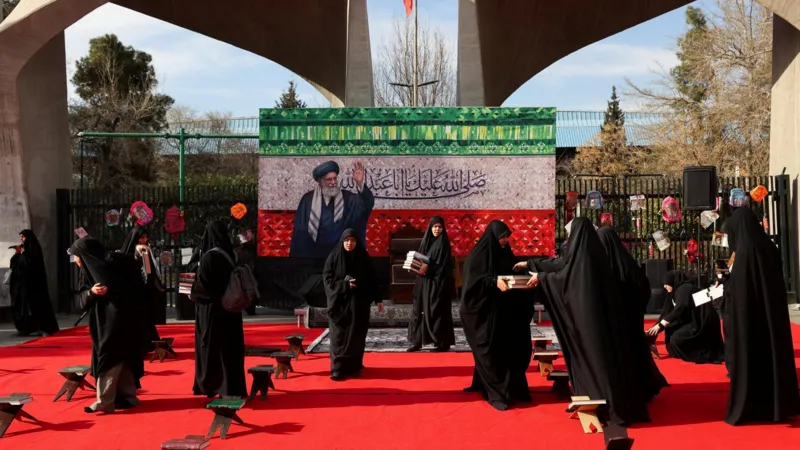
Authorities in Iran have postponed the funeral ceremony for the late Supreme Leader, Ayatollah Ali Khamenei, as US and Israeli forces continue intense strikes across the country.
An official said there had been many requests from people wanting to attend the three-day event at a Tehran prayer complex and that infrastructure needed to be prepared. It had been due to begin on Wednesday night.
A member of the Assembly of Experts meanwhile said the clerical body was “close” to choosing a successor to Khamenei, who was killed in a strike at the start of the US and Israeli assault on Saturday.
Iran has responded by launching missiles and drones at Israel and Gulf states with US bases.
Kuwait’s health ministry said overnight that a girl had been killed by shrapnel that fell on a residential area during an Iranian attack.
Meanwhile, US Secretary of Defence Pete Hegseth said a US submarine sank anIranian navy frigate in the Indian Ocean off the coast of Sri Lanka.
“The warship thought it was safe in international waters. Instead, it was sunk by a torpedo. Quiet death,” he told reporters.
Sri Lanka’s Defence Secretary Air Vice Marshal Sampath Thuyyakontha said the bodies of 80 people on board the Iris Dena had been recovered.
Another 32 people have been rescued, while dozens more are missing.
Hegseth also said that US and Israeli forces would have total aerial superiority over Iran within days and would “soon” control the country.
“This was never meant to be a fair fight, and it is not a fair fight. We are punching them while they’re down,” he declared.
The secretary of Iran’s Supreme National Security Council, Ali Larijani, said US President Donald Trump had “dragged the American people into an unjust war”.
Khamenei – who was Iran’s spiritual leader and its highest authority – was killed at his compound in Tehran in the first wave of US and Israeli strikes, along with his wife, one of their adult sons, and several top officials.
The three-day funeral ceremony for the 86-year-old cleric had been due to start at 22:00 local time (18:30 GMT) on Wednesday, with mourners invited to pay their respects as he lay in state at the capital’s Grand Mosalla prayer complex.
But on Wednesday morning, the head of the Islamic Propaganda Co-ordination Council of Tehran province told the hardline Tasnim news agency that it had been decided to postpone the ceremony until “a more appropriate time”.
Seyyed Mohsen Mahmoudi said this was because of “the high volume of requests to attend this ceremony and the need to provide appropriate facilities to host the people”.
Following Khamenei’s assassination, state media showed crowds of the Islamic Republic’s supporters protesting in Tehran against the US and Israeli attacks. But social media videos also showed opponents celebrating on the streets in the capital and other cities.
Khamenei became supreme leader in 1989 after the death of the Islamic Republic’s founding father, Ayatollah Ruhollah Khomeini. He maintained a firm grip on Iran’s politics and its armed forces, and suppressed challenges to the ruling system, sometimes violently.
Many people called for his overthrow or his death during nationwide protests in late December and early January. Security forces under his command crushed the uprising with unprecedented force, killing at least 6,480 people, according to human rights groups.
Iran’s new supreme leader is supposed to be chosen by the Assembly of Experts. The clerical body’s 88 members are elected by Iranians every eight years, but Khamenei ensured they were conservatives who would follow his guidance on picking a successor.
One member, Ayatollah Ahmad Khatami, told state TV that the candidates had already been identified but did not name them.
“The supreme leader will be identified in the closest opportunity, we are close to a conclusion. However, the situation in the country is a war situation,” he said.
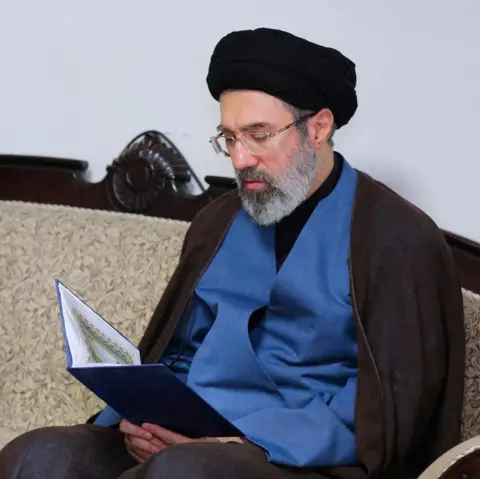
Two Iranian sources told news agency Reuters that another of Khamenei’s sons, Mojtaba, was considered the front-runner to succeed him.
Mojtaba, a 56-year-old cleric, is a shadowy figure said to have amassed significant power and wealth under his father’s rule. He is close to conservatives and the powerful Islamic Revolutionary Guard Corps (IRGC), which is tasked with defending the country’s Islamic system.
Israel’s defence minister said any successor who continued to threaten Israel and the US would be “an unequivocal target for elimination”.
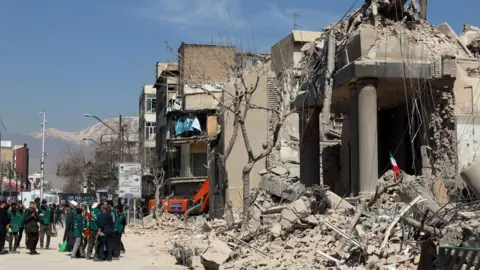
The Israel Defense Forces (IDF) meanwhile announced that its had carried out several waves of strikes across Iran on Wednesday.
A military official said more than 100 Israeli fighter jets had dropped about 250 munitions on a military compound containing multiple command centres in eastern Tehran.
The IDF also said it had struck ballistic missile arrays and air defence systems, as well as a missile storage and production facility, and “defence and detection systems” at Tehran’s Mehrabad airport.
It added that an Israeli F-35 fighter jet shot down an Iranian Yak-130 over Tehran, describing it as “the first shoot down in history of a manned fighter aircraft by an F-35”.
There was no immediate comment from Iranian authorities.
On Tuesday night, the head of the US military’s Central Command, Adm Brad Cooper, said the US-Israeli campaign was “ahead of our game plan”.
“In simple terms, we’re focused on shooting things that can shoot us,” he added.
Iran’s state news agency Irna reported on Wednesday that US and Israeli strikes had killed 1,045 military personnel and civilians since the start of the conflict.
It was not immediately possible to verify the figures, but the US-based Human Rights Activists News Agency (HRNA) said overnight that the number of reported civilian deaths had reached 1,097, including 181 children under the age of 10.
Iran’s armed forces have responded to the strikes by launching hundreds of missiles and drones at Israel and neighbouring Arab states that host US military installations.
Iranian President Masoud Pezeshkian told neighbouring states that the US-Israeli attack had “left us no choice but to defend ourselves” after diplomacy had failed.
“We respect your sovereignty and believe the region’s security and stability has to be achieved through the collective efforts of its states.”
It came after Qatar’s Prime Minister, Sheikh Mohammed bin Abdul Rahman Al Thani, told Iranian Foreign Minister Abbas Araghchi in a phone call that Iran was seeking to harm its neighbours and draw them into a war “that is not theirs”, according to the Qatari government.
Thani also “categorically rejected” Araghchi’s assertion that the missiles were directed solely at US interests, citing the strikes on civilian infrastructure and residential areas.
Early on Wednesday, Kuwait’s health ministry said an 11-year-old girl, who was a resident of the country, had died after being hit by falling shrapnel.
Nine other people – six US service personnel, two Kuwaiti army soldiers, and one other civilian – have been killed in Kuwait since the start of the conflict.
Authorities in Saudi Arabia said there had been an attempted drone attack on its largest oil refinery, Ras Tanura, on the Gulf coast. No damage or disruption had been reported, it added.
On Monday, the refinery was forced to halt some operations after a drone attack caused a fire.
Turkey’s defence ministry also said an Iranian missile heading towards its airspace had been intercepted by Nato air and missile defence systems in the Eastern Mediterranean.
And in Qatar, the State Security Service announced the arrest of 10 members of two cells allegedly linked to the IRGC, which it said had been tasked with spying on infrastructure and carrying out “sabotage operations”.
The IDF also said its defence systems had operated to intercept more salvos of Iranian missiles. There were no immediate reports of any casualties.
A total of 10 people have been killed in missile strikes in Israel over the past five days.
[BBC]
On Saturday, New Zealand had nervously tuned into Sri Lanka vs Pakistan, wondering if they could sneak into the semi-final. Matt Henry was on the way back home from Colombo for the birth of his second child. New Zealand’s build-up to the semi-final was just as uncertain as they waited anxiously for their bowling spearhead to return. On Wednesday, their performance in the semi-final was anything but uncertain as they KO’d South Africa, who were unbeaten until this game, and launched New Zealand into their second men’s T20 World Cup final.
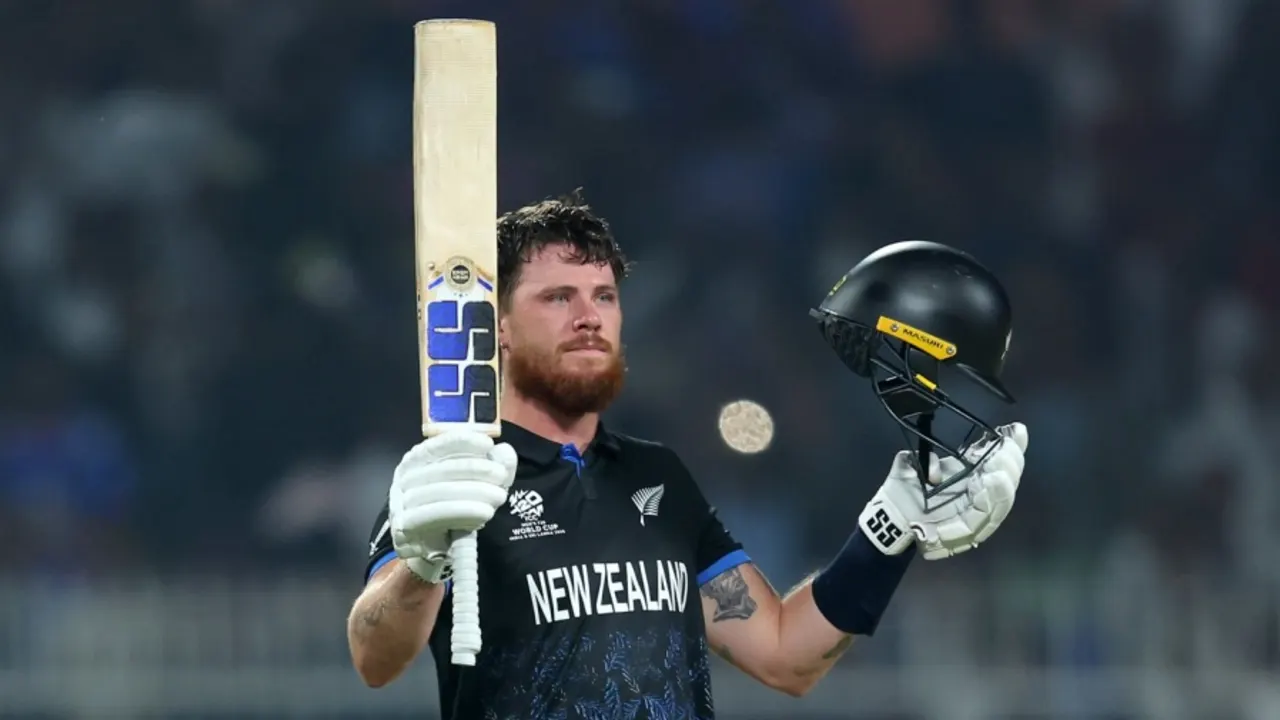
After their attack welcomed Henry back and limited South Africa to 169 for 8 on a slower-than-usual Eden Gardens track, Finn Allen took centerstage and crashed a 33-ball century, the fastest ever in a men’s T20 World Cup, to make a mockery of the chase. Just as Allen was soaking in his sensational century in the middle, Tim Seifert, the other half of New Zealand’s Bash Brothers, pumped his fist in the dugout. New Zealand completed the demolition job with nine wickets and just more than seven overs to spare.
Mitchell Santner handed the new ball to offspin-bowling allrounder Cole McConchie in the second over, and he aced his match-up, taking out the left-handed pair of Quinton de Kock and Ryan Rickelton in the only over he bowled.
De Kock threw the first punch at McConchie when he swiped him over mid-on for four. McConchie then punched back next ball by darting one into the pitch and having de Kock pop a catch to mid-on for 10 off eight balls. It was the third time in five innings that de Kock was dismissed by an offspinner in this competition.
Rickelton, at No.3, had a crack at an offbreak next ball and ended up slicing a cut to short third for a golden duck. Brevis then avoided the hat-trick, but McConchie, the 18th player included in New Zealand’s T20 World Cup squad, had done his job.
With the two left-handers gone and the powerplay done, Santner introduced himself into the attack and conceded just three runs off the seventh over. The New Zealand captain helped offset the damage caused by a 17-run powerplay over from Jimmy Neesham, who had replaced legspinner Ish Sodhi.
Rachin Ravindra then struck in his first over, tossing up one at Aiden Markram’s stumps and having him caught at long-on for 18 off 20 balls. Daryl Mitchell charged in from long-on, dived forward and plucked it inches from the ground. Replays suggested it was touch-and-go, but Nitin Menon, the TV umpire, eventually ruled it as a clean catch.
After dropping Markram on 3 at midwicket, Ravindra enjoyed redemption with the ball.
Against the left-handed David Miller, Ravindra hiked his pace and aimed to hide the ball away from his swinging arc. Ravindra could have had Miller on 3 but Glenn Phillips, believe it or not, dropped a catch in the outfield. Miller added three to his tally before chipping Ravindra to Mitchell at long-off for a regulation catch. Ravindra finished with 2 for 29 in his four overs, extending his own tournament tally to 11. Among spinners, only Varun Chakravarthy, the No.1-ranked T20I bowler, has more wickets than him in this T20 World Cup.
Dewald Brevis flickered briefly for 34 off 27 balls before he was undone by the slowness of the Eden pitch. He jabbed at a drive early and ended up spooning Neesham to Santner at cover. South Africa were 77 for 5 at that point.
Marco Jansen then combined with Tristan Stubbs for a 73-run partnership for the sixth wicket – a new record for South Africa in men’s T20Is. Despite the clatter of wickets, Jansen showed his power and composure. After charging at Ravindra, his former team-mate at Washington Freedom in the MLC, and lofting him for six, Jansen lined Henry up for a no-look six over wide long-on.
He reached his half-century off 27 balls, with a six off Neesham, and finished with his T20I career best of 55 off 30 balls, including two fours and five sixes. Lockie Ferguson snapped the stand in the 19th over when he castled Stubbs for 29 off 24 balls with a nifty legcutter from around the wicket. Henry then closed out the innings with a six-run over, which also included the wickets of Corbin Bosch and Kagiso Rabada. Jansen’s half-century, though, gave South Africa’s attack something to bowl at.
That something soon turned into next to nothing once Allen took off in the chase as the dew set in at Eden Gardens. Allen faced 33 balls and sent 18 of those to or over the boundary. Rabada tried his legcutter, Lungi Ngidi dipped into his slower dipper, Jansen tried to bang it away on a hard length and Bosch offered pace, but nothing worked against Allen.
After reaching his fifty off 19 balls, Allen stormed to his ton off 33 balls. Allen shattered Chris Gayle’s previous T20 World Cup record of a 47-ball hundred against England in 2016.
It was Seifert who had made the early running, contributing 41 of the 62 New Zealand had scored in the first five overs of their chase. In the final over of the powerplay, Allen carted Bosch for a sequence of 6,4,4,4,4 as New Zealand finished with 84 for 0. It was the second-highest powerplay score in this T20 World Cup and the highest powerplay score across all knockout games in the T20 World Cup.
From thereon, it was all about Allen and his brute power. If this was a bat-off for an IPL opening spot at Kolkata Knight Riders (KKR), Allen won it emphatically. South Africa found some respite when Rabada removed Seifert for 58, but Allen finished it off in grand style at Eden Gardens, in the company of Ravindra, another Knight Rider.
Brief scores:
New Zealand 173 for 1 in 12.5 overs (Finn Allen 100*, Tim Seifert 58, Rachin Ravindra 13*; Kagiso Rabada 1-28) beat South Africa 169 for 8 in 20 overs (Aiden Markram 18, Quinton de Kock 10, Marco Jansen 55*, Dewald Brevis 34, Tristan Stubbs 29; Matt Henry 2-34, Cole McConchie 2-09, Lockie Ferguson 1-29, James Neesham 1-42, Rachin Ravindra 2-29) by nine wickets
[Cricinfo]

PM, ADB officials discuss strengthening education reforms

Iran postpones Khamenei funeral as US-Israeli bombardment continues

Flying Finn launches New Zealand into the final with record ton

Cabinet nod to accept Japanese government grant of 08 used low floorboard buses

Payment of the financial subsidy for fertilizer to farmers cultivating paddy lands for the Yala season 2026.

Ministerial Committee appointed to submit recommendations on proposed program to mitigate loss of crops to wild animals

‘Dates have the highest sugar content to fight Coronavirus’

Sunday Island 27 December – Headlines

#SundayIsland 17th December – Headlines

Sunday Island – 28th March

Sunday Island Headlines – 21 March

Sunday Island – 21st February – Headlines
-
 Features3 days ago
Brilliant Navy officer no more
-

 Opinion6 days ago
Jamming and re-setting the world: What is the role of Donald Trump?
-
 Features6 days ago
An innocent bystander or a passive onlooker?
-
 Features7 days ago
Ratmalana Airport: The Truth, The Whole Truth, And Nothing But The Truth
-
 Opinion3 days ago
Sri Lanka – world’s worst facilities for cricket fans
-
 Business7 days ago
IRCSL transforms Sri Lanka’s insurance industry with first-ever Centralized Insurance Data Repository
-

 Business6 days ago
An efficacious strategy to boost exports of Sri Lanka in medium term
-
 Features4 days ago
Overseas visits to drum up foreign assistance for Sri Lanka