
Sports
Calcutta; the city of joy

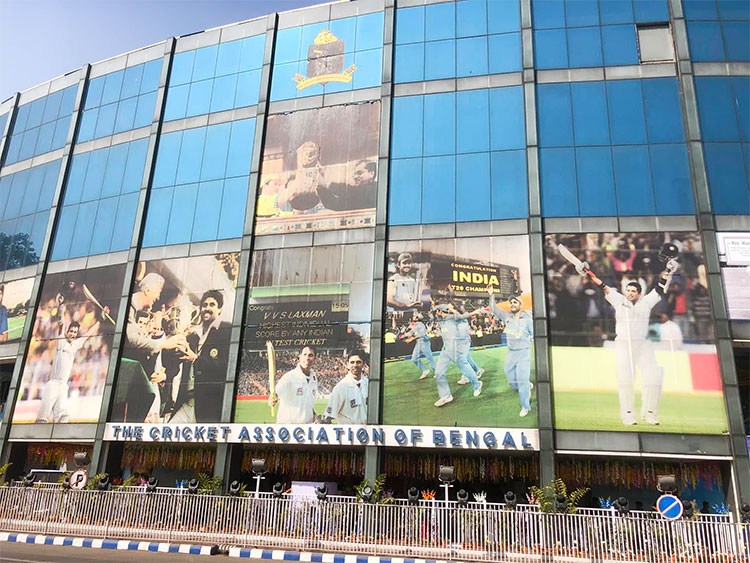
Rex Clementine in Calcutta
Calcutta used to be the capital of India until King George V proclaimed the transfer of the capital to Delhi in 1911. Known as the City of Joy, it’s a pleasant experience to be here during Deepavali time with the streets nicely decorated. This is where the World Cup semi-final between South Africa and Australia take place today (Thursday).
Calcutta’s airport is named after Subash Chandra Bose, one of India’s prominent freedom fighters. While Mahatma Gandhi was all about nonviolence, Bose was a complete contrast. He believed in a militant approach to freedom from the British. He also endorsed socialist political values unlike his Cambridge colleague and first Prime Minister of India Jawaharlal Nehru, who endorsed democratic values.
As for cricket, we have long admired the Prince of Calcutta – Sourav Ganguly. As captain, Ganguly got under the skin of the opposition and skippered India to many memorable wins both at home and away. The Prince of Calcutta was coined to him by Geoffrey Boycott. By the time Ganguly had become the captain of the Indian team people started telling Boycott that he better call him now the ‘King of Calcutta’. This Boycott refused and explained why, ‘For me, there is only one King of Calcutta – Jagmohan Dalmiya.’
Mr. Dalmiya was a business tycoon and was the first Asian President of the ICC. He faced many challenges as the President of the governing body and taught people a few lessons most notably taking the ICC away from Lord’s to Dubai.
Mr. Dalmiya was also a dear friend of Sri Lanka. During the 1996 World Cup, with Australia and West Indies refusing to play their World Cup games in Colombo, he played a pivotal role in putting up a joint India – Pakistan team to come and play a game in Colombo to prove the country was safe to play cricket.
Mr. Dalmiya was a practical man. The joint India – Pakistan team had the captains of both countries – Mohammad Azharuddin and Wasim Akram. It was impossible for Wasim to play under Azhar or vice-versa as fans of the two countries wouldn’t have endorsed it.
So, Mr. Dalmiya called up former Pakistan captain Inthikab Alam and made him the Manger of that team. Then, he told Inthikab now that a Pakistani is the Manager of the team it is unfair if the captaincy also went to Pakistan and it was up to him to convince Wasim to play under Azhar.
Then there was another problem. Wills the tournament’s sponsors had a deal that no cricket should be played two weeks prior to the tournament or after the tournament. This game a mere couple of days before the World Cup got underway contravened the agreement. Mr. Dalmiya then called up the sponsors and said, ‘Never again you are going to see a joint India – Pakistan team playing. In fact, you should pay me for putting your logo in the players’ jersey. So, just shut up and play.’
Mr. Dalmiya was an outstanding administrator. He had just finished his term as ICC boss ahead of the 2003 World Cup in South Africa. England had just launched T-20 cricket in a bid to address the dwindling spectator turnouts in England.
The British press asked Mr. Dalmiya whether others should follow suit by embracing the T-20 format. “Why should we embrace T-20 cricket. In my home town in Calcutta, when Eden Garden hosts a Test match, there are 100,000 spectators inside the ground and 20,000 people outside the ground trying to get in,” he said.
Eden Garden of course is a cricket ground with full of history. Not so long ago, the venue could host some 100,000 fans. But after renovations, some of the temporary stands are gone and now the capacity is reduced to 65,000.
The venue hosted India’s second Test match way back in 1934. Virtually, it is India’s oldest active cricket ground as Bombay Gymkhana where the first ever Test was played has ceased to exist.
Eden Gardens hosted the final of the 1987 World Cup and the semi-finals of the 1996 World Cup where Sri Lanka famously knocked out the hosts and people reacted angrily.
The blinder that Aravinda de Silva played here is fondly remembered. He raced to a half-century on a tough wicket and set up the game for Sri Lanka.
In 2017, when Sri Lanka played a Test match at Eden Gardens, you thought that you had seen another player with a bright future in Niroshan Dickwella. The wicketkeeper not only got under Indian captain Virat Kohli’s skin, but earned much plaudits for his game awareness as India placed three fielders behind square and he happily hooked and pulled knowing too well that he cannot be out and just in time brought the error to the attention of the umpires who no balled Mohammad Shami.
Shami, the local boy, then got into an altercation with Dickwella. It was clever time wasting tactics by the rookie as Sri Lanka were struggling to save the Test.
In the end, the game ended in a draw and Kohli predicted a bright future for DIckwella. Six years on, Dickwella is not even in the reckoning these days with his off the field excesses getting him into trouble. Not scoring a hundred after 54 Tests made the selectors to say enough is enough.
That exactly has been the problem with Sri Lankan cricket. So many players emerge promising so many things but they lose track once they establish themselves in the side buying into a team culture that is far from ideal. You desperately hope that someone like Sadeera Samarawickrama doesn’t go the same route.
Calcutta is also the city where Mother Theresa, now a saint of the Catholic Church started her charitable mission. She went in search of the slum dwellers providing them medical care and the Missionaries of Charity that she established in Calcutta is now spread across the world. Many cricketers support the charity and Steve Waugh is a frequent visitor here.
“I know God will not give me anything I can’t handle. I just wish that He didn’t trust me so much,” is one of her famous quotes.


by Reemus Fernando
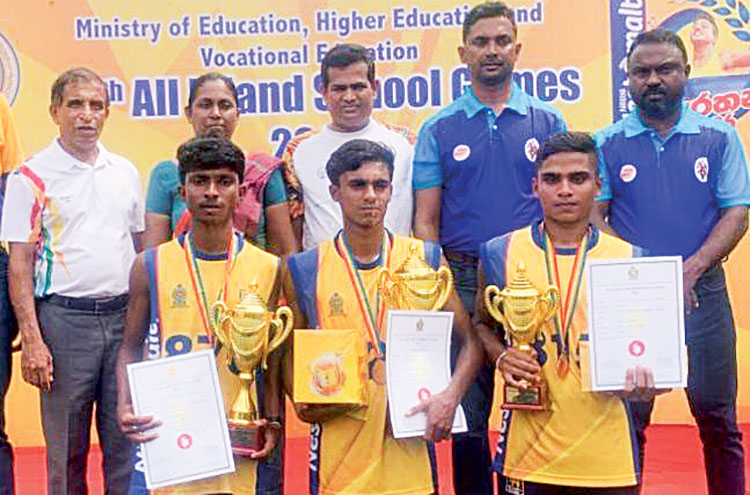
Supun Chathura of Welimada Central and Tharindi Chamalka of Nuwara Eliya High School claimed the boys’ and girls’ titles at the All-Island Schools Games Half Marathon, held in Colombo on Sunday.
Chathura won the boys’ race in a notable 1:14.51. Sameesha Nimsath of St. Pope Paul the Sixth MV, Gampaha, took second in 1:16.40, while Suranga Lal Kumara of Pussadewa Secondary School, Batagolla, clinched third in 1:16.42.
In the girls’ category, Chamalka won in 1:28.56. D.M.S. Nimsarani of CWW Kannangara MMV, Matugama (1:31.09), and W.S.C. Priyadharshani of President’s College, Ambagasdowa (1:33.10), finished second and third respectively.
The 21.0975-kilometre race, sponsored by Nestomalt, started at the Ministry of Education in Battaramulla. It passed through Polduwa Junction, Parliament Road, Ape Gama Junction, Kimbulawala Junction, Thalawathugoda, Hokandara Junction, Arangala Junction, Koswatta and Battaramulla Palanthuna Junction before returning to the starting point.
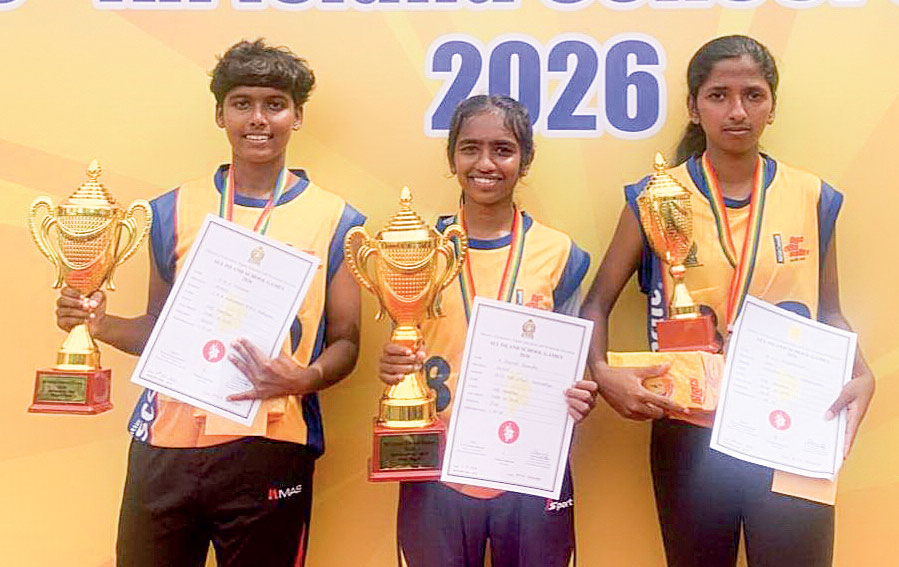
Girls winners (from left)D.M.S. Nimsarani (2nd), Tharindi Chamalka (first) and W.S.C. Priyadharshani
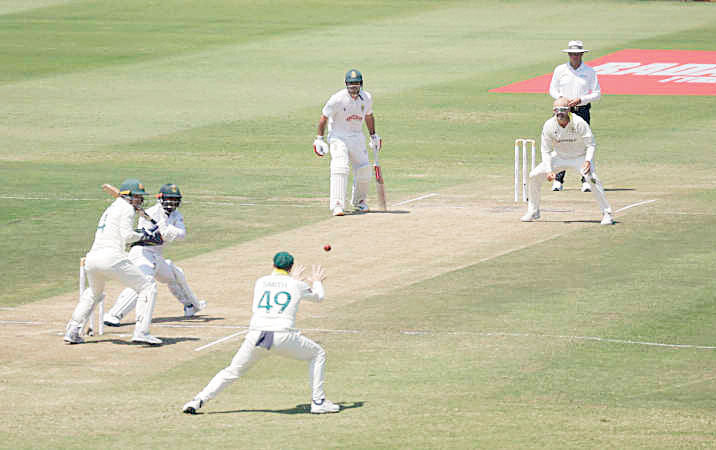
Pat Cummins outfoxed a lacklustre South Africa batting-order on a relatively benign Durban surface, while Steven Smith continued to showcase his mastery in the slips as Australia eyed a big first innings lead in the opening Test.
Outstanding bowling and fielding suffocated South Africa, who appeared set to be bowled out before tea on day three until a rearguard from Keshav Maharaj and Simon Harmer halted Australia’s push.
Cummins has been at his best, consistently challenging the batters as he regularly hit speeds of 140kph and above. He had 3-54 from 15 overs by tea, with all four frontline bowlers having taken wickets.
Smith backed up the bowlers by claiming three sublime catches, which lifted him past Joe Root for the most Test catches by a non-wicketkeeper.
With great anticipation, Smith moved into position to snare skipper Temba Bavuma, who had unfurled a reverse-sweep off Nathan Lyon. Smith then pulled off a stunning catch to dismiss David Bedingham, diving across first slip – it was No. 221 of his Test career.

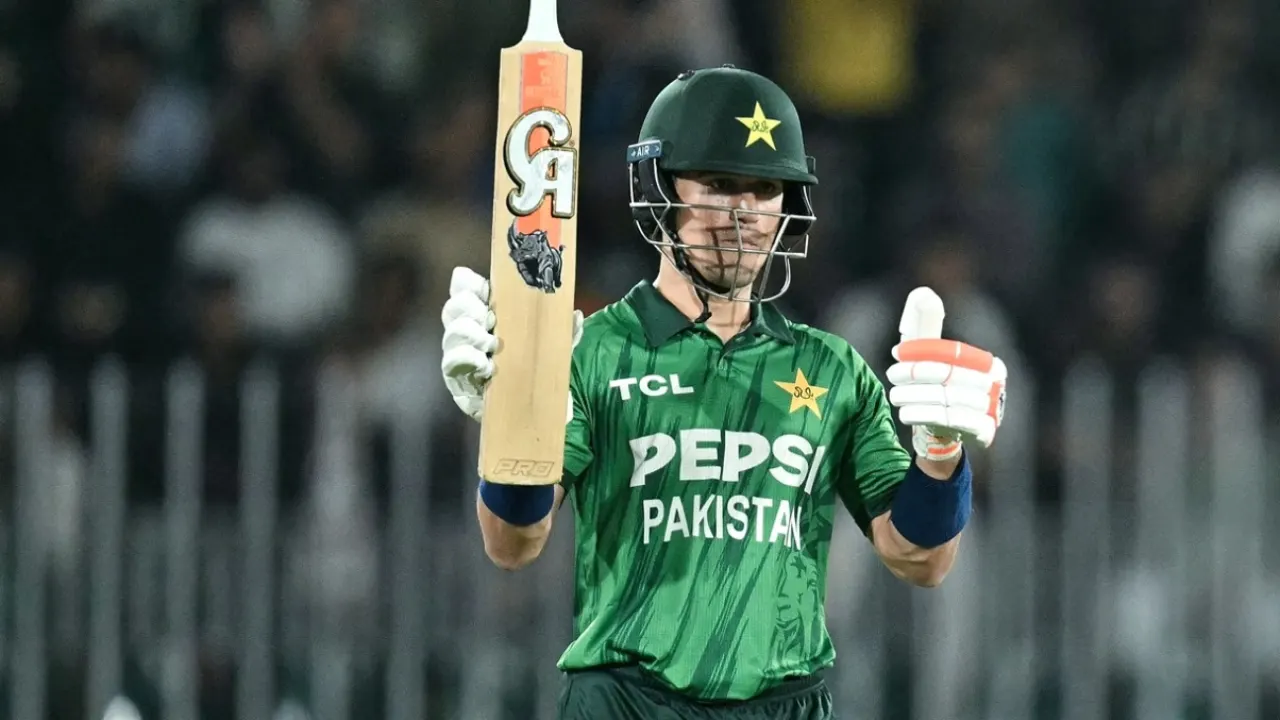
Maaz Sadaqat crashed 96 off 51,Sahibzada Farhan clobbered 73 off 44, and Pakistan scorched their way through the last 12 overs of their innings to mount a fearsome total of 215 for 3. Pakistan reaped 156 runs just in the last 12 overs of their innings, as a 73-run stand between Sadaqat and Farhan was followed by a manic 72-run partnership between Sadaqat and Hasan Nawaz.
Sri Lanka’s batting was woeful in response. They slumped to 64 for 5 by the 11th over, with none of their top seven managing to get to 30. They limped to 133 for 7, having had their hopes of leveling the series wrecked by quicks Mohammad Imran and Salman Mirza, who took five wickets between them.
Sadaqat propels Pakistan into the stratosphere
The openers had laid a decent platform with Pakistan having got to 55 for 1 by the end of the seventh over. But it was Sadaqat who injected the energy that truly set Pakistan on course to their mammoth total. Having gone at less than a run a ball in his first eight balls, Sadaqat unleashed a spectacular lofted square drive off Eshan Malinga to collect his first six, before pumping the same bowler down the ground later in the 10th over.
Sadaqat would go on to clobber six further sixes and five further fours. The big hits tended to come down the ground, while his fours were more square of the wicket. Of the 125 runs Pakistan plundered in the second half of their innings, 79 off 40 came from Sadaqat, who pummeled both pace and spin with equal relish. Off the sixteenth over, bowled by Maheesh Theekshana, Sadaqat thumped three sixes in the arc between long on and midwicket.
Sadaqat, whose previous top score in three T20Is had been 50, could have gone to triple figures off the last ball of the innings, but holed out to deep cover instead, unable to quite find the power to lift a Malinga slower ball over the ropes. He had utterly dominated the middle and late overs, however.
Farhan sets the tone
On another flat Rawalpindi deck, Farhan made the first big charge, although he waited until spin came on to really get into high gear. Theekshana was one of his main victims as well. Farhan’s first six came from a slog sweep off Theekshana in the seventh over, before he launched the same bowler over wide long on and cow corner off successive balls in the ninth over. Getting to his 12th T20I fifty off the 31st ball he faced, Farhan began to aim big blows off the seamers as well. He was caught at deep third off the bowling of Dasun Shanaka, in the 15th over.
Sri Lanka stumble in the powerplay
An excellent Salman Mirza bouncer took the glove of Lahiru Udara in the first over, ending the innings of one of Sri Lanka’s few form batters for a mere five runs. And although Sineth Jayawardena – playing his first international in a full-strength Sri Lanka side – hit three consecutive boundaries in the third over, Sri Lanka were unable to build up any momentum in the powerplay. By the end of the sixth over, they had laboured to 35 for 2.
Imran’s spell lights up the middle overs
A full house in Rawalpindi was treated to some excellent fast bowling by Imran, who finished with the game’s best figures of 3 for 11 from his four overs. Having got Jayawardena to top-edge a desperate pull shot at the end of his second over, Imran had Kusal Mendis caught behind off a slower delivery, before two balls later (a wide in between), he took Sahan Arachchige’s edge with a quick delivery angled across the left-hander. Wicketkeeper Khawaja Nafay made two diving grabs to convert these chances in the eighth over.
All through his unbroken spell, Sri Lanka’s batter struggled to so much as hit Imran off the square, despite the good batting conditions on offer. Imran mixed up his pace, frequently going to slower balls, but his line and length control were also excellent through the spell. When he finished his unbroken spell at the end of the 10th over, Sri Lanka’s required rate had climbed past 15.
Chamindu Wickramasinghe and Theekshana struck some late boundaries, but by the time they came to the crease, Sri Lanka did not have a realistic shot at levelling this series. They lost by 82 runs in the end.
Scores:
Pakistan 215 for 3 in 20 overs (Sahibzada Farhan 73, Fakhar Zaman 22, Maaz Sadaqat 96, Hasan Nawaz 19*; Maheesh Theekshana 1-55, Eshan Malinga 1-41,Dasun Shanaka 1-30) beat Sri Lanka 133 for 7 (Sineth Jayawardena 22, Kamnbdu Mendis 23, Chamindu Wickremasinghe 29, Maheesh Theekshana 32*; Salman Mirza 2=28, Mohammad Imran 3-11, Saim Ayub 1-19, Shadab Khan 1-19) by 82 runs
[Cricinfo]

Navy Commander attends Trans-Regional Seapower Symposium in Italy

Heavy showers about (100-150) mm are likely at some places in the Central, Sabaragamuwa, Uva and Southern provinces

Elephant enrichment programme centred on the Thabbowa Reservoir proves successful
Showers above 75 mm are likely at some places in the Western, Sabaragamuwa, Central, Southern, Uva and North-Western provinces and in Anuradhapura and Mannar districts.

New prison regulations for monks serving jail terms soon: President’s Office

CP alleges NPP has taken the blame for illegal US sanctions on Iranian vessels

‘Dates have the highest sugar content to fight Coronavirus’

Sunday Island 27 December – Headlines

#SundayIsland 17th December – Headlines

Sunday Island – 28th March

Sunday Island Headlines – 21 March

Sunday Island – 21st February – Headlines
-

 Features5 days ago
The Sri Lankan who made Scottish history
-

 Features7 days ago
Preventing grievances from becoming communal
-

 Sports5 days ago
Nissanka absence opens door for Sri Lanka’s young guns
-

 News6 days ago
Gnansara Thera to be assigned to prison printing section: Officials
-

 News4 days ago
NDB fraud Rs 60mn more than reported
-

 News4 days ago
Removing monk’s robes matter for Sangha to decide: Mahanayake Theras
-

 Features5 days ago
Future of Sri Lanka’s state university system: Should it be shut down and reopened?
-

 News6 days ago
OIC of FCID summoned before Maligakanda Magistrate