
Latest News
Bumrah to miss Oval Test against England; Akash Deep likely to replace him


Jasprit Bumrah will not play the fifth and final Test of the Anderson-Tendulkar Trophy at The Oval starting Thursday. ESPNcricinfo has learned that the BCCI medical team has told Bumrah that the decision is in line with safeguarding his back and keeping the long-term in mind.
The development is not entirely a surprise, considering the medical team in coordination with Bumrah, the Indian team management, and the selectors had decided he would play only three of the five Tests during the England tour. Bumrah played in the first Test at Headingley, sat out in the second Test at Edgbaston, which India won, and played in the following two Tests at Lord’s and last week at Old Trafford.
With Bumrah having not bowled since the fourth morning at Old Trafford, coupled with a three-day break between the final two Tests, India might have toyed with the idea of changing the original plan, especially with a possibility of levelling the series 2-2 with a win at The Oval.
However, a combination of a slowish, flat surface and the workload had impacted Bumrah’s pace in the fourth Test. He picked two wickets in 33 overs, which was the most he has bowled in an innings, and for the first time, his runs column had breached 100. As the series progressed, the number of balls he bowled above 140kph in the first innings of each Test also reduced from 42.7% at Headingley to 22.3% at Lord’s to 0.5% at Old Trafford.
Bumrah is currently the joint second highest wicket taker with 14 wickets in the series alongside Mohammed Siraj. After the draw in Manchester, India’s head coach Gautam Gambhir had said Bumrah was available for the final Test, but two days later, India have decided to rest him.
Who will replace Bumrah was evident at India’s optional training session on Tuesday. Akash Deep, who missed the fourth Test with a groin niggle, found his rhythm easily as he seamed the ball appreciably on the greenish practice pitches. In the second Test at Edgbaston, which was his first Test since Melbourne in December, Akash Deep picked up a ten-wicket match haul, including a career-best 6 for 99 in England’s second innings, extracting movement from a benign surface.
In the following Test at Lord’s, though, Akash struggled for consistency, especially bowling down the slope from the Pavilion End. He picked up just one wicket in the Test, but the seamer-friendly conditions at The Oval could help Akash get back in the saddle quickly.
Still, Gill and Gambhir will have to deal with finding the right balance in the bowling attack. That it is a challenge is primarily because of the below-par performances from three other fast bowlers who have featured so far in the series:Prasidh Krishna, Shardul Thakur and Anshul Kamboj. Prasidh has not played since the win in the second Test, while Thakur and Kamboj barely got to bowl after their first spells at Old Trafford.
In the absence of Bumrah, Siraj, the only fast bowler to play all the Tests, will once again lead the pace attack. Siraj has bowled the fourth-most overs among seamers this series – 139 – but hasn’t let his intensity down. India will be worried about his workload and fitness but they have little choice other than playing Siraj. Even then, India will have to make a call regarding the third seamer.
It is likely to be one of Prasidh and Arshdeep Singh, who bowled and batted without any discomfort, showing he had recovered completely from the freak injury he picked up on his bowling hand in the days leading to the fourth Test while trying to intercept a ball on follow-through.
With Risbah Pant ruled out of the Oval Test, Dhruv Jurel will keep wickets and bat in the middle order. Despite the boldness of his batting, which can turn eyes, Jurel’s inexperience, especially of playing in England, might tilt India to focus on retaining Thakur to provide the batting depth. That would mean there will be no room once again for Kuldeep Yadav.
India might also believe Kuldeep could be surplus to the requirement, especially keeping in mind the pitch and the cloudy conditions that are likely to play a role during the Test. Two days ahead of the match, the pitch had enough greenish patches, so India could continue with the spin pair of Ravindra Jadeja and Washington Sundar.
Apart from that, the bowling numbers at The Oval this domestic season are predominantly favourable to the seamers: fast bowlers have picked up 131 of the 150 wickets in five matches. Surrey have won twice at home with three draws, including the last round against Durham, where the fourth-highest score in county cricket was registered. Surrey made 820 for 9 declared on the back of Dom Sibley’s triple-hundred, but that match was played with Kookaburra balls as part of the ECB’s drive since last year to upgrade the bowlers’ skills.
[Cricinfo]

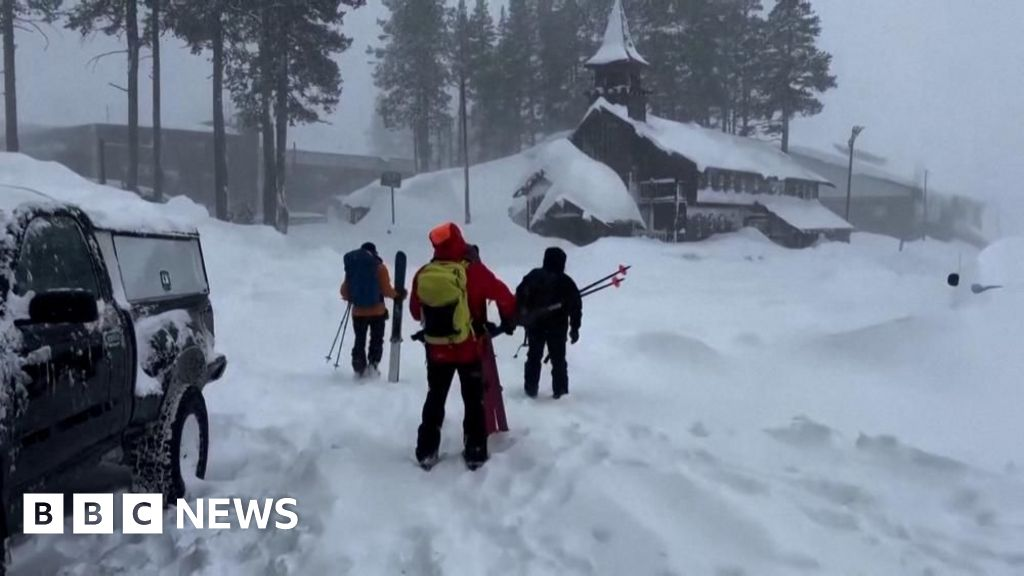
Rescue teams combing through the backcountry of California’s Lake Tahoe region say they have found the bodies of eight skiers who went missing in an avalanche on Tuesday.
The search for a final missing skier continues but that person is presumed dead, Nevada County Sheriff Shannan Moon said at a news conference on Wednesday.
Officials said one of the deceased was the spouse of someone on one of the search-and-rescue teams, making continued rescue efforts “challenging emotionally”.
Fifteen skiers were reported missing on Tuesday after a “football-field” sized avalanche came barreling down in the Castle Peak area around 11:30 PST (19:30 GMT). Six have been rescued.
“I want to offer my condolences to the family in this very trying time,” Placer County Sheriff Wayne Woo said on Wednesday.
The bodies of the eight dead skiers are still trapped in the snow and can’t yet be recovered due to “pretty horrific” conditions, officials said.
Since the avalanche, another 3ft (.9m) of snow has fallen on the area, Tahoe National Forest supervisor Chris Feutrier said.
“The hazard remains high,” he said.
Once the bodies are recovered, they will be transported to the Placer County morgue.
Families of the deceased have been notified. Authorities have not yet released any of their names.
Officials say the victims are seven women and two men.
Sheriff Woo said the rescue operation was a joint effort involving two teams and roughly 50 crew members who had to traverse “extreme weather conditions” using specialised equipment.
At 17:30 local time on Tuesday, search teams arrived to an area roughly two miles (3.2km) from where survivors were sheltering in make-shift tents, and had to ski in from there.
Two of the six survivors had to be carried back and “could not walk because of the injuries they sustained during the avalanche”, Sheriff Moon said. They were taken to hospital with non-life-threatening injuries.
Among the survivors, one was a guide and five were clients of the Blackbird Mountain guided tour.
The entire ski group consisted of a mix of 11 recreational skiers and four ski guides.
The avalanche on Tuesday occurred as they were making their way back at the end of a three-day trip.
California Governor Gavin Newsom’s office said in a post on X that state authorities were “co-ordinating an all-hands search-and-rescue effort” with local emergency teams.
Conditions on Wednesday remained dangerous, multiple officials said, with Woo describing the climate as “treacherous”.
“Avoid the back country,” he said. “Please allow us to focus all of our resources on continuing to recover these bodies for the family and bring them home.”
The avalanche that trapped the skiers was rated as a D2.5 on a destructive potential scale of D1 to D5, according to the Sierra Avalanche Center, which would mean it was over half a mile in length and would have a deposit of around 6.5ft (2 metres).
The Boreal Mountain Ski Resort, which is near where the accident occurred, has reported over 30in (76cm) of snowfall since Tuesday.
The resort decided to close on Tuesday because of high winds and low visibility.
The storm has also closed several highways, including Interstate 80 and Highway 50.
[BBC]
Latest News
Advisory for low pressure area in the Southwest Bay of Bengal to the south-east of Sri Lanka
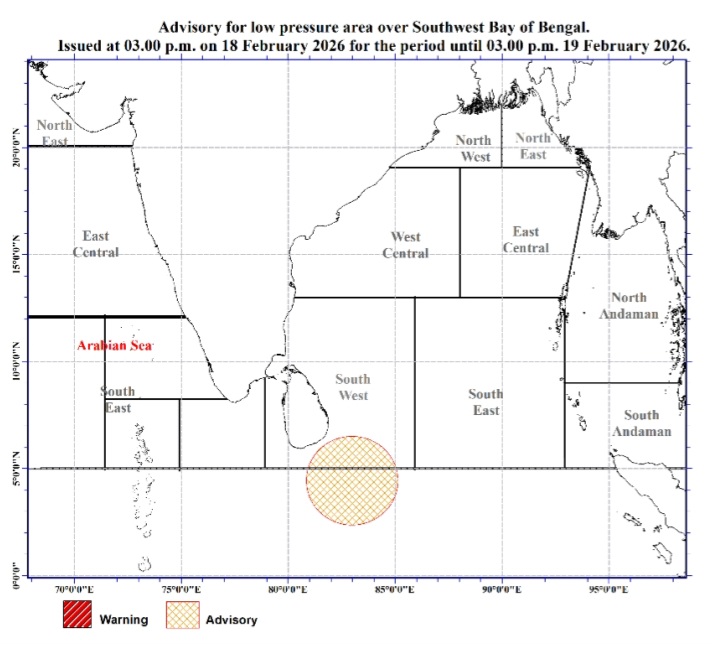
Advisory for low pressure area in the Southwest Bay of Bengal to the south-east of Sri Lanka.
Issued by the Natural Hazards Early Warning Centre of the Department of Meteorology at 03.00 pm on 18 February 2026
Multiday boats fishermen and naval community are warned that the low-pressure area still persists over the Southwest Bay of Bengal to the south-east of Sri Lanka. Under the influence of this system, heavy showers or thundershowers, Strong winds about (50-60) kmph, and rough or very rough seas can be expected in these sea areas.
The Meteorological Department is constantly monitoring the behavior of the system.
The naval and fishing communities are requested to be attentive to the future forecasts and bulletins issued by the Department of Meteorology in this regard.

India 193/6 in 20 overs (Ishan Kishan 18, Tilak Varma 31, Suryakumar Yadav 34, Shivam Dube 66; Hardik Pandya 30; Aryan Dutt 2-19, Logan van Beek 3-56, Kyle Klein 1-38) beat Netherlands 176/7 in 20 overs (Michael Levitt 24, Max O’Dowd 20, Bas de Leed 33, Collin Ackerman 23, Scott Edwards 15, Zach Lion-Cachet 26, Noah Croes 25*; Jasprit Bumrah 1-17, Varun Chakravarthy 3-14, Hardik Pandya 1-40, Shivan Dube 2-35) by 17 runs

Ambassador of Switzerland to Sri Lanka pays courtesy call on PM

Suspected carbon-monoxide leak kills at least 30 miners in Nigeria, witnesses say

Eight skiers found dead after California avalanche

Advisory for low pressure area in the Southwest Bay of Bengal to the south-east of Sri Lanka

Showers will occur at times in the Northern , North-central, Central, Uva and Eastern provinces and in Hambantota district

Canada concerned about delay in holding PC polls

‘Dates have the highest sugar content to fight Coronavirus’

Sunday Island 27 December – Headlines

#SundayIsland 17th December – Headlines

Sunday Island – 28th March

Sunday Island Headlines – 21 March

Sunday Island – 21st February – Headlines
-

 Life style4 days ago
Marriot new GM Suranga
-

 Business3 days ago
Ministry of Brands to launch Sri Lanka’s first off-price retail destination
-

 Features4 days ago
Monks’ march, in America and Sri Lanka
-

 Features4 days ago
The Rise of Takaichi
-

 Features4 days ago
Wetlands of Sri Lanka:
-

 News4 days ago
Thailand to recruit 10,000 Lankans under new labour pact
-
 News4 days ago
Massive Sangha confab to address alleged injustices against monks
-

 News2 days ago
IMF MD here