
Latest News
Budgetary allocations should be fully utilised within the respective financial year to deliver benefits to the public -President

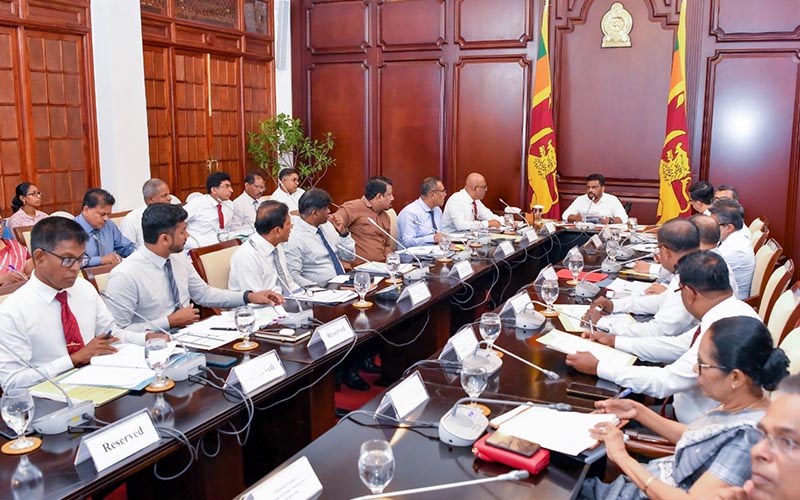
A review on the implementation of the 2025 budget allocations for the Ministry of Youth Affairs and Sports, together with preliminary discussions on the 2026 budget proposals, was held on Friday (15) morning at the Presidential Secretariat under the patronage of President Anura Kumara Dissanayake.
During this discussion, the allocations made in 2025 to eight institutions under the Ministry of Youth Affairs and Sports and the current status of the related projects were reviewed separately.
The President pointed out that the long-standing issue in all sectors, including youth affairs and sports, is the failure to allocate budgetary provisions properly for their advancement. He further noted that although the last budget allocated the necessary funds for all sectors, there has been dissatisfaction regarding their proper utilisation for the relevant projects. The President emphasised that such allocations should be fully utilised within the respective financial year to deliver benefits to the public, treating this as a priority task.
During the discussion, the President stressed the importance of preparing the 2026 budget proposals with the objectives of creating a sports culture in the country, developing sports-related infrastructure, implementing programmes to identify athletes with international potential and elevating athletes to the global stage.
The President instructed that a plan be prepared to establish a sports culture and also advised that, in promoting sports, the maximum possible participation of sports associations should be secured and the necessary facilities be provided to them.
President Dissanayake also emphasised that the allocation of funds for this purpose is not merely an investment in sports development, but one that simultaneously achieves multiple goals such as improving the nation’s health, enhancing social welfare, reducing crime, combating drug use, fostering social cohesion and creating a dynamic workforce.
The President also stated that in sports, vigour alone is not sufficient; in this era, training and technology are decisive factors and therefore, providing athletes with the necessary opportunities in these areas should be a primary responsibility of the Ministry of Sports.
At this meeting, the President also instructed officials to expedite the renovations and construction of sports complexes for which funds have already been allocated, including the Sugathadasa Stadium in Colombo, those in the Kilinochchi and Mannar districts and others being built across the island.
The discussion also touched on the significance of employing experts for specialised construction in sports infrastructure development, establishing an advisory company under the government for this purpose and obtaining consultancy services at an international level.
The President instructed officials to focus on the development of school sports and expressed his readiness to allocate the necessary funds for this purpose.
Taking all the above points into consideration, President Dissanayake further instructed ministry officials to prepare and present a new integrated plan for sports development as soon as possible.
Attention was also drawn to the upcoming plans of the Ministry of Youth Affairs, which are to be implemented with the participation of the young men and women who took part in the 2025 National Youth Conference held recently.
The event was attended by the Minister of Youth Affairs and Sports Sunil Kumara Gamage Minister of Labour and Deputy Minister of Economic Development Dr Anil Jayantha Fernando, Deputy Minister of Youth Affairs Eranga Gunasekara and Deputy Minister of Sports Sugath Thilakaratne, Secretary to the President Dr Nandika Sanath Kumanayake, Secretary to the Ministry of Finance Dr Harshana Suriyapperuma, Senior Additional Secretaries to the President Russell Aponsu and Kapila Janaka Bandara and a group of senior officials from the Ministry of Youth Affairs and Sports.

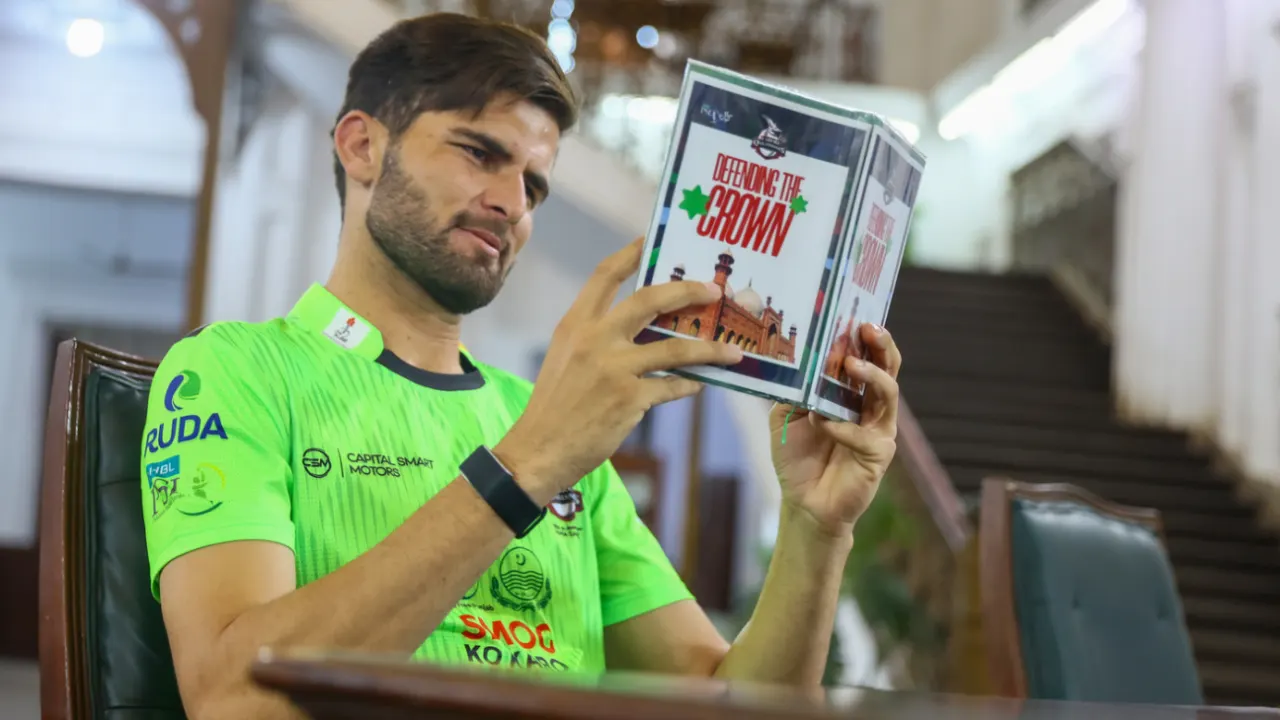
Lahore Qualandars have fined Shaheen Shah Afridi PKR 1 million (approx. USD 3600) following the incident that saw the Punjab police accuse him of violating security protocols at the team hotel. In a statement, Qalandars said they had imposed the fine on their captain to “maintain discipline and impose accountability”.
There will be no action taken against Qalandars player Sikandar Raza, who was also accused by the police of violating the same protocols. At a press conference yesterday, Raza said he took responsibility for the incident and attempted to exonerate Afridi from blame.
News of the incident emerged after a letter from the Punjab police to PSL CEO Salman Naseer was made widely available on social media. It accused Qalandars, Afridi and Raza’s team, of violating security protocols, alleging that, despite being refused permission to receive visitors in Raza’s room by both the PCB’s security and anti-corruption manager as well as Naseer, Afridi and Raza took people up to the player’s room. Despite Raza saying they stayed in his room for 40 minutes, the letterclaims they spent approximately three hours there.
Qalandars accepted the broader details of the incident, but the statement said it had been “overstated in public discourse, amplified beyond its original context”, and was “unnecessarily escalated”.
“While underscoring that the matter arose from a misunderstanding rather than any deliberate attempt to violate established procedures, Lahore Qalandars reiterated its full respect for all security protocols,” the statement said.
“The organisation reaffirmed its commitment to strict adherence to standard operating procedures (SOPs) and emphasised the importance of continued clarity and alignment in the communication of protocols to prevent similar situations in the future.”
[Cricinfo]
New IPL season, new-look team, but same-old batting troubles for Chennai Super Kings [CSK].
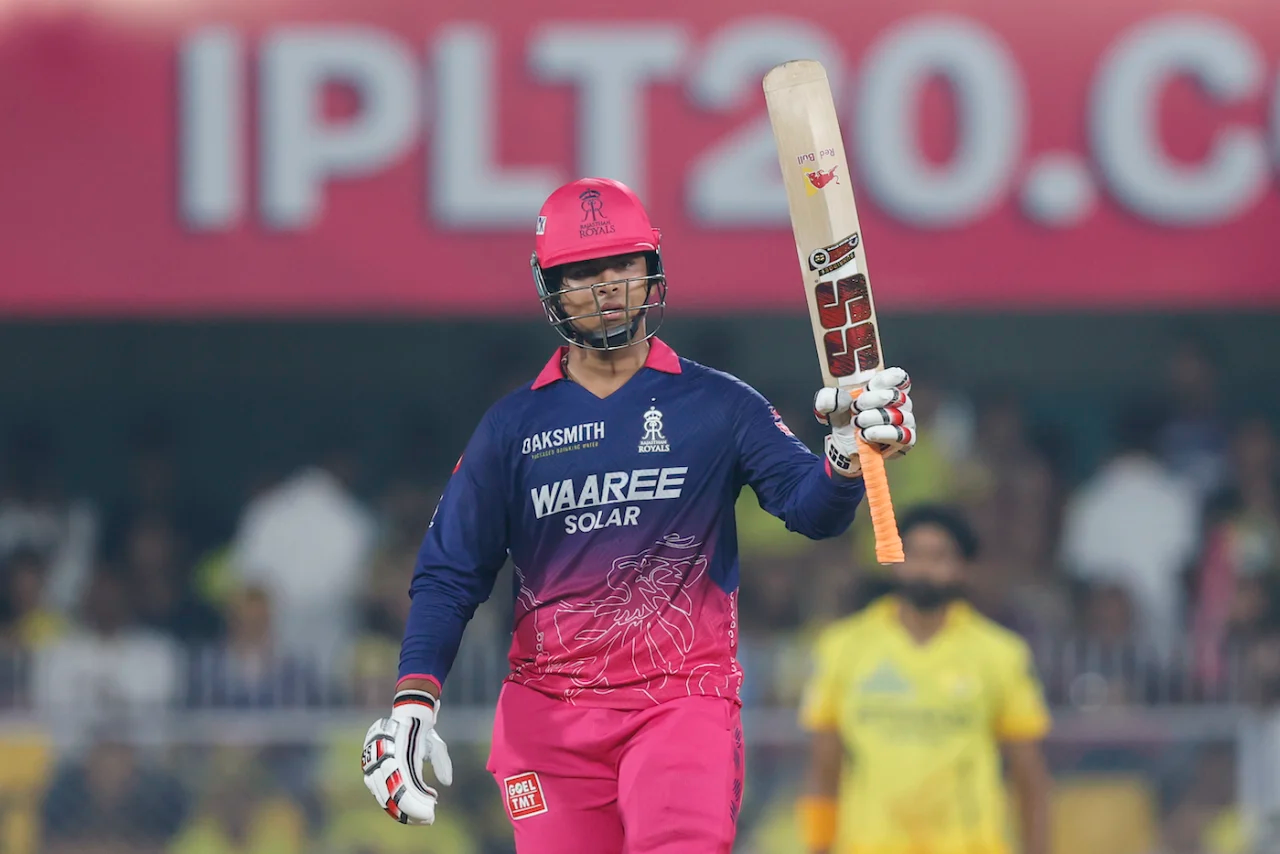
On Monday, their powerplay score of 41 for 4 against Rajasthan Royals [RR] was straight out of 2025, when they had finished rock bottom in the league, before they were eventually bowled out for 127. That total then looked next to nothing when 15-year-old Vaibhav Sooriyavanshi, who is four years younger than the IPL itself, clattered a 15-ball half-century. RR razed the target down with eight wickets and almost as many overs to spare.
The Guwahati pitch was trickier to bat on in the early exchanges – it had spent considerable time under covers both on match day and match eve – and RR made excellent use of the dampness after winning a crucial toss and opting to bowl. Both Jofra Archer and Nandre Burger bowled Test-match lengths to wreck CSK’s top order. Ravindra Jadeja then marked his return to RR after 17 years with a double-wicket first over. Sooryavanshi then ripped up CSK’s attack, and the IPL record books.
It was Burger who made the opening breakthrough when he knocked Sanju Samson over in the second over. Burger bowled a perfectly pitched delivery – neither full or short – on a good length, and got it to seam away from over the wicket. Samson, who was shaping up for an inswinger, was made to look silly by the left-arm quick.
Ruturaj Gaikwad then exposed all his stumps, only to be bowled by a 143.3kph delivery from Archer. Both the CSK openers fell for 6 each, and the revamped middle order could not stop the rot.
CSK’s title-winning sides of old used to navigate such Test-match style passages of play with their all-format experience. But the team management has now pivoted to youth who tried to hit their way out of trouble, and wound up collapsing spectacularly.
Ayush Mhatre dared to hook a head-high bouncer, and was caught behind for a golden duck. Matthew Short, who got an opportunity in place of the injured Dewald Brevis, chipped a slower ball from Sandeep Sharma to midwicket to leave CSK at 38 for 4 in the sixth over.
That soon became 57 for 6 after Jadeja’s double-strike in his first over. The first wicket of Sarfaraz Khan had Jadeja written all over it. He speared in a fast, flat dart that thudded into Sarfaraz’s pads, and trapped him lbw for 17 off 12 balls. Sarfaraz had come in as CSK’s Impact Sub in their bat-first XI that had Noor Ahmad slotted in at No. 8. Had CSK fared better with the bat, they may have had the option of strengthening their bowling with the potential inclusion of Gurjapneet Singh or allrounder Ramakrishna Ghosh.
Shivam Dube came out attacking as well, launching his first ball for six over wide long-on. But Jadeja quickly shifted his lines wide of off and had Dube slicing a catch to wide long-off. Jadeja bared his emotions and gave his former team-mate a send-off. He finished with 2 for 18 in his three overs and later said “pink looks good on me” with a big smile on his face during the innings break.
At one point, CSK were in danger of being bowled out for a sub-100 total, but Jamie Overton’s 43 off 36 balls – he was the only CSK batter to pass 20 on the day – dragged them to 127. Overton added 33 with Anshul Kamboj, the highest ever for the last wicket for CSK.
CSK could’ve dismissed Sooryavanshi for a golden duck had debutant Kartik Sharma not dropped him in the first over of the chase. Matt Henry drew a mis-hit over midwicket with a hard-length delivery, but Kartik, who usually keeps wicket for Rajasthan, missed a difficult catch and parried it away to the boundary. What happened next ball? Sooryavanshi swatted it over wide long-on for the first of his five sixes.
The pick of Sooryavanshi’s sixes was a scythed hit off a slower ball from Henry in the third over. Henry took pace off and bowled a slower cutter wide of off, but Sooryavanshi powered it over deep point, one of the two fielders in the outfield, with his incredible bat speed and bat swing. He pressed on to bring up his fifty off 15 balls. Only four other players – his opening partner Yashasvi Jaiswal, KL Rahul, Pat Cummins and Romario Shepherd – have hit quicker fifties in the IPL.
CSK cut Sooryavanshi’s innings short on 52 off 17 balls when Sarfaraz pulled off a superb diving catch at sweeper cover off Kamboj in the seventh over. Kamboj struck again in his next over to remove Dhruv Jurel, but Jaiswal (38*) and captain Riyan Parag (14*) completed RR’s demolition of CSK.
Brief scores:
Rajasthan Royals 128 for 2 in 12.1 overs (Vaibhav Sooryavanshi 52, Yashaswi Jaiswal 38*, Druv Jurel 18, Riyan Parag 14*; Anshul Kamboj 2-27) beat Chennai Super Kings 127 in 19.4 overs (Sarfaraz Khan 17, Kartik Sharma 18, Jamie Overton 43; Ravindra Jadeja 2-18, Jofra Archer 2-19, Nandre Burger 2-26, Brijesh Sharma 1-17, Sandeep Sharma 1-22, Ravi Bishnoi 1-16) by eight wickets
[Cricinfo]
Latest News
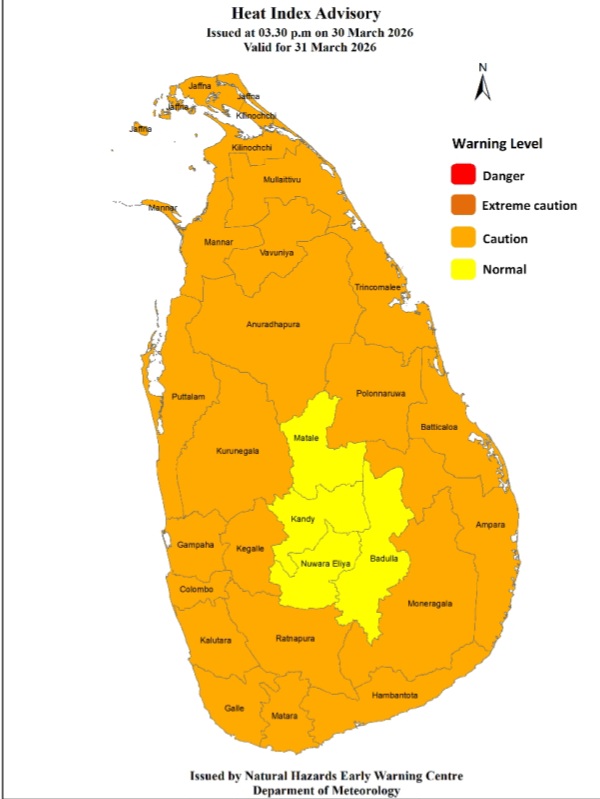
Heat Index at ‘Caution Level’ in the Western, Sabaragamuwa, Southern, Eastern, North-western, Northern and North-central provinces and in Monaragala district
Warm Weather Advisory
Issued by the Natural Hazards Early Warning Centre
Issued at 3.30 p.m. on 30 March 2026, valid for 31 March 2026.
The Heat index, the temperature felt on human body is likely to increase up to ‘Caution level’ at some places in the Western, Sabaragamuwa, Southern, Eastern, North-western, Northern and North-central provinces and in Monaragala district.
The Heat Index Forecast is calculated by using relative humidity and maximum temperature and this is the condition that is felt on your body. This is not the forecast of maximum temperature. It is generated by the Department of Meteorology for the next day period and prepared by using global numerical weather prediction model data.

Effect of the heat index on human body is mentioned in the above table and it is prepared on the advice of the Ministry of Health and Indigenous Medical Services.
ACTION REQUIRED
Job sites: Stay hydrated and takes breaks in the shade as often as possible.
Indoors: Check up on the elderly and the sick.
Vehicles: Never leave children unattended.
Outdoors: Limit strenuous outdoor activities, find shade and stay hydrated.
Dress: Wear lightweight and white or light-colored clothing.
Note:
In addition, please refer to advisories issued by the Disaster Preparedness & Response Division, Ministry of Health in this regard as well. For further clarifications please contact 011-7446491.

Steps are taken to accelerate the recovery efforts following Cyclone Ditwah despite Global Economic Challenges

Qalandars fine Afridi for violating security protocols

Sooryavanshi, Archer, Burger demolish Chennai Super Kings

Showers may occur at a few places in the Western and Sabaragamuwa provinces and in Galle and Matara districts after 2.00 pm

Burning of low-grade coal at N’cholai plant increases pollution: Parliament

Tariff shock from 01 April as power costs climb across the board

‘Dates have the highest sugar content to fight Coronavirus’

Sunday Island 27 December – Headlines

#SundayIsland 17th December – Headlines

Sunday Island – 28th March

Sunday Island Headlines – 21 March

Sunday Island – 21st February – Headlines
-

 News6 days ago
Senior citizens above 70 years to receive March allowances on Thursday (26)
-

 Features3 days ago
A World Order in Crisis: War, Power, and Resistance
-

 News4 days ago
Energy Minister indicted on corruption charges ahead of no-faith motion against him
-

 News5 days ago
US dodges question on AKD’s claim SL denied permission for military aircraft to land
-

 Business5 days ago
Dialog Unveils Dialog Play Mini with Netflix and Apple TV
-

 News6 days ago
CEB Engineers warn public to be prepared for power cuts after New Year
-

 Sports4 days ago
SLC to hold EGM in April
-

 Latest News5 days ago
A strong Technical and Vocational Education and Training (TVET) system equips individuals with practical, relevant, and future-oriented skills helping to innovate responsibly towards a greener and sustainable future – PM