
News
Budget to be presented on Nov 17

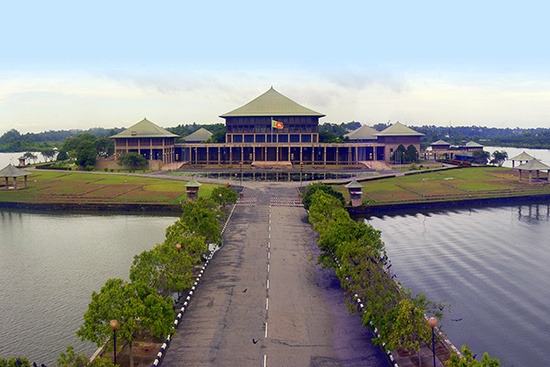
by Saman Indrajith
The new government would present its first budget to Parliament on November 17, Parliament sources said yesterday, adding that however the matter on the dates for the debate had not yet been finalised
In the Appropriation Bill for 2021, Government expenditure for the year 2021 has been estimated at Rs. 2.6 trillion with the limit on borrowing set at Rs. 2.9 trillion.
The government on 20 Oct. presented two appropriation bills to provide for the financial years 2020 and 2021. Along with the Appropriation Bill for 2021, the government presented a separate bill to cover the expenses for 2020 including the funds withdrawn from the Consolidated Fund under the authorisation of the President between March and August this year.
President Gotabaya Rajapaksa authorised the withdrawal of funds from the consolidated fund using powers vested in him under Article 150 of the Constitution, once in March and again in June during the period Parliament stood dissolved with elections postponed due to the COVID-19 outbreak.
Following the election victory of the SLPP in August 2020, Parliament approved a resolution to obtain around Rs 1.7 trillion to cover state expenditure for the next four months of the year by way of a Vote on Account .
The government expenditure for 2020 is estimated to be around Rs 2.538 trillion for the service of the period beginning on 1 January, 2020 and ending on 31 December, 2020. The limit on borrowings this year is Rs 2.65 trillion, according to the Bill.
In the Appropriation Bill for 2021, the government expenditure for the year 2021 has been estimated at Rs. 2.678 trillion with the limit on borrowing set at Rs. 2.9 trillion.
The highest allocations in both years will be for the Ministries of Defence, Highways and Provincial Councils.
The limit on borrowings for the financial year 2021 has been set at Rs. 2,900 billion with the details of such loans to be incorporated in the Final Budget Position Report which is required to be tabled in Parliament under section 13 of the Fiscal Management (Responsibility) Act No. 3 of 2003.
The highest allocations in the Budget will be for the Ministry of Defence topping Rs. 355 billion (Rs. 355,159,250,000) of which Rs. 316 billion (Rs. 316,806,290,000) will go for recurrent expenditure while capital expenditure at Rs. 38 billion (Rs. 38,352,960,000).
The State Ministry of Internal Security, Home Affairs and Disaster Management will get around Rs. 152 billion (Rs. 130,818,002,000 for recurrent expenditure, Rs. 21,647,040,000 for Capital expenditure).
The State Ministry of Provincial Councils and Local Government under which allocations are made to the nine PCs will get over Rs. 338 billion of which around Rs. 279 billion (Rs. 279,824,000,000) will be recurrent expenditure and around Rs. 58 billion (Rs. 58,250,000,000) capital expenditure.
The Ministry of Highways will get around Rs. 330 billion, of which around Rs. 329 billion (Rs. 329,999,590,000) will be capital expenditure and Rs. 185,415,000 recurrent expenditure.
The Ministry of Public Services, Provincial Councils and Local Government will get around Rs. 271 billion of which over Rs. 270 billion (Rs. 270,473,000,000) will be for recurrent expenditure and Rs. 1 billion (Rs. 1,250,000,000) for capital expenditure.
The allocation for the Ministry of Finance is around Rs. 157 billion with recurrent expenditure amounting to over Rs. 100 billion (Rs. 100,338,845,000) and capital expenditure stands at Rs. 57 billion (Rs. 57,264,870,000).
The Ministry of Education will get over Rs. 126 billion with over Rs. 102 billion (Rs. 102,670,000,000) allocated for recurrent expenditure and around Rs. 23 billion (Rs. 23,870,000,000) for capital expenditure.
The Ministry of Health has been allocated around Rs. 159 billion but the bulk of Rs. 128 billion (Rs. 128,480,998,000) will go for capital expenditure and around Rs. 30 billion (Rs. 30,995,000,000) for recurrent expenditure.
The Ministry of Urban Development and Housing will get around Rs. 23 billion (Rs. 530,341,000 for recurrent expenditure and Rs. 22,990,858,000 for capital expenditure.
The expense head of the Office of the President has been allocated close to Rs. 9.3 billion (Rs. 9,345,660,000) of which Rs. 3,206,180,000 will go for recurrent expenditure and Rs. 6,139,480,000 for capital expenditure.
The office of the Prime Minister will receive Rs. 1,051,750,000.
Party Leaders who met for a special meeting at the Parliament Complex last week had decided to take up the Appropriation Bill 2020 on Nov 12 and pass it the same day, Parliament sources said, adding that they also decided that the government would present budget 2021 on Nov 12.

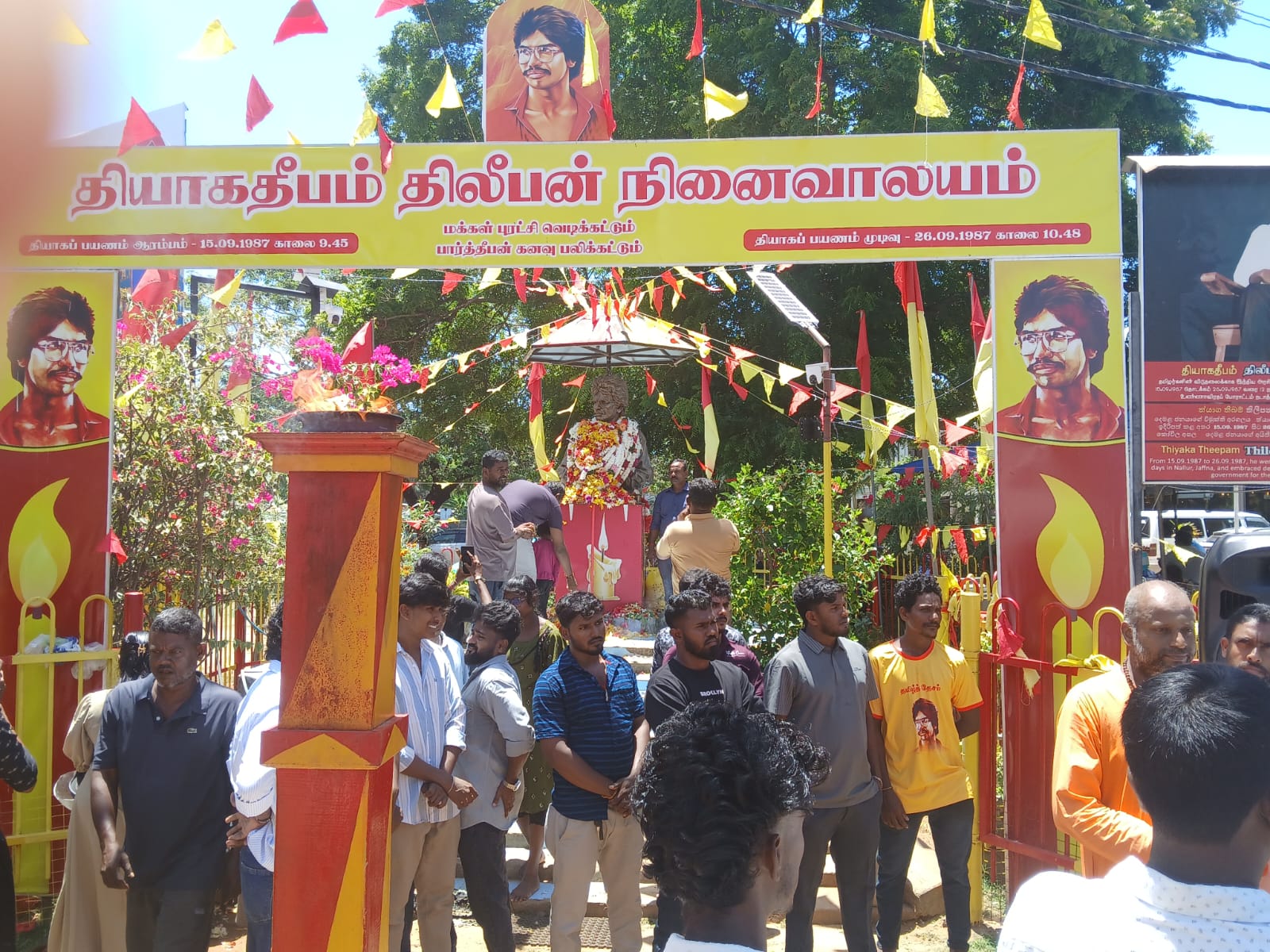
A commemorative service was held in memory of Rasaiah Parthipan commonly known by the nom de guerre ‘Thileepan’ in Nallur Jaffna this morning (26).
Parthipan a revolutionary member of the LTTE and a student of the University of Jaffna, commenced a hunger strike on 15th September 1987 untill his death on 26th September 1987. He was 23 years old at the time of his demise.
Latest News
Landslide Early Warnings issued to the districts of Colombo, Galle, Gampaha, Hambanthota, Kalutara, Kandy, Kegalle, Kurunegala, Matara, Nuwara Eliya and Ratnapura

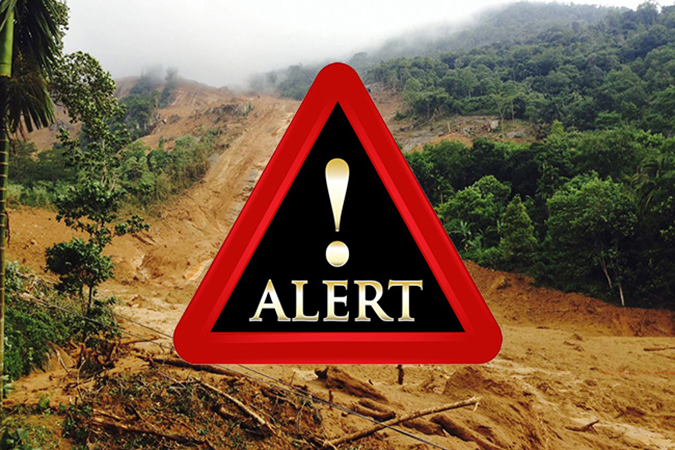
The National Building Research Institute has issued landslide early warnings to the districts of Colombo, Galle, Gampaha, Hambanthota, Kalutara, Kandy, Kegalle, Kurunegala, Matara, Nuwara Eliya and Ratnapura from 16:00 hrs on 25.09.2026 To 16:00 hrs on 26.09.2026
Accordingly,
LEVEL III [RED] landslide early warnings have been issued to the Divisional Secretaries Divisions and surrounding areas of Neluwa, Nagoda, Niyagama and Thawalama inthe Galle district, Ganga Ihala Korale, Udapalatha, Doluwa and Pasbage Korale in the Kandy district, and Kothmale West, Ambagamuwa, Kotmale East and Norwood in the Nuwara Eliya district.
LEVEL II [AMBER] landslide early warnings have been issued to the Divisional Secretaries Divisions and surrounding areas of Elpitiya, Baddegama and Karandeniya in the Galle district, Walallawita in the Kalutara district, Deltota, Udunuwara, Gangawata Korale, Yatinuwara and Panvila in the Kandy district, Aranayake, Dehiowita, Mawanella, Deraniyagala and Yatiyanthota in the Kegalle district, Thalawakelle in the Nuwara Eliya district and Ratnapura and Pelmadulla in the Ratnapura district.
LEVEL I [YELLOW] landslide early warnings have been issued to the Divisional Secretaries Divisions and surrounding areas of Seethawaka and Padukka in the Colombo district, Attanagalla and Mirigama in the Gampaha district, Katuwana and Walasmulla in the Hambanthota district, Ingiriya and Bulathsinhala in the Kalutara district, Hatharaliyadda, Poojapitiya, Medadumbara, Kundasale, Ududumbara, Thumpane, Akurana, Pathadumbara, Harispattuwa and Pathahewaheta in the Kandy district, Warakapola, Bulathkohupitiya, Galigamuwa, Kegalle and Ruwanwella in the Kegalle district, Mallawapitiya, Alawwa, Polgahawela and Mawathagama in the Kegalle district, Pitabeddara, Kotapola and Pasgoda in the Matara district, Nuwara Eliya in the Nuwara Eliya district and Elapatha, Ayagama, Nivithigala, Kuruwita and Kalawana in the Ratnapura district

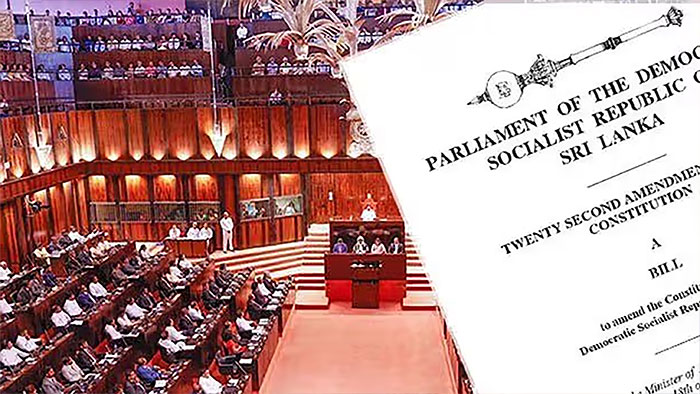
Parliament yesterday passed the Twenty-Second Amendment to the Constitution Bill and the Judicature (Amendment) Bill with two-thirds majorities, with 158 MPs voting in favour and 63 against each Bill.
The Illankai Tamil Arasu Kadchi (ITAK) and Sri Lanka Muslim Congress (SLMC) voted with the SJB against the Bills.
NDF MPs Ravi Karunanayake and Faizer Musthapha and SJB Badulla District MP Nayana Wasalathilaka were not present when the votes were taken.
The final vote on the Judicature (Amendment) Bill was announced at around 8.08 p.m. after Opposition MPs called for divisions on its clauses during the Committee Stage.
The votes followed a two-day debate which commenced on Thursday (24), after Justice and National Integration Minister Harshana Nanayakkara presented the Bills for their Second Reading.
The Supreme Court’s determination on the Bills was presented to Parliament on Tuesday (22) by Speaker Dr Jagath Wickramaratne. The Court determined that the 22nd Amendment Bill did not require approval at a referendum and could be passed by a special two-thirds majority in Parliament.
The amendment provides for raising the mandatory retirement age of Supreme Court judges from 65 to 67 and that of Court of Appeal judges from 63 to 65. It also provides for the Chief Justice to retire at 67 or after completing six years in office, whichever comes earlier.
The Speaker informed Parliament that the Judicature (Amendment) Bill could be passed by a simple majority.
The SJB opposed the legislation and its MPs attended Parliament dressed in black yesterday. The party also staged a protest at Polduwa Junction, Battaramulla, under the theme “No to 22, which destroys democracy”, with Opposition Leader Sajith Premadasa and several SJB politicians participating.

Thileepan rembered on 39th death anniversary

Landslide Early Warnings issued to the districts of Colombo, Galle, Gampaha, Hambanthota, Kalutara, Kandy, Kegalle, Kurunegala, Matara, Nuwara Eliya and Ratnapura

Showers in the Western, Uva and Sabaragamuwa provinces and in Galle, Matara, Kandy, Nuwara-Eliya, Batticaloa and Ampara districts.

22A, Judicature Amendment Bills passed with 2/3 majority

TIN mandatory for key transactions from Nov. 1

Navy brings 25 Indonesian fishermen ashore after trawler capsizes

‘Dates have the highest sugar content to fight Coronavirus’

Sunday Island 27 December – Headlines

#SundayIsland 17th December – Headlines

Sunday Island – 28th March

Sunday Island Headlines – 21 March

Sunday Island – 21st February – Headlines
-

 News7 days ago
Namal Rajapaksa Buddhist gambit fails, bail denied
-

 Features7 days ago
Why the spelling Sri Lankan names in English vary
-

 Features7 days ago
Three bands, a new identity: Sri Lankan wolf snake recognised as distinct species
-
 Business7 days ago
SLIIT holds largest-ever convocation
-

 News7 days ago
Vehicle prices drop by up to Rs. 1 mn, says importers’ body
-

 News7 days ago
Govt monitors reported Saudi death sentence – Foreign Ministry
-
 Business7 days ago
Lanka’s famed beach shack battles demolition
-

 Business7 days ago
All-new Bolero MaXX Pik-Up unveiled in Lanka