
News
Budget 2025: AKD promises growth and progress

* Minimum public sector salary increased by Rs 15,750
* Retirement benefits to be calculated on the basis of new salary structure
* Private sector minimum salary increased to Rs 27,000 from Rs 21,000
* Plantation sector daily wages raised to Rs 1,700
* Move to revise pensions of those who retired before 1 Jan., 2020 in three phases
* Significant revenue boost expected from liberalisation of motor vehicle imports
By Saman Indrajith
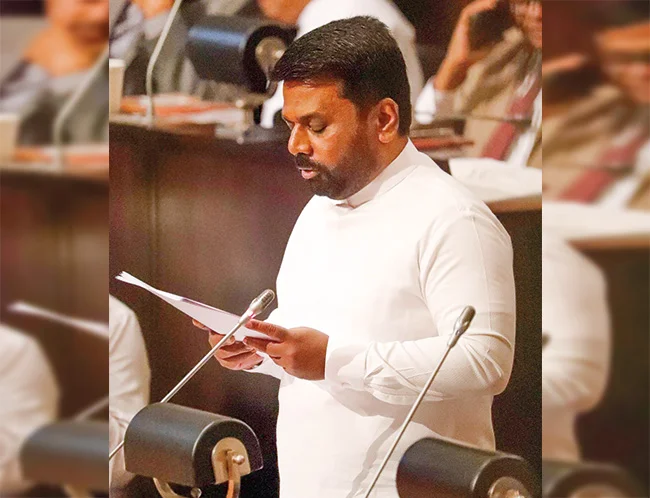
President Anura Kumara Dissanayake yesterday (17) proposed to increase the minimum public sector basic salary by Rs. 15,750 – from Rs. 24,250 to Rs. 40,000 The President said that the current ad-hoc interim allowance and special allowance would be integrated into the basic salary, giving a net increase of Rs. 8,250 in the minimum salary.
The President was delivering his maiden budget speech. He said that the proposed minimum monthly basic salary increase would also be applicable to judicial services, public corporations, statutory boards, university staff, and officers of the armed forces, on the same basis in line with the minimum basic salary increase for public sector employees.
In addition, the President proposed to increase annual salary increment by 80%. Consequently, the minimum annual salary increment of Rs. 250 will be increased to Rs. 450. It is also proposed to adjust annual salary increments for all public sector employees to the same percentage, the President mentioned.
The President said: “The total estimated cost of this salary increase is expected to be Rs. 325 billion. Considering the present fiscal constraints, it is proposed that this salary increase be implemented in phases. Of the total net salary increase, Rs. 5,000 and 30 percent of the balance amount will be paid, starting from April 2025, with the remaining 70 percent being paid in equal portions, beginning in January 2026 and January 2027.
“Therefore, it is proposed that Rs. 110 billion be allocated for the proposed salary increase in 2025.
“As part of this salary increase, it is proposed that the retirement benefits for officers retiring on or after 01.01. 2025 be calculated, based on the new salary structure, ensuring that they receive retirement benefits under the proposed 2025 salary scheme.
“Considering the increase in the minimum basic salary of state employees, the limit on distress loans for public servants, which is currently set at Rs. 250,000, will also be increased to Rs. 400,000. .
“The Employers’ Associations have already agreed to increase the monthly Minimum Wage to the Private Sector workers, from Rs. 21,000 to Rs. 27,000, in April 2025, and to Rs. 30,000 from 2026.
“The government will intervene to increase the daily wages of the Plantation workers to Rs. 1,700.
“Commenting on public sector pensions, the President said that immediately after the presidential election, a Rs 3,000 monthly increase was granted to resolve pension anomalies of those who retired before January 1, 2020.
The President said: “We observe that there will be a pension anomaly created by revising the pensions of the Government employees who retired from 2016 – 2020 only, based on the salary scale of the fifth phase related to the year 2020, since all the pensioners who retired till 31.12.2017 are on the same salary scale.
As this issue remains unresolved for a long time, we believe that it has to be resolved in a phased manner within the existing limited fiscal space. Therefore, we propose to revise the pensions of all pensioners who retired before 01.01.2020 in three phases, corresponding to the salary scales applicable to the year 2020 as per the Public Administration Circular No. 03/2016.
As the first phase, the pensions of all pensioners who retired before 01.01.2018 will be revised in line with the third stage salary scales relevant to the year 2018 in the Public Administration Circular No. 03/2016 and to be implemented from July 2025. For this phase, we propose to allocate Rs. 10,000 million through the Budget 2025.
Furthermore, we also propose to implement the pension conversions related to the fourth and fifth stages of the salary conversion from July 2026 and July 2027, respectively.”
The President dealt with revenue measures. The Parliament was told that Sri Lanka’s economic reform programme is based on a foundation of revenue-based fiscal consolidation. This is reflective of the fact that leading up to the economic crisis, Sri Lanka had one of the world’s lowest Government tax revenue levels of 7.3 percent of GDP in 2022.
For the year 2025, the bulk of revenue gains is expected to be delivered by the liberalisation of motor vehicle imports that took place on 1st February 2025. This process is being carefully monitored to ensure that import of vehicles does not result in undue negative impacts on external sector stability. Other key revenue measures which have already been announced in Parliament, previously in December 2024, include the increase of tax-free threshold for personal income tax, further adjustments to the second income tax slab, removal of VAT on fresh milk and yoghurt. The Government also decided to not pursue this year the Imputed Rental Income Tax that had been agreed by the previous administration. To compensate for any revenue losses, the Government already presented in Parliament measures, including the introduction of VAT on digital services, the imposition of corporate income tax on export of services, and an increase in the corporate tax on cigarettes/liquor, and gaming.
The tax policy measures outlined here are expected to deliver the required revenue to enable Sri Lanka to meet the revenue targets of 15.1 percent of GDP in 2025. Nonetheless, in parallel, the Government is taking concerted efforts to improve tax administration and compliance. In fact, Sri Lanka’s revenue strategy for the upcoming Budget aims to enhance fiscal sustainability by strengthening tax administration, improving compliance, improve institutional strength through enhanced digitalization and rigorous monitoring mechanisms; while providing relief to the most vulnerable groups of the society. Efforts will be directed toward digitalizing tax systems to reduce leakages and enhance transparency while minimizing human interactions in tax administration.
Sri Lanka is moving towards a cashless economy as a part of its broader digitalization agenda to formalize the economy and improve revenue collection. The use of Point-of-Sale (POS) machines across businesses, especially in VAT-registered enterprises, will be implemented as a key initiative to facilitate digital transactions and reduce cash dependency. A cashless economy will not only curb tax evasion and illicit financial activities but also enhance fiscal efficiency, contributing to Sri Lanka’s economic stability and growth.
Digitalisation of revenue agencies and the overall digital economy drive is expected to provide significant impetus to the revenue enhancing efforts. However, it is not just the tax collection authorities that have a responsibility in this regard. Several other stakeholders, including audit firms and tax accountants, have a responsibility to discharge their duties in a socially responsible manner such that the Government is not deprived of due tax revenue. Appropriate measures will be taken to ensure compliance with the regulatory and legal framework in this regard as well.
We are confident that these tax administration and tax compliance enhancement measures will enable Sri Lanka to surpass revenue targets beyond 2025. At that point, it will be possible to provide further relief to the public in a manner that does not jeopardize the achievement of revenue targets and ensure the country’s fiscal and economic stability. “






More than 1,600 students sat this year’s Russian Classical Ballet Examination, the largest number ever to take part in the examination in Sri Lanka. Exams were held in Colombo from 5, to 18, October and in Galle on 10 October.
Students aged four and above came from across the island, including Colombo, Galle, Gampaha, Negombo, Matara, Kelaniya, Panadura, Wattala, Kiribathgoda, Ratnapura, Kandy, Kurunegala, Bandarawela and Badulla. They are taught by 15 dedicated teachers trained in the Vaganova method, the renowned Russian system of classical ballet training.
They were examined by Dr. Oxana Karnovich of the Moscow State Academy of Choreography, a distinguished academic and curator.
The Russian School of Ballet and Dancing was established in 2001 by Michael Ustinov, Buddhapriya Ramanayake and Mrs Chandi Aluvihare, with Mrs Galina Pleshakova as its founding instructor. Today the School is led by Director Madam Maria Popova, Counsellor of the Embassy of the Russian Federation in Sri Lanka.


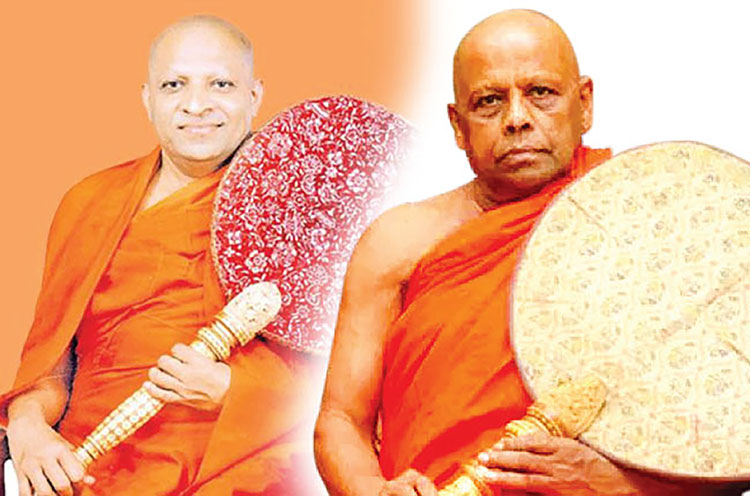
MONETABRIEF– Sri Lanka’s two most senior Buddhist chapters, Malwatte and Asgiriya, demanded special concessions for monks serving prison sentences, following the disrobing of convicted monk Ven. Galagodaatte Gnanasara in line with established procedures.
The chief prelate of the Asgiriya chapter, Most Venerable Warakagoda Sri Gnanarathana, told Prisons Commissioner Senaka Palletenna that Ven. Gnanasara, who is serving a six-year sentence for contempt of court, must be released immediately.
Prison authorities have no power to release or pardon convicts, but Palletenna told the monk in Kandy on Friday that he would convey his request to the relevant government authorities.
“There is no point in talking about this and that… The entire country has been shaken (??????? ) . He must be released,” the Asgiriya chief prelate said.
The Malwatte chief prelate, Most Venerable Thibbatuwawe Sri Siddhartha Sumangala, appeared to accept the court verdict against Ven. Gnanasara, but asked the prisons chief whether a separate section could be established for convicted monks.
Palletenna noted that a special ward for the clergy already existed at Welikada Prison.
At least 63 convicted Buddhist monks are currently incarcerated within Sri Lanka’s criminal justice system.
Meanwhile, a group of 34 Buddhist monks named in a Colombo Fort Magistrate’s Court order to vacate the vicinity of the Presidential Secretariat ended their protest and dispersed after lunch on Friday.The monks are demanding an unconditional pardon for Ven. Gnanasara, who has previously been imprisoned, making him a reconvicted prisoner.
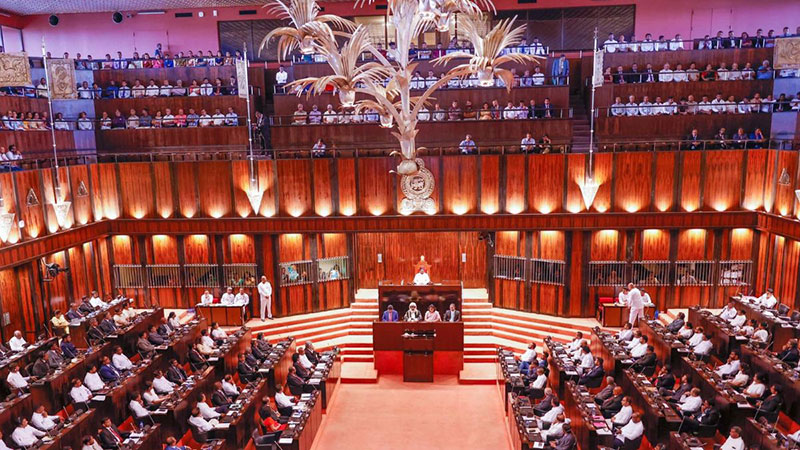
The debate on the no-confidence motion against Speaker Dr. Jagath Wickramaratne, submitted by the Samagi Jana Balawegaya (SJB), has been postponed indefinitely pending the Attorney General’s opinion on certain technical issues in the motion.
Government representatives raised the matter at a meeting of the Committee on Parliamentary Business, pointing out that several provisions of the motion required clarification and that the Attorney General’s advice should be obtained.
As obtaining the opinion would take time, the debate could not be scheduled for the next parliamentary week, parliamentary sources said.
Chief Opposition Whip Gayantha Karunatilaka said a date for the debate would be decided after the Attorney General’s advice was received.
Meanwhile, Parliament is scheduled to meet from October 20 to 23, Secretary General of Parliament Kushani Rohanadeera announced.
The parliamentary business for the week was finalised at a meeting of the Committee on Parliamentary Business held on Friday (16) under the chairmanship of Deputy Speaker Dr. Rizvie Salih.
On each sitting day, the period from 9.30 a.m. to 10 a.m. will be allocated for parliamentary business under Items 1 to 6 of Standing Order 22. Questions for Oral Answers will be taken up from 10 a.m. to 11 a.m., followed by questions under Standing Order 27(2) from 11 a.m. to 11.30 a.m.
On Tuesday, October 20, an Opposition-sponsored Adjournment Motion will be debated from 11.30 a.m. to 5.30 p.m.
On Wednesday, October 21, a resolution under the Public Debt Management Act and a Supplementary Estimate will be taken up for debate and approval from 11.30 a.m. to 5 p.m. The annual reports of five statutory institutions will subsequently be presented for approval without debate, while questions at the Adjournment Time will be taken up from 5 p.m. to 5.30 p.m.
On Thursday, October 22, the Second Reading debates on two Bills to amend the Poisons, Opium and Dangerous Drugs Ordinance (Bills Nos. 79 and 80) will be held from 11.30 a.m. to 5 p.m.
The annual reports of five statutory institutions will then be taken up for approval without debate, followed by an Opposition-sponsored Adjournment Motion from 5 p.m. to 5.30 p.m.
On Friday, October 23, the Second Reading debate on the Elimination of Rabies and Registration of Dogs Bill will be held from 11.30 a.m. to 5 p.m. A Government-sponsored Adjournment Motion will be debated during the final half-hour of the sitting.

Pakistan quicks seal win after Salman Agha ton sets tone

Record 1,600 students take Russian Classical Ballet examination in Sri Lanka

Half a million people join protests in France, but some turn violent

Deadly fire breaks out at Canada military base

Showers or thundershowers will occur in most parts of the island after 1.00 p.m.

Buddhist hierarchy demands prison perks for monk convicts

‘Dates have the highest sugar content to fight Coronavirus’

Sunday Island 27 December – Headlines

#SundayIsland 17th December – Headlines

Sunday Island – 28th March

Sunday Island Headlines – 21 March

Sunday Island – 21st February – Headlines
-

 Latest News6 days ago
Nissanka’s return headlines Sri Lanka’s Test squad against Pakistan
-

 Features7 days ago
Intake 16: 45 years of duty and honour
-
 News7 days ago
Malwathu Chapter issues statement on talks with President over Gnanasara Thera’s robes
-
 News7 days ago
CP alleges NPP has taken the blame for illegal US sanctions on Iranian vessels
-

 News5 days ago
Sri Lanka, India caught in US-Iran ship crisis
-

 Opinion7 days ago
How long can Sri Lanka remain silent on its demographic crisis?
-
 Latest News6 days ago
Imran Khan’s PTI braces to fight federal takeover of Khyber Pakhtunkhwa
-
 Latest News5 days ago
Kusal Mendis’ unbeaten 87 hands Sri Lanka consolation win