
Business
Browns Introduces Exide Matrix – The Battery that Powers the Future

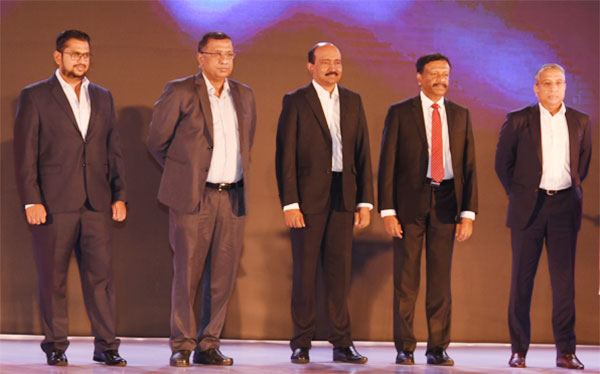
Exide unveils its latest revolutionary battery range ‘Exide Matrix’, exclusively designed for cars and SUVs. Exide Matrix boasts technological superiority and represents a paradigm shift in the Sri Lankan automotive battery industry. Exide Matrix is a groundbreaking technological collaboration among Furukawa-Japan, East Penn-USA and Moura-Brazil, which enables the battery to be upgraded with all latest and cutting-edge technologies such as Punched Grid, Roche and EFB (Enhanced Flooded Battery).
A forward-thinking enterprise, Browns joined hands with Associated Battery Manufacturers Ceylon Limited (ABM) to launch Exide Matrix. Together with Exide Industries who has mastered the art of thriving amidst challenging environments, evolving customer demands and dynamic competitive landscapes, Browns and ABM introduced the new Exide Matrix battery range to Sri Lanka. Battery technology is the cornerstone of energy transition and Browns firmly believes that better automotive batteries could revolutionise the automotive world. The ceremonial product launch — a one-of-a-kind immersive experience — was recently held at Shangri-La Colombo, in line with strict health and safety guidelines. The ceremony was graced by the presence of Ishara Nanayakkara, Deputy Chairman, LOLC Holdings PLC; Kapila Jayawardena, Group Managing Director/Chief Executive Officer, LOLC Holdings PLC; General Daya Rathnayaka, Secretary to the Ministry of Industries and other distinguished guests. The event was organised by Browns Batteries together with ABM to unveil the product line to their business partners and other stakeholders.
Exide Matrix redefines battery technology with a host of innovative features, including a patented cover with a special omega lid design that supports less evaporation and avoids the battery getting dried up. The special plate chemistry, higher CCA and super charge acceptance of Exide Matrix perfectly meet the advanced auto electrical needs of modern cars and SUVs. The battery is engineered to cater to a wide range of requirements under different standards, technological advancements and layouts, including ISS, JIS and EFB. Moreover, the use of “silver alloy metal” ensures increased resistance to corrosion and high temperature, while promising a longer shelf life. The special plate formulation for positive and negative plates ensures higher life expectancy and superior charge acceptance. The double-clad polyethylene and glass mat separators make Exide Matrix highly reliable. Furthermore, Exide Matrix is spill resistant and ensures little or no water loss compared to conventional automotive batteries.
Exide Industries Ltd. is South Asia’s largest manufacturer of lead acid storage batteries and power storage solutions provider. With seven international standard factories spread across India, the company offers a wide array of batteries for every conceivable application in automotive as well as industrial segments. In order to streamline the entire value chain, the company has established three lead smelting units and two UPS manufacturing facilities. Exide also has manufacturing facilities in Sri Lanka—ABM—which is a joint venture with Browns. Exide conducts business globally through its subsidiaries and international affiliates, and the products are sold across the world, particularly in developed markets such as Australia, Japan and Western Europe, under its own brand names. Exide’s vast product range represents both conventional and non-conventional energy sectors.
Commenting on the launch of Exide Matrix, Ajith De Silva, Cluster Chief Operating Officer, Automotive and Hardware Cluster, Browns said, “The launch of Exide Matrix unveils a whole new chapter of the Sri Lankan automotive industry. Exide Matrix challenges global standards and sets itself apart from all other automotive batteries in the local market. Manufactured in line with the latest technology, Exide Matrix is ideal for both European and Japanese cars and SUVs. We are elated to introduce this revolutionary battery to the market as a technology-driven company where innovation and agility are hallmarks of existence. Our future-oriented mind-set is the powerful tool that drives innovation throughout every aspect of our business—today and tomorrow.”
Operating in the market for over nine decades, Browns dominates the automotive battery market with a significant market share over 80%. Browns is the sole distributor for Exide automotive batteries in Sri Lanka. Fuelled by a passion and commitment to drive innovation beyond the frontiers of excellence, Browns Exide, the best SLS certified battery in Sri Lanka, has been able to position itself as a product of global acclaim and strength, and to stay in the local market as the market leader.
Established in 1875, Browns has flourished over the years to grow into a household name with a reputation as strong as its years are long. Today, the prestigious Browns Group is one of Sri Lanka’s largest diversified conglomerates, which manages a fast growing and valuable portfolio of brands across several key industry sectors, such as automotive; power generation; agriculture and plantation; pharmaceuticals; investments; marine and manufacturing as well as leisure.



Timing aligns with national policy discussions
By Sanath Nanayakkare
The USA–Sri Lanka Chamber of Commerce is exploring an innovative promotional initiative to showcase Sri Lanka’s tourism, cultural heritage, and commercial opportunities in the heart of New York City during the upcoming Christmas and holiday season.
The proposed campaign aims to bring Sri Lanka’s unique identity to one of the world’s most internationally recognized cities through a mobile digital billboard featuring high-quality photographs and videos highlighting the island’s natural beauty, rich heritage, and diverse commercial offerings. Designed to capitalize on New York City’s significant holiday-season foot traffic, the initiative will reach American consumers, international tourists, and potential business partners.
The digital showcase will feature pristine beaches, scenic mountains, waterfalls, tea plantations, wildlife, ancient cities, Buddhist heritage, traditional arts, authentic cuisine, and modern attractions, positioning the country as a premier international travel destination. An interactive QR code linking to comprehensive tourism information will also be incorporated, allowing viewers to directly explore travel opportunities.
Beyond destination promotion, the initiative provides Sri Lankan businesses with a vital platform to introduce their products and services to the American market. Enterprises representing Ceylon tea, spices, food products, gems and jewellery, apparel, handicrafts, wellness, hospitality, and tourism will have the opportunity to showcase their brands alongside the broader national campaign.
The Chamber notes that this effort will be particularly beneficial for small and medium-sized enterprises (SMEs) seeking greater international exposure, brand recognition, and commercial partnerships in the United States. By integrating tourism promotion with commercial visibility, the project aims to strengthen Sri Lanka’s international image while supporting trade, investment, and business development.
Operating under the central message of “Discover Sri Lanka. Experience Sri Lanka. Visit Sri Lanka,” the campaign presents the island as a destination defined by natural beauty, cultural richness, distinctive products, and entrepreneurial potential. More information on the initiative is accessible at www.usaslcc.org.
Tourism sector stakeholders have welcomed the move, noting that private-sector-led initiatives of this nature bypass cumbersome bureaucratic procurement procedures and complex tender processes typically associated with state-run promotional campaigns abroad.
The timing aligns with recent national policy discussions regarding tourism promotion. Participating in a Fireside Chat at the inauguration of the Sri Lanka Economic and Investment Summit 2026, organized by the Ceylon Chamber of Commerce, President Anura Kumara Dissanayake emphasized that a proper procurement mechanism needs to be established before acquiring tourism promotional concepts, recommending a performance-based system where agencies are compensated according to verified growth in tourist arrivals.

For 10th consecutive year
Seylan Bank PLC, the Bank with a Heart, has reaffirmed its commitment to supporting Sri Lanka’s automotive industry by partnering with the 20th edition of the Colombo Motor Show 2026 as the Official Banking & Leasing Partner for the 10th consecutive year. This makes Seylan Bank the longest-standing partner of the Colombo Motor Show, further reflecting its longstanding association with one of Sri Lanka’s most prominent automotive exhibitions. The four-day exhibition is scheduled to take place from 20th to 23rd November 2026 at the Bandaranaike Memorial International Conference Hall (BMICH), marking the first time the Colombo Motor Show will be held as a four-day event.
As one of Sri Lanka’s leading international motor and motor accessories exhibitions, the Colombo Motor Show will bring together vehicle enthusiasts, prospective buyers, industry professionals and automotive service providers. The 2026 edition is expected to feature over 200 trade stalls covering motor vehicles, accessories, spare parts, lubricants, tyres, batteries, leasing facilities and other motor-related services.
Through its continued partnership, Seylan Bank will showcase a comprehensive range of financial solutions designed to support customers in meeting their personal and business needs, with a particular focus on Seylan Leasing facilities. Visitors to the exhibition will have the opportunity to receive on-the-spot leasing evaluations and expert guidance from Seylan Leasing Specialists, helping them explore vehicle financing options conveniently during the event.
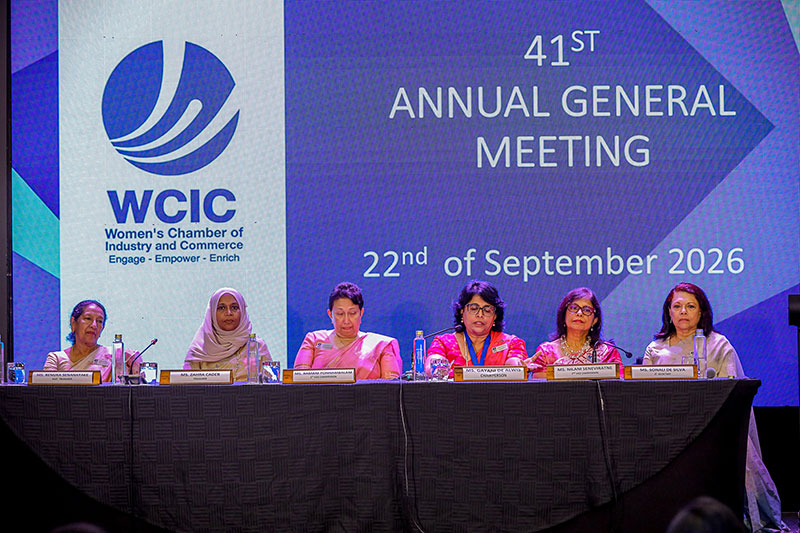
The Women’s Chamber of Industry and Commerce (WCIC) is sharpening its focus on helping women entrepreneurs move beyond business creation towards sustainable growth, as it expands its membership, partnerships and advocacy footprint.
WCIC Chairperson Gayani de Alwis, concluding her second tenure, highlighted the Chamber’s efforts had increasingly centered on creating pathways for women to translate entrepreneurial ambition into viable enterprises and, importantly, build those businesses for the longer term.
“Ultimately, our impact is not measured by the number of programmes we conducted, but by the women whose businesses grew, whose voices became stronger, whose horizons expanded and whose contribution to the economy became greater,” she said addressing the WCIC 41st Annual General Meeting (AGM) held on 22 September for which the Chief Guest was Canadian High Commissioner to Sri Lanka and the Maldives Isabelle Martin.
The focus has included a special initiative for female university students with an entrepreneurial mindset, regional chapter initiatives in the Northern Province, capacity-building programmes and the inaugural ‘Beyond Ramp Up’ workshop.
The Chairperson said these initiatives were designed to move women “from aspiration to enterprise, and from enterprise to sustainable growth”, signaling a broader focus on strengthening the progression of women entrepreneurs beyond the initial stages of business formation.
WCIC recorded a 20 percent increase in membership during the period with membership crossing 460 and expanded its ecosystem through a series of strategic partnerships.
Internally, WCIC moved to strengthen its governance framework, revising its Articles of Association to ensure regulatory compliance and introducing a Code of Conduct and Board self-assessment. Clearer organisational roles, job descriptions and performance targets were also introduced as part of efforts to strengthen accountability and professionalise its operations.
Reflecting on her tenure, the Chairperson said the period had been about building a stronger, more connected and professionally governed organisation, while converting its wider ambitions into tangible opportunities for women in business.

Showers or thundershowers will occur in most parts of the island after 1.00 p.m

CTU: Teacher shortage casts doubt on govt.’s education reforms

Norochcholai to remain offline for several days after blackout

President links businessman held with arms to politicians

CID probe sought into tusker’s death amid fears of elephant-killing syndicate

Bill to allow remote witness testimony in courts

‘Dates have the highest sugar content to fight Coronavirus’

Sunday Island 27 December – Headlines

#SundayIsland 17th December – Headlines

Sunday Island – 28th March

Sunday Island Headlines – 21 March

Sunday Island – 21st February – Headlines
-

 Latest News7 days ago
Nissanka’s return headlines Sri Lanka’s Test squad against Pakistan
-

 News6 days ago
Sri Lanka, India caught in US-Iran ship crisis
-

 Latest News7 days ago
Imran Khan’s PTI braces to fight federal takeover of Khyber Pakhtunkhwa
-

 Features2 days ago
Kotahena:A Small Enclave, An Extraordinary Legacy
-

 Latest News6 days ago
Missiles intercepted near Riyadh after Saudi coalition hits Yemen fuel depot
-

 News3 days ago
Asgiri Mahanayake calls for immediate release of Gnanasara Thera
-

 Latest News6 days ago
Kusal Mendis’ unbeaten 87 hands Sri Lanka consolation win
-

 News7 days ago
Mahinda and Shiranthi hospitalised