
News
British MPS demand Magnitsky-style sanctions on Lanka


British MPS from across the political aisle unified in their demand last week for the UK government to act on Sri Lanka in the form of Magnitsky-style sanctions; refer Sri Lanka to the International Criminal Court; urge Sri Lanka to meet its GSP+ commitments; and, dramatically reduce its bloated military spending.A Backbench Business Committee debate on the UK response to the human rights and economic situation in Sri Lanka took place on Wednesday (9) in the House of Commons chamber.
Opening the debate, Elliot Colburn, Conservative MP for Carshalton and Wallington and Chair of the All-Parliamentary Group for Tamils, stressed the need to go beyond to the latest UN Human Rights Council resolution.
“The new resolution certainly is a step in the right direction to achieving justice and accountability, but—with respect— we have had resolutions before. International action at the Human Rights Council on its own is not enough. The resolution falls short of providing a mechanism to truly investigate war crimes and pursue criminal accountability”.
Colburn further emphasized the need for Lankan war criminals to be referred to the International Criminal Court. “Specific resources need to be raised to build cases against those who are accused of war crimes and to prosecute them. Criminal accountability should be pursued by referral to the International Criminal Court. Those who commit war crimes should not enjoy immunity because the state in question is unwilling or unable to prosecute them”.
His statement was supported by Siobhain McDonagh, MP for Mitcham and Morden, who asked why the latest UN resolution failed to include a referral to the ICC.
“In the most recent UN resolution, to which the UK was a penholder, why was there no recommendation to pursue criminal accountability by referral to the International Criminal Court?
“I could barely believe my eyes when reading the Government’s reasoning, which cited ‘insufficient…Security Council support’. Who are we to cast a veto for China or Russia before they have done so themselves? Our role on the international stage must be to send the loudest message that impunity will not be tolerated, not to pre-empt the inaction of other nations”.
“Why has Britain failed to impose Magnitsky-style sanctions on any Sri Lankan official implicated in human rights abuses or corruption,” she queried.
In describing Sri Lanka’s economic demise, former Shadow Chancellor, John McDonnell noted that the country’s poverty was not a natural result but due to the political and military framework of the island.
Sri Lanka “has natural resources on a scale any other country would wish for and dream of, including natural mineral resources, and agriculture resources. The problem is that a political and military complex now controls the economy for its own interests. As a result, we have extremes of wealth and poverty through not just mismanagement but calculated management by the military who dominate the economy”.
This point was also raised by Conservative MP Theresa Villiers, who stressed that the British government must “find a way to ensure that any bailout from international institutions be accompanied by rigorous efforts to root out cronyism and corruption in Sri Lanka, and cut the irrationally large military spending budget”.
“The failure to include Tamils in economic activity, a large defence budget that supports a disproportionately large military […] corruption and, of course, poor fiscal policies have led Sri Lanka’s economy to the brink of bankruptcy. For Sri Lanka to be rescued, it needs to reduce its military spending, which stands at $1.86 billion per annum. That makes it one of the largest militaries in the world and costs more than its health and education budgets combined,” Elliot Colburn said.
He further highlighted the corrosive effects of militarization. “The militarisation of the country is also firmly linked to the deteriorating human rights situation on the island. The Prevention of Terrorism Act has been used to target predominately Muslim and Tamil communities, resulting in arbitrary detention, sexual torture and enforced disappearances. In fact, Sri Lanka has the second highest number of UN-registered enforced disappearances in the world, most of whom are Tamils. Furthermore, the Sri Lankan military is engaged in commercial activities in the north-east, including tourism, farming and fishing, which stifles the local economy and prevents Tamils from contributing to economic activity in any meaningful way. That needs to be stopped to allow for regional economic regeneration. Sri Lanka also needs to conduct a strategic defence and security review, similar to the one that the UK completed in 2021, to ensure that its military size reflects its security requirements”.

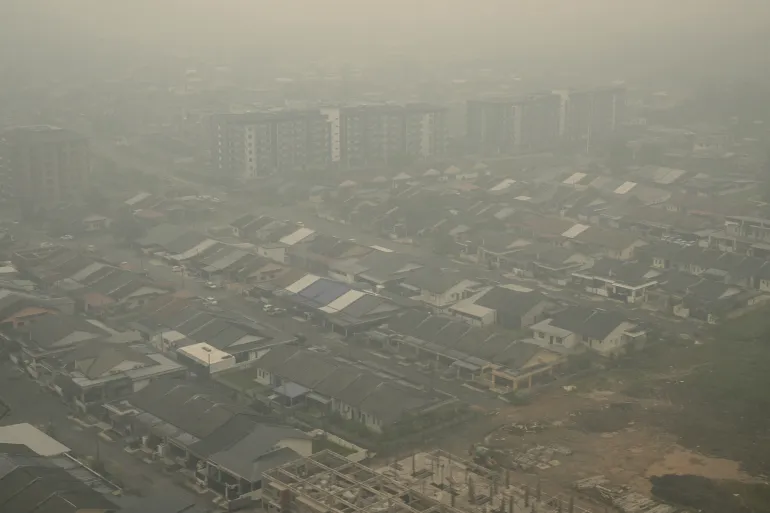
Malaysia has declared a state of emergency in a district in Sarawak state after haze caused by wildfires in neighbouring Indonesia increased air pollution to “hazardous” levels.
King Sultan Ibrahim “has consented to the declaration of emergency throughout Serian Division, Sarawak, following haze conditions that have reached air pollution levels hazardous to public health and safety”, Prime Minister Anwar Ibrahim’s office said in a statement on Thursday.
The declaration followed a formal request from the Sarawak Disaster Management Committee after the region’s Air Pollutant Index reached levels warranting consideration of a local emergency.
Under the order, 647 schools in Serian will close from Monday until at least the end of next week, alongside government and private offices, plantations, construction sites and quarries, with only essential services continuing to operate.
The state’s disaster management authorities said a three-day cloud-seeding operation launched on Thursday would be extended to at least Monday, citing forecasts of “more conducive cloud formations” during that period.
Sarawak State Disaster Management Committee chairman Douglas Uggah Embas, speaking at a news conference in Kuching, stressed that the emergency applied only to Serian, not the entire state, but urged residents there to take the situation seriously.
“Please minimise outdoor activities and avoid strenuous activities outdoors,” he said.
Sarawak, in the northern part of Borneo island, has been heavily affected by haze for weeks, as have the neighbouring states of Sabah and Peninsular Malaysia.
(Aljazeera)
Latest News
Sun directly overhead Moratuwa, Kesbewa, Handapangoda, Idalgashinna, Yudhaganawa, Kotiyagala and Panama about 12.08 noon today (05)


The sun is going to be directly over the latitudes of Sri Lanka from 28th of August to 07th of September due to its apparent southward relative motion.
The nearest places of Sri Lanka over which the sun is
overhead today (05) are Moratuwa, Kesbewa, Handapangoda, Idalgashinna, Yudhaganawa, Kotiyagala and Panama about 12.08 noon
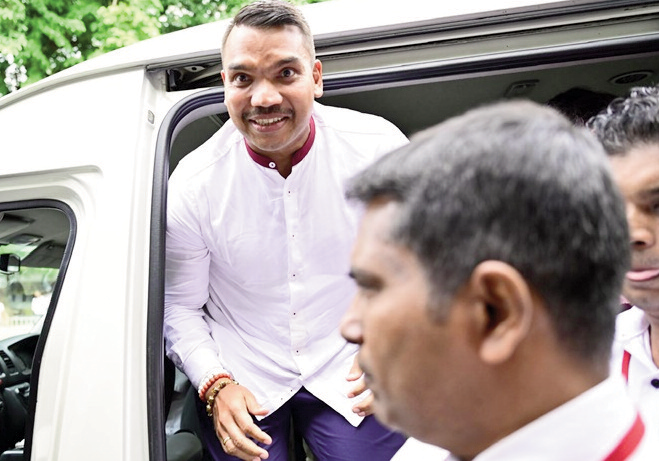
Sri Lanka Podujana Peramuna (SLPP) National Organiser and Parliamentarian Namal Rajapaksa was yesterday remanded until September 18 by the Colombo Chief Magistrate’s Court following his arrest by the Commission to Investigate Allegations of Bribery or Corruption (CIABOC) in connection with an investigation into the controversial SriLankan Airlines Airbus aircraft transaction.
Rajapaksa appeared before the CIABOC at around 9.15 am yesterday to record a statement after being summoned over the transaction. He was taken into custody following several hours of questioning and subsequently produced before the Colombo Chief Magistrate.
The investigation centres on allegations surrounding the acquisition of six Airbus A330 and eight A350 aircraft by SriLankan Airlines in 2013, in connection with an alleged USD 2 million bribe.
Former SriLankan Airlines Chief Executive Officer Kapila Chandrasena and his wife, Priyanka Niyomali Wijenayake, had previously been named in connection with the alleged bribery.
Chandrasena was arrested on March 12 as part of an investigation launched by the CIABOC under the Anti-Corruption Act and was subsequently released on bail. He was later found dead on May 8 while on bail, with police suspecting that his death was a suicide.
Open warrants have been issued for the arrest of Wijenayake, who is named as the second suspect, and Shamindra Rajapaksa, named as the third suspect, in the case pending before the Fort Magistrate’s Court in connection with the Airbus transaction.
The investigation has also received assistance from Airbus, with a delegation from the company’s parent group in France visiting Sri Lanka during the first week of August. The delegation provided statements and other assistance to the CIABOC as part of the ongoing inquiry.
Rajapaksa’s arrest and remand yesterday mark a further development in the widening investigation into the controversial aircraft deal.

Malaysia declares emergency in Sarawak as haze from Indonesia worsens

UAE keep semi-final hopes alive after convincing win over Indonesia

Sun directly overhead Moratuwa, Kesbewa, Handapangoda, Idalgashinna, Yudhaganawa, Kotiyagala and Panama about 12.08 noon today (05)

Showers above 75 mm are likely at some places in the Uva, Central and Eastern provinces and in Polonnaruwa and Mullaittivu districts after 2.00 p.m

Namal remanded until Sept. 18 over Airbus deal investigation

Dengue cases surpass 96,000 this year

‘Dates have the highest sugar content to fight Coronavirus’

Sunday Island 27 December – Headlines

#SundayIsland 17th December – Headlines

Sunday Island – 28th March

Sunday Island Headlines – 21 March

Sunday Island – 21st February – Headlines
-

 Features7 days ago
“Wrap Me Up in My Blazer”— A Gentlemanly Bradby Reminiscence
-

 Features6 days ago
When Sri Lankan stories find their own voice
-
 Features7 days ago
JVP/NPP government as seen from outside by Lionel Bopage now domiciled in Australia
-
 News6 days ago
BASL takes exception to Justice Ganepola being denied a place in SC
-
 Features7 days ago
Prof. Savitri Goonesekere: What has she done?
-

 News3 days ago
Denied of promotion to SC despite vacancies, justice Gurusinghe retires
-
 Latest News3 days ago
Grade 5 scholarship exam results released
-

 News3 days ago
22A: SC urged to suspend hearing, appoint full bench