
News
British Council report highlights urgent need to include young people in climate change policy


*75 percent of young people around the world report having skills to deal with climate change in their communities – but 69 percent have never participated in climate action.
*Concern that voices of women and minority groups overlooked in current climate change policy.
*67 percent of young people feel leaders cannot address climate change alone. Consistent call for young people to be included in policy decisions
Young people around the world unanimously consider climate change to be the biggest threat facing the planet but many struggle to engage in meaningful action and have their voices heard, a British Council report published recently (on 9th September) has revealed.
The Global Youth Letter Report used a mixed methodology approach including crowdsourcing to garner the views, experiences and aspirations of 8,000 young people aged 18-35 across 23 countries – including Brazil, India, Kenya, Sri Lanka and the UK – about their perspectives on climate change. It found a strong, unanimous voice of young people on climate change across all 23 countries.
This research is part of the British Council’s Climate Connection programme, which aims to bring people around the world together to address the challenges of climate change. Research for the report was carried out between January and March 2021.
The findings from the report have been used to write a Global Youth Letter, a plan of action setting out young people’s aspirations and recommendations around climate change. The letter directly addresses the policymakers and world leaders who will attend the UN Climate Change Conference of the Parties (COP26) in November.
25 percent of the young people surveyed globally, came from rural areas, which can be harder to reach, and 75 percent from urban areas. 55 percent of respondents were female. The report also heard from traditionally overlooked groups such as young people with disabilities, and those belonging to minority groups and indigenous communities.
67 percent of young people felt that their country leaders could not address climate change on their own. They raised concerns that the voices of women and minority groups were not reflected in current climate change policy.
The report found a consistent call for young people to be included in policy decisions. Young people felt that their involvement would ensure more innovative ideas for tackling climate change and would have a wider, more effective reach. The findings emphasised a clear need for policymakers to channel the passion and enthusiasm of young people in more practical and structured ways.
The report found that whilst young people are willing and keen to make meaningful contributions, many lack the opportunities to do so. 75 percent of young people reported that they had the skills to deal with climate issues in their communities and 63 percent said that they knew about the UN Climate Change Conference of the Parties (COP26). However, 69 percent said they had never participated in climate change action.
Some of the barriers to youth participation in climate action include limited digital access, hierarchical social cultures that exclude young people, and a lack of access to training and skills development.
The report also highlighted the role and potential of digital channels as a tool for young people to tackle climate change, although acknowledged that the ‘digital divide’ that sees some people excluded from accessing the internet must be taken into consideration.
Young people unanimously viewed social media as an important platform to share messages about climate change with their peers, countering disinformation and influencing those around them. For young people in remote areas without internet access, television and radio can provide them with information about climate change instead.
Young people are encouraged to sign the letter and pledge to tackle climate change, adding their own recommendations to be considered. The letter can be signed here: www.britishcouncil.org/climate-connection/get-involved/global-youth-letter
The Global Youth Letter was launched at a virtual event recently (on 9th September). Insights from the Global Youth Letter will inform ongoing discussions with policymakers in the run up to and during COP26.
The Global Youth Letter includes youth voices from Sri Lanka extracted from the ‘Perceptions of Young People on Climate Change and Action’ research study that was conducted with over 1000 respondents. In relation to youth perceptions, youth in Sri Lanka are generally aware of climate change but the majority does not have a technical understanding and detailed knowledge of it.
There is a significant interest among youth to learn more about climate change, and the majority believes to some degree that their opinions and actions on climate change will matter in the future. When it comes to making this change and engaging in climate action, emphasis was placed on education and showcasing successful practices as a tangible way to inspire and facilitate action. Sri Lanka’s youth believe in collective action for climate change and see it as a public responsibility, not an individual issue, highlighting the need for systemic changes and large-scale actions.
In both urban and rural contexts lack of access to knowledge resources, lack of tutoring and low engagement with government action were highlighted as barriers for youth engagement.
The UK will host COP26 in Glasgow, Scotland, from 1 to 12 November. The British Council is supporting the UK government’s ambition for COP26 to be the most inclusive ever by using its global networks to inspire millions of people around the world to take action against climate change.



Engineers at the Ceylon Electricity Board have drawn a clear red line over the government’s plan to gazette the appointed date for restructuring the utility, warning that trade union action will follow if the move is pushed through without addressing their core demands, the Sunday Island learns.
The powerful Ceylon Electricity Board Engineers’ Union (CEBEU) says preparations are already under way for industrial action, most likely after the appointed date gazette is published, should the Minister proceed without resolving outstanding issues raised repeatedly by engineers.
“If the appointed date is gazetted without addressing our demands, we will have no option but to take trade union action,” a senior electrical engineer told The Island, stressing that the warning should be taken seriously.
CEBEU sources say the engineers’ demands are aimed at preventing a structural and financial crisis in the electricity sector, rather than blocking reform. They insist that unbundling the CEB without first putting in place firm safeguards would expose the sector to instability and consumers to higher costs.
The engineers’ key demands include: legally binding financial safeguards to ensure the proposed Electricity Generation Company is viable from inception; protection against the transfer of legacy liabilities, extraordinary costs, or inefficiencies to new entities or electricity consumers; enforceable accountability for management and policy decisions that inflate system costs; genuine, structured consultation with technical professionals before irreversible decisions are taken; and a halt to gazetting the appointed date until these safeguards are formally incorporated.
Engineers warn that rushing the appointed date would lock existing weaknesses into the new structure, making them harder—and more expensive—to fix later. “Once the appointed date is gazetted, there is no rewind button,” a senior engineer said. “If the foundation is flawed, the entire structure will suffer.”
Meanwhile, according to energy analyst, Dr. Vidhura Ralapanwe, electricity sector reforms must be grounded in technical and financial reality, not driven by administrative timelines.
He has cautioned that implementing structural changes without correcting underlying governance and cost issues risks destabilising the sector and undermining public confidence.
CEBEU officials reject claims that the union is resisting reform. They say engineers are being sidelined in decision-making while being held responsible for system performance. “We are accountable for keeping the system running, but our professional warnings are being ignored,” one engineer said. “That is not reform; it is reckless governance.”
With the Minister yet to gazette the appointed date, tensions within the power sector are rising sharply.
Engineers say the government now faces a stark choice: engage with professionals and fix the problems first—or brace for confrontation in a sector where disruption will have coutrywide consequences.
By Ifham Nizam ✍️

The annual Colombo Navam Maha Perahera, along with an exhibition of sacred relics brought from India, will be held at Gangaramaya Vihara in Hunupitiya, featuring a series of religious observances, according to Most Venerable Dr. Kirinde Assaji Thera.
Addressing a media briefing on Friday, the Venerable Thera said the Perahera will take place on January 31 and February 1, commencing at 7.30 p.m. and concluding before 10.00 p.m., after parading through the streets of Colombo.
He said specially decorated floats have been prepared to depict key historical events, enabling foreign visitors to better understand Sri Lanka’s cultural and religious heritage. The floats will portray significant moments such as the arrival of Arahat Mahinda, the bringing of the Sri Maha Bodhi, and the arrival of the Sacred Tooth Relic, and will be performed by leading local artistes.
The procession is expected to feature around 8,000 dancers and elephants, representing a wide range of traditional dance forms.
The exhibition of sacred relics from the Devnimodara Shrine in India will be held at Gangaramaya Vihara from February 4 to 11. The Venerable Thera urged devotees to visit the temple dressed in white and to refrain from bringing valuables or large items of luggage. He added that necessary facilities have been arranged to accommodate the large number of devotees expected.
Meanwhile, Minister of Buddhasasana, Religious and Cultural Affairs Dr. Hiniduma Sunil Senevi said a mobile application will be introduced to inform devotees of the approximate date and time allocated for venerating the Sarvagna Dhathu, in a bid to manage crowds more efficiently.
Senior DIG in charge of Colombo G. Nishantha de Zoysa said a special security plan has been implemented with the assistance of the tri-forces, in accordance with instructions from the Ministry of Public Security and the Inspector General of Police. He added that a comprehensive traffic management plan, including alternative routes, has been prepared, and that detailed police announcements will be issued shortly. The Senior DIG also advised the public not to carry large luggage, jewellery, mobile phones, or other valuables when visiting the exhibition.
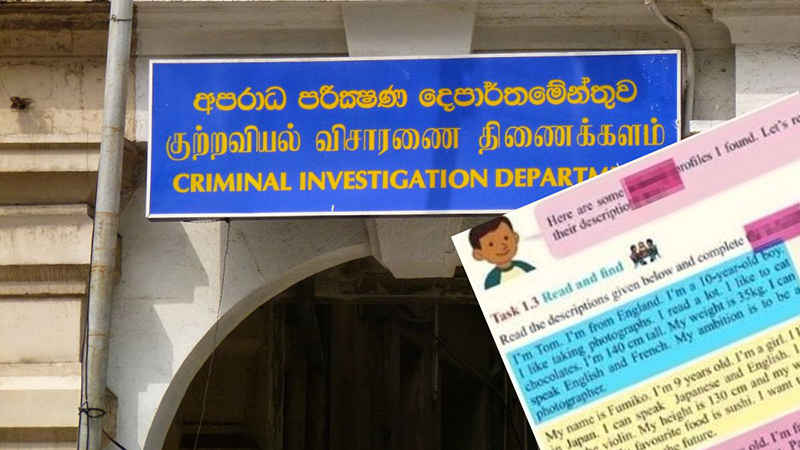
The CID has so far recorded statements from 15 individuals in connection with the Grade 6 English module, police headquarters sources said yesterday.
The CID stated that several officials of the National Institute of Education (NIE), Maharagama, are among those from whom statements have been obtained.
On Thursday, the CID also recorded a statement from Venerable Ulapane Sumangala Thera.
Several parties, including the Secretary to the Ministry of Education, had previously lodged complaints with the CID regarding the inclusion of the name of an inappropriate website in the Grade 6 English module.
by Norman Palihawadane ✍️

Engineers draw red line as CEBEU warns of union action over appointed date

Navam Perahera and sacred relics exhibition at Gangaramaya

CID sleuths still plodding on with their probe into controversial Grade 6 English module

Anusha Palpita remanded over alleged illicit assets

26th Edition: Journalism Awards for Excellence 2024

From colour to contour: Ramani Fernando on what next in 2026

‘Dates have the highest sugar content to fight Coronavirus’

Sunday Island 27 December – Headlines

#SundayIsland 17th December – Headlines

Sunday Island – 28th March

Sunday Island Headlines – 21 March

Sunday Island – 21st February – Headlines
-

 Features6 days ago
Extended mind thesis:A Buddhist perspective
-

 Opinion5 days ago
American rulers’ hatred for Venezuela and its leaders
-
 Business3 days ago
CORALL Conservation Trust Fund – a historic first for SL
-

 Opinion3 days ago
Remembering Cedric, who helped neutralise LTTE terrorism
-

 Opinion2 days ago
A puppet show?
-

 Opinion5 days ago
History of St. Sebastian’s National Shrine Kandana
-

 Features4 days ago
The middle-class money trap: Why looking rich keeps Sri Lankans poor
-
 Features2 days ago
‘Building Blocks’ of early childhood education: Some reflections