
Latest News
Brian Bennett blazes century but England scent three-day win after follow-on


The inequality between England and Zimbabwe as Test nations has been reflected on the field over the first half of this one-off Test match at Trent Bridge. Thursday’s flow of runs for the former was followed by a cascade of wickets from the latter, as Zimbabwe finished day two following on, 30 for 2, after being dismissed for 265 in their first innings, still 270 shy of England’s mammoth 565 for 6 declared.
And yet, the story on Friday was not of the dominating team, but of the dominated, as a lone hand by opening batter Brian Bennett to the tune of 139 made this one-way traffic watchable. Bennett’s second century in the format now ranks as Zimbabwe’s fastest, clocking in at 97 deliveries, and only their third against England.
The 21-year-old, playing in his seventh Test, now has four fifty-plus score in 12 innings. He did not take a backward step, with 104 of his runs from fours, most of them sweetly struck, including three in a row off Gus Atkinson that took him to three figures. Boundary numbers 18 (a square drive) and 19 (a punch down the ground) moved him to 99, before Atkinson offered enough width for a back-cut that was steered expertly through deep third.
An impassioned celebration was matched in the stands, as pockets of Zimbabwe supporters erupted with glee, in amongst a strong ovation from locals. And he kept all enterained with further crisp strikes, particularly down the ground, before England finally decided to test him with short deliveries.
They were vindicated when Josh Tongue, playing his first Test since the 2023 Ashes encounter at Lord’s, dug the penultimate legal delivery of the 53rd over into the armpit of Bennett, who fended to Ollie Pope at short leg. An acrobatic take was soon for nothing as replays showed Tongue had overstepped.
Bennett’s reprieve, on 139, was the fourth he had been given. But he could not make it count this time as the same duo combined legally to remove the right-hander in similar fashion, albeit with a far simpler take for Pope. Just 13 overs of play later, Bennett was making a second walk back, trapped LBW by Atkinson as the first to go in the follow-on innings for just one from nine deliveries.
As frustrating as England found Bennett’s enterprise, they were never really up against it, barring a period when his 65- and 60-run stands with Craig Ervine and Sean Williams respectively had the visitors sitting relatively pretty on 156 for 2. By the end, the hosts were able to tick off a few nuggets that may come to benefit them when India arrive next month.
Harry Brook’s morning cameo – eventually the last man to fall, for 58 – was a broadly useful hit out against a weary attack who were still a man down with left armer Richard Ngarava unable to take the field after his back spasm on day one. Five overs into Zimbabwe’s first innings, Sam Cook having become the first England debutant to bowl the first ball in his maiden innings since Martin McCague did so here in 1993 against Australia, registered his maiden Test wicket when Ben Curran edged to Brook at second slip.
That would be Cook’s lot from his opening 17 overs in the format, 1 for 72 and a fair few narrow misses, including Bennett edging through the cordon and past his own stumps on 16 and 32 respectively. But there was better luck for Shoaib Bashir, who became the youngest English bowler to take 50 Test wickets with the first of his 3 for 62 that has now more than doubled his first-class haul this summer. His first two across three matches for Glamorgan had come at a grim average of 152.00.
There was also encouragement for Ben Stokes, who bagged two wickets in 11 deliveries in his first appearance of the year after replacing Bashir in the attack following a botched caught-and-bowled attempt that split the off-spinners left ring finger.
Brought on first change at the Radcliffe Road End after 12 overs, Bashir started with a full toss that was guided through extra cover by Ervine, before producing a beauty to take the left-hander’s edge, low to Brook at first slip. A bit of bounce then did for Williams, who played onto his stumps.
It looked like Bashir was done for the day when Sikandar Raza, on three, danced down the wicket and smashed back at the bowler, who put in a valiant effort to his right to claim the return catch. Bloodied, and with two balls remaining in his 13th over, Bashir had to leave the field, with Stokes using the opportunity to bowl for the first time since his hamstring operation at the start of the year.
Having teased an over here or there to taper into form, citing bowling as the hardest thing to get right following an extended period out, Stokes almost made an immediate impact. His first legal delivery – having started with a front-foot no ball – squared up Bennett on 89 but was shelled inexplicably by Root at first slip.
The error meant Stokes had to make do with a remarkable spell of two dismissals in 11 balls rather than three in 14. He was finally on the board with a devilish delivery that turned Raza inside-out – this time an edge flying through to Jamie Smith behind the stumps – before Wessly Madhevere was unpicked by the surprise inswinger after a diet of outswingers, handing the No.6 batter a 10-ball duck.
Bashir eventually returned in the evening session, and made up for lost time with an immediate pearler when reintroduced to the attack for the 57th over, bowling Tafadzwa Tsiga through the gate with a classic off-break. An aborted caught-and-bowled chance off Blessing Murzarabani was a wilfully missed opportunity for a fourth, his injured finger clearly a factor, but the end came quickly when Atkinson found the tall quick backing away for the ninth and final dismissal.
Atkinson soon had his third of the day when Bennett was undone by a lack of bounce, and Ervine’s tame bunt to short leg – another for the Tongue-Pope combo – was followed by a slow trudge off from the Zimbabwe captain.
Even allowing for Bennett’s brilliance, it has been a tough couple of days for otherwise willing opponents. Day three promises to be tougher still.
Brief scores:
Zimbabwe 265 in 63.2 overs (Brian Bennett 139, Craig Ervine 42, Sean Williams 25, Tafadzwa Tsiga 22; Gus Atkinson 2-58, Shoaib Bashir 3-62, Ben Stokes 2-11) and [f/o] 30 for 2 in 10 overs (Sean Williams 22*, Ben Curran 4*; Gus Atkinson 1-01)trail England 565 for 6 dec in 96.3 overs (Ollie Pope 171, Ben Duckett 140, Zak Crawley 124, Harry Brook 58; Blessing Muzarabani 3-141) by 270 runs
[Cricinfo]

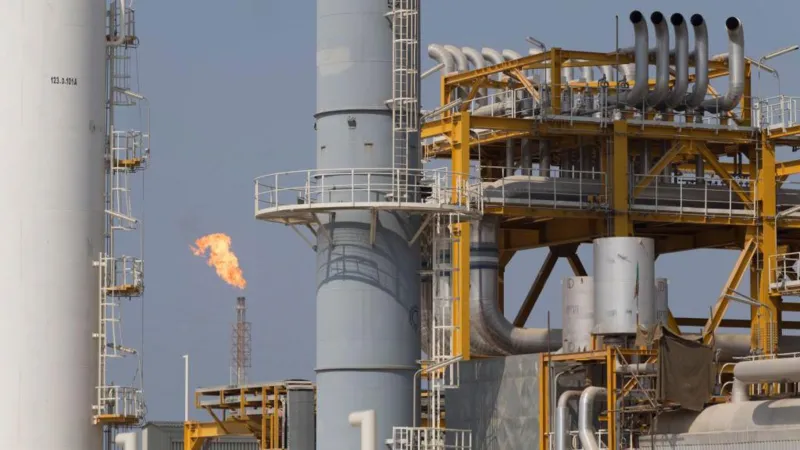
Oil prices leapt to nearly $110 a barrel after Iranian media reported an airstrike hitting a facility on the world’s largest natural gas field.
The Brent crude oil benchmark hit $109.91 a barrel just after 14:30 GMT, more than 5% higher than Tuesday’s prices, but has since fallen slightly.
The benchmark UK gas price also jumped by 6% to 143.53p a therm before falling back below the 140p mark.
The surge followed reports Iran’s petrochemical complex on the South Pars gas field had been hit. Several hours later, Qatar reported that there was “extensive damage” at the Ras Laffan industrial site following threats from Iran.
While the price of both oil and gas spiked, they remained below highs seen earlier in the conflict.
Oil reached $116.78 a barrel on 9 March, while UK gas reached 162.55p a therm on 3 March.
Iran’s oil ministry said a fire at the petrochemical complex was under control, according to Tasnim, a news agency affiliated with the Islamic Revolutionary Guard Corps.
Iran’s military warned it would take “decisive action” in response to the strike on its energy infrastructure.
“As previously warned, if the fuel, energy, gas, and economic infrastructures of our country are attacked by the American-Zionist enemy, in addition to a powerful counterattack against the enemy, we will severely strike the origin of that aggression as well,” the military said in a statement published by Tasnim.
“We consider targeting the fuel, energy, and gas infrastructures of the countries of origin legitimate and will retaliate strongly at the earliest opportunity.”
Qatar also operates facilities on the gas field, which it calls North Dome.
But the country, which produces a fifth of the world’s liquefied natural gas, had halted production earlier in March in response to the conflict.
Qatar’s foreign ministry spokesman Majed Al Ansari said strikes against energy infrastructure “constitutes a threat to global energy security”.
Just after 1815 GMT, the Qatari interior minister said it was responding to “a fire in the Ras Laffan area following an Iranian targeting”. Qatar’s petrol firm QatarEnergy later said there was “extensive damage” at the site.
The interior minister said just after 1900 GMT that it had “initially brought the fire in Ras Laffan under control, with no injuries reported”.
Ras Laffan was among the sites listed by Iran in a warning that it would take “decisive action” after its South Pars gas field facilities were reportedly hit by Israeli strikes.
‘Energy markets will likely remain volatile’
AJ Bell’s head of financial analysis Danni Hewson said the attack and retaliation by Iran had “helped dial up the temperature once again and put renewed upward pressure on oil prices”.
“Any solution to the blockage of the Strait of Hormuz looks pretty distant at this point and until there is progress on that front, energy markets will likely remain volatile,” she added.
The White House on Wednesday responded to the rising oil price by saying it was suspending the Jones Act — a 1920 law that says only American-made ships can be used to transport goods between US ports.
US Press Secretary Karoline Leavitt said the 60-day waiver of the rules, which are intended to boost shipbuilding, will allow “vital resources like oil, natural gas, fertiliser, and coal to flow freely” as non-American-made ships can now be used.
However, maritime groups in the US said the effect would be minimal, noting that oil prices, not shipping costs, are behind rising prices at the pump.
Experts say earlier efforts by world leaders to ease price pressures, including an unprecedented release of oil reserves, have done little to reduce oil prices.
Meanwhile, Iran has also suspended the flow of gas to Iraq to shore up domestic supplies, a senior Iraqi official told Reuters.
The vast majority of Iran’s gas supply – 94% – is used domestically, according to data from the Gas Exporting Countries Forum.
[BBC]
Latest News
Heat Index at ‘Caution Level’ in the Western, Sabaragamuwa, North-central, Southern and North-western provinces and in Monaragala, Mannar, Vavuniya and Mullaitivu districts
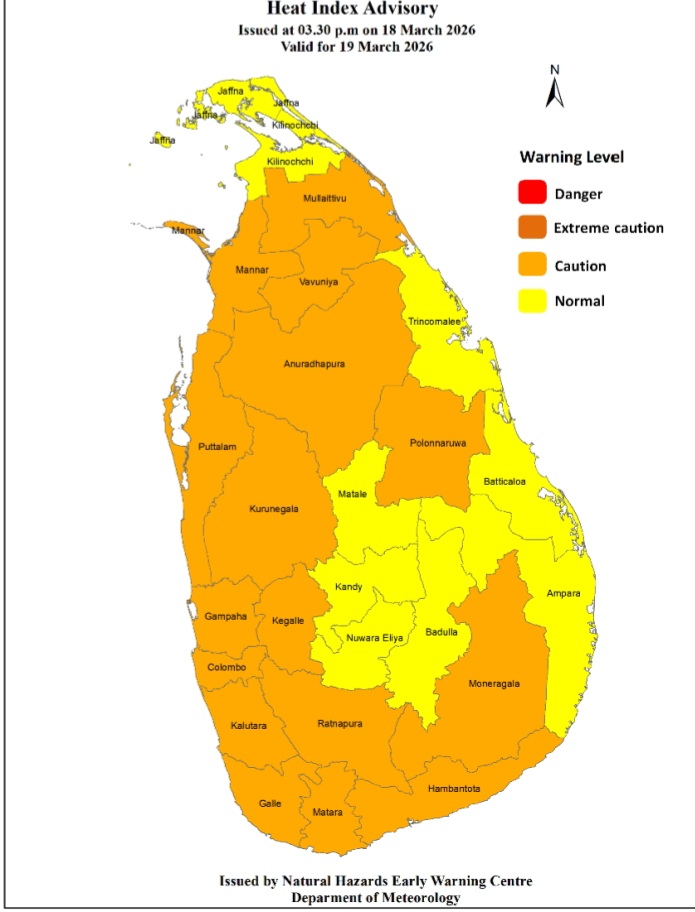
Warm Weather Advisory Issued by the Natural Hazards Early Warning Centre of the Department of Meteorology at 3.30 p.m. on 18 March 2026, valid for 19 March 2026
The general public are cautioned that the Heat index, the temperature felt on human body is likely to increase up to ‘Caution level’ at some places in the Western, Sabaragamuwa, North-central, Southern and North-western provinces and in Monaragala, Mannar, Vavuniya and Mullaitivu districts.
The Heat Index Forecast is calculated by using relative humidity and maximum temperature and this is the condition that is felt on your body. This is not the forecast of maximum temperature. It is generated by the Department of Meteorology for the next day period and prepared by using global numerical weather prediction model data.
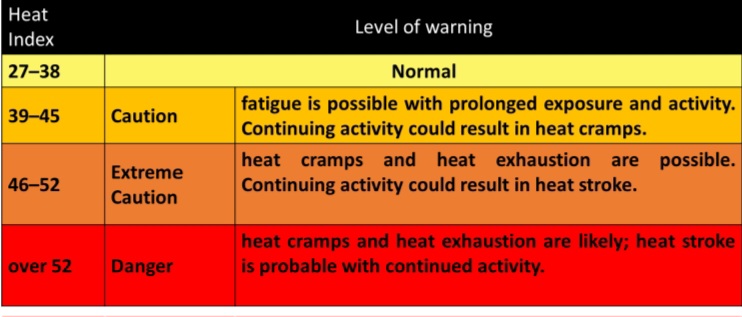
Effect of the heat index on human body is mentioned in the above table and it is prepared on the advice of the Ministry of Health and Indigenous Medical Services.
ACTION REQUIRED
Job sites: Stay hydrated and takes breaks in the shade as often as possible.
Indoors: Check up on the elderly and the sick.
Vehicles: Never leave children unattended.
Outdoors: Limit strenuous outdoor activities, find shade and stay hydrated.
Dress: Wear lightweight and white or light-colored clothing.
Note:
In addition, please refer to advisories issued by the Disaster Preparedness & Response Division, Ministry of Health in this regard as well. For further clarifications please contact 011-7446491.

Four persons including a Budhist monk died and 32 others were injured when two SLTB buses collided head on at Weerawila at arond 12 noon today (18).
Three of the deceased were women. 22 of the injured were admitted to the Hambanthota Hospital while 10 others have been admitted to the Debarawewa hospital.

King Charles praises ‘living bridge’ with Nigeria at glitzy banquet

Our objective is to ensure that the Commission to Investigate Allegations of Bribery or Corruption operates as an independent institution, free from any external influence – PM

Showers above 50 mm can be expected at some places in the Central, Sabaragamuwa and Uva provinces and in Ampara district.

Oil nears $110 a barrel after gas field strike

Iran’s intelligence minister Esmail Khatib killed in air strike

Heat Index at ‘Caution Level’ in the Western, Sabaragamuwa, North-central, Southern and North-western provinces and in Monaragala, Mannar, Vavuniya and Mullaitivu districts

‘Dates have the highest sugar content to fight Coronavirus’

Sunday Island 27 December – Headlines

#SundayIsland 17th December – Headlines

Sunday Island – 28th March

Sunday Island Headlines – 21 March

Sunday Island – 21st February – Headlines
-

 Business3 days ago
Browns EV launches fast-charging BAW E7 Pro at Rs. 5.8 million
-

 Life style4 days ago
From culture to empowerment: Indonesia’s vision for Sri Lanka
-

 News1 day ago
CIABOC questions Ex-President GR on house for CJ’s maid
-

 Opinion6 days ago
M. D. Banda: Memories of Appachchi – II
-

 Business5 days ago
Sri Lanka Institute of Information Technology raises the bar for academic excellence
-

 Latest News4 days ago
QR code system will be implemented for fuel with effect from 06.00 a.m. today (15th)
-

 News2 days ago
Australian HC debunks misleading travel risk claims for Sri Lanka
-

 News5 days ago
Crypto loopholes funnel Lankan funds abroad