
Latest News
Brandon King, Rovman Powell turn on the power as West Indies surge to 2-0 lead

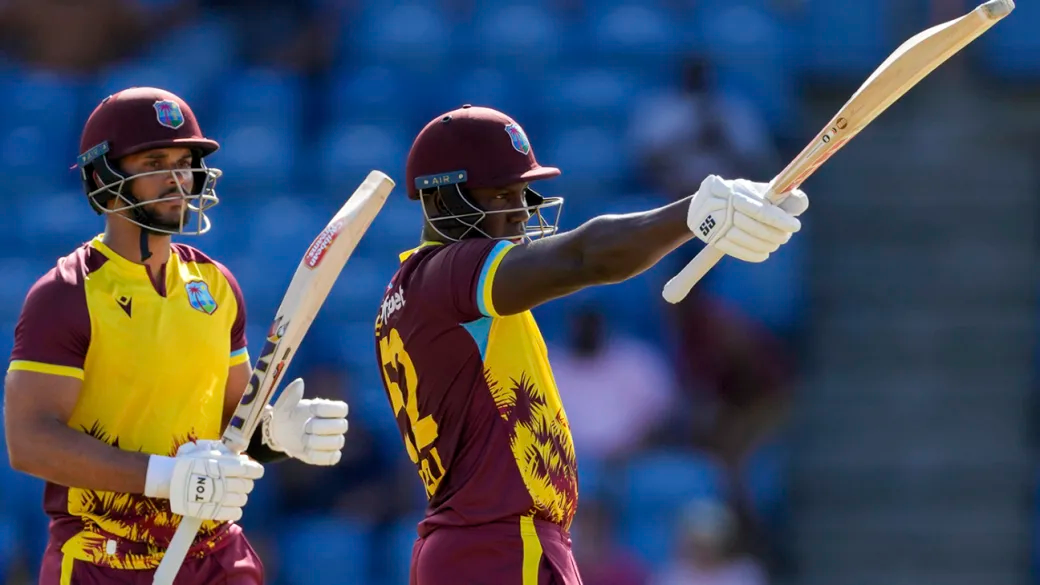
Brandon King and Rovman Powell produced the power surge that England’s renowned white-ball hitters couldn’t come close to replicating, as West Indies romped to a 2-0 series lead with a victory in Grenada that was significantly more emphatic than the final 10-run margin would have you believe.
Such a result didn’t seem on the cards when a collapse of 4 for 11 in 16 balls left West Indies rocking at 54 for 4 in the ninth over of the match, at which point England’s twin-spin attack of Adil Rashid and Rehan Ahmed were in complete command of the contest.
And yet, West Indies turned the tables in startling fashion, first through a brace of half-centuries from Powell, who belted 30 runs off Sam Curran’s second and final over, and King, whose superb unbeaten 82 from 52 included three sixes and four fours off the last 12 balls of Rehan’s day.
And then, with a stiff but attainable 177 to defend, West Indies served up a spin stranglehold of their own, as the left-armers Akeal Hossein and Gudakesh Motie put a lock on the contest for eight consecutive overs from the Pavilion End. They produced the combined figures of 3 for 33, and though Curran showed gumption to top-score with 50 from 32 balls after his chastening bowling display, a requirement of 28 off the final over proved way beyond Rehan and Moeen Ali.
West Indies owed their victory in the opening T20I to a familiar trait, with their pain-train of batters out-thumping England by 14 sixes to six. Today was a similar story – 13 played eight in the final analysis, including Rehan’s penultimate-ball slap over point when the game was already lost.
For the first half of their bowling effort, however, England appeared to have mitigated for that threat. Three of West Indies’ sixes duly came in the powerplay, but then, so too did 18 dot-balls, or half of their allocation, as the recalled Moeen burgled a three-run opening over before Chris Woakes’ crafty use of the cutter gave him the final say in an engaging duel with Kyle Mayers.
With memories of the record-breaking 46-six ODI on this same ground in 2019, Jos Buttler had had no compunction about bowling first after winning the toss, safe in the knowledge that a hefty chase was on the cards. The fact is, their eventual target wasn’t nearly as stiff as he might have bargained for, yet England were still a distant second-best.
Master and apprentice, heir apparent and all that, from the moment he bowled England to the Under-19 World Cup final two years ago, there was never much doubt that Rehan would eventually take over the mantle of England’s attack-leading legspinner across formats.
What was less obvious, however, was that there would be a period, in Rehan’s international infancy and at the tail-end of Rashid’s magnificent career, that the pair would dovetail as a twin-spin force to be envied. And to judge by their thrilling post-powerplay surge, that time might just be now, notwithstanding the gulf that eventually emerged between their eventual figures.
After entering the attack for the seventh over, Rashid was first to strike, just three balls into his spell, as Nicholas Pooran was flummoxed by a diet of loopy googlies and surrendered with a loose hack to long-on. Rehan then went one better – his second delivery burst through the defences of the in-form Shai Hope, dipping and ripping into off stump to dispatch him for 1 from 3.
Not to be outdone, Rashid took the baton back in his very next over, confounding Shimron Hetmyer with a wonderful double-whammy – a huge air-ball first-up that plopped on a middle-and-leg line, followed by a flatter flipper outside off next-up that Hetmyer could only prod uneasily to Moeen at slip.
By the time their five-over alliance was done, West Indies were listing at 68 for 4 after 11, with King’s forceful thump through the line off Rehan being their only boundary in 31 balls. That, inevitably, was about to change.
Unwittingly or otherwise, Rehan’s change of ends marked the start of West Indies’ charge. His first ball was too full and got the treatment as King climbed handsomely through the line. A fumble from Woakes at long-on then gave way to a beastly slog-sweep for King’s fourth six, and a 33-ball half-century, whereupon Powell unleashed a muscular thrash off Tymal Mills to bring up the hundred inside the 14th over.
Rashid returned to restore some short-term order. His fourth and final over yielded a trio of singles, for the outstanding figures of 2 for 11, but Powell was only just getting started. Curran’s fragile form has been a concern for some months now, and now he found himself fully exposed by the most expensive over of his career.
It started, as these things sometimes do, with a hint of misfortune, as Powell’s under-edge eluded both his stumps and Buttler’s dive. But thereafter it was carnage. Twice Curran took the pace off, twice he was butchered high over the ropes. Twice he aimed fuller, and was launched brutally down the ground. In between whiles, he tried to hide the ball and was done for a brace of wides.
The fourth of Powell’s sixes brought up his 27-ball fifty, and he might have made it five in the over had Brook at long-on not intercepted with a brilliant full-stretch dive. But his departure didn’t exactly slow West Indies’ onslaught. King was waiting for Rehan’s return, and made it 48 in two overs with three fours and a mighty slog over deep midwicket, as the rookie retreated with 1 for 47, his most bruised figures of the tour so far.
At least Mills had the experience to restore a degree of order. He’d been quietly effective across his first two overs and utilised his startling range of pace-on and -off deliveries to limit King and Andre Russell to an exchange of four singles in his third. Russell, inevitably, connected with two sixes before the innings was done, including a remarkable leaping uppercut off long-off, but Mills struck back with a pinpoint slower ball before making two in two to wrap up the 20 overs, as Jason Holder holed out to cow corner.
Left-arm round, wide on the crease, angled into the body, cramping the ambitions of a succession of eager right-handers. It was a simple recipe, devastatingly deployed, as Hosein and Motie – only playing due to a knee niggle for Romario Shepherd – dovetailed to perfection.
Three overs for Hosein in the powerplay, four overs for nine runs for Motie thereafter, then one final over for Hosein, in which the dangerous Harry Brook became the third and final of their combined victims. The lack of gumption in England’s approach was palpable, not least from the listless Buttler, whose attempt to give Hosein the charge ended with a limp push to short cover – either that or accept he was about to be stumped by a mile.
And while that lockdown was being enacted, Alzarri Joseph had licence to crank it up from the far end. His extra pace had been something of a liability in the preceding contests of this tour, but now his pounding of the pitch from just back of a length, with awkward lift into the body and a succession of catchers lined up on the leg-side, was all West Indies needed to turn the screw on their opponents.
His methods did for both Phil Salt and Will Jacks inside the first ten overs, both men falling in the mid-20s having struggled to turn their proactive intent into anything telling. And though Joseph’s figures were dented in his third over as Curran – promoted to No. 5 and responding with a 31-ball fifty that was, remarkably, the first of his T20I career – the first ball of his fourth effectively sealed the deal, as Hosein clung onto a skewed drive to point.
Up until that point, the only real threat to West Indies’ hegemony had come via an off-day with the ball for Andre Russell. After figures of 3 for 19 on Tuesday, he went wicketless for 66 this time, including a 22-run second over that featured an all-too-rare sighting of Liam Livingstone in power-hitting mode. Before he could turn his 17 from seven into anything substantial, Motie was on hand to saw him off.
Brief scores:
West Indies 176 for 7 (Brandon King 82*, Rovman Sam Powell 50,Moeen Ali 22*; Adil Rashid 2-11, Tymal Mills 2-30) beat England 166 for 7 (Phillip Salt 25, Will Jacks 24, Curran 50, Akeal Hossein 2-24, Alzarri Joseph 3-39) by 10 runs
(Cricinfo)








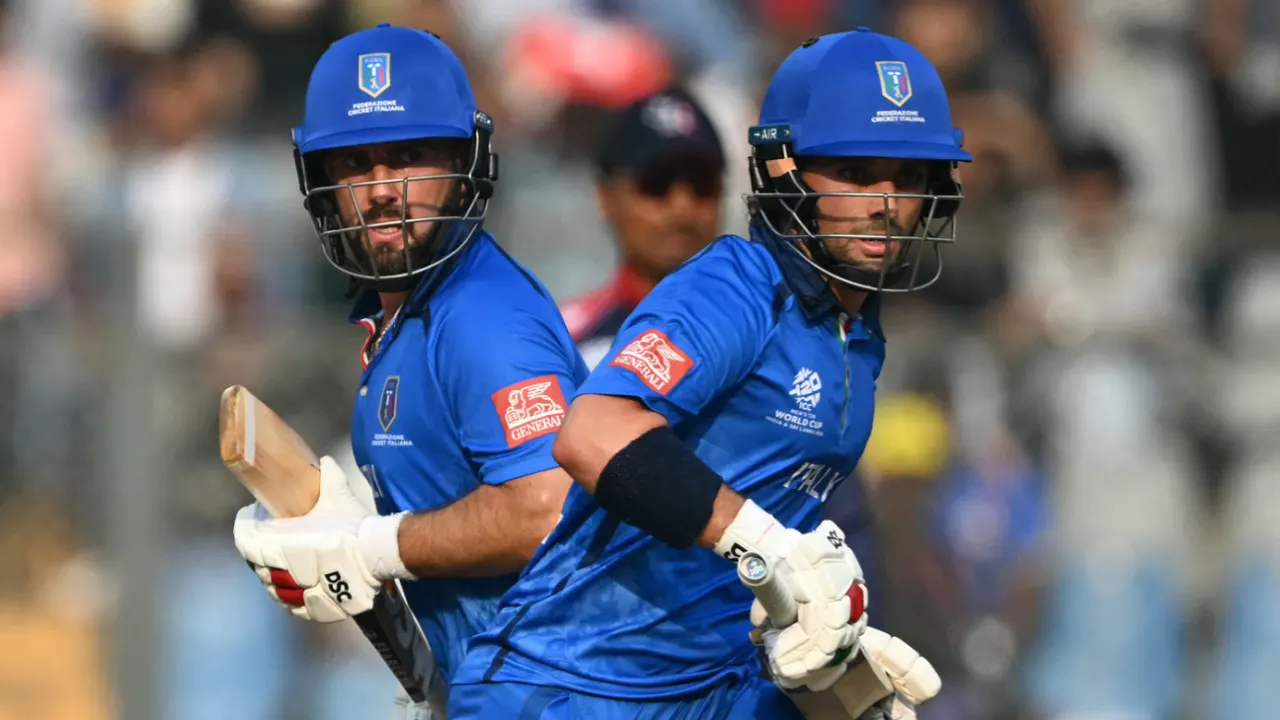
In only their second World Cup outing, Italy claimed a clinical first win, silencing a largely Nepal supporting crowd in Mumbai. After the bowlers restricted Nepal effectively on a worn surface, Italy’s opening pair, the Sydney-raised brothers, Justin and Anthony Mosca, then rampaged to the target on their own, both notching half-centuries to seal victory with more than seven overs to spare.
Nepal, having run England so close in their opening match, came in as the favoured side – in terms of both their pedigree at global events and the backing in the stands. But they struggled to get going with the bat after being inserted, with Aasif Sheikh’s 27 off 24 the top score of an underpowered effort. Italy’s spin attack were superb, Crishan Kalugamage , Ben Meneti and JJ Smuts claiming combined figures of 6 for 49 from their 12 overs.
Needing to score at little more than a run a ball, Italy were in no mood to get bogged down. Anthony Mosca hammered his second ball for a towering six over midwicket and, after a slower start, Justin soon joined his brother in targeting the boundary. Justin was the first to 50, from 37 balls, with Anthony bringing up the milestone from just 28 balls with another blazing slog-sweep moments later. It was Anthony who completed the Italian job with a single into the covers to spark jubilation on the sidelines.
The Wankhede is used to dominant displays from a team in blue, but few would have expected such a thrashing to be handed out by the Azzurri. Not least because they came into this match without their captain, Wayne Madsen, and having suffered a heavy defeat to Scotland in their opening match in Kolkata. Nepal, meanwhile, we looking to record their third win in T20 World Cups – and first since 2014.
Given their strengths, Nepal might have fancied their chances defending a low total on the same surface where spin played such a key role in Wednesday’s game between West Indies and England – but any such thoughts were quickly dispelled. Anthony Mosca, the elder brother, was particularly brutal in taking apart an experienced Nepal attack, while both openers used the crease intelligently to target scoring opportunities.
Having needed a few balls to get in, Justin Mosca took 14 off Karan KC’s second over, then the brothers traded sixes off Lalit Rajbanshi’s only over to raise Italy’s 50 at the end of the fourth over. Even the early introduction of Nepal’s trump card, legspinner Sandeep Lamichhane, could not slow the Moscas’ advance, as Anthony cleared long-off and then dragged past short fine leg to leave Italy 68 for 0 at the end of the powerplay.
From there, with 56 required off 84, they could tick along towards individual milestones – and by reaching the target in tandem, they recorded the highest partnership between siblings in all T20 internationals, beating the 119 added by Kathryn and Sarah Bryce for Scotland against Netherlands at the 2019 Women’s T20 World Cup qualifier.
Italy’s victory was a family affair, with Harry Manenti – younger brother of Ben – standing in for the injured Madsen as captain. “Our goal was always to compete at this level,” Harry said afterwards. “We didn’t quite nail it the other day [against Scotland] but we showed the world what we’ve got.”
T20 isn’t the format that naturally lends itself to catenaccio – the famed Italian approach to football which is focused on defence – but Italy went about restricting Nepal superbly after opting to bowl first. The surface was the same as that used for West Indies’ win over England the night before, and stroke-making looked to be a challenge as Ben Manenti started with a maiden over to Kushal Bhurtel.
Bhurtel took eight balls to get off the mark, found the boundary with his ninth and then was dismissed from his tenth, miscuing a slash off Ali Hasan straight to cover point. Nepal were 10 for 1 after three overs, but got going with Aasif Sheikh picking up back-to-back boundaries in Hasan’s second over. Paudel then got the crowd on their feet with sixes off JJ Smuts and Grant Stewart, as they ended the powerplay in better shape on 46 for 1.
However, Italy returned to spin and reapplied the defensive press. Paudel was dismissed in Crishan Kalugamage’s first over, hoicking a googly to long-on, and two balls later both set batters were gone: Aasif Sheikh overbalanced against Manenti’s arm ball, leaving his toe on the line as Gian-Piero Meade whipped off the bails.
A hard-running partnership of 44 off 39 ensued between Aarif Sheikh and Dipendra Singh Airee. Just three boundaries were scored between the end of the powerplay and the fifth ball of the 18th over as Nepal scrambled to get a score on the board. Airee had helped take down Adil Rashid as they gave England a scare, but he struggled for timing this time around before being bowled by Italy’s legspinner, Kalugamage smuggling a googly through the gap to hit off stump.
That triggered a disastrous collapse, from 93 for 3 to 102 for 8. Lokesh Bam hauled Ben Manenti to deep midwicket, Aarif Sheikh picked out deep backward square leg off Smuts and Kalugamage bagged a third when Gulsan Jha holed out to long-on. Some shoddy running did for Nandan Yadav. Karan KC nailed the returning Hasan for six and four to briefly re-energise the Nepali support in the stands, but two wickets in three balls at the start of the 19th saw them bowled out short of their allocation.
Brief scores:
Italy 124 for 0 in 12.4 overs (Anthony Mosca 62*, Justin Mosca 60*) beat Nepal 123 in 19.3 overs (Aasif Sheikh 20, Rohit Paudel 23, Dipendra Singh Airee 17, Aarif Sheikh 27, Karan KC 18; Ben Manenti 2-09, Ali Hasan 1-34,JJ Smuts 1-22, Crishan Kalugamage 3-18, Jasprit Singh 1-08) by 10 wickets
[Cricinfo]

North Korean leader Kim Jong Un has selected his daughter as his heir, South Korea’s spy agency told lawmakers on Thursday.
Little is known about Kim Ju Ae, who in recent months has been pictured beside her father in high-profile events like a visit to Beijing in September- her first known trip abroad.
The National Intelligence Service (NIS) said it took a “range of circumstances” into account including her increasingly prominent public presence at official events” in making this assessment.
The NIS also said it would keep close tabs on whether she will attend the North’s party congress later this month – its largest political event that is held once every five years.
The party Congress is where Pyongyang is expected to give more details about priorities like foreign policy, war planning and nuclear ambitions for the next five years.
On Thursday lawmaker Lee Seong-kwen told reporters that Ju Ae, who was previously described by the NIS as being “trained” to be a successor, was now at the stage of “successor designation”.
“As Kim Ju Ae has shown her presence at various events, including the founding anniversary of the Korean People’s Army and her visit to the Kumsusan Palace of the Sun, and signs have been detected of her voicing her opinion on certain state policies, the NIS believes she has now entered the stage of being designated as successor,” Lee said.
Ju Ae is the only known child of Kim Jong Un and his wife, Ri Sol Ju. The NIS believes Kim Jong Un has an older son, but this son has never been acknowledged nor shown on North Korean media.
News of Ju Ae’s existence first emerged through an unlikely source: the American basketball player Dennis Rodman, who revealed to The Guardian newspaper back in 2013 that he “held baby Ju Ae” during a trip to the secretive state.
Ju Ae – who is believed to be 13 – made her first appearance on state television in 2022. She was shown inspecting North Korea’s latest intercontinental ballistic missile while holding her father’s hand.
She has since made frequent appearances on on state media, softening her father’s image of a ruthless dictator. She accompanied him to Beijing for China’s largest-ever military parade, where she was seen stepping off his armoured train at Beijing Railway Station.
She is often seen wearing her hair long, which is forbidden for her peers, and wearing designer clothes, which are out of reach for most in her country.
Another lawmaker, Park Sun-won said the role Ju Ae had taken on during public events indicated that she has started to provide policy input and is being treated as the de facto second-highest leader.
The North Korean power had passed down the three generations of the Kim family, and it is widely believed that Kim Jong Un will pass on the throne to Ju Ae.
In recent months, she was shown standing taller than her father, walking beside him, rather than following him.
In North Korea, where photos published by the state media are believed to carry a great symbolic weight, it is rare for individuals other than Kim Jong Un to be positioned equally prominently in the frame.
Although the South Korean spy agency now believes Ju Ae is the designated heir, it still raises questions.
It is puzzling why Ju Ae, a daughter, would be selected as the heir above an older son in North Korea’s deeply patriarchal society.
Many defectors and analysts had previously dismissed the idea of a woman leading North Korea as an unlikely scenario, referring to the country’s entrenched traditional gender roles. But Kim Jong Un’s sister – Kim Yo Jong – does offer a precedent for female authority in the regime.
Kim Yo Jong currently holds a senior position in the Central Committee of the Workers’ Party of Korea, and is reported to have influence over her brother.
However, it is also a mystery why Kim Jong Un, who is still young and appears relatively healthy, is already designating a 13-year-old child as his heir now.
It is unclear what changes Ju Ae’s succession may bring to North Korea.
Many North Koreans hoped that Kim Jong Un, a Western-educated young man, would open their country up to the outside when he succeeded his father.
Yet such hope was unfulfilled. Whatever plans this teenager may have for her country, she would likely have the singular power to shape it however she likes.
[BBC]
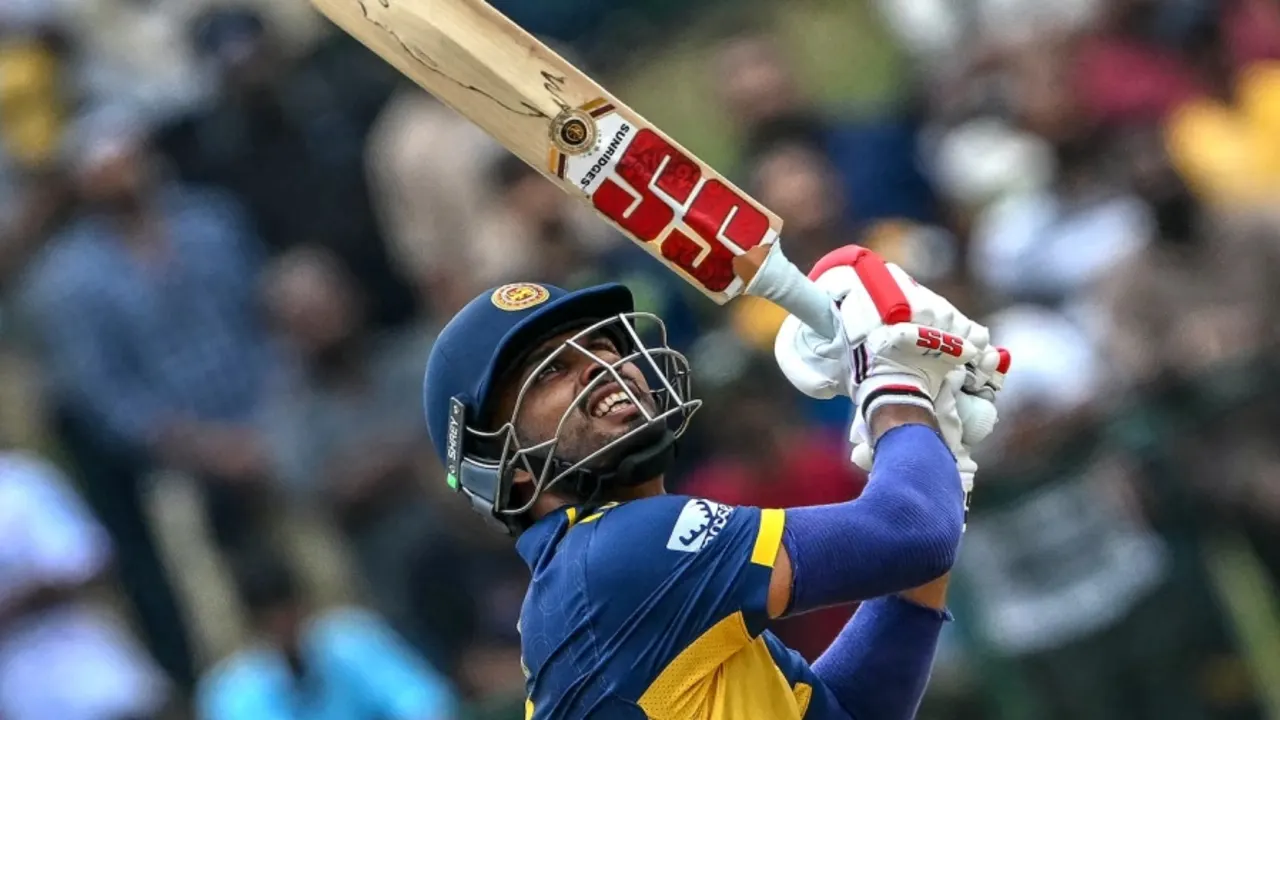
Sri Lanka’a powerful middle order blew Oman away in Pallekele, helping them sweep to a 105-run win. In perhaps the most one-sided game of the T20 World Cup so far, Dasun Shanaka struck Sri Lanka’s fastest ever T20I half-century, in 19 balls, while a 28-ball 60 from Pavan Rathnayake and 61 by Kusal Mendis propelled Sri Lanka to 225, this World Cup’s highest score and Sri Lanka’s second-highest in T20 World Cups.
Oman did strike early when Jay Odedra cleaned up Kamil Mishara, but the wickets they took never stymied the flow of runs. Pathum Nissanka was trapped up front off the first ball of the sixth over by Sufyan Mehmood, but it still went for 16. And the middle overs saw Mendis ensure the run rate only ever kept rising. The fireworks from Rathnayake and Shanaka in the second half of the innings powered Sri Lanka well beyond Oman’s batting capabilities.
The total was never likely to be challenged, and while Oman tried damage limitation, even that was less than successful. Dushmantha Chameera cleaned up Jatinder Singh first ball, and Oman went on to lose two more wickets in a powerplay where only 36 runs were scored. Maheesh Theekshana was sensational throughout his four-over spell, conceding just 11 runs, and made the task much easier for his fellow bowlers. Much of what followed was both sides largely going through the motions. Oman limped to 120, largely thanks to Mohammad Nadeem’s half-century – which makes him the oldest half-centurion at a men’s T20 World Cup. But it was little more than a footnote as Sri Lanka romped to victory in Pallekele’s first match at this World Cup.
In the overs when a bowling side might generally be expected to rein in the scoring, Oman’s disciplines wavered, and Sri Lanka made them pay. The three overs after the powerplay produced just 21 for Sri Lanka, but as Wasim Ali was wrapping up another tidy over, he overstepped, and then overstepped on the free-hit ball again. The over ended up leaking 17, and kicked off a four-over spell where 54 runs were scored. It set up the perfect platform for Rathnayake and Shanaka to exploit at the death.
By the 15th over, Sri Lanka were on course for a total beyond Oman’s reach, but the carnage was only just starting. Shanaka had made a sedate start, with seven in his first seven balls, but would need just 12 more to get to 50, beating his own Sri Lankan record for the fastest T20I half-century. It began with a six and a four off Jiten Ramanandi before Nadeem Khan was carted around for a 20-run over, and Sufyan for 19 more. The last five overs fetched the hosts 79, comfortably the highest at the death at this World Cup.
His wicket-taking days weren’t done, though, and he demonstrated a willingness to come on anytime the batters clawed the slightest momentum back. Dushan Hemantha was hit for two sixes in the 11th by Wasim Ali, and Theekshana was straight back on, and had Wasim caught behind before the over was out. He rounded out his spell with a miserly one-run over, finishing with 2 for 11, comfortably the most economical four-over spell this World Cup.
Brief scores:
Sri Lanka 225 for 5 in 20 overs (Pathum Nissanka 13, Kusal Mendis 61, Pavan Rathnayake 60, Dasun Shanaka 50, Kamindu Mendis 19-; Jay Odedra 1-14, Sufiyan Mahmood 1-60. Jiten Ramanandi 2-41) beat Oman 120 for 9 in 20 overs (Mohammad Nadeem 53*, Wasim Ali 27; Maheesh Theekshana 2-11, Dushmantha Chameera 2-19, Dunith Wellalage 2-17, Dushan Hemantha 1-45, Kamindu Mendis 1-10) by 105 runs
[Cricinfo]

Showers expected in the Central, North-central , Uva, Eastern, Southern and Northern provinces and in Kaluthara district

GL: Proposed anti-terror laws will sound death knell for democracy

SJB complains to bribery commission about alleged bid to interfere with evidence

Substandard Ondansetron: CIABOC launches probe

Shanaka fireworks helps Sri Lanka thrash Oman

Passport issuance resumes after system glitch fixed

‘Dates have the highest sugar content to fight Coronavirus’

Sunday Island 27 December – Headlines

#SundayIsland 17th December – Headlines

Sunday Island – 28th March

Sunday Island Headlines – 21 March

Sunday Island – 21st February – Headlines
-

 Features5 days ago
My experience in turning around the Merchant Bank of Sri Lanka (MBSL) – Episode 3
-

 Business6 days ago
Zone24x7 enters 2026 with strong momentum, reinforcing its role as an enterprise AI and automation partner
-

 Business5 days ago
Remotely conducted Business Forum in Paris attracts reputed French companies
-

 Business5 days ago
Four runs, a thousand dreams: How a small-town school bowled its way into the record books
-

 Business5 days ago
ComBank and Hayleys Mobility redefine sustainable mobility with flexible leasing solutions
-

 Business2 days ago
Autodoc 360 relocates to reinforce commitment to premium auto care
-

 Business6 days ago
HNB recognized among Top 10 Best Employers of 2025 at the EFC National Best Employer Awards
-

 Midweek Review2 days ago
A question of national pride