
News
Blamed for current crisis, Monetary Board before House Committee today


By Shamindra Ferdinando
Chairman of the Committee on Public Finance (CoPF) Anura Priyadarshana Yapa, MP, says they’ll inquire into the possibility of bringing former Governor of the Central Bank Ajith Nivard Cabraal before the Watchdog Committee inquiring into the conduct of the Monetary Board pertaining to the current crisis.
Governor, CBSL chairs the five-member Monetary Board.
Cabraal, who succeeded Prof. W.A. Lakshman as Governor, CBSL, in Sept last year, announced his resignation on Monday (04) with the resignation of virtually the entire Cabinet as the economic crisis triggered political mayhem with unprecedented protests that began with one outside President Gotabaya Rajapaksa’s residence at Mirihana.
SLPP lawmaker Yapa said that the Monetary Board members were scheduled to appear before the CoPF today (06).
Earlier, the Monetary Board was scheduled to appear before the CoPF on March 21. It was later rescheduled for March 24 but at the last moment, the CBSL informed the CoPF that the entire Monetary Board couldn’t attend the meeting as board member S. R. Attygalle, Secretary to the Ministry of Finance, was to hold discussions with the World Bank on that day.
Subsequently, the CoPF tried to arrange the meeting scheduled for April 01.
The Monetary Board consists of the Governor of the Central Bank (ex-officio), Treasury Secretary S.R. Attygalle (ex-officio), President’s Counsel Sanjeeva Jayawardena, Dr. Rani Jayamaha and Samantha Kumarasinghe.
Recently, former Deputy Governor of the Central Bank Dr. W.A. Wijewardena in a brief interview with The Island asserted that the country wouldn’t have landed in the current predicament if the Central Bank floated the Rupee in April 2021 during the tenure of Prof W.D. Lakshman as the Governor of the Central Bank.
Dr. Wijewardena said that the current crisis should be studied against the backdrop of the CBSL delaying the depreciation of the rupee till early March this year.
CoPF member Dr. Harsha de Silva said that Cabraal, who had served as the State Finance Minister before receiving the appointment as Governor, CBSL, quit the job within six months. Lawmaker de Silva asked what had happened to the former Governor’s six-month road map (Oct 2021-March 2022) meant to pave the way for economic recovery.
Alleging that the Monetary Board was responsible for the current predicament of the country, the former UNP State Minister said that the Monetary Board should be removed. The Colombo District lawmaker emphasised that the Monetary Board couldn’t absolve itself of the responsibility as all decisions taken by the outfit proved wrong.
MP de Silva said that the Monetary Board couldn’t be silent on the government’s failure to initiate talks with the IMF early last year when the SJB led the calls for IMF’s intervention. The MP emphasised that the government repeatedly rejected the SJB’s calls for IMF intervention. Dr. P. B. Jayasundera, former Secretary to President Gotabaya Rajapaksa, too, steadfastly opposed IMF’s intervention.
Former Senior Deputy Governor of the Central Bank Nandalal Weerasinghe, now domiciled in Australia, has been approached by the government to take over the position of Central Bank Governor.
Former Governor of the CBSL, Dr. Indrajith Coomaraswamy would help the government in an advisory capacity. Sources said so when asked whether Dr. Coomaraswamy would be accommodated in some relevant capacity to assist the government.


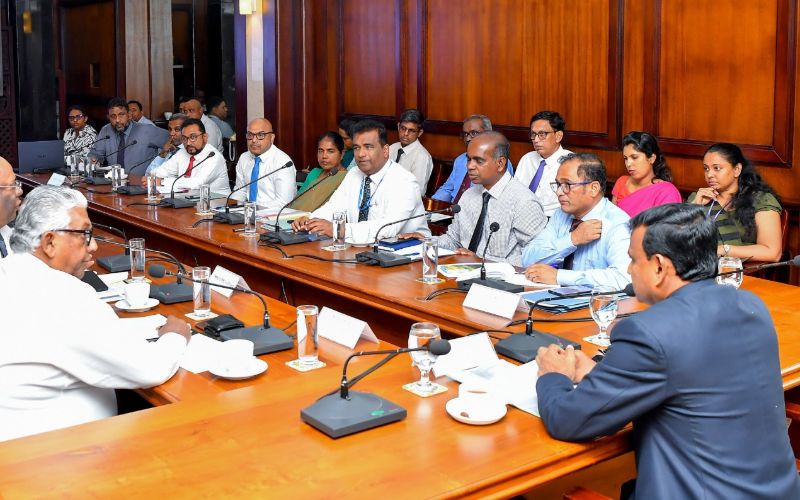
A discussion to review the progress of the housing project under which 4,700 houses are being constructed for the Malayagam community with Indian assistance was held this afternoon (24) at the Presidential Secretariat under the chairmanship of the Chief of Staff to the President, Prabath Chandrakeerthi.
Under this housing programme, 2,026 houses are to be provided to families identified by the National Building Research Institute (NBRI) as being at disaster risk. The remaining houses are expected to be allocated to eligible workers residing in the plantation sector.
Accordingly, the houses will be provided to Malayagam community families living on estates belonging to 22 Regional Plantation Companies, as well as estates under the State Plantations Corporation, Janawasama and Elkaduwa Plantations.
For the construction of each house, the Government of India has allocated Rs. 2.8 million, while the Government of Sri Lanka has contributed Rs. 400,000.
During the discussion, Chandrakeerthi instructed officials to ensure that the housing project is completed before the end of this year. He further directed that land identified for the construction of houses be released without delay and that the National Building Research Institute provide the necessary reports to identify suitable land for the project.
The housing project is being implemented jointly by the Ministry of Plantation and Community Infrastructure, the National Housing Development Authority, the State Engineering Corporation and the Plantation Human Development Trust.
Among those present were Additional Secretary (Development) of the Ministry of Plantation and Community Infrastructure, K. S. Wijayakeerthi; Director General (Engineering), N. D. N. Pushpakumara; Director General (Planning), W. A. K. S. Damayanthi; the Secretary General of the Planters’ Association; and officials from the National Housing Development Authority, the State Engineering Corporation, relevant institutions and plantation companies.
(PMD)

It has been reported that Attorney at Law Rakitha Rajapakshe, the son of former Minister of Justice Wijeyadasa Rajapakshe, has been arrested by the Commission to Investigate Allegations of Bribery or Corruption (CIABOC) over alleged links with the underworld.

… alleges NPP trying to implement UPFA, UNP plan
Front-line Socialist Party (FSP) yesterday (24) alleged that the NPP government’s move to amalgamate the Employees’ Trust Fund (ETF) and the Employees’ Provident Fund (EPF), under a unified, tripartite governance framework, would be detrimental to the private sector workers.
Addressing the media at Melder Place, Nugegoda, FSP spokesman Duminda Nagamuwa said that the Cabinet of Ministers approved this proposal on 15 June.
Nagamuwa claimed that the NPP was trying to implement what President Mahinda Rajapaksa had sought to do, in 2011, causing the police to open fire on a group of the Export Processing Zone workers, protesting against the move to create a private pension scheme. A worker, identified as Roshen Chanaka, was shot by police on May 30, 2011, and he succumbed to his injuries.
Pointing out that the EPF and the ETF had been established for the benefit of private sector workers but with different objectives, Nagamuwa warned that amalgamation of the two funds could cause unnecessary complications.
The FSP spokesman said that Ravi Karunanayake, in his capacity as the Finance Minister of the Yahapalana government, in late November 2015 had declared their intention to amalgamate the ETF with the EPF.
FSP’s Pubudu Jayagoda told The Island that they expected all political parties, other than the NPP, to disclose their stand on the vital issue. Jayagoda urged the Opposition to take a stand on the vital issue .
By Shamindra Ferdinando

Progress of Housing Project for Malayagam Community families funded by India reviewed

South Africa stun South Korea to reach World Cup knockouts for the first time

Tremors of 7.5, 7.2 kill 32, injure hundreds in Venezuela

Former Minister Wijeyadasa Rajapakshe’s son arrested by CIABOC

Morocco come back after historic Haiti goals to reach World Cup last 32

Strong earthquake strikes northern Japan

‘Dates have the highest sugar content to fight Coronavirus’

Sunday Island 27 December – Headlines

#SundayIsland 17th December – Headlines

Sunday Island – 28th March

Sunday Island Headlines – 21 March

Sunday Island – 21st February – Headlines
-

 News6 days ago
Creditor receives USD 2.5 mn as Lankan public bears loss from theft of Treasury funds
-

 News5 days ago
Creditor not yet paid
-
 News5 days ago
Consumers bearing 22% tax burden despite 18% VAT claim: Dr. Harsha de Silva
-

 Features4 days ago
Nanda Pethiyagoda Wanasundara as three generations of family saw her
-

 Features3 days ago
Sri Lanka developing independent hydrographic capabilities
-

 Opinion6 days ago
SriLankan Airbus struck by lightning
-

 Editorial4 days ago
Fuel crisis: Beyond price debate
-

 Latest News4 days ago
Sooryavanshi thumps fastest List A fifty as India A win tri-series