
Features
BIA’s Terminal 2 delays: jinx or blessing in disguise?

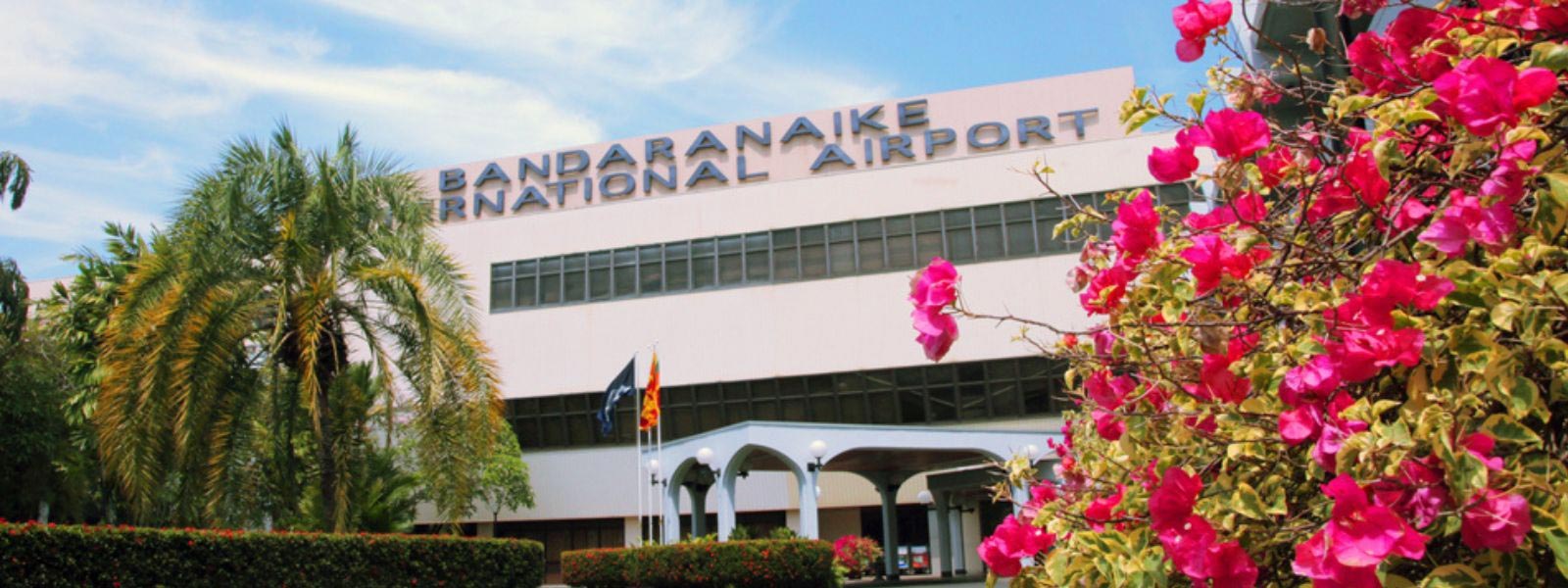
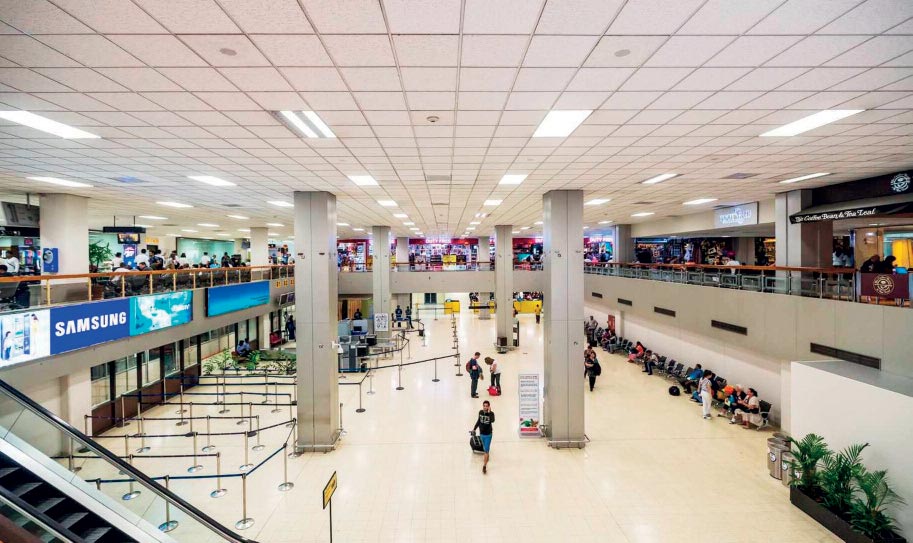
When it was conceptualized in 2012, the rationale for T2 was that the six million annual passenger capacity of Terminal 1 (T1) would not be able to serve the 14 million passengers expected by 2020. Accordingly, Sri Lanka borrowed JPY 74 billion (JPY 29 billion in 2012 and JPY 45 billion in 2016) from Japan, mainly to design and construct the 185,900 sqm T2 with a nine million passenger annual capacity, and to increase the total capacity of BIA to 15 million passengers by November 2019.
However, this project has taken many twists and turns since then. AASL and the government took 19 months after the design was completed and 52 months after the second loan agreement was signed to award the $357 million civil works contract in July 2020. The selected contractor, Japan’s Taisei Corporation, began the works in December 2020, despite COVID-19 restrictions and supply chain disruptions, which only eased in June 2021. Then came the debt crisis in early 2022 and subsequent price escalations.
Japan suspended the $405m project loan in July 2022. The contractor suspended the works in December 2022 and terminated the contract in mid-2023. By then, the original time for completion had almost elapsed, but only six percent of the works was completed. The slow progress is attributed to COVID-19 and events such as the engineer rejecting the subcontractor proposed by Taisei in July 2021. Nevertheless, according to the subcontractor’s company website, it completed the “first platform foundation” in November 2021.
Since Taisei’s termination, AASL has made numerous attempts to restart the works. They were rushing a new procurement because the work, for which Taisei was paid 15% of the contract amount, is deteriorating and will be unusable unless works restart immediately. It called for international bids in December 2023 for the major works and procured works worth $12 million from a local contractor through a national competition in April 2024.
From the international competition, a national contractor was chosen in July 2024 after Japan agreed with the government to lift the loan suspension. However, a Court of Appeal order on September 26, 2024 suspended the award based on a writ application by a competing bidder citing irregular procurement. Neither the winner nor the petitioner in this case is an experienced and reputable airport contractor. In fact, there is no record of them constructing even a domestic airport terminal.
Two days before the ruling, AASL again called for international bids. This competition, for which only two bidders entered, is also marred in controversy, and a contract has yet to be awarded as of June 30, 2025. Even if three years are attributable to delays because of the pandemic and the economic crisis, failure to deliver the project seven years after the loan signing is unusual.
Recent media reports have highlighted deficiencies in the design and supervision consultancy services of the AASL-selected Japan Airport Consulting (JAC). The T1 upgrading project that started in 1999 with Taisei and JAC as contractor and consultant, respectively, was delayed for 24 months. This implies that T2 is not jinxed, but AASL has failed.
So, why are these delays a blessing in disguise? Because they have created an opportunity for the government to change the mindset of AASL, modernize the design, and find an efficient financing modality to reduce its debt obligation. This approach is justifiable for several reasons. One, even if the contract is awarded in July 2025, delivering T2 in 30 months is a challenge. Two, the $690 million estimated cost of the works (assumed based on the two percent bid security of LKR four billion), which is 100% more than the original contract amount, is questionable. Three, SITA, an international airline agency, has forecast Colombo’s passenger traffic to be 14 million by 2027. Therefore, even if T2 comes on stream in 2028, the combined annual capacity of T1 and T2 of 15 million will soon be exceeded.
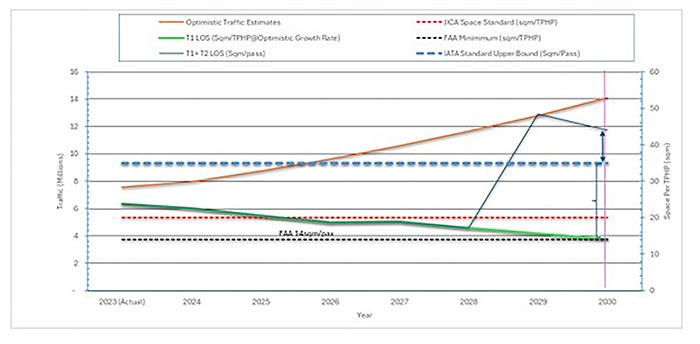
The fourth justification is the adequacy of T1. Passenger terminal capacity is better assessed using the peak period traffic instead of the annual traffic. The United States Federal Highway Administration (FAA) uses 14 sqm/TPHP (typical peak hour passenger), and the IATA uses 35 sqm/TPHP for estimating capacity. The standard used in JICA-funded projects elsewhere is 20 sqm/TPHP. JICA used 30 sqm/TPHP for the refurbished T1 in 2005 and 46 sqm/TPHP for T2.
However, the Figure below shows that at the FAA standard and IATA passenger growth rate, T1 has sufficient capacity until 2032. At the IATA standard and the IATA growth rate, T1 saturation will be in 2029. The saturation year can be further extended if AASL spreads the peak in consultation with the airline to reduce the TPPH in T1. This is a common practice in the airport industry to maximize capacity utilization. Therefore, T2 is neither urgent nor necessary at present. Tourism and economic growth will not be impeded by rescheduling the T2 commissioning to at least 2030. (See graph)
Last, but not least, justification is that AASL can update the current design, completed in 2018. It can introduce efficient energy sources, intelligent systems such as virtual queuing and robotics for baggage handling, and security systems such as biometric authentication and advanced imaging. The government can consider alternative financing options such as a PPP through a Swiss Challenge, like in the Philippines, and green financing and revenue bonds.
This is a huge opportunity to change the way of doing aviation business that must not be missed. Use this opportunity to give future travelers and taxpayers their value for money. In the interim, the government can continue with T1 upgrades, focusing on the travelers’ complaints about signing, seating, and staff attitude highlighted by Skytrax, an international air transport rating organization.
by Prianka Nalin Seneviratne, PhD, PE ✍️
fessor of Civil Engineering and Team Leader (Retd.)
Utah State University and Asian Development Bank


(A sequel to the two-part article, War with Iran and unravelling of the global order, published in The Island on April 8 and 9.)
The unfolding developments in the US-Israeli coordinated military attack against Iran reveal a striking paradox at contemporary geopolitics: efforts to weaken a state through coercion may, under certain conditions, contribute to its structural elevation within the international system. What appears as short-term tactical success can generate long-term strategic consequences that are neither anticipated nor easily reversible. In this context, the policies associated with Donald Trump and Benjamin Netanyahu, marked by unilateralism and the willingness to use force, risk producing precisely such an unintended outcome. Rather than marginalising Iran, their actions may be accelerating its re-emergence, not merely as a regional actor in the Middle East, but as a consequential player in the global geopolitics and the wider architecture of international supply chains of energy economy.
Iran not merely a state
Iran is not merely a state, but a civilisation with a distinctive political trajectory. At the heart of the present transformation lies its asymmetric strategy, rooted in the strategic exploitation of geography. Few states possess the capacity to shape the global system through geography alone. Iran’s proximity to the Strait of Hormuz, a narrow maritime passage through which a substantial share of the world’s oil and liquefied natural gas flows, endows it with a latent structural power that transcends conventional measures of national capability.
In periods of stability, this position translates into economic opportunity; in moments of crisis, it becomes a lever of systemic disruption. Recent tensions have demonstrated that even limited instability in this corridor can reverberate across global markets, triggering sharp increases in energy prices, disrupting supply chains, and amplifying inflationary pressures worldwide. Should Iran consolidate its capacity to influence or control this chokepoint, whether through military deterrence, asymmetric instruments, or diplomatic maneuvering, it would shift from being a participant in global energy markets to a pivotal arbiter of their functioning.
Energy-embedded global economy
The contemporary global economy is not merely energy-dependent; it is deeply energy-embedded. Hydrocarbons underpin not only transportation and electricity generation but also the production of petrochemicals, fertilisers, and a wide range of industrial inputs essential to modern manufacturing and food systems. Disruptions linked to Iran have already illustrated how shocks in the energy sector cascade through interconnected supply chains, affecting everything from agricultural output to high-technology industries. In this sense, Iran’s leverage is no longer confined to the traditional realm of resource geopolitics. It increasingly operates within a networked global system in which control over a single critical node can generate disproportionate influence across multiple sectors. This form of power, diffuse, indirect, and systemic, marks a departure from the more linear dynamics of twentieth-century oil politics.
The implications of such a shift are profound for the structure of the international order. For decades, the global system has been underpinned by a set of institutions, norms, and economic arrangements often described as the so-called liberal international order. Sanctions, financial controls, and diplomatic isolation have been key instruments through which dominant powers have sought to discipline states that challenge this order. However, Iran’s prolonged exposure to sanctions has compelled it to develop adaptive strategies: alternative trade networks, informal financial channels, and closer ties with non-Western partners. A crisis-induced re-entry into global markets would therefore not signify reintegration into the existing order, but rather the expansion of parallel systems that operate alongside, and sometimes in opposition to, it. In this context, Iran’s rise would contribute to the gradual fragmentation of the global economy, accelerating trends toward decoupling, regionalization, and the erosion of established institutional authority.
Decline of global order based on US hegemony
This process of fragmentation is closely linked to declining global order based on U.S. hegemony. A more globally consequential Iran would inevitably become a focal point in the strategic player in emerging multipolar world. For China, whose economic growth remains heavily dependent on secure energy supplies, deeper engagement with Iran would serve both economic and geopolitical objectives, reinforcing its presence in the broader Middle East and insulating it from vulnerabilities associated with maritime chokepoints. Russia, already positioned as a major energy exporter and a challenger to Western dominance, may find in Iran a complementary partner in reshaping global energy markets and contesting sanctions regimes. Meanwhile, countries across the Global South, including major importers such as India, would face a more complex strategic environment, characterized by heightened exposure to supply disruptions and increased pressure to navigate between competing power centers. In this emerging landscape, Iran would function less as an isolated actor and more as a pivotal node within a reconfigured network of global alignments.
Dynamics enhancing Iran’s strategic importance
Paradoxically, the very dynamics that enhance Iran’s strategic importance may also accelerate efforts to reduce dependence on the conditions that enable its influence. Recurrent energy shocks tend to catalyze policy responses aimed at diversification and resilience. States are likely to expand strategic reserves, invest in alternative supply routes, and accelerate transitions toward renewable energy and nuclear power. Over the longer term, such measures could diminish the centrality of fossil fuel chokepoints, thereby constraining Iran’s leverage. However, this transition will be uneven and contested. Advanced economies may possess the resources to adapt more rapidly, while developing countries remain structurally dependent on affordable hydrocarbons. In the interim, the global system may experience a prolonged period in which dependence on Iranian-linked energy flows coexists with attempts to transcend it—a duality that adds further complexity to the evolving geopolitical landscape.
Beyond material considerations, Iran’s potential re-emergence also signals a deeper transformation of the existing global order. Traditional metrics—military strength, economic size, technological capacity—remain somewhat important, but they are increasingly complemented by the ability to influence critical nodes within global networks. The capacity to disrupt, delay, or redirect flows of energy, goods, and capital can generate strategic effects that rival, or even surpass, those achieved through direct military confrontation. In this sense, Iran exemplifies a broader shift from territorial geopolitics to what might be termed network geopolitics. Control over chokepoints, supply chains, and infrastructural linkages become a central determinant of influence, enabling states with relatively limited ‘conventional’ capabilities to exert outsized impact on the international system.
Iran’s trajectory may be understood as a transition through several distinct phases: from a regional challenger seeking to assert influence within the Middle East, to a strategic disruptor capable of unsettling global markets, and ultimately to a systemic actor whose decisions carry worldwide consequences. This evolution is neither inevitable nor linear; it depends on a complex interplay of domestic resilience, external pressures, and the responses of other global actors. Nevertheless, the possibility itself underscores the unintended consequences of policies that prioritize short-term coercion over long-term strategic foresight.
Transition shaped by paradoxes
In historical perspective, moments of systemic transition are often shaped by such paradoxes. Actions taken to preserve an existing order can, under certain conditions, accelerate its transformation. The current crisis involving Iran may represent one such moment. By elevating the strategic significance of energy chokepoints, exposing the vulnerabilities of interconnected supply chains, and encouraging the development of alternative economic networks, it contributes to a broader reconfiguration of global power. In this emerging context, Iran’s re-emergence as a global actor would not simply reflect its own capabilities or ambitions; it would also embody the structural shifts reshaping the international system itself. What began as an effort to constrain Iran may ultimately facilitate its transformation into a decisive player in the global energy economy and supply chain architecture. The implications of this shift extend far beyond the Middle East, touching upon the stability of markets, the cohesion of international institutions, and the evolving nature of power in the twenty-first century.
The war with Iran is best understood not as a discrete regional conflict, but as a structural moment in the transformation of the international system. It reveals a growing disjuncture between the continued reliance on coercive statecraft and the realities of an interdependent global order in which power increasingly derives from control over critical economic and infrastructural nodes. Rather than achieving strategic containment, the conflict has underscored the capacity of a relatively constrained actor to generate systemic effects through geoeconomic leverage. In doing so, it highlights a broader shift from military-centric conceptions of power toward forms of influence embedded in networks of energy, trade, and supply chains.
This is not merely a redistribution of power, but a redefinition of how power operates. At the systemic level, the war accelerates the erosion of the post-Cold War order, reinforcing tendencies toward fragmentation, parallel economic arrangements, and multipolar competition. Iran’s potential re-emergence as a global actor should therefore be seen less as an isolated outcome than as a manifestation of these deeper structural changes. In this sense, the strategic significance of the war lies in its unintended consequences: it exposes the limits of coercive hegemony while simultaneously amplifying the importance of those actors positioned to exploit the vulnerabilities of an interconnected world.
by Gamini Keerawella ✍️

How Artificial Intelligence is breaking barriers in Autism Diagnosis and Care
For any parent, the early years are a most valuable countdown of “firsts” of his or her precious child: the first step, the first clear word, the first beautiful smile, and quite a few other firsts as well. Yet for all that, for some families, that joy is overshadowed by a growing, quiet, but disturbing intuition that something is even a little bit different. Perhaps a child is not responding to his or her name, or the little one seems to be more interested in the spinning wheels of a toy than a game of peek-a-boo, or even avoids normal social responses.
In many countries, especially in the developing world, the road from that first “gut feeling” that there is something wrong, to a formal diagnosis of Autism Spectrum Disorder (ASD) is often a long and exhausting journey. While doctors can often identify autism in children as young as 12 to 18 months, the average age of diagnosis in our communities still hovers around four years. In these critical years, when a child’s brain is most like a machine ready to learn and adapt, time is of the essence and is the most valuable resource a family has.
Today, a new “algorithmic dawn” is offering a shortcut to really cut that delay. Artificial Intelligence (AI), the very same smart technology that helps us navigate traffic, suggest a new song, or help people with ChatGPT, is moving out of the lab and into the children’s nursery. By acting as a digital “magnifying glass”, specifically designed AI tools can now spot subtle patterns in a child’s gaze, some little quirks in the rhythm of their babbling, or the way they move, often much faster than the human eye can. Then the machine can issue a warning signal and indicate that further action and a proper evaluation are necessary. This is most certainly not about replacing the brain, the heart and the expertise of a paediatrician; it is about providing “Smart Help” that can be accessed from a smartphone in a family living room. For millions of “little ones on the spectrum”, most notably in the developing world, this technology is turning a journey once defined by waiting, uncertainty and even tears, into one of proactive care and even brighter horizons. The time gained is most certainly a very valuable window of opportunity.
What is the “Spectrum,” and Why Does Time Matter?
Autism is described as a “spectrum” because it affects many children somewhat differently and to varying degrees. Some children may have advanced technical skills but struggle to hold a conversation; others may be non-verbal or have intense sensory sensitivities. It can be very mild or very severe, and perhaps everywhere in between as well.
The common thread is that the brain develops differently in these affected children. This is why Early Intervention is the gold-standard goal. During the toddler years, a child’s brain is incredibly “plastic”, meaning that it is a highly adaptable and ready to learn type of organ. Starting therapy and management strategies during this valuable period of opportunity can fundamentally change a child’s future life path.
The problem, to a certain extent, is that traditional diagnosis of ASD is a slow, manual process. It requires intensively trained experts to watch a child play for hours and fill out complex checklists. In many countries, including Sri Lanka, where there is a massive shortage of these highly qualified specialists, the waiting list for a consultation alone can take months or even years. These doyens are rather thin on the ground and even when available, are heavily overworked.
Enter the AI Revolution: Seeing the Unseen
AI certainly does NOT replace doctors, but it acts like a high-powered magnifying glass. By using “Machine Learning”, computers can analyse massive amounts of data to find tiny patterns that the human eye might miss. Here is how it is changing the game:
1. Tracking Gaze and Smiles
One of the earliest signs of autism is how a child looks at the world. AI “Computer Vision” can analyse a simple video of a child playing. It can track exactly where the child is looking. Does the child look at a person’s eyes when they speak, or are they drawn to the spinning wheels of a toy in the corner? AI can quantify these “social attention” patterns in seconds and add them to a cache of things that ring warning bells.
2. The Sound of a Voice
Did you know that the “music” of a child’s speech can hold clues? AI can listen to the pitch and rhythm (called prosody) of a child’s voice. Children on the spectrum sometimes have a “flat” or monotonic way of speaking. AI algorithms can measure these vocal biomarkers with incredible precision, helping to flag concerns long before a child is old enough for a full conversation.
3. Movement and Play
Repetitive behaviour, like hand-flapping or rocking, are core traits of ASD. Sensors in smartphones or simple video analysis can now categorise these movements objectively. Instead of a parent trying to describe how often a behaviour happens, the application or ‘app’ provides a clear, data-driven report for the doctor.
Innovation at Home: India’s Digital Solutions
The most exciting part of this technology is that it does not require a million-dollar lab. In India, where smartphone use is booming, several “homegrown” apps are bringing specialist-level screening to rural and urban homes alike.
Apps like CogniAble, which give parents a step-by-step intervention plan based on the child’s specific needs, or START, a tablet-based tool used by local health workers in areas like Delhi slums to spot risks via simple games, or LEEZA.APP, which offers free AI screening to remove the “money barrier” that keeps many families from seeking help, or AutismBASICS, which provides thousands of activities and a milestone tracker to help parents manage daily therapy at home, are just a few of the programs in use at present. These tools are “democratising” healthcare. A mother in a remote village with a basic smartphone can now access the same level of screening logic that was once only available in a major city hospital.
Beyond the Diagnosis: A Robot Tutor?
The role of AI does not stop once a diagnosis is made. It is also becoming a tireless “co-therapist.”
For many children with autism, the human world can be unpredictable and overwhelming. AI-powered “Social Robots” or interactive apps provide a safe, predictable environment. These “Robo-Therapists” do not get tired, they do not get frustrated, and they can repeat a social lesson even 100 times until the child feels comfortable.
Furthermore, for children who are nonverbal, AI-powered communication apps serve as a “voice”. These apps use smart technology to predict what a child wants to say, allowing and facilitating them to express their needs and feelings to their parents, even for the very first time.
The Human Element: Proceed with Care
As bright as this dawn is, experts warn that we must move forward carefully and most intelligently.
= Privacy: Because these apps collect sensitive videos and data about children, keeping that information secure is a top priority.
= Cultural Differences: An AI trained on children in the US or Europe might not perfectly understand a child in Sri Lanka. We need “diverse local data” to ensure the algorithms understand our local languages, gestures, and social norms. Many of these programs need to be home-grown or baked at home in Sri Lanka.
= The Human Touch: Most importantly, we need to always remember that AI is a tool, not a replacement. A computer can spot a pattern, but it cannot give a hug, provide emotional support to a struggling parent, or celebrate a breakthrough with the same joy as a human therapist.
A Brighter Future
We are moving toward a world where “waiting and seeing” is no longer, and quite definitely, not the only option for parents. By combining the heart of a parent and the expertise of a doctor with the speed of an algorithm, we can ensure that no child is left behind because of where they live or how much money they have.
The “Algorithmic Dawn” is not just about code and data. It is about giving every child the best possible start in life. It is the main principle on which Hippocrates, the Father of Medicine, all those centuries ago, based all his postulations on how physicians should work.
The “Red Flag” Checklist: 18 to 24 Months
The American Academy of Pediatrics recommends screening all children at 18 and 24 months. If you notice several of these signs, it is time to use an AI screening app or consult your paediatrician.
Communication and Social Cues
= The Name Test: Does your child consistently fail to turn around or look at you when you call his or her name?
= The Pointing Test: By 18 months, most toddlers point at things they want (like a biscuit) or things they find interesting (like a dog). Is your child using your hand as a “tool” to get things instead of pointing?
= The Eye Contact Test: Does your child avoid looking at your face during social interactions or during play or when being fed?
= The Shared Smile: Does your child rarely smile back when you smile at him or her?
Behaviour and Play
= The Toy Test: Does your child play with toys in “unusual” ways? (e.g., instead of rolling a car, they spend 20 minutes just spinning one wheel or lining them up in a perfect, rigid line).
= The Routine Rule: Do they have an extreme “meltdown” over tiny changes, like taking a different route to the park or using a different coloured cup?
= Repetitive Motions: Do you notice frequent hand-flapping, rocking, or spinning in circles, especially when they are excited or upset?
The “Golden Rule” of Regression
Finally, an extremely important rule for concerned parents to follow.
If your little one had words (like “Mama” or “Dada” or “Amma” or “Thaththa” or Thaii/Amma or Appa) or social skills (like waving “Bye-Bye”) and a beautiful social smile etc, and then SUDDENLY STOPS USING THEM, that could be a most significant red flag. In such situations, the standard advice would be: Please consult a doctor immediately.
by Dr B. J. C. Perera
MBBS(Cey), DCH(Cey), DCH(Eng), MD(Paediatrics),
MRCP(UK), FRCP(Edin), FRCP(Lond), FRCPCH(UK),
FSLCPaed, FCCP, Hony. FRCPCH(UK), Hony. FCGP(SL)
Specialist Consultant Paediatrician and Honorary Senior Fellow,
Postgraduate Institute of Medicine, University of Colombo, Sri Lanka.

The recent disclosure of a substantial internal fraud at National Development Bank has understandably unsettled the financial community. What began as a relatively contained incident has since been revised upwards, revealing a scheme that operated over an extended period within a specific operational area. To their credit, both the bank and the Central Bank of Sri Lanka responded with speed. Staff were suspended, arrests followed, an independent forensic review was commissioned, and clear assurances were given that customer funds remained secure. The institution’s capital and liquidity positions continue to meet regulatory requirements, and day to day operations have not been disrupted.
Yet it would be a mistake to view this as an isolated operational error at a single respected institution. When a fraud of this magnitude, equivalent to more than a year’s profit for the bank, emerges within one of our most established listed companies, the implications extend well beyond the banking sector. It prompts a necessary and uncomfortable question. Are we truly strengthening the foundations of our economy so that every part of our society can operate with the integrity and confidence that sustainable progress demands?
Banking sits at the heart of any modern economy. It channels savings into investment, supports enterprise, and underpins household security. When even a leading institution reveals weaknesses in internal controls, risk oversight or governance culture, the signal to international observers is difficult to ignore. It suggests that the financial system upon which growth depends may not yet possess the resilience we aspire to project. If institutions that have undergone significant reform since 2022 can still experience such failures, what assurance can investors reasonably expect in other sectors of our economy? At a time when Sri Lanka needs to demonstrate strength and reliability, perceptions of fragility carry a heavy cost.
This matters profoundly because a genuine window of opportunity is now opening. Geopolitical shifts in the Middle East and beyond are prompting global investors and entrepreneurs to seek stable, well governed destinations for capital and talent. Sri Lanka possesses distinct advantages. Our geographical position offers natural connectivity. We have invested in critical infrastructure, including two major ports, international airports and strategic energy reserves. In an era where businesses prioritise rule of law, institutional predictability and sound fundamentals, our potential alignment with these criteria is significant. However, high profile governance failures at this precise moment risk undermining that narrative before it can gain meaningful traction.
The stakes are equally significant for initiatives such as the Port City Colombo. With substantial projects now approved, foreign investment commitments secured and early construction underway, this endeavour is moving from concept to delivery. Yet persistent concerns about governance standards in our established companies can act as a drag on investor sentiment. The confidence required to attract high value international tenants and long- term capital depends not only on physical infrastructure but on the perceived strength of our institutions and the consistency of our regulatory environment.
For decades, Sri Lanka has experienced growth averaging around four to five per cent per year. While this is not insignificant, it falls short of our potential, particularly when measured against the progress of our regional neighbours. India, for example, has sustained growth at roughly twice our rate for more than twenty years, driven by consistent policy execution and strengthening institutional credibility. Our own trajectory has been held back not by a lack of ideas or ambition, but by recurring shortcomings in how our major institutions are governed and held to account. The result is a cycle of unrealised potential, where promising openings are not fully converted into lasting advancement.
The current situation, though challenging, can serve as a catalyst for meaningful change. Boards of listed companies must move beyond procedural compliance to foster a genuine culture of ethical leadership, proactive risk management and zero tolerance for control failures. Regulators have an opportunity to undertake a comprehensive review of fraud prevention frameworks, whistle-blower protections and monitoring standards across the financial sector, with lessons applied to other key industries. Greater transparency in reporting material incidents and more timely forensic follow through will help rebuild trust with both domestic and international stakeholders.
Crucially, the government must tread carefully as it responds. Short term fixes or reactive measures may address immediate concerns but will not deliver the enduring stability that investors seek. What is required is a coherent long-term strategy that balances the imperative for rapid economic development with the equally vital need to conserve our natural environment and strengthen regional cooperation. Our neighbours in South Asia and Southeast Asia offer not only markets for trade and investment but also partners in shared challenges such as climate resilience, sustainable infrastructure and digital connectivity. By deepening these relationships through practical collaboration, Sri Lanka can position itself as a reliable and forward-looking partner in a dynamic region.
Sri Lanka stands at a pivotal moment. Global realignments are creating rare opportunities for capital inflows, technology transfer and new economic partnerships. Yet these opportunities will flow most readily to nations that demonstrate they can protect investor interests, uphold the rule of law and operate with predictability and transparency. If we allow governance weaknesses in our flagship institutions to persist, we risk once again watching potential pass us by.
This is a defining moment, and our response must be equally purposeful. We can treat the recent events as an unfortunate but isolated incident and return to established patterns. Or we can seize this moment as a timely reminder to strengthen every pillar of our economy, with particular attention to environmental stewardship and regional collaboration. Only by getting our house in order, with patience, consistency and a clear-eyed commitment to long term goals, can we convert today’s challenges into tomorrow’s competitive advantage. The path to sustained prosperity demands nothing less.
by Professor Chanaka Jayawardhena
Professor of Marketing
University of Surrey
Chanaka.j@gmail.com
-

 Features6 days ago
Ranjith Siyambalapitiya turns custodian of a rare living collection
-

 News6 days ago
Global ‘Walk for Peace’ to be held in Lanka
-

 News4 days ago
Lankan-origin actress Subashini found dead in India
-

 Business1 day ago
Israeli attack on Lebanon triggers local stock market volatility
-

 News2 days ago
AG: Coal procurement full of irregularities
-

 Features6 days ago
Beyond the Blue Skies: A Tribute to Captain Elmo Jayawardena
-

 Features6 days ago
Aspects of Ceylon/Sri Lanka Foreign Relations – 1948 to 1976
-

 Business2 days ago
Hayleys Mobility introduces Premium OMODA C9 PHEV