News
Beijing bares it in Jaffna, warms up to Tamils in Sri Lanka
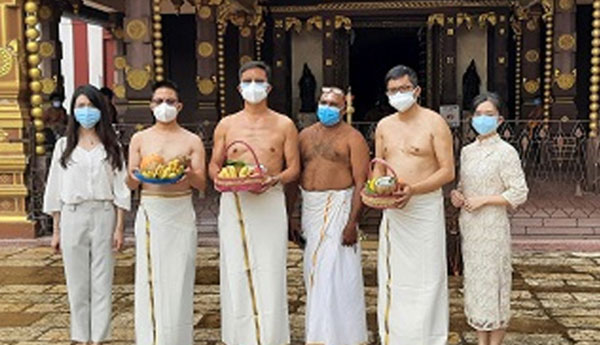
Taking off their shirts and wearing traditional white veshtis, the bare-chested men, carrying trays laden with fruit and puja offerings, entered the temple. Nothing unusual because that’s the practice at the Nallur Kandaswamy Kovil, a temple near Jaffna in Sri Lanka. But the man who dressed as a devotee and led the others into the temple Thursday stood out — Qi Zenhong, China’s Ambassador to Sri Lanka.
Days after announcing on Twitter that a Chinese solar company had found a new client in the Maldives because security concerns” of a “third party” had led to the suspension of its project on three islands off Jaffna peninsula, Ambassador Qi is touring Sri Lanka’s Tamil-dominated Northern Province, wooing an ethnic minority that has traditionally been close to India.
His visit to Jaffna peninsula on Wednesday and Thursday and his outreach to a community that remains cold to the Sinhalese south 12 years after the end of the ethnic war also came amid a bitter, public rough patch in Sri Lanka-China relations over Colombo’s cancellation of a fertiliser import.
In conversations with Jaffna’s civil society representatives, Qi responded to questions on the China-India rivalry in Sri Lanka, saying there was more geographical distance between India and Sri Lanka than between India and China since both countries share a border.
Dismissing the rivalry, he said both countries were continuously engaged in resolving their problems. He even said that talk of “third party” pressure on Sri Lanka to cancel the solar farm on three islands off Jaffna was “fake news”.
While this is not the first time that a Chinese diplomat has visited the Northern Province, it may be the first time that any Chinese ambassador has stayed overnight and engaged in such extensive public diplomacy in the peninsula where India takes its diplomatic and political influence for granted because of the ties of history, language, culture that have remained strong despite Delhi distancing itself from the Tamil separatist cause.
Chinese interests and its infrastructure projects in Sri Lanka have been largely focussed on the Sinhala south, particularly due to the snug relations that Beijing has with the Rajapaksas. While the Chinese have constructed roads and houses in the war-ravaged Tamil areas, Qi’s visit, which included a tour of Vavuniya and Mannar districts too, indicate a desire to expand the engagement on turf where political and people-to-people ties with India are strong.
Among his stops in the peninsula was the historic Jaffna Library which was burnt down by a mob led by Sinhalese politicians in 1983. There, he donated laptops and computers and offered assistance in the digitisation of the library. After its restoration in the 1990s, both Delhi and the Tamil Nadu government have donated thousands of books to rebuild the collection. In 2015, an “India Corner” was inaugurated in the library.
The main livelihood of people in Jaffna is fishing, and their rivalry with Tamil Nadu fishermen for scarce marine resources has eluded resolution. On Wednesday, the Chinese envoy’s outreach included donations of fishing nets and dry rations worth $100,000 to members of the Fishermen’s Co-operative Society Union Federation. Sri Lankan Minister for Fisheries and Aquatic Resources, Douglas Devananda, who is also a parliamentarian from Jaffna, accompanied Qi during the visit.
“So far, Tamil people have not had much rapport with the Chinese. The visit might have been to improve relations with the Tamils,” said Dharmalingam Sithadthan, a member of Parliament from Jaffna and leader of the former militant group PLOTE.
In recent months, Tamils have questioned signage in Sri Lanka that includes Mandarin but has left out Tamil, even though it has the status of an official language. Official sources said the Chinese wanted to be seen as making amends for this. The visit is being viewed as a message to the Tamils that they should consider China as a friend.
Some also see the visit as a signal to the Sri Lankan leadership during a downturn in ties after Colombo cancelled the import of an organic fertiliser which did not pass local tests. In retaliation, China blacklisted the Sri Lankan state-owned People’s Bank for a payment “default” which the Chinese Embassy described in a tweet as “vicious”. China’s Ministry of Commerce said the default on the Letter of Credit had caused huge losses to Chinese companies.
Sritharan Thirunavakkarasu, a former member of the EPRLF and a Jaffna resident, said Qi’s visit was “unprecedented” by a Chinese diplomat for the time the envoy spent on the peninsula, and for the range of people he met during the visit.
Qi held discussions with government officials and civil society members on how China could contribute to increasing employment opportunities in the Northern Province. Shrimp farming was among the ideas that figured in the discussions. (Indian Express)
News
Bambalapitiya Railway Station renovated under the “Dream Destination” project opened to the public
Prime Minister Dr. Harini Amarasuriya stated that Sri Lanka is now creating a common dream as a nation and that the Government’s objective is to make public transport the convenient choice for the people. The Prime Minister made these remarks while participating in the ceremony held to open the renovated Bambalapitiya Railway Station under the “Dream Destination” project.
The renovated Bambalapitiya Railway Station was opened to the public on 10 September under the “Dream Destination” project, jointly implemented by the Ministry of Transport, Highways and Urban Development and the Sri Lanka Railways Department in line with the Clean Sri Lanka national programme. Prime Minister Dr. Harini Amarasuriya participated in the occasion.
The Prime Minister also inspected the renovated railway station, as well as the new pedestrian overpass providing access to the railway station, constructed by the Road Development Authority for which the Dawoodi Bohra community in Sri Lanka contributed Rs. 60 million.
Addressing the gathering, the Prime Minister expressed her special appreciation to the Bohra community for taking the initiative to renovate and provide the people with improved facilities at the Bambalapitiya Railway Station, a busy and well-known location in the Colombo District.
She stated that the renovation of public spaces and the provision of improved facilities have contributed to generating greater interest and a more positive perception of public transport among the people.
The Prime Minister also expressed her appreciation to the Minister of Transport, Highways and Urban Development, the Deputy Ministers and the staff for their contribution towards improving public transport services and attracting greater public interest towards these services.
The development of a country is not determined by the number of private vehicles it has. It is determined by the manner in which people use public transport. The Government’s objective is to improve the public transport service, which has disappointed the people for many years, and create a situation where people feel that public transport is more convenient and safer than using a private vehicle. The Government’s commitment to public transport is clearly demonstrated by the increased allocation of funds for the sector. The ’Dream Destination’ programme is another significant initiative under this effort, bringing together State institutions and the private sector to contribute to national development,” the Prime Minister stated.
“A country does not belong only to the Government. A country is the home for everyone who lives in it. It is the responsibility of all of us to contribute to that home through our knowledge, labour or resources. For a long time, we did not have a common dream as a country. Today, we feel that such a dream is beginning to emerge.
“We have a collective dream. The journey towards that dream is the collective journey we have begun together to build our country, which is our common home.
“What we witness here today is the active participation of our people, our diverse communities and the private sector in this journey. Such collective participation is essential to moving a country forward. Therefore, we deeply appreciate this contribution.
“The Bohra community reminds us today of the importance of this collective spirit. We have now embarked on a collective journey. We share a common dream of what our country should be, what the future of our country should look like and what kind of experience life in our country should offer. The Clean Sri Lanka national programme further strengthens these objectives,” the Prime Minister further stated.
Addressing the gathering, Deputy Minister of Urban Development Eranga Gunasekara stated that increased funding would be allocated to the Sri Lanka Railways Department for development activities next year. He noted that public transport and railway services had not previously received sufficient attention from the Government, but that this would change moving forward.
“Our transport services are progressing step by step, and the railway system is a key component of this development. Accordingly, on the instructions of the President, we will commence the electric railway system, which has long been a dream for our country, next year. We expect to introduce electric railway services from Maradana to Makumbura, from Maradana to Panadura and from Maradana to Ragama. We will also commence work to extend the Kelani Valley railway line from Avissawella to Ratnapura.
He also appreciated the contribution made by private institutions towards the “Dream Destination” project without seeking any promotional benefits in return.
Speaking on behalf of the Dawoodi Bohra community, Khuzaimah Jefferjee stated that the Dawoodi Bohra community, which has been part of Sri Lanka’s social, cultural and economic landscape for more than 150 years, believes that being a citizen of the country means more than simply living in the country. It means contributing to the country, caring for it and leaving behind a better country for future generations.
He said that, as part of this responsibility, the community had taken steps to renovate, modernise and beautify the Bambalapitiya Railway Station. He added that the community hopes these efforts will make the daily journeys of passengers a cleaner, safer, more convenient and dignified experience.
The occasion was attended by the Deputy Speaker of the Parliament of Sri Lanka Dr. Rizvie Sally, Deputy Minister of Religious and Cultural Affairs Muneer Mulaffer, Mayor of the Colombo Municipal Council Vraie Cally Balthazar, Secretary to the President Dr. Nandika Sanath Kumanayake, Secretary to the Prime Minister Pradeep Saputhanthri, General Manager of Sri Lanka Railways Padmapriya, Janab Amil Saheb Ibrahim and representatives of the Dawoodi Bohra community, officials of the Clean Sri Lanka programme and several others.


[Prime Minister’s Media Division]
News
Steps being taken to reduce paper usage in parliament and the public sector through digitalisation – PM
Prime Minister Dr. Harini Amarasuriya stated that steps are being taken to reduce the use of paper in Parliament and the public sector through digitalisation.
The Prime Minister made these remarks in Parliament on Thursday (10 September) in response to a question raised regarding digitalisation and the use of paper.
The Prime Minister further stated:
“The total expenditure incurred in 2023, 2024 and 2025 for the provision of Hansard reports, Order Books, Agendas and other parliamentary printed materials provided to Members of Parliament and Ministers for use within the Chamber is Rs. 45.3 million in 2023, Rs. 58.7 million in 2024 and Rs. 73.1 million in 2025.
All these printed materials have been produced based on requests made by Parliament. At the same time, a programme is currently being developed to reduce the use of paper.
In accordance with a request made by the Secretary to the Treasury to the Secretary-General of Parliament, the Committee on Parliamentary Business considered the possibility of submitting reports to Parliament solely in digital format in the future. It was decided to conduct a survey to ascertain the preference of each Member of Parliament. Based on the results of the survey, arrangements will be made to provide relevant documents digitally to Members who prefer digital copies, while printed copies will be provided to those who prefer printed versions.
Following the completion of this survey, arrangements will be made to implement the programme on a date to be determined by the Committee on Parliamentary Business.
Similarly, all ministries and government institutions are currently taking steps towards digitalisation while reducing their use of paper. However, this process will take some time. In this manner, particularly the exchange of files and many other such processes can be facilitated through digital systems in the future.
For example, in the Ministry of Education, applications for leave submitted by university lecturers for overseas travel were previously submitted to the Ministry in printed form. The entire process has now been digitalised. The Ministry, through the University Grants Commission, provides approval for such leave applications through a digital process. Ministries across the government are taking similar measures. We believe that once digital systems are fully established, we will be able to significantly reduce the use of paper.
Responding to a question regarding measures to reduce the weight of schoolchildren’s bags, the Prime Minister stated:
The weight of students’ books will be reduced through the activity-based learning process introduced under the new education reforms. Since the books will be kept in the classroom, students will no longer need to carry them back and forth. They will only need to take the books home at the end of the term after completing their work.
From 2027, a module-based learning process will be introduced for Grade 6. Modules will not consist of large textbooks; instead, students will be provided with modules relevant to each subject for the particular term. Therefore, this system will significantly reduce the weight of schoolchildren’s bags.
[Prime Minister’s Media Division]
Latest News
INS Udaygiri departs Colombo concluding formal visit
The Indian Naval Ship (INS) Udaygiri departed the Port of Colombo today, 11 September 2026, following the successful completion of a four day official visit.
On her departure, the Sri Lanka Navy bade farewell to the ship in accordance with time-honoured naval traditions.
During the visit, naval personnel from both navies engaged in joint initiatives to strengthen bilateral ties. These included a friendly volleyball match, a beach cleanup along the Galle Face
promenade, and a training exercise on Visit, Board, Search, and Seizure (VBSS) conducted by the Sri Lanka Navy Special Boat Squadron (SBS).
As part of the visit, the Indian Navy handed over a consignment of spares and supplies to the Sri Lanka Navy. Visiting crew members also toured key tourist attractions in and around Colombo.
Official interactions of this nature aim to enhance cooperation and knowledge-sharing between the two maritime forces, supporting joint responses to evolving regional maritime challenges.
-
News7 days agoNamal remanded until Sept. 18 over Airbus deal investigation
-
Latest News6 days agoTharanga creates history with Diamond League crown in Brussels
-
Sports18 hours agoDDS set to lose Test captaincy
-
Features5 days agoAfter the parade: What a traffic OIC’s walk-out tells us
-
News6 days agoDispute which triggered listed company director being detained at BIA resolved
-
Editorial7 days agoPower vs Equality
-
Editorial5 days agoArrests as theatre
-
Latest News5 days agoHarshitha’s composed knock seals Sri Lanka’s semi-final berth