
Foreign News
BBC on French beach as police slash migrant ‘taxi-boat’ heading to UK


French police have waded into shallow waters off a beach south of Boulogne and used knives to slash an inflatable small boat – packed with men, women and children – that was wallowing, dangerously, in the waves.
All those onboard clambered to safety as the boat collapsed in chaotic scenes.
The intervention was highly unusual.
French police usually follow strict rules that bar them from going into the sea in case they put lives at risk.
“Let’s go in,” said one of the gendarmes, pulling off his body armour, and taking out a small knife. His colleagues took their heavy armour off, too, placing equipment in the back of a nearby police car before rushing into the water.
There had been some speculation that this rare incident could be evidence that the French police – under growing pressure to stop a surge of small boat migrant crossings to the UK – are changing their tactics.
But they have made it clear to the BBC that police have not adopted any new tactics in dealing with small boat launches, that the rules forbidding intervention in the water remains in place and officers must continue to prioritise safety on the beaches. They are allowed to intervene, however, if they believe lives are at immediate risk.
Well-placed sources in France have told us that the procedural changes now being considered will almost certainly focus on the use of patrol boats at sea to intercept the “taxi-boats” before they’re fully loaded, rather than on approving more aggressive interventions from police on the beaches.
The UK prime minister’s official spokesman said the images of French police destroying a boat were “a significant moment and we welcome this action”.
“We want to see tougher action taken, that’s precisely the focus of our work, it is the outcome of that close work that you’ve seen,” the spokesman said.
A few metres offshore, the boat itself was clearly in trouble. People were crowded around the outboard motor, which had briefly stalled but was being restarted.
Waves were breaking underneath the boat, causing it to lurch wildly, and there were loud screams from several children who were in danger of being crushed onboard.
Earlier, two large groups of people already wearing orange life jackets had emerged from the nearby dunes and rushed towards the sea.
In all there were probably 80 or 100 people. But when the first “taxi-boat” – used by the smuggling gangs to collect passengers from various points along the French coast – sped past perhaps 100m from the shore, it was clearly full already and did not stop to pick anyone else up.
A few minutes later, a second boat, with almost no passengers, came towards the shore, watched by a French coastguard boat further into the English Channel.
Initially, people were ushered forwards in organised groups, holding hands, and directed by one man who appeared to be leading events.
But as the inflatable boat turned and reversed towards the shore, there was a scrum as dozens of people scrambled to climb aboard in water that was at least waist deep.
At first the gendarmes declined to intervene and stood watching from the shore.
One officer repeated a now-familiar explanation to me – that they were barred from going into the water except to rescue people.
But as the situation became increasingly chaotic, the officers at the scene clearly felt that a line had been crossed, that those on board were now in danger, and that there was a brief opportunity to disable the boat in relative safety and while any smugglers – who might have fought back – were distracted by their attempts to restart the engine.
As a policeman slashed repeatedly at the rubber, there were cries and shouts of anger and frustration from some of those onboard.
A young girl, who had been in the middle of the scrum, squashed at the stern of the boat close to the engine, was plucked to safety as others scrambled on to the nearby sand.
Moments later the boat was dragged ashore by the police as the migrants began collecting items they had dropped on the beach and then headed inland, up the sandy paths through the dunes towards the nearest village and a bus-ride back to the migrant camps further north.
[BBC]


The United States military says that two service members have been killed and four medically evacuated following an Iranian missile and drone attack in Jordan.
In a statement shared on Saturday, US Central Command (CENTCOM), which oversees US military operations in the Middle East, said that one service member remains missing following an Iranian strike on Friday.
“On July 17, two US service members in Jordan were killed in action as US Central Command (CENTCOM) and partner forces defended against Iranian ballistic missile and drone attacks. Additionally, one service member is currently missing in action,” the statement reads.
“Four American service members were medically evacuated to Jordanian hospitals. They have since been discharged. Other personnel who were evaluated for minor injuries have returned to duty.
“Out of respect for the families, CENTCOM will withhold additional information, including the identities of the fallen warriors, until 24 hours after the next of kin have been notified.”
The statement appears to be the first US confirmation of fatalities resulting from renewed Iranian strikes on US forces, following the breakdown of a memorandum of understanding (MoU) that temporarily paused fighting between the US and Israel, and Iran.
Responding to the deaths of the two service members, US Defence Secretary Pete Hegseth said that “their sacrifice only stiffens our resolve”.
CENTCOM later announced that it was launching retaliatory airstrikes against Iran at President Trump’s direction.
[Aljazeera]
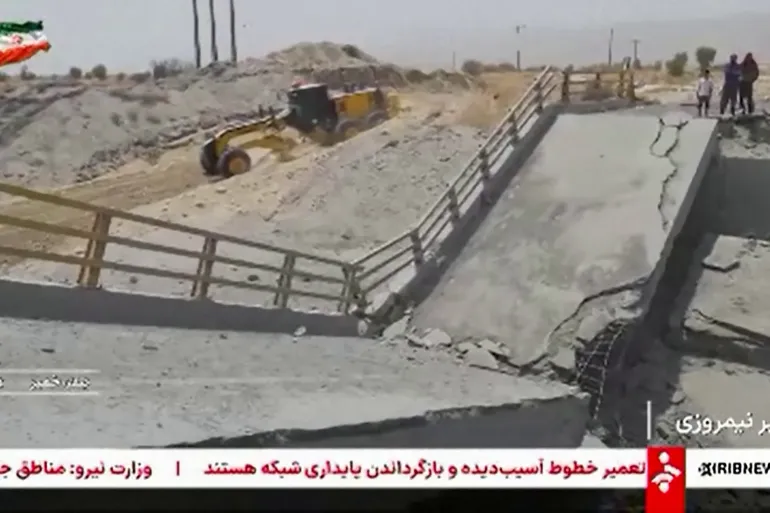
A seventh consecutive night of attacks by United States forces on targets across Iran has left 10,000 people without water after a desalination plant was hit, with Iran retaliating by launching another wave of drones and missiles at US-allied Gulf states.
Hamzeh Pour, chief executive of the Hormozgan Water and Wastewater Company, was quoted by the Tasnim news agency on Saturday as saying that a seawater pumping station and a power transformer at the Bunji desalination plant in Jask in southern Iran were “completely destroyed”, depriving 20 villages of water.
Iran’s retaliation also targeted civilian infrastructure, a war crime under international humanitarian law.
In the early hours of Saturday, Kuwait announced the closure of its airspace and said two power and water desalination plants were hit by Iranian attacks. Several Kuwaiti firefighters were wounded while responding to a fire sparked by the strikes, the country’s firefighting force said.
Air raid sirens also sounded repeatedly in Bahrain, where authorities urged residents to seek shelter.
In Jordan, authorities said they intercepted 10 Iranian ballistic missiles.
Iran’s Islamic Revolutionary Guard Corps (IRGC) said its naval forces had targeted a US military fuel pier at Kuwait’s al-Ahmadi port and a US warplane assembly site at Bahrain’s Sheikh Isa Air Base. The IRGC also said it attacked a US base in Azraq in Jordan, claiming to have destroyed two American fighter jets.
The Iranian attacks came after the US military’s Central Command, or CENTCOM, announced it had carried another wave of overnight strikes targeting “surveillance sites, military logistics infrastructure, underground weapons storage, and maritime capabilities” in Iran.
[Aljazeera]
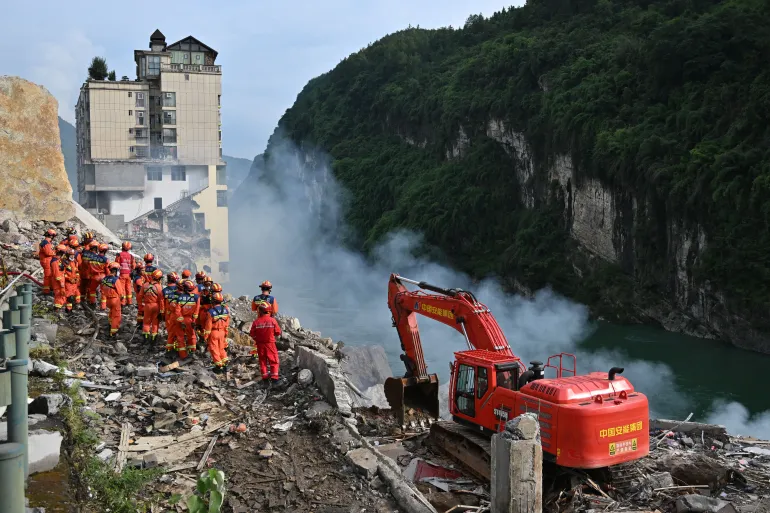
Rescuers are rushing to locate dozens of people missing in the southwestern Chinese city of Chongqing, after a deadly landslide buried homes in the area, according to Chinese authorities.
The landslide took place around 9:10am (01:10 GMT) on Friday in Chongqing’s Pengshui county, killing eight people, leaving 34 unaccounted for and displacing more than 1,100, reported state media.
Footage shared by China’s CCTV broadcaster showed a huge buildup of rocks and dirt covering part of a residential and commercial street at the bottom of a mountain in the region.
Ten people have been rescued from the debris, including two who are seriously injured, reported China’s state-run Xinhua news agency.
Water, electricity and gas supplies were cut off within a one-kilometre (0.6-mile) radius of the landslide to prevent further disruptions. More than 800 rescuers have gone to the site, reported CCTV.

Authorities said they sent more than 8,000 disaster relief items to Chongqing, including tents, folding beds and family emergency kits.
Pengshui county is located in the southeast part of Chongqing, bordering the provinces of Hubei and Guizhou.
The area where the landslide happened is known for “unpredictable” steep terrain, a local official told a news conference, adding that dangerous rocks remain along the sides of the cliff.
The government has allocated 50 million yuan ($7.36m) in natural disaster relief funds to support the rescue and relief operations and to provide assistance to affected residents, the Ministry of Finance and the Ministry of Emergency Management said.
[Aljazeera]

Trump threatens to bomb a power plant for each ship strike

Mexico goalkeeper Guillermo Ochoa retires after 22-year career

New Chairperson and Members appointed to the Finance Commission

True leadership is not about titles or power, but about acting responsibly for the well-being of others – Prime Minister

A few showers will occur in the Western, Sabaragamuwa and North-western provinces and in Kandy, Nuwara-Eliya, Galle and Matara districts

Customs asked to resume probe or face legal action

‘Dates have the highest sugar content to fight Coronavirus’

Sunday Island 27 December – Headlines

#SundayIsland 17th December – Headlines

Sunday Island – 28th March

Sunday Island Headlines – 21 March

Sunday Island – 21st February – Headlines
-

 Features4 days ago
Two memorable excerpts from a former SLAF commander’s memoir
-
 Business4 days ago
‘Giving up was never an option’: The fisherman who fought back after losing millions in SL
-

 Latest News4 days ago
Davis cup Asia/Oceania Group IV 2026 to be held in Colombo from 20th to 25th July
-

 Features4 days ago
Erdoğan’s New Republic
-

 Life style4 days ago
Taste of the Swiss Alps comes to Colombo
-

 News5 days ago
Evidence recorded in money laundering case against Yoshitha Rajapaksa
-

 News5 days ago
Dengue outbreak gallops ahead: Infections surpasses 73,455, leaving 50 dead
-

 News6 days ago
Money laundering case against Yoshitha, fixed for pre-trial conference