
Features
Banning Muslim organisations without power to ban, and attacking Islam through ‘thowheedi’ hate campaigns!


By M. M. Zuhair, PC
Those who attempt to vilify the Muslim community, particularly its religious leaders and the civil society with unsubstantiated and deceptive allegations need to know that such misguided accusations based mostly on foreign inputs are a threat to the peoples’ security, unity, peace and harmony, the elimination of which threats are essential for lifting the country’s economy from the tragic levels to which it had fallen.
Recent reports and comments on matters relating to the banning of certain Muslim organisations appear to be attempts to exploit religious differences for political purposes as well as to serve foreign vested interests bent on creating divisions within the country and its people. Persons who are believed to have misled former Presidents seem to be back, kindling again the fire, which certainly will do no good to the economic resurgence of the country.
Pope Francis and Archbishop Malcolm Cardinal Ranjith have warned of the despicable role played by the Western arms industry and its war mongers. Beginning 2012, attacks in Sri Lanka, on Churches, and hate campaigns against Muslim life styles, attacks on Mosques and businesses, led to anti-Muslim violence in Aluthgama, Galle, Ampara, Digana, etc.
Earlier in 1989, Muslims were driven away from the North and over a thousand unarmed Muslim civilians were killed in the East by the LTTE for not supporting the division of the country. Now another round of hate campaign against ‘thowheed’, belief in the ‘oneness’ or ‘singleness’ of Allah as distinguished from the Christian concept of ‘trinity’, appears to be in the making!
On 13th April 2021, then President Gotabaya Rajapaksa banned 11 organisations by a gazette notification under the Prevention of Terrorism (Temporary Provisions) Act. The order of banning, lumped together several active and service oriented Muslim civil society organisations functioning legally in Sri Lanka, ingloriously with the dead ‘Al Qaeda’ and the then dying ‘ISIS’, the latter two entities were widely believed to be under US handlers.
The gazette did not set out any offences or violations of the law alleged against any of the other nine Muslim organisations! Commentators on the subject never raised their voices or moved their pens to question the legitimacy of committing the cruel act of banning a part of the country’s civil society without expressly declaring the offences or violations, if any, which each of the nine organisations had committed.
There were no prosecutions of any of the nine organisations, if they had committed, aided, abetted, conspired to commit any offences or unlawful acts under the PTA or any other law. At the least any country governed by the rule of law would have asked each of the nine organisations to show cause why the organisation should not be banned for committing whatever offences or violations if any. That was not done. These commentators are strangely silent on the violations of the principles of natural justice!
Who then is answerable for the UN High Commissioner for Human Rights criticizing Sri Lanka for the “intensified surveillance and harassment of civil society organiasationa, human rights defenders and victims” with over 40 civil society organisations in Sri Lanka approaching the office of the High Commissioner with reports of harassment, surveillance and repeated scrutiny by the CID, TID and State Intelligence officials? Will these wrongful acts by the State not reflect adversely on the country’s judiciary?
Why is the banning of these nine Muslim organisations considered as wrongful acts of the State? It is not only wrongful but also illegal to have banned these organisations, not only for the reasons stated earlier but also because the President or anyone else advisedly does not have any power whatsoever to ban any organization, though violators of the law may be prosecuted for any offences committed or dealt with for violations of the law.
The LTTE was banned under the Proscribing of Liberation of Tigers of Tamil Eelam and Other Similar Organisations Law No 16 of 1978, which had provided for many safeguards before any similar organization could be proscribed (or banned). But section 30 of the PTA repealed Law 16 of 1978 with effect from 24/07/1979. Today there is no law to proscribe any organization, except under Article 157A (5)(a) of the Constitution in cases where the Supreme Court decides that the political party, association or organization has as its object the establishment of a “separate State” ‘within the territory of Sri Lanka’. However, it may also be argued that even this restriction does NOT prohibit any organization having for instance the object of establishing a ‘Buddhist State in the entirety of Sri Lanka’ as distinguished from establishing a “separate State” within Sri Lanka.
Why do these commentators not raise, as to how to deal with the findings of the Parliamentary Select Committee on the 21/4 Easter Sunday attacks and the Presidential Commission of Inquiry on the Easter attacks on the ‘rise of Buddhist extremism’ in Sri Lanka ‘from 2012, due to the actions of the BBS’ and the non-banning of several named ‘anti-social Sinhala Buddhist movements’ which according to the Commission’s report led to Zahran Hashim’s Muslim extremism! Not that the Muslims here want such action now but that if the then governments had taken firm action against the hate speeches and anti -minority violence, Sri Lanka may not have suffered the widely condemned Easter attacks. These matters arise because of the official space being given to purveyors of hate thowheed campaign!
The belief in one single Almighty Allah also known as monotheism or ‘Thowheed’ with over 1,400-year history, is the fundamental belief of every Muslim, of all schools of Islamic thought, including Sufis to Shias. Attacking this belief or Sufism is attacking Islam and the rights protected under Articles 9 and 10 of the Constitution. Civilized people the world over respect these rights as well as the rights of others not to subscribe to that belief. But unfounded attacks on this belief, imputing it as the cause of violence, will be absolutely false and an unacceptable form of a hate Islam campaign, which will be condemned by the civilized world. These will turn out to be unsuccessful attempts to hide the real causes of anti-minority violence in Sri Lanka.
‘Wahhabism’ is a derogatory reference to “Muwahhideens’ by the orientalists. Muwahhideens are those inspired by the commitment to the revival of Islam, in countries which came under six centuries of colonial domination in the Middle-East and the defensive or jihadist requirement to resist the foreign invasion of one’s country, based on the thoughts of the respected Arab Islamic scholar Muhammed Ibn Abdul Wahhab (1703- 1787). The thoughts of Wahhab inspiring resistance to foreign invasions, which continues to this day not by Christian forces but by the arms industry, was seen then as the biggest threat to the invaders continued occupation of others’ lands.
The matter of resistance to foreign invasions arose in a case on 11th May 2022 in the Supreme Court of India presided by Chief Justice of India N V Ramana when the CJ questioned the Attorney General of India on the rationale of not repealing the sedition law in section 124A of the Indian Penal Code enacted in 1890 when India was under British rule. The CJ raised the issue in open Court that this section was extensively used to curb political dissent, during India’s struggle for independence.
Celebrated Indian freedom fighters, including Bal Gangadhar Tilak, Annie Besant, Maulana Shaukat Ali, Mohammed Ali, Maulana Azad and Mahatma Gandhi had been arrested and detained under this provision, he said. Wahhabi Muslims resisted the foreigners in many village level encounters. The Court also referred to the AG’s submissions, which referred to certain “glaring instances of abuse of section 124A”.
Sri Lankan Muslims have always been a patriotic community. They have never attempted to overthrow the elected government of the country, at any time. They were never a party to the 1962 coup, the 1971 and 1989 insurgencies or the 30-year-war, which were attempts to overthrow illegally, the elected governments of the day or to divide the country. The reprehensible Easter Sunday attacks are being seen as a totally unacceptable and uncalled for reaction to the anti-Muslim violence that engulfed Sri Lanka after the defeat of the LTTE in 2009. The 21/4 attacks also pale off in comparison to the 147 Muslim civilians killed in Kattankudy while at prayers in Mosques in 1990 and over a thousand Kattankudy-centred killings of Muslims from 1987 to 1990 committed by the LTTE.


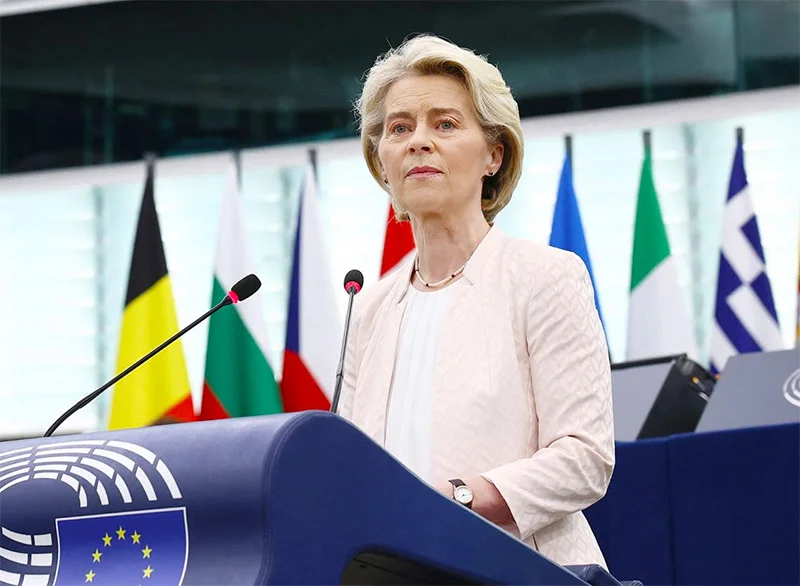
 European Commission President Ursula von der Leyen addressing the World Economic Forum in Davos, Switzerland on Tuesday put forward the EU’s viewpoint on current questions in international politics with a clarity, coherence and eloquence that was noteworthy. Essentially, she aimed to leave no one in doubt that a ‘new form of European independence’ had emerged and that European solidarity was at a peak.
These comments emerge against the backdrop of speculation in some international quarters that the Post-World War Two global political and economic order is unraveling. For example, if there was a general tacit presumption that US- Western European ties in particular were more or less rock-solid, that proposition apparently could no longer be taken for granted.
For instance, while US President Donald Trump is on record that he would bring Greenland under US administrative control even by using force against any opposition, if necessary, the EU Commission President was forthright that the EU stood for Greenland’s continued sovereignty and independence.
In fact at the time of writing, small military contingents from France, Germany, Sweden, Norway and the Netherlands are reportedly already in Greenland’s capital of Nook for what are described as limited reconnaissance operations. Such moves acquire added importance in view of a further comment by von der Leyen to the effect that the EU would be acting ‘in full solidarity with Greenland and Denmark’; the latter being the current governing entity of Greenland.
It is also of note that the EU Commission President went on to say that the ‘EU has an unwavering commitment to UK’s independence.’ The immediate backdrop to this observation was a UK decision to hand over administrative control over the strategically important Indian Ocean island of Diego Garcia to Mauritius in the face of opposition by the Trump administration. That is, European unity in the face of present controversial moves by the US with regard to Greenland and other matters of contention is an unshakable ‘given’.
It is probably the fact that some prominent EU members, who also hold membership of NATO, are firmly behind the EU in its current stand-offs with the US that is prompting the view that the Post-World War Two order is beginning to unravel. This is, however, a matter for the future. It will be in the interests of the contending quarters concerned and probably the world to ensure that the present tensions do not degenerate into an armed confrontation which would have implications for world peace.
However, it is quite some time since the Post-World War Two order began to face challenges. Observers need to take their minds back to the Balkan crisis and the subsequent US invasions of Afghanistan and Iraq in the immediate Post-Cold War years, for example, to trace the basic historic contours of how the challenges emerged. In the above developments the seeds of global ‘disorder’ were sown.
Such ‘disorder’ was further aggravated by the Russian invasion of Ukraine four years ago. Now it may seem that the world is reaping the proverbial whirlwind. It is relevant to also note that the EU Commission President was on record as pledging to extend material and financial support to Ukraine in its travails.
Currently, the international law and order situation is such that sections of the world cannot be faulted for seeing the Post World War Two international order as relentlessly unraveling, as it were. It will be in the interests of all concerned for negotiated solutions to be found to these global tangles. In fact von der Leyen has committed the EU to finding diplomatic solutions to the issues at hand, including the US-inspired tariff-related squabbles.
Given the apparent helplessness of the UN system, a pre-World War Two situation seems to be unfolding, with those states wielding the most armed might trying to mould international power relations in their favour. In the lead-up to the Second World War, the Hitlerian regime in Germany invaded unopposed one Eastern European country after another as the League of Nations stood idly by. World War Two was the result of the Allied Powers finally jerking themselves out of their complacency and taking on Germany and its allies in a full-blown world war.
However, unlike in the late thirties of the last century, the seeming number one aggressor, which is the US this time around, is not going unchallenged. The EU which has within its fold the foremost of Western democracies has done well to indicate to the US that its power games in Europe are not going unmonitored and unchecked. If the US’ designs to take control of Greenland and Denmark, for instance, are not defeated the world could very well be having on its hands, sooner rather than later, a pre-World War Two type situation.
Ironically, it is the ‘World’s Mightiest Democracy’ which is today allowing itself to be seen as the prime aggressor in the present round of global tensions. In the current confrontations, democratic opinion the world over is obliged to back the EU, since it has emerged as the principal opponent of the US, which is allowing itself to be seen as a fascist power.
Hopefully sane counsel would prevail among the chief antagonists in the present standoff growing, once again, out of uncontainable territorial ambitions. The EU is obliged to lead from the front in resolving the current crisis by diplomatic means since a region-wide armed conflict, for instance, could lead to unbearable ill-consequences for the world.
It does not follow that the UN has no role to play currently. Given the existing power realities within the UN Security Council, the UN cannot be faulted for coming to be seen as helpless in the face of the present tensions. However, it will need to continue with and build on its worldwide development activities since the global South in particular needs them very badly.
The UN needs to strive in the latter directions more than ever before since multi-billionaires are now in the seats of power in the principle state of the global North, the US. As the charity Oxfam has pointed out, such financially all-powerful persons and allied institutions are multiplying virtually incalculably. It follows from these realities that the poor of the world would suffer continuous neglect. The UN would need to redouble its efforts to help these needy sections before widespread poverty leads to hemispheric discontent.

 Hi! This week I’ve come up with tips to brighten up your skin.
* Turmeric and Yoghurt Face Pack:
You will need 01 teaspoon of turmeric powder and 02 tablespoons of fresh yoghurt.
Mix the turmeric and yoghurt into a smooth paste and apply evenly on clean skin. Leave it for 15–20 minutes and then rinse with lukewarm water
Benefits:
Reduces pigmentation, brightens dull skin and fights acne-causing bacteria.
* Lemon and Honey Glow Pack:
Mix 01teaspoon lemon juice and 01 tablespoon honey and apply it gently to the face. Leave for 10–15 minutes and then wash off with cool water.
Benefits:
Lightens dark spots, improves skin tone and deeply moisturises. By the way, use only 01–02 times a week and avoid sun exposure after use.
* Aloe Vera Gel Treatment:
All you need is fresh aloe vera gel which you can extract from an aloe leaf. Apply a thin layer, before bedtime, leave it overnight, and then wash face in the morning.
Benefits:
Repairs damaged skin, lightens pigmentation and adds natural glow.
* Rice Flour and Milk Scrub:
You will need 01 tablespoon rice flour and 02 tablespoons fresh milk.
Mix the rice flour and milk into a thick paste and then massage gently in circular motions. Leave for 10 minutes and then rinse with water.
Benefits:
Removes dead skin cells, improves complexion, and smoothens skin.
* Tomato Pulp Mask:
Apply the tomato pulp directly, leave for 15 minutes, and then rinse with cool water
Benefits:
Controls excess oil, reduces tan, and brightens skin naturally.
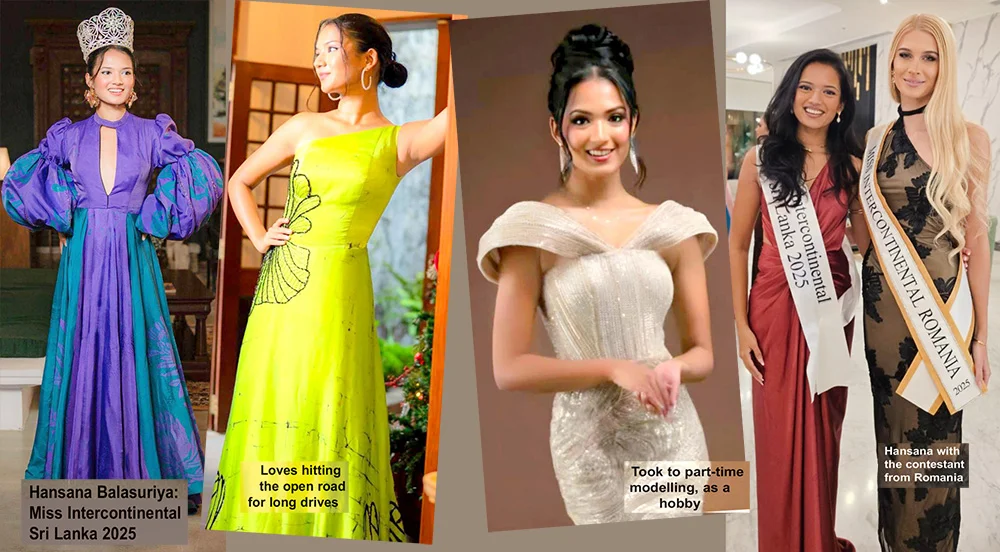
 That’s precisely what 25-year-old Hansana Balasuriya has in mind – shooting for the stars – when she was selected to represent Sri Lanka on the international stage at Miss Intercontinental 2025, in Sahl Hasheesh, Egypt.
The grand finale is next Thursday, 29th January, and Hansana is all geared up to make her presence felt in a big way.
Her journey is a testament to her fearless spirit and multifaceted talents … yes, her life is a whirlwind of passion, purpose, and pageantry.
Raised in a family of water babies (Director of The Deep End and Glory Swim Shop), Hansana’s love affair with swimming began in childhood and then she branched out to master the “art of 8 limbs” as a Muay Thai fighter, nailed Karate and Kickboxing (3-time black belt holder), and even threw herself into athletics (literally!), especially throwing events, and netball, as well.
A proud Bishop’s College alumna, Hansana’s leadership skills also shone bright as Senior Choir Leader.
She earned a BA (Hons) in Business Administration from Esoft Metropolitan University, and then the world became her playground.
Before long, modelling and pageantry also came into her scene.
She says she took to part-time modelling, as a hobby, and that led to pageants, grabbing 2nd Runner-up titles at Miss Nature Queen and Miss World Sri Lanka 2025.
When she’s not ruling the stage, or pool, Hansana’s belting tunes with Soul Sounds, Sri Lanka’s largest female ensemble.
What’s more, her artistry extends to drawing, and she loves hitting the open road for long drives, she says.
This water warrior is also on a mission – as Founder of Wave of Safety,
Hansana happens to be the youngest Executive Committee Member of the Sri Lanka Aquatic Sports Union (SLASU) and, as founder of Wave of Safety, she’s spreading water safety awareness and saving lives.
Today is Hansana’s ninth day in Egypt and the itinerary for today, says National Director for Sri Lanka, Brian Kerkoven, is ‘Jeep Safari and Sunset at the Desert.’
And … the all-important day at Miss Intercontinental 2025 is next Thursday, 29th January.
Well, good luck to Hansana.

Ravi: foreign exchange inflow does not reflect increased tourist arrivals

India arranges capacity building programme for District Court judges on SC’s request

Cinnamon Hotels extend support to flood-affected students in Peradeniya and Gampola

Govt. will introduce mechanism to tackle issues arising from education reforms: President

Opposition moves motion seeking PSC to probe lack of disaster preparedness

Arvind Subramanian: Why hasn’t Sri Lanka’s democracy acted as a hedge against economic chaos?

‘Dates have the highest sugar content to fight Coronavirus’

Sunday Island 27 December – Headlines

#SundayIsland 17th December – Headlines

Sunday Island – 28th March

Sunday Island Headlines – 21 March

Sunday Island – 21st February – Headlines
-

 Editorial4 days ago
Illusory rule of law
-
 News5 days ago
UNDP’s assessment confirms widespread economic fallout from Cyclone Ditwah
-
 Editorial5 days ago
Crime and cops
-
 Features4 days ago
Daydreams on a winter’s day
-

 Editorial6 days ago
The Chakka Clash
-
 Features4 days ago
Surprise move of both the Minister and myself from Agriculture to Education
-

 Features3 days ago
Extended mind thesis:A Buddhist perspective
-
 Features4 days ago
The Story of Furniture in Sri Lanka