
Latest News
Bangladesh’s ousted leader Sheikh Hasina sentenced to death


Bangladesh’s former prime minister has been sentenced to death for crimes against humanity over her crackdown on student-led protests which led to her ousting.
Sheikh Hasina was found guilty of allowing lethal force to be used against protesters, 1,400 of whom died during the unrest last year.
Hasina was tried in absentia by the International Crimes Tribunal (ICT) in Bangladesh, having been exiled in India since she was forced from power in July 2024.
Prosecutors accused her of being behind hundreds of killings during the protests and families of those killed or injured called for tough penalties. Hasina has denied all charges, calling the trial “biased and politically motivated”.
The months-long tribunal in Bangladesh’s domestic war crimes court was widely expected to find her guilty.
But the verdict marks a pivotal moment for the nation, vindicating protests that found their roots in anger over years of repression under her rule.
Hasina had governed Bangladesh for 15 years, overseeing economic progress, but increasingly attempting to silence opposition, with politically-motivated arrests, disappearances and extra-judicial killings.
The protests saw Hasina forced to flee and Nobel Peace Prize laureate Muhammad Yunus installed as leader of an interim government.
Reacting to the verdict on Monday in a five-page statement, Hasina said the death penalty was the interim government’s way of “nullifying her party the Awami League as a political force” and that she was proud of her government’s record on human rights.
“I am not afraid to face my accusers in a proper tribunal where the evidence can be weighed and tested fairly.”
The student-led uprising last year started with demands to abolish government job quotas but morphed into a wider anti-government movement.
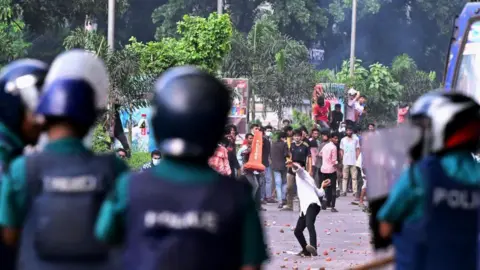
UN human rights investigators said in a report in February that the approximately 1,400 deaths could amount to “crimes against humanity”.
The report documented the shooting at point-blank range of some protesters, the deliberate maiming of others, arbitrary arrests and torture.
Leaked audio of one of Hasina’s phone calls verified by BBC Eye earlier this year suggested she had authorised the use of “lethal weapons” in July 2024. The audio was played in court during the trial.
Ahead of the verdict, the capital, Dhaka, where the tribunal took place, was under tightened security, with many of Hasina’s critics staging a rally and cheering as the judgement was read.
The city has seen a recent spike in unrest, with dozens of bombs exploded and buses set on fire in the days leading up to the verdict.
At least one bomb explosion was reported in Dhaka on Monday morning, with no casualties reported, local police official Jisanul Haque told the BBC.
Family members of those killed during the protests earlier told the BBC they wanted Hasina to be punished severely.
Ramjan Ali, whose brother was shot dead in July 2024, said he wanted “exemplary punishment” for Hasina and others who have “committed acts of vengeance and abused their power”.
Lucky Akther, whose husband was killed near Dhaka in August 2024, said she wanted Hasina’s sentence to be “carried out before the election”.
“Only then the families of those killed [in the protests] will find peace in their hearts.”
Since Hasina’s ousting, an interim government led by economist Muhammad Yunus has taken charge. A parliamentary election is scheduled for February 2026.
However, the Awami League, Hasina’s political party, was banned by Bangladesh’s interim government in May.
Hasina warned last month that if the party’s candidates were banned from standing in the upcoming election, millions would boycott the vote.
The verdict now poses a diplomatic challenge for India and Bangladesh. Dhaka has formally requested her extradition but so far India has shown no willingness to comply so her death sentence is unlikely to be carried out.
Hasina’s state-appointed lawyer Mohammad Amir Hossain said he was “sad and wishes the verdict had been different”.
“I even cannot appeal because my clients are absent; that’s why I am sad,” he added.
Last week, Hasina’s lawyers said they had filed an urgent appeal to the UN, raising serious fair trial and due process issues at the ICT. She says she has “repeatedly challenged” the interim government to bring its charges to the International Criminal Court in the Hague.
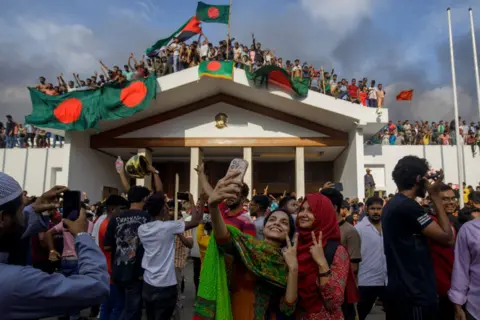
Hasina was tried alongside her former home minister and police chief.
While the sentence offers some closure to families of killed in the protests, it may do little to soothe the country’s political divisions.
“The anger against Sheikh Hasina and the Awami League has not subsided,” Shireen Huq, a Dhaka-based rights activists told the BBC. “Neither she nor the party has apologised or shown any remorse for the killings of hundreds of people.”
She said “it makes it difficult for the party to be accepted by a majority of people in this country”.
Ms Huq added that the punishment was not closure for the families of those killed and injured.
“We work with several people who lost their limbs forever, they are amputees now, due to the crackdown. They will never be able to forgive her.”
David Bergman, a journalist and a long-time Bangladesh watcher, said the “very nature of the conviction could make it even more difficult” for Awami League to become a normal feature of Bangladeshi politics again.
This may change if “there is some kind of apology and a distancing from Sheikh Hasina and the old leadership”, he said.
[BBC]

Six American soldiers were killed in an Iranian strike against a military facility in Kuwait on Sunday, the US has confirmed.
US Central Command originally said three soldiers died in the incident but officials confirmed on Monday that the death toll had doubled, after one person succumbed to their injuries and two more bodies were found in the rubble.
Defence Secretary Pete Hegseth confirmed a US bunker in Kuwait was hit after a missile was launched during Iran’s original retaliation evaded air defences.
The six deaths are the only fatalities confirmed by the US military since it launched a new war against Iran with Israel.
Hegseth said a “powerful weapon” struck a “tactical operations centre that was fortified”, without providing further details about the site’s location.
Three US military officials with direct knowledge of Iran’s attack told the BBC’s US partner CBS News that the service members were in a makeshift office space in Kuwait.
They questioned whether the building had been adequately fortified, telling CBS News a trailer was being used as an office, with 12ft (3.7m) steel-reinforced concrete barriers to shield it.
The US has a long-standing defence relationship with Kuwait, and more than 13,000 American soldiers are stationed in the Gulf nation.
Iran has responded to attacks against it by launching missiles at Gulf countries allied with the US. Bahrain, UAE, Saudi Arabia, Oman and Qatar have all also seen strikes.
Separately in Kuwait, the US confirmed three fighter jets were downed after what it described as an incident of “friendly fire” on Monday.
Footage showed the jets spiraling to the ground. The pilots involved all managed to eject and survived the incident.
Iran state media claimed the Iranian military had shot down the jets, without providing evidence.
Latest News
Israel attacks presidential office in Tehran as reported death toll in Iran rises to 787
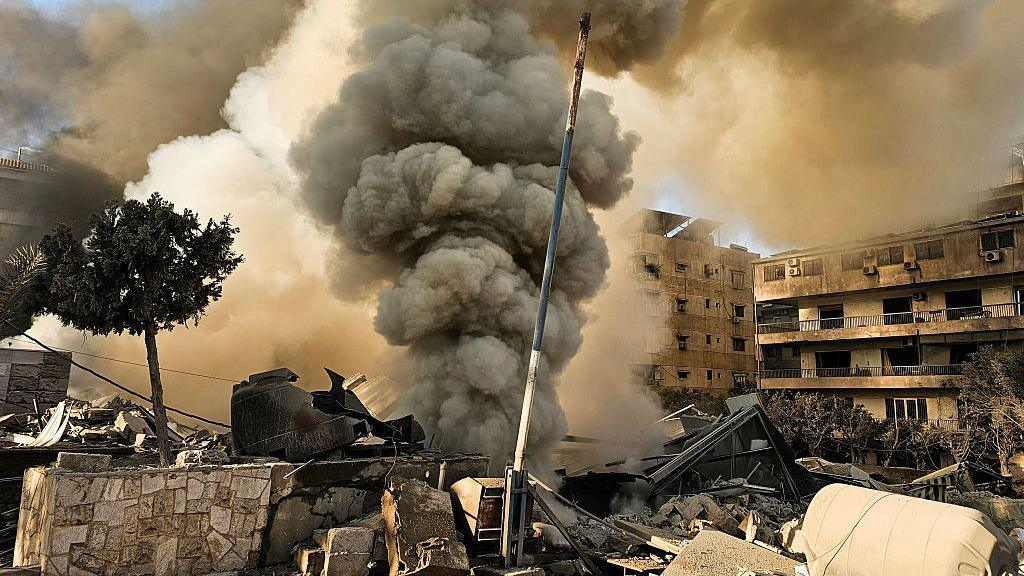
Israel says it has carried out new attacks on Iran’s “leadership compound” in Tehran, including the presidential office
One reporter inside Iran says ‘every part” of Teheran has been hit since Saturday, while new pictures show explosions in the east of the city.
The number of people killed since US-Israeli attacks began has reached 787, the Red Crescent says.
Elsewhere, Israel says ground troops will ‘advance and seize aditional strategic areas in Lebanon in order to stop attacks on Israel
The US embassy in Riyadh, Saudi Arabia, has been hit by two drones, seemingly from Iran
And the gas price on international markets has risen again – up 30% at one point o Tuesday morning, after 50% increases on Monday
Meanwhile, US President Donald Trump has again criticised Keir Starmer for initially denying access to British bases.
The US and Israel struck Iran on Saturday, killing Supreme Leader Ayatollah Ali Khamenei. Iran has retaliated with a wave of attacks across the region. On Monday, the US told Americans across the Middle East to “depart now”.
[BBC]
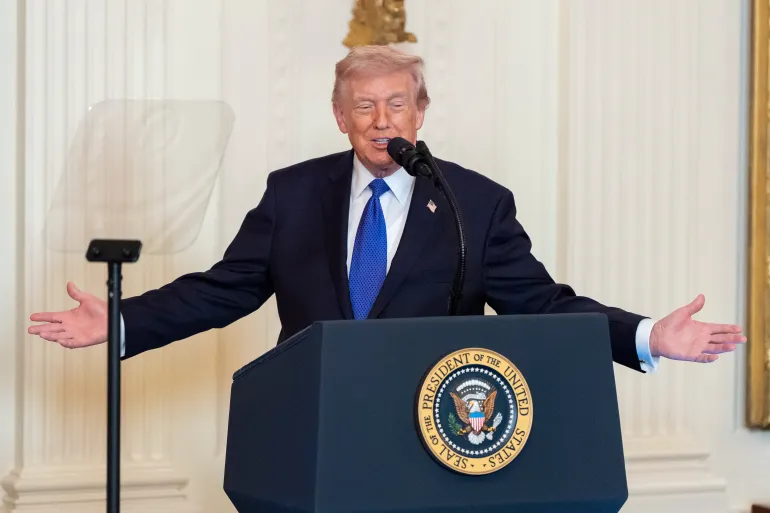
United States President Donald Trump has said the plan for the Iran war initially “projected four to five weeks”, adding the US military has the “capability to go far longer than that”.
Speaking on Monday from the White House, Trump outlined his administration’s justification for going to war against Iran alongside Israel, saying that Iran posed “grave threats” to the US, even as he again claimed that US strikes on Iran in June of last year led to the “obliteration of Iran’s nuclear programme”.
Trump also said that Iran’s ballistic missile programme was “growing rapidly and dramatically, and this posed a very clear, colossal threat to America and our forces stationed overseas”.
“The regime already had missiles capable of hitting Europe and our bases, both local and overseas, and would soon have had missiles capable of reaching our beautiful America,” Trump said, repeating a claim his administration has repeatedly made in the run-up to Saturday’s attack, for which US government officials have not provided any evidence.
The statements were significant, with Trump appearing to pivot from claims that Iran posed an immediate threat to the US. Instead, he characterised the Iranian government as potentially posing a longer-term threat.
“The purpose of this fast-growing missile programme was to shield their nuclear weapon development and make it extraordinarily difficult for anyone to stop them from making these – highly forbidden by us – nuclear weapons,” Trump said.
“An Iranian regime armed with long-range missiles and nuclear weapons would be an intolerable threat to the Middle East, but also to the American people,” Trump said.
“Our country itself would be under threat, and it was very nearly under threat,” Trump said.
Under both US domestic law and international law, attacks on a foreign country must be in response to an immediate threat. Under the US Constitution, only Congress can declare war, while the president can act unilaterally in response to an imminent threat.
Trump has released two video speeches since the US and Israel began their attacks, including saying in a recorded message released yesterday that Iran had waged a “war against civilisation”.
He also predicted there would likely be more US military personnel deaths after the Pentagon confirmed the first three members of the military killed in the Middle East on Sunday.
To date, at least 555 people have been killed in Iran, 13 have been killed in Lebanon, 10 killed in Israel, three killed in the United Arab Emirates, and two killed in Iraq, with Oman, Bahrain and Kuwait each reporting one death amid Iranian retaliations in the region.
On Monday, shortly after the Pentagon confirmed a fourth member of the US military had died, Trump did not give a clear timeline for the operations.
He said “Right from the beginning, we projected four to five weeks, but we have capability to go far longer than that.”
Trump added that the military had originally projected four weeks to “terminate the military leadership” of Iran.
To date, Iran’s Supreme Leader Ali Khamenei and several other top officials, including the head of Iran’s Islamic Revolutionary Guard Corps (IRGC), have been confirmed killed in US-Israeli strikes.
“We’re ahead of schedule there by a lot,” Trump said.
Trump spoke shortly after Pentagon chief Pete Hegseth took questions from reporters for the first time since the attacks began.
Hegseth appeared to respond to concerns from Trump’s own “Make America Great Again” (MAGA) movement about entering into a prolonged war.
Trump had vowed to end US interventionism during his presidential campaign, promising to focus on domestic needs over adventurism abroad.
“This is not Iraq. This is not endless,” Hegseth said.
“This operation is a clear, devastating, decisive mission. Destroy the missile threat, destroy the navy, no nukes,” he said.
“Israel has clear missions as well, for which we are grateful, capable partners,” he said, without defining Israel’s mission.
Israeli Prime Minister Benjamin Netanyahu has long called for the toppling of Iran’s government
Hegseth further vowed to fight the war “all on our terms, with maximum authorities, no stupid rules of engagement, no nation-building quagmire, no democracy building exercise, no politically correct wars”.
[Aljazeera]
Six US soldiers killed in Iranian strike on Kuwait base

Israel attacks presidential office in Tehran as reported death toll in Iran rises to 787

Attorney At Law S K Sangakkara pasess away

SriLankan Airlines Update on Middle East Operations

Trump says Iran war projected to last 4 to 5 weeks, could go ‘far longer’

Qatar downs two Iranian fighter jets as conflict widens

‘Dates have the highest sugar content to fight Coronavirus’

Sunday Island 27 December – Headlines

#SundayIsland 17th December – Headlines

Sunday Island – 28th March

Sunday Island Headlines – 21 March

Sunday Island – 21st February – Headlines
-

 Opinion4 days ago
Jamming and re-setting the world: What is the role of Donald Trump?
-
 Features4 days ago
An innocent bystander or a passive onlooker?
-

 Features5 days ago
Ratmalana Airport: The Truth, The Whole Truth, And Nothing But The Truth
-

 Features6 days ago
Building on Sand: The Indian market trap
-

 Business6 days ago
Dialog partners with Xiaomi to introduce Redmi Note 15 5G Series in Sri Lanka
-

 Opinion6 days ago
Future must be won
-

 Business5 days ago
IRCSL transforms Sri Lanka’s insurance industry with first-ever Centralized Insurance Data Repository
-

 Opinion1 day ago
Sri Lanka – world’s worst facilities for cricket fans