Sports
Bangladesh gain a stranglehold after Mushfiqur’s ton
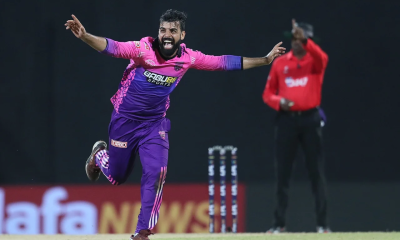
Bangladesh dominated the second day’s play with both bat and ball to get to a position where victory isn’t far away. After piling up 369 in the first innings in just over 80 overs, their spinners also prised out four Irish wickets by stumps.
Ireland’s second innings, which they started with a deficit of 155, went southwards soon as Taijul Islam, once again, and Shakib Al Hasan struck with the new ball. The skipper opened the attack and trapped opener Jams McCollum LBW in just the first over to kickstart the carnage.
Brief scores:
Ireland 214 (Harry Tector 50, Lorcan Tucker 37; Taijul Islam 5/58) & 27/4 (Taijul Islam 2-7) trail Bangladesh 369 (Mushfiqur Rahim 126, Shakib Al Hasan 87, Mehidy Hasan 55; Andy McBrine 6-118) by 128 runs

Sports
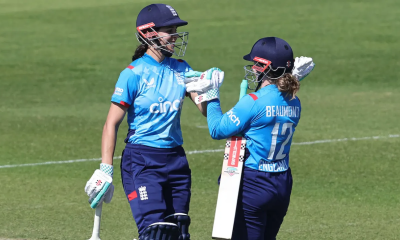
It’s still a queendom, but Sri Lanka are more than just Athapaththu now
Sometimes all you need is a little push.
The 2024 Asia Cup was a watershed for this young Sri Lanka outfit. Prior to that exhilarating climax in Dambulla , Sri Lanka’s flashes of international brilliance were almost exclusively engineered by Chamari Athapaththu. Sure, they could occasionally trade heavy blows with the world’s elite, but they lacked the collective capacity for a sustained fight. This was a queendom, one where removing Athapaththu early meant the game was as good as won.
That lopsided dynamic had been there ever since Athapaththu’s debut back in 2009. So it was impossible not to share her heartbreak when she bemoaned her team’s failure to make the T20 World Cup semi-finals earlier this year – “It’s a sadness beyond words… I could never get a chance to take my team into a semi-final of a World Cup… I think I’m a failure as a captain.”
The tragedy of that lament lay in the irony of its timing. For the first time in Athapaththu’s career, she wasn’t actually marooned by herself. The world had already been treated to a glorious glimpse of the team’s ceiling in 2024, when Harshitha Samarawickrema and Kavisha Dilhari struck the winning runs against a heavily favoured India side.
But keeping the progress going is rarely that straightforward – think less ladder and more hiking path with troughs and peaks. And it was a truth that Sri Lanka quickly learned. The euphoria of Dambulla was swept aside by a winless group stage exit at the T20 World Cup in 2024, followed by a barren 2025 devoid of series wins.
The year ended in structural upheaval as the team parted ways with head coach Rumesh Ratnayake, whose calming influence and fatherly reassurance had been foundational to their initial breakthrough.
So was it any surprise that in the last throes of an astonishing career, Athapaththu might have felt her time was up? At 36, with retirement on the not-so-distant-horizon, Athapaththu could be forgiven for thinking her last chance had come and gone.
But women’s cricket has shown in recent times that traditional career timelines, calibrated on the men’s game, might not necessarily make sense. Athapaththu has only grown stronger with age. After a quiet 2025 where she scored just 190 T20I runs at a strike rate of 113.77, she has struck 476 at 143.80 in 2026 – her best strike rate in a calendar year.
And if it was motivation that she needed, her younger colleagues are playing their part in keeping the queen locked in for as long as possible.
Imesha Dulani, 24, has had a breakthrough year, becoming the first Sri Lanka woman not named “Chamari Athapaththu” to score a T20I century, while centuries from Vishmi gunerathne, 21, and Samarawickrama, 28, led a successful chase of 275 – Sri Lanka’s third highest in ODIs – against Pakistan earlier this year, with Athapaththu watching on like the rest of us.
This was also the first year that Sri Lanka Cricket’s annual awards, had Athapaththu going without a nomination in the best women’s ODI batter category, as Samarawickrama won over the electric Nilakshika Silva. Athapaththu was still the big winner overall, though. In fact, there is now genuine competition for places at the top of the batting order, with the likes of Dulani, Gunaratne and Hasini Perera all vying for top-order berths.
The arrival of Jamie Siddons as head coach earlier this year has helped. Since he took over in March, Sri Lanka have made a noticeable shift to a more aggressive brand of cricket – something Siddons had signposted upon arrival. Whereas boundary-hitting had taken a back seat previously, Siddons has sought to bring the team’s approach in line with modern practices.
“We win in singles and twos, but we don’t score more boundaries than the opposition, and that’s why we lose against the best teams,” Siddons had said when he took over.
All this is to say that, this Sri Lanka is not the same Sri Lanka that entered the Asia Cup two years ago, nor is it even the one that won it. While they remain distinct underdogs against a formidable India, this is now a side equipped with multiple match-winners and a swelling sense of belief.
It’s also a side that is yet to touch its ceiling. There have been times when Athapaththu has not clicked and others have bailed the team out, but it’s those scintillating periods when it has all come together that this unit has shown its true fire. If they can put together more of those days, then a consecutive Asia Cup crown might well be within their reach.
Latest News
Namibia T20I tri-series: Youth, depth and a continental dream take centre stage
Summer has come early to the southern hemisphere and not just because of climate change. In Australia, where they have never played Tests in August before, a two-match series has already been completed, and it’s not even the end of the month. In South Africa, the international season officially starts next door – in Namibia, where a T20I tri-series kicks off a packed season.
Zimbabwe are the other participants, having long abandoned the idea of a conventional home season so they can host teams during their mild winters. It also gives next year’s men’s ODI World Cup co-hosts an opportunity to get cosy ahead of the main event.
The tri-series is a precursor to a mooted Africa T20 Cup, a continental tournament in the mould of the Asia Cup, aimed at growing the game in this region. The likes of Uganda, who played at the 2024 T20 World Cup, and recent men’s Under-19 World Cup participants Tanzania (2026) and Nigeria (2020) are likely to be involved in future editions. For now, the organisers have kept it to the continent’s heavyweights, to raise awareness and, crucially, funds. All proceeds from this tournament will go to the Africa Cricket Association.
How much the total earnings will be remains to be seen. The new Namibia Cricket Ground has world-class high-performance facilities and a seating capacity of 7,500. Ticket prices are reasonable enough to attract full houses, but that does not mean there are millions to be made. General seating has gone on sale for between 50 and 100 Namibian dollars (US$3.12 and 6.25) while premier seating is 200 Namibian dollars (12.50 USD). There is no major broadcast deal in place and on the eve of the tri-series, a television partner was yet to be announced. Cricinfo understands the games may be available on the streaming service of the continent’s biggest sports broadcaster, SuperSport , but not on their regular bouquet of channels. The series may consequently fly slightly under the radar, but it will still serve as an exercise in relationship-building for the three boards and self-discovery for their teams.
Namibia: Desperate to level up
Hosts Namibia have not progressed as they’d have liked after making the Super 12s of the 2021 T20 World Cup. They played in the next three events but had their worst outing earlier this year when they lost all four matches in their group. More game time against Full Members is what many Associates ask for and over the next three weeks Namibia will get that, in both white-ball formats as South Africa will stay on for three ODIs.
It’s exactly the kind of challenge they want as they enter the latter stages of Cricket World Cup League 2 (the progression pathway to 2027 World Cup qualification) and with the 2028 T20 World Cup qualification process not far away. “It’s sort of a question that we always get in the associate world. How do you bridge the gap to the next level? You only bridge it by winning against teams at the next level,”Gerhard Erasmus, Namibia’s captain said at the pre-tournament press conference. “The Associate teams over the years have made that happen more frequently. Lots of the Associate nations have gone away from the tag of just competing and games are actually started on very equal footing these days, especially the T20 format. It gives you that ability to impact the game or use a bit of momentum on your side. If you have two star performers on the day, it could swing the result your way.”
Erasmus is Namibia’s stand-out, as their leading run-scorer and third-highest wicket-taker in the format but it is important that they unearth others. For this series, Namibia have two 18-year-olds, Waldo Smith and Max Heingo, in the squad and three 21-year-olds. Alexander Busing-Volschenk, Junior Taanyanda and Jack Brassell are all being seen as players for the future and the last of those has impressed Erasmus most.
“A guy that comes to mind for me is Jack Brassell. Not only has his skillset gone up by the amount of overs that he’s bowled and the loads that he’s got behind him but he’s made a conscious decision to get stronger and bowl faster,” Erasmus said. “He’s now the fastest member of our side, which is something that he wants to do. They take their careers very personally and professionally. That’s what we as management or leadership also have to always do.”
South Africa: Mining their depth
Namibia will open the tri-series against South Africa, who they have bragging rights over after beating them at their only T20I meeting last year. The naysayers will point out that the South Africa XI was experimental, but so is this one and Lhuan-dre Pretoripus, Rubin Hermann and Bjorn Fortuin, as stand-in captain, are back to try and set the record straight. “It wasn’t a fun experience,” Fortuin said. “We got beaten by the better team on the day. If you take things for granted, you will definitely feel it.”
The current South African squad, which welcomes Quinton de Kock back into the fold, will be wary of making the same mistake. It is made up largely of players on the fringes of the first-choice side who will be hoping to strengthen their cases for future selection.
Fortuin occupies a slightly different position. Though capped 43 times in white-ball formats for South Africa, his entire career has run parallel to frontline left-arm spinner Keshav Maharaj and it’s difficult to see how Fortuin will get a sustained run but that gives him a different role. “Kesh has obviously been exceptional for quite a few years and he’s taken those talents all across the world. I’ve tried to emulate that as much as I can,” Fortuin said. “My opportunities have been limited, but as a player, all I can do is try and make the best of it. With regards to the squad that we’ve got here, it’s a fairly inexperienced squad, but really talented. And they’ve all done some special things around the world. Hopefully I can just impart some knowledge to them and let their natural game flow.”
In line for debuts are Duan Jansen and Ethan Bosch, but everyone from Lhuan-dre to Dewald Brevis to Kwena Maphaka is worth keeping an eye on, especially in a season with eight Tests, nine ODIs, three T20Is and the SA20.
Zimbabwe: Chasing consistency
The middle of the sandwich are Zimbabwe, who stunned the cricket world by reaching the Super Eight of this year’s T20 World Cup and are finally on an upward trajectory. Three chastening T20Is against India aside, Zimbabwe’s progress has been steady but now it’s about how long they can make it last.
They’ve kept some of their senior core in captain Sikandar Raza and soon-to-be-40 Graeme Cremer to “handle all the youth,” in Raza’s words. But they are starting to transition too.
Briam Benett, Brad Evans and Blessing Muzarabani are the names that will dominate their future but they need the likes of Newman Nyamhuri, Dion Myers and Tadiwanashe Marumani to show they can do a job more often than not in order to build the core of a future side. That’s something on Raza’s mind and this series could go some way to showing him, and Zimbabwe, what they have to work with.
“For Zimbabwe to go forward and for us to be competing and winning at the top level, we need to have a big pool of players. I’ve been very vocal about that,” he said. “I’m very hopeful that the guys we have picked will grab this opportunity because one, will grow our pool of players and two, that means Zimbabwe has more depth in different fields of play and that could only mean that Zimbabwe is going up. That’s what I want to see. My personal ambition, one of them is that before I call time, I want to make sure this country is still going on the upward trajectory and that can only happen if we have a big pool of players to choose from.”
Is Raza’s time coming to an end soon? Even at 40, it doesn’t sound like it. “Unfortunately, to handle all this youth that we have in the team, I don’t think one old guy was enough. So to get another old guy is certainly helpful,” he joked, referring to himself and Cremer. “These Gen Zs are a bit difficult to handle at times.”
Ultimately, it is the Gen Zers for whom a series like this has been created. The tournament should be fast-moving and, ideally, high-octane. Seven matches will be played in 10 days before the winner will walk away with a trophy, which incidentally is a cross-section of a tree trunk.
The rings that reveal the tree’s age, and the environment it grew in, are all clearly visible in a living record of its history. The symbolism is fitting as African cricket takes another step towards a future in which the sport can grow across the continent and establish itself as a stronger force on the global stage.
[Cricinfo]
Latest News
Tharanga storms past 92m in Zurich
World-leading javelin thrower Rumesh Tharanga underlined his status as the man to beat in world athletics with another sensational performance, winning the men’s javelin at the prestigious Weltklasse meeting in Zurich with a massive 92.07 metres.
Tharanga’s best effort came in the final round and left him just 21 centimetres short of the meeting record of 92.28m, which has stood for three decades.
The 23-year-old first overcome first round challenge from two-time world champion Anderson Peters of Grenada. Peters took the early lead with a first-round throw of 86.93m, but Tharanga responded in the second round with 88.23m to move ahead.
He then increased his advantage in the third round before producing his best effort of the night in the final round, sending the javelin soaring to 92.07m.
Peters had to settle for second with 86.93m, while Poland’s Dawid Wegner was third with 85.16m. Trinidad and Tobago’s Keshorn Walcott finished fourth with 83.02m, followed by Kenya’s Julius Yego (81.66m) and American Marc Anthony Minichello (80.38m).
The Zurich victory further strengthens Tharanga’s position at the top of the world javelin hierarchy at a crucial stage of the season. With the Wanda Diamond League Final in Brussels just a week away and the World Athletics Ultimate Championship looming, he has emerged as the athlete everyone will be watching.
Tharanga’s latest 92-metre-plus throw also provides a timely reminder of his extraordinary consistency at the highest level, as he continues his remarkable rise among the world’s elite javelin throwers. (RF)
-
Business7 days agoSriLankan Airlines makes ShakthiSAT Mission possible for talented Sri Lankan student
-
Features6 days agoMy secondary schooling after Royal Primary
-
Features6 days agoFrom the First to the 22nd: A short history of Amendment Politics and Reform Frustrations
-
News4 days agoMissing doctor’s body found in Mahiyanganaya
-
Latest News7 days agoTharanga edges out Chopra in 88m javelin battle
-
Features6 days agoHow Shelton Kodikara became first Professor of International Relations
-
Features6 days agoHow St. John’s College Shaped Panadura for 150 Years
-
News4 days agoAustralia declines to release Finance Secy Suriyapperuma’s citizenship details