
Latest News
Babar and Iftikhar centuries serve up Pakistan victory

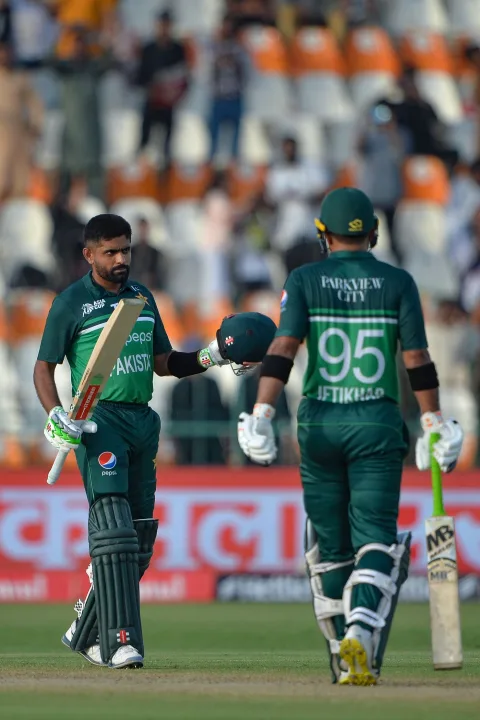
On a tricky pitch in Multan, Nepal had made early breakthroughs to leave Pakistan in a precarious position. Babar consolidated the innings during that period, taking 72 balls to reach his fifty. Gradually, he increased the tempo and moved from 51 to 100 in 37 balls. Once he reached his hundred, he went into the T20 mode and smashed 51 off the next 22 balls.
Suryakumar Yadav recently said that ODIs are challenging because you have to bat like all three formats. On Wednesday, Babar showed how to do it.
Babar and Ifthikar Ahmed, who smashed an unbeaten 109 off 71, added 214 off 131 balls in a fifth-wicket stand that lifted Pakistan to 342 for 6. Babar didn’t come out to field and Shadab Khan captained the side during the chase. It made little difference, as Nepal were bowled out for just 104 in 23.4 overs.
Nepal were making their Asia Cup debut, and playing against Pakistan for the first time in any format. That inexperience, and probably the nerves, showed on several occasions. In the first over of the match, Sompal Kami drifted down the leg side a couple of times, and Fakhar Zaman helped himself to two boundaries.
However, the slowness of the pitch and some good fielding came to Nepal’s rescue. With the ball not coming onto the bat, both Fakhar and Imam-ul-Haq struggled for timing. When Fakhar threw his bat at a length ball from Karan and got a thick outside edge, wicketkeeper Aasif Sheikh stretched to his left to grab it with both hands. In the next over, Rohit Paudel nailed a direct hit from mid-off to find Imam short.
With Pakistan 25 for 2, Babar and Mohammad Rizwan started rebuilding the innings. Playing risk-free cricket and still picking up a boundary here and there, they took the side to 100 in the 22nd over.
But then Nepal struck back, once again via their fielding. This time Dipendra Singh Airee, from cover, hit the stumps at the bowler’s end to find Rizwan’s bat and both feet in the air as the batter tried to avoid getting hit by the throw. Had Rizwan run normally and grounded his bat, he would have been safe. He made 44 off 50 balls.
Agha Salman attempted a sweep from well outside off and a reverse sweep in the first three balls he faced; neither shot fetched him any runs. Three overs later, he tried another reverse sweep, off Sandeep Lamichhane, but failed to keep it down and was caught at short third.
At 124 for 4, Pakistan were in trouble but Babar was unperturbed. Against spin, he used the cut shot well to rotate the strike, and reached his fifty in 72 balls.
While Nepal fielded like the World XI at certain times, they looked like Ilford Second XI at others. Having dropped Imam on 5 earlier, they put down Babar on 55, not to mention several other causal efforts resulting in misfields. Babar made them pay. He started finding the boundary with increasing frequency and got to his hundred in 109 balls. Fittingly, it was another cut shot against spin that took him to the milestone.
After that, he really opened up. In the 45th over, he hit Kami for 4, 4 and 6 off successive balls before smashing back-to-back sixes off Lamichhane.
From the other end, Iftikhar was even more brutal. In fact, it was his knock that allowed Babar to shift the gears gradually.
Iftikhar attacked right from the moment he came to the crease. He hit the first six of the innings when he launched Kami over deep midwicket in the 35th over. It took him just 67 balls to bring up his maiden ODI hundred against a helpless Nepal attack. In all, Iftikhar hit 11 fours and four sixes as Pakistan ransacked 129 in the last ten overs.
Shaheen Shah Afridi then picked up two wickets in the first over of the chase. He first strangled Kushal Bhurtel down the leg side before trapping Paudel lbw for a first-ball duck. In the next over, Naseem Shah had Aasif caught at first slip to make it 14 for 3.
Aarif Sheikh and Kami gave the innings some semblance of stability by adding 59 off 78 balls but the pair didn’t last long against Haris Rauf’s pace. He first cleaned up Aarif and then had Kami caught behind. The only resistance Pakistan’s fast bowlers faced was from the muggy weather: both Shaheen and Haris had to leave the field for a breather after their first spells.
Nepal’s lower order was no match for Shadab’s variations. Mixing his legbreaks and googlies, he picked up the last four wickets to finish with figures of 4 for 27.
Brief scores:
Pakistan 342/6 in 50 overs (Babar Azam 151, Iftikhar Ahmed 109*; Sompal Kami 2-85) beat Nepal 104 (Sompal Kami 28; Shadab Khan 4-27, Haris Rauf 2-16) by 238 runs.
(Cricinfo)











An unprecedented wave of AI-generated misinformation about the US-Israel war with Iran is being monetized by online creators with growing access to generative AI technology, experts have told BBC Verify.
Our analysis has found numerous examples of AI-generated videos and fabricated satellite imagery being used to make false and misleading claims about the conflict which have collectively amassed hundreds of millions of views online.
“The scale is truly alarming and this war has made it impossible to ignore now,” says Timothy Graham, a digital media expert at the Queensland University of Technology.
“What used to require professional video production can now be done in minutes with AI tools. The barrier to creating convincing synthetic conflict footage has essentially collapsed,” he says.
The US and Israel began launching strikes on Iran on 28 February. In response, Iran has launched drone and missile attacks on Israel, as well as multiple Gulf nations and US military assets in the region.
Many have turned to social media to search for and share the latest information and to help make sense of a fast-moving week of conflict.
The platform X announced this week it will temporarily suspend creators from its monetization programme if they post AI-generated videos of armed conflict without a label.
The scheme rewards eligible users whose posts create large numbers of views, likes, shares and comments with payments from the platform.
“It’s a notable signal that they’ve noticed that this is a big problem,” says Mahsa Alimardani, a researcher specialising in Iran at the Oxford Internet Institute.
We asked TikTok and Meta, the company of Facebook and Instagram, if they intend to take similar action, but they did not respond to our requests for comment.
A typical example of an AI-generated video that BBC Verify has tracked appears to show missiles striking the city of Tel Aviv in Israel as the sound of explosions rings out in the background.

This video has been featured in more than 300 posts which have then been shared tens of thousands of times across social media platforms.
Some X users turned to the platform’s AI chatbot Grok to confirm the video’s veracity. But in many cases seen by BBC Verify, Grok wrongly insisted that the AI-generated video was real.
Another fake video, viewed tens of millions of times, claims to show Dubai’s Burj Khalifa skyscraper in flames, while a crowd of people seem to be running towards the building.
This AI-generated footage spread widely online at a time of considerable concern from residents and tourists about the drone and missile strikes on the city.
“Fake videos like these have a detrimental impact on people’s trust in the verified information they see online and make it much harder to document real evidence,” says Alimardani.

A new feature of this conflict analysed by BBC Verify is the emergence of AI-generated satellite imagery.
We verified multiple real videos showing Iranian drone and missile strikes on the US Navy’s Fifth Fleet headquarters in Bahrain on the first day of the conflict.
A fabricated photo, shared on X by the state-linked newspaper The Tehran Times, began to spread the following day and claimed to show extensive damage to the base.
The fake appears to be based on real satellite imagery of a US naval base in Bahrain taken in February 2025, which is publicly available online.
According to Google’s SynthID watermark detector, the fake image was generated or edited with a Google AI tool.

Three vehicles parked outside are also in the exact same spot in both the genuine satellite imagery and the AI picture – despite the photos allegedly having been taken a year apart.
Google’s AI tools, including its video generator Veo, are on the growing list of popular AI platforms, like OpenAI’s Sora model, Chinese AI app Seedance, and Grok which is built into X.
“The number of different tools that are now available to create a wide range of highly realistic AI manipulations is unprecedented,” says Henry Ajder, a generative AI expert.
“We have never seen these tools so available, so easy and so cheap to use,” he says.
This has led to a surge of AI-generated content online “because the pipeline onto social media can now be almost fully automated,” says Victoire Rio, executive director of the technology policy non-profit What To Fix.

X’s head of product said on Tuesday that “99%” of the accounts spreading AI-generated videos like these were trying to “game monetization” by posting content that will generate large amounts of engagement in return for payment through the app’s Creator Revenue Sharing programme.
The platform does not publish how many accounts are part of the programme, or how much money they can make.
But Graham estimates that X could pay about “eight to 12 dollars per million verified user impressions”.
“Creators have to hit five million organic impressions in three months, plus hold an X premium subscription, to be eligible,” he added.
“Once you’re in, viral AI-generated content is basically a money printer,” he says. “They’ve built the ultimate misinformation enterprise.”
X did not respond to our request for comment or our questions about the Creator Revenue Sharing programme.
Experts have told BBC Verify that while many social media companies say they are trying to change their moderation and detection systems to address the scale and speed at which AI-generated content spreads, there is no simple solution to the problem.
“The deeper issue is that engagement-driven monetisation and accurate information are fundamentally in tension, and no platform has fully resolved that tension or perhaps ever will,” says Graham.
[BBC]

Explosions have rocked one of Teheran’s main commercial airports, with eyewitnesses reporting a burning plane and large plumes of smoke at the Mehrabad airport – Iran’s busiest airport and main domestic hub – in footage shared on social media. Satellite imagery taken on Friday shows multiple aircraft were at the airport.
Israel earlier said it was launching a new wave of strikes on Iran
[BBC]

Retiring skipper Alyssa Healy fell cheaply late on a bowler-dominated opening day that saw debutants Lucy Hamilton and Sayali Satghare produce spectacular starts to their Test careers.
Thirteen wickets fell on a grassy WACA surface, including Healy who on 13 hit Satghare straight to backward point with 30 minutes left before stumps. Healy trudged off the field – perhaps not for the final time – to a loud ovation as India, fielding four debutants, hit back after being bowled out in 62.4 overs.
Annabel Sutherland, backing up her earlier standout bowling effort, steadied before the close alongside Elllyse Perry, who is playing as a specialist batter after recovering from a quad strain.
After Healy elected to bowl to kick-start her swansong, left-arm quick Hamilton ignited Australia by clean bowling Smriti Mandhana for 4 in a brilliant start to her Test career.
She also claimed the wickets of Jemimah Rodrigues, who top-scored with 52, and Sneh Rana to finish with 3 for 31 off 11 overs in an impressive first up effort after earning selection over uncapped Maitlan Brown.
Australia’s seamers relished the conditions as they swung the pink ball menacingly to cause nightmares for an India side returning to Test cricket for the first time since mid-2024.
Sutherland was unplayable for long stretches as she hooped the ball around to finish with 4 for 46 off 17 overs, figures that could have been even better if not for four dropped catches off her bowling.
Australia’s sloppy performance in the field prolonged India’s first innings and meant they had the tough task of fronting up to bat under lights. Satghare lifted India by knocking over Georgia Voll with a menacing delivery that pitched well outside off-stump before swinging back to hit leg stump.
Fellow debutant Kranti Gaud also had a first wicket to remember when she dismissed Phoebe Litchfield, largely thanks to a brilliant catch from Rodrigues at backward point.
It led to Healy walking out to a mighty ovation, but India weren’t in a generous mood as they clawed back into a contest they must win if they are to draw the multi-series format.
Healy’s day had started brightly when the coin fell in Australia’s favour for the first time in the multi-format series. Her decision to bowl caused a groan in the terraces with fans itching to watch her bat.
But the supporters were soon in full voice when Hamilton, 19, was introduced into the attack in the second over. She came close to a wicket on her fourth delivery but a reviewed lbw shout on opener Shafali Verma was unsuccessful due to an inside edge.
Hamilton only had to wait until her third over to get through Mandhana with a cracking full-pitched delivery that comprehensively beat the bat and smashed into middle stump.
She was mobbed by her teammates before bowling a fierce short delivery to fellow debutant Pratika Rawal, who streakily opened her account through the slip cordon.
Hamilton, who earlier received her baggy green from Beth Mooney, returned the impressive figures of 1 for 12 from five overs in her first spell. But India hung tough with Shafali – maturely resisting her attacking instincts – and Rawal combining well in a rearguard to get through the new ball.
Sutherland entered the attack and started a fabulous bowling performance by cutting short Shafali’s blossoming knock on 35 with a terrific delivery that was caught behind.
It was a reward for Sutherland who had earlier been desperately unlucky not to pick up the wicket of Rawal after Hamilton fumbled in the gully. In what proved to be a costly missed chance, Rodrigues was reprieved by Voll at short-leg on 0 when she fended a fierce short delivery from Sutherland.
But Sutherland was not to be denied after she enticed Rawal into edging to gully where Hamilton hung onto her first catch at Test level. Captain Harmanpreet Kaur started swiftly before her off-stump was knocked by a pearler from Darcie Brown as India entered the tea break in trouble at 99 for 4.
Sutherland continued to be irrepressible after the resumption and dismissed Deepti Sharma with a length ball as the pressure heightened on Rodrigues and Richa Ghosh, who was purely in survival mode early in her innings.
Local hero Alana King was held back until the 40th over and Rogrigues decided it was time to put the foot down, counterattacking to devastating effect with four consecutive boundaries.
She sped to her half-century off 74 balls with the milestone reached in fitting style with a gorgeous drive as she continued to take a liking to King’s legspin.
Just when the partnership started to gather momentum, Ghosh threw it away when she hit a dragged down delivery from Ashleigh Gardner straight to short midwicket before Rodrigues tamely flicked a loose delivery from Hamilton to square leg.
Hamilton bagged Rana as India spiraled to 157 for 8 before debutant Kashvee Gautam attacked just like she had done during the ODI series. She eventually ran out of support with Sutherland claiming her fourth wicket when she dismissed Satghare.
The hectic day’s play also launched a new era at the revamped WACA ground with most spectators nestled in the rare shaded areas – still an issue even after the redevelopment – as the temperature peaked at 37 degree Celsius with a similar forecast set for day two.
Brief scores: [Stumps Day 1]
Australia Women 96 for 3 in 27 overs (Ellyse Perry 43*, Annabel Sutherland 20*; Kranti Gaud 2-28) trail India Women 198 in 62.4 overs (Shafali Verma 35, Jemmimah Rodrigues 52, Kasnvee Gautam 34*; Darcie Brown 2-41, Annabel Sutherland 4-46, Lucy Hamilton 3-31) by 102 runs
[Cricinfo]

Qatar partially reopens airspace as Iranian strikes continue to hit Gulf

The final voyage of the Iranian warship sunk by the US

AI-generated Iran war videos surge as creators use new tech to cash in

Huge explosions rock major Tehran airport as Israel strikes ‘regime infrastructure’

India hit back but Sutherland, Hamilton impress to give Australia the edge

Heat Index at ‘Caution Level’ in the Sabaragamuwa province and, Colombo, Gampaha, Kurunegala, Anuradhapura, Vavuniya, Hambanthota and Monaragala districts

‘Dates have the highest sugar content to fight Coronavirus’

Sunday Island 27 December – Headlines

#SundayIsland 17th December – Headlines

Sunday Island – 28th March

Sunday Island Headlines – 21 March

Sunday Island – 21st February – Headlines
-

 Features5 days ago
Brilliant Navy officer no more
-

 Opinion5 days ago
Sri Lanka – world’s worst facilities for cricket fans
-

 News2 days ago
Legal experts decry move to demolish STC dining hall
-

 News1 day ago
University of Wolverhampton confirms Ranil was officially invited
-

 Features5 days ago
A life in colour and song: Rajika Gamage’s new bird guide captures Sri Lanka’s avian soul
-

 Business3 days ago
Cabinet nod for the removal of Cess tax imposed on imported good
-

 Features6 days ago
Overseas visits to drum up foreign assistance for Sri Lanka
-

 Features6 days ago
Sri Lanka to Host First-Ever World Congress on Snakes in Landmark Scientific Milestone