
Latest News
Australia clinch thriller to book yet another semi-final; India on the brink

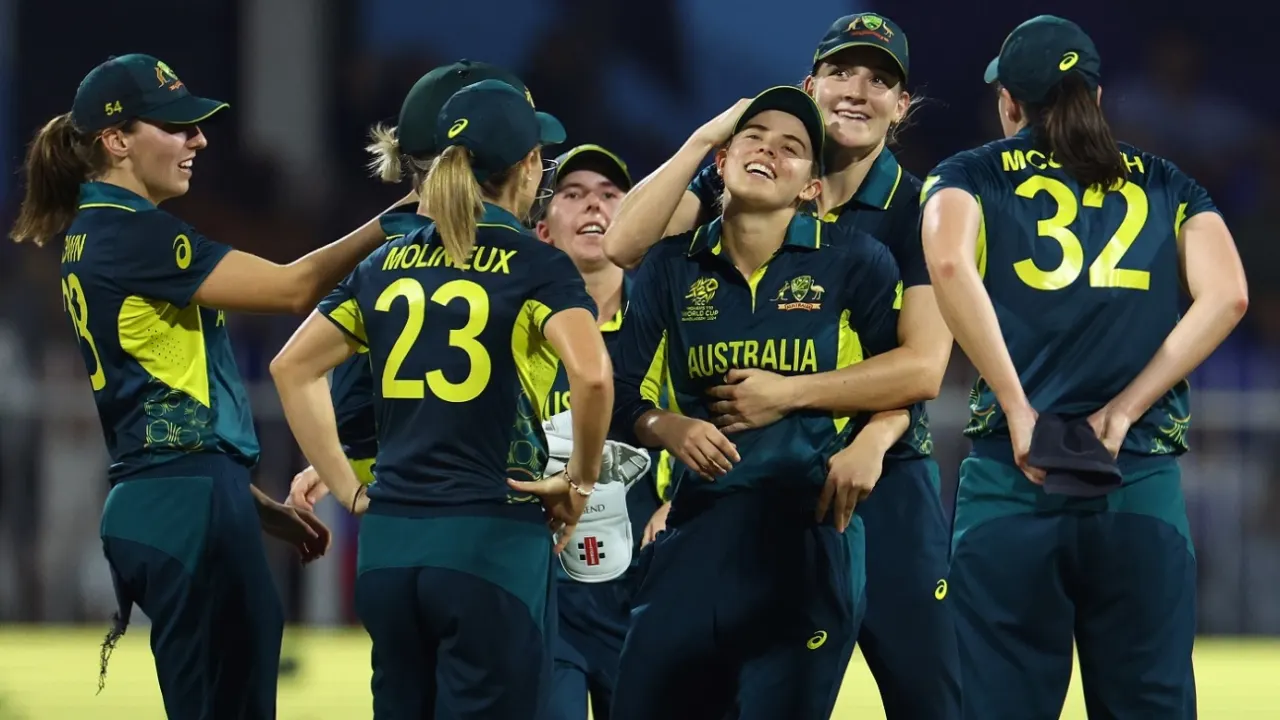
India’s T20 World Cup semi-final hopes have been taken out of their hands after a nine-run defeat to Australia in their final group-stage match. India have lost two of their four matches and will have to wait on the result of New Zealand vs Pakistan tomorrow to find out if they will advance to the knockouts. Any margin of victory for New Zealand will eliminate India but a Pakistan victory will decide the semi-finalists on net run rate.
Permutations aside, the tournament finally got the thriller it had been crying out for in an intense clash in front of an electric, sold-out Sharjah crowd of 14,946. They were treated to a high-octane affair with both sides acutely aware of what was at stake amid injury concerns. Australia were without captain, opening batter and wicket-keeper Alyssa Healy, who arrived on crutches after sustaining a foot injury against Pakistan, and Tayla Vlaeminck who has been ruled out of the tournament. .
India also lost Asha Sobhana to a knee injury after the toss and needed Australia’s permission to replace her in the XI, which was given0 Radha Yadav who had appeared as a substitute fielder in previous games, was included in Asha’s place. Later, Renuka Singh left the field limping after bowling her four overs but came back to face the final ball of the match.
By then, India’s chances of victory were gone after their chase started brightly but was pinned back by wickets at crucial times. They were 47 for 3 in the seventh over before a 63-run stand between Harmanpreet Kaur and Deepti Sharma put them back on track. A collapse of 6 for 31 left Harmanpreet the last batter standing and despite a second successive half-century, she could not take India over the line alone.
Australia were uncharacteristically messy in the field, put down two chances and bowled four wides and a no-ball but had enough at their disposal to defend.Grace Harris opening in Healy’s place, was their top-scorer with a 41-ball 40 and shared a 62-run stand with Tahlia McGrath, which steadied Australia after two early losses. Ellyse Perry’s 23-ball 32 gave them much-needed impetus at the end.
Australia were off to a slowish start with 17 runs from their first 16 balls when Renuka struck with a delivery that angled away from Beth Mooney. Australia’s senior opener reached for it and hit a low chance to Radha at backward point, where she dived forward to take a good catch. Georgia Wareham was pushed up to No. 3, where she has occasionally been used as a pinch hitter, and the first ball she faced thudded into the front pad as she missed her flick.
Renuka was joined by every single one of her team-mates in appealing and umpire Sue Redfern eventually raised her finger as Wareham began walking off. Harris asked Wareham if she wanted to review but she decided against it, only to return to the dressing room and find out that ball tracking showed that the ball would go on to miss leg stump by some distance. Australia held Perry back and stand-in captain McGrath was in at No. 4, where she had to rebuild.
Harris and McGrath took Australia to 37 for 2 in the powerplay and launched into attack mode from the eighth over, when they both took on Pooja Vastrakar. McGrath hit her through cover for four and then Harris scooped her over fine leg in an over that cost ten runs and took Australia past fifty. Australia were 65 for 2 at the halfway stage of their innings and the Harris-McGrath stand grew to 62 off 54 balls and India were desperate to separate them.
They reviewed an lbw appeal against McGrath off a Renuka full toss which was missing leg. McGrath was then dropped on 31 by Harmanpreet off Radha at cover. The India captain got both hands on the ball but it burst through. Harris hit the next ball in the air and Harmanpreet ran back to try and take an overhead catch but missed. It was third time lucky for India when McGrath charged Radha, missed and Richa Ghosh stumped her.
Harris went nine balls later when she pulled her WPL team-mate Deepti to Smriti Mandhana at short mid-on and India had their foot on the Australian middle order’s throat when Ashleigh Gardner’s leading edge found Radha at cover. After 15 overs, Australia were 101 for 5. Perry showed intent when she took 13 runs off Shreyanka Patil’s third over.
India thought they had another important breakthrough when Deepti appealed for lbw after Phoebe Litchfield missed an attempted reverse sweep. Redfern gave it out on field and Litchfield was walking but Perry convinced her to review. The ball was pitching outside leg stump and even though Litchfield changed her stance, the third umpire Jacqueline Williams deemed that Litchfield did that only after the ball was delivered and asked Redfern to change her decision to not out. India initially protested the decision but soon calmed down. Litchfield was on 5 at the time, finished the innings unbeaten on 15, and hit a six off the last ball.
India’s intent was evident off the bat of Shafali Verma, who had to wait until only the sixth ball she faced when she found the boundary with great force. She slogged Gardner over square leg for India’s first four, then sent Megan Schutt over her head for four more and finally went all the way, slamming Schutt over long-off. Shafali had soon raced to 20 off 12 balls but fell to Gardner for the fifth time in T20Is, trying to clear Annabel Sutherland at long-on.
Australia sensed an opportunity to break through and when Sutherland rapped Jemimah Rodrigues on the pad. They reviewed the call after it was given not out only to find that the impact was outside the line. Their next review was successful, when Mandhana was beaten on the pull and hit on the back thigh off Sophie Molineux’s quick, skiddy first ball. Ball-tracking confirmed it was hitting the middle of middle stump and India ended their powerplay on 41 for 2.
Australia got even further ahead when Rodrigues pulled Schutt straight to Gardner at deep midwicket in the seventh over. It allowed them to apply the squeeze. Deepti gloved a sweep for four in the eighth over but then there were no boundaries for three overs, at the end of which Australia had confirmed their semi-final spot.
Harmanpreet pulled Darcie Brown through deep square leg in the 11th over, which was her first boundary and off the 15th ball she faced. Another 20 balls went by before India found the boundary again, in the 14th over by which point the required run rate was above ten an over. India needed 62 runs off the last six overs.
The India captain almost single-handedly kept her side in the hunt, especially when the boundaries dried up. At the end of the 14th over, she hit the four that reignited the chase and she went on to find gaps in the field that kept India in it. After Deepti sent Wareham over short fine for four, Harmanpreet bisected the gap between extra cover and mid-off.
Deepti and Ghosh were dismissed in the space of three balls and Harmanpreet struck successive fours off Gardner to make sure India stayed in the contest. She brought up fifty off 44 balls but was at the non-striker’s end for most of the final over, from where watched four wickets fall and India’s chances fade away.
Brief scores:
Australia Women 151 for 8 in 20 overs (Grace Harris 40, Tahlia McGrath 32, Elysse Perry 32; Renuka Singh 2-24, Shreyanika Patil 1-32, Pooja Vastrakar 1-22, Deepti Sharma 2-28, Radha Yadav 1-14) beat India Women 142 for 9 in 20 overs (Shafali Verma 20, Harmanpreet Kaur 54*, Deepti Sharma 29; Megan Schutt 1-25, Ashleigh Gardner 1-32, Annabel Sutherland 2-22, Sophie Molineux 2-32) by nine runs
[Cricinfo]


The Philippine House of Representatives has voted to impeach Vice-President Sara Duterte for a second time, threatening her plan to run for president in 2028.
Monday’s vote moves the impeachment process to the Senate for trial, where if convicted, the daughter of former President Rodrigo Duterte will be disqualified from holding public office.
The 47-year-old is leading early surveys to replace her ally-turned-bitter foe, President Ferdinand Marcos Jr.
The case against the vice-president stemmed from her alleged misuse of public funds and public threats against Marcos, his wife and his cousin, the former House speaker.
Duterte was impeached on the same grounds in 2025, but the Supreme Court blocked it on a technicality before the
senate trial could start.
The case was revived this year. Last week, a House committee that looked into the evidence against the vice-president ruled that there was sufficient grounds to impeach her.
Duterte described the case as “nothing more than a scrap of paper” in a formal written response. She refused to appear in the committee hearings which she said had been politically motivated.
After the impeachment vote on Monday, Duterte’s defence counsel said in a statement that “the burden now rests on the accusers to substantiate their claims” according to the law.
Monday night’s impeachment vote served as a barometer of Marcos’ support in the House. 257 of the 290 lawmakers in attendance voted to impeach Duterte, more than the one-thirds required to advance the case to trial.
But unlike in the House, a conviction in the Senate is uncertain, if a trial does start and runs its course.
In Philippine politics that is dominated by patronage and dynastic alliances, House members, who are elected per legislative district are friendlier to the incumbent president, compared to senators.
The country’s 24 senators are elected on the national level and the Senate is a traditional springboard for those hoping to run for president or vice-president in the future.
In the 2025 mid-term vote, where half of the Senate was elected, candidates allied with Duterte fared better than those who ran under Marcos’ coalition.
But the outcome of an impeachment vote will be difficult to predict under the country’s multi-party system with shifting alliances.

Duterte announced her intention to run for president in February, much earlier than expected. Marcos is limited by the constitution to a single six-year term.
She holds a 17-point lead over her nearest rival based on a survey in March by Manila pollster WR Numero.
In the 2022 elections, Duterte was the survey frontrunner to succeed her father, but she formed an alliance with Marcos and ran for vice-president instead to consolidate their support bases and fend off a reformist wave. The pair won by a landslide.
But the alliance soon unravelled as they pursued divergent political agendas.
Marcos’ allies in the House, led by cousin, then speaker Martin Romualdez, investigated allegations of fund misuse in Duterte’s office.
At the height of public scrutiny, Duterte hosted a late night online press conference, where she said she told one person that “if I get killed, go kill BBM [President Marcos], [First Lady] Liza Araneta, and [House Speaker] Martin Romualdez”.
Then in March last year, Marcos allowed theInternational Criminal Court to arrest Rodrigo Duterte and detain him at The Hague, where he now awaits trial for crimes against humanity over the hundreds who died in his so-called war on drugs.
[BBC]

An American and a French national who have returned to their home countries having left a cruise ship hit by a deadly outbreak of hantavirus have tested positive, authorities say.
In total seven cases of hantavirus linked to the MV Hondius have been confirmed, with two other cases suspected, the World Health Organization [WHO] said on Monday.
The US health department said a second American national on the repatriation flight had also shown mild symptoms, adding that both passengers had travelled back in “biocontainment units out of an abundance of caution”.
French Health Minister Stéphanie Rist said a woman was isolating in Paris and her health was deteriorating, with 22 contacts traced.
Three passengers have died after travelling on the ship, two of whom were confirmed to have had the virus.
The WHO said the person who is believed to have been the first to be infected in the outbreak died before he could be tested.
Two other British nationals with confirmed cases are currently being treated in the Netherlands and South Africa.
Hantaviruses are usually carried by rodents, but human transmission of the Andes strain – which the World Health Organization (WHO) believes was contracted by some of the Dutch ship’s passengers while in South America – is possible.
Symptoms can include fever, extreme fatigue, muscle aches, stomach pain, vomiting, diarrhoea and shortness of breath.
Officials say the risk of a major outbreak is very low.
More than 90 passengers of the MV Hondius ship, currently docked in Spain’s Canary Islands, are being repatriated.
In its latest update from Tenerife on Monday, Spanish officials said 54 passengers and crew were still on board the ship. Spanish Health Minister Mónica García said six of those were passengers: four Australians, one Briton and one New Zealander.
Some 22 people would disembark the ship to fly to the Netherlands on Monday, she said – including the Australians who had been expected to be flown home directly but whose plane could not be guaranteed to arrive on time.
The MV Hondius was then expected to leave for the Netherlands later on Monday, she said.
In its statement early on Monday, the US Department of Health and Human Services said all 17 US citizens on Sunday’s flight would undergo “clinical assessment” at a medical facility in Nebraska. A British national living in the US was also repatriated alongside them.
Seven other US passengers had already returned home and were being monitored in their home states.
Before the American case was confirmed, WHO head Tedros Adhanom Ghebreyesus warned that the decision by the US not to follow his organisation’s guidelines over the hantavirus outbreak “may have risks”.
The WHO has recommended 42 days of isolation for those leaving the MV Hondius.
But Dr Jay Bhattacharya, the acting head of the US Centers for Disease Control (CDC) said he did not want to cause public panic, insisting that human-to-human transmission was rare and it should not be treated like the Covid virus.
Cruise ship passengers were pictured wearing blue gowns, bouffant caps, and medical face masks as they disembarked on Sunday at the port of Grandilla de Abona in Tenerife.
On Sunday, a plane carrying 20 British nationals arrived in the UK.
The passengers flew into Manchester Airport on a chartered flight from Tenerife and were taken to Arrowe Park Hospital in Wirral, Merseyside, to isolate for 72 hours. None of them have reported symptoms.
In Spain, 14 Spaniards flown to Madrid now face mandatory quarantine at a military hospital. Another two evacuation flights are scheduled for Monday afternoon.
A separate flight with 26 passengers and crew – including eight Dutch nationals – arrived in the Netherlands on Sunday.
Earlier on Monday, Ukraine said four of its citizens would remain on board the MV Hondius as part of the crew to ensure the ship’s transfer to the Netherlands. Upon arrival, the foreign ministry said, they would be expected to quarantine at a medical facility.
Another Ukrainian national was expected to leave the ship as part of the partial crew evacuation on a flight to the Netherlands.
At present, no signs of illness have been recorded among the Ukrainians, the ministry added.
In a video message released on Monday by Oceanwide Expeditions, which operates the MV Hondius, the captain said the crew’s thoughts were “with the ones that are now longer with us”.
Jan Dobrogowski also said that “the past few weeks have been extremely challenging to us all”, while praising the patience, discipline and kindness shown on board the vessel.
During her update, the Spanish health minister also said that one of the police officers involved in the ongoing repatriation operation had died of cardiac arrest.
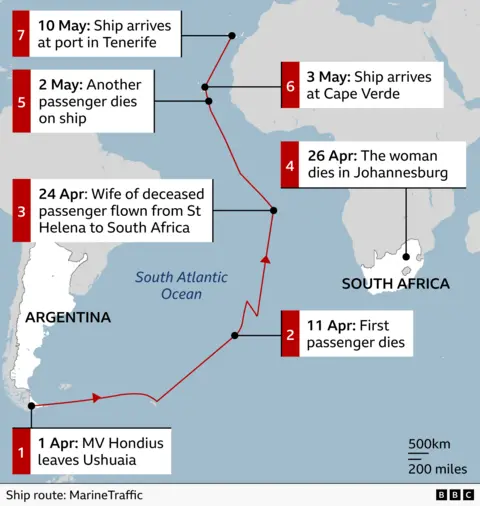
An elderly Dutch man was the first passenger who died on board the MV Hondius on 11 April. He had earlier developed symptoms – but is considered a probable case as no tests have been carried out.
His wife – a 69-year-old woman – left the ship on the island of St Helena on 24 April and flew to South Africa. She died two days later in a clinic in Johannesburg.
A German woman died on board the cruise ship on 2 May.
The two women are both confirmed cases.
The MV Hondius departed Argentina’s southern city of Ushuaia on 1 April, and is currently docked at the port of Grandilla, southern Tenerife.
[BBC]
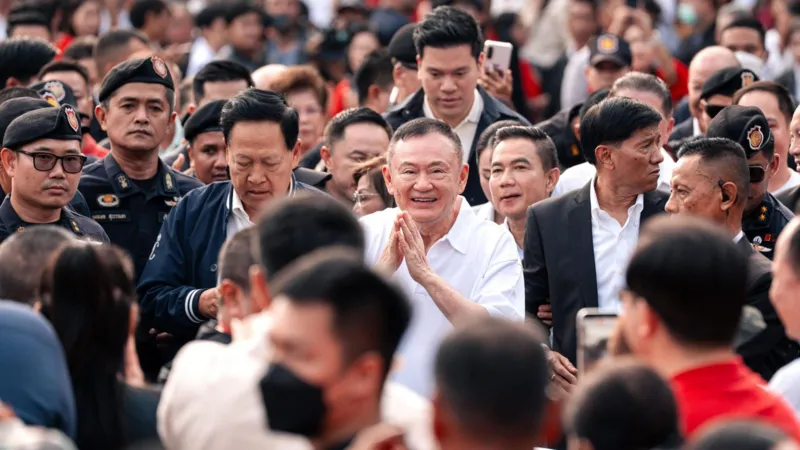
For a man who spent most of the past 20 years in exile, and the past eight months in jail, the figure of former prime minister Thaksin Shinawatra still looms large over Thailand.
His release from prison at the age of 76 after serving part of a one-year sentence for corruption and abuses of power during his terms as prime minister from 2001 to 2006, was headline news in Thailand.
Hundreds of supporters wearing red cheered as Thaksin emerged from Bangkok’s Klong Prem jail on Monday, wearing a white shirt and short cropped hair.
Thaksin told reporters soon after his release that he was in good health and was “relieved”.
He was greeted outside Bangkok’s Klong Prem prison by family members, including his daughter and protege, former prime minister Paetongtarn Shinawatra.
Thaksin’s party Pheu Thai’s insistence that from now on he will remain in the background could not stop feverish media speculation over what role he might still play in Thai politics.
This is hardly surprising.
From the moment he swept to power in January 2001 Thaksin, a brash, self-made billionaire, has sought to reshape his country, winning devoted supporters and bitter opponents in equal measure. His parties kept winning elections, even after he was deposed by a coup in September 2006, but fear of his vaunting ambition in the powerful royalist establishment led to multiple court rulings against his allies, years of violent street clashes, and another coup in 2014.
Yet he refused to step back. He continued to run his party from abroad, and, after an apparent “grand bargain”, his conservative opponents allowed him to come home in 2023, to direct it once it was back in government again.
His continued popularity was evident outside the prison where his supporters had gathered.
One of them – Maysa Lombuarot – had driven 700km (435 miles) to see him released.
“Today I brought him 20kg of lychees. I know he likes them. Now that he’s free, I want him to eat something good,” she told the BBC, adding that she hoped he would continue his political career.
“I want him to help the country, to help the people who are suffering so much right now… only he can deliver what he promised,” she said.
And Thaksin does seem incapable of taking a back seat, whatever he may say about spending more time with his grandchildren.
This time, though, it really could be different.
Thaksin was jailed ;ast September, after the Supreme Court ruled that the six months he spent in a police hospital after his return to Thailand had been a ruse to avoid serving his sentence.
This verdict followed the collapse of the Pheu Thai-led coalition government less than two weeks earlier, when the Constitutional Court dismissed his daughter Paetongtarn as prime minister over a leaked phone conversation she had had with the Cambodian leader Hun Sen over how to handle the border dispute between the two countries. Once again, the powerful, conservative courts were determining his party’s fate, as they have so often in the recent past.
While Thaksin was behind bars, Pheu Thai had its worst-ever result in the February general election. It was pushed down to third place behind the reformist People’s Party, and eclipsedby the conservative Bhumjaithai party, which benefited from a surge of nationalist sentiment after the border war with Cambodia. Pheu Thai has been forced to accept being a junior coalition partner in the new government.
“Thaksin emerges from prison to a new political environment”, says political analyst Ken Lohatepanont.
“Pheu Thai has been sidelined as just a mid-sized party. You can never count Thaksin out, but the challenge that he and his Party face is of a different magnitude to those he has faced in the past. Pheu Thai will have to decide whether a public comeback for Thaksin will boost the party, or whether the party might be better served by placing the spotlight on their newer generation leaders.”
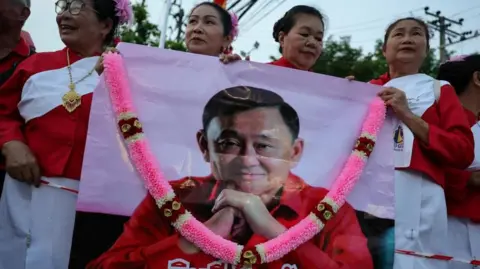
The jury is still out in Thailand over why the “grand bargain” with royalist forces which had allowed Thaksin to end his long exile in 2023 collapsed so quickly.
Had the conservatives always intended to use the courts to cripple the governments his party led? His first choice of prime minister was also dismissed by the courts on a seemingly trivial pretext.
Or were they provoked into moving against him by his refusal to stay in the background, his determination to drive his party’s agenda and to explore new and controversial areas of business?
Either way, the mistrust between Thaksin and Thai conservatives is now probably insurmountable. Even if he does still hanker after a prominent political role, he will almost certainly be barred from getting one.
The past 25 years in Thailand could reasonably be called “the Thaksin era”. That era is almost certainly over.
[BBC]

Philippine VP Sara Duterte impeached for a second time

US and French nationals test positive for hantavirus after leaving ship

Thailand’s divisive ex-PM is out of jail, but is the Thaksin era over?

Andy Flower fined for ‘use of an audible obscenity’ during Mumbai Indians clash

Royal Challengers Bengaluru eliminate Mumbai Indians and go top after tense finish

Car bomb attack and ambush in northwest Pakistan kill at least 21 police

‘Dates have the highest sugar content to fight Coronavirus’

Sunday Island 27 December – Headlines

#SundayIsland 17th December – Headlines

Sunday Island – 28th March

Sunday Island Headlines – 21 March

Sunday Island – 21st February – Headlines
-

 News5 days ago
MIT expert warns of catastrophic consequences of USD 2.5 mn Treasury heist
-
 News7 days ago
CJ urged to inquire into AKD’s remarks on May 25 court verdict
-

 News2 days ago
Lanka Port City officials to meet investors in Dubai
-

 Editorial5 days ago
Clean Sri Lanka and dirty politics
-

 Opinion7 days ago
Security, perception, and trust: Sri Lanka’s delicate balancing act
-

 Editorial4 days ago
The Vijay factor
-

 News3 days ago
SLPP expresses concern over death of former SriLankan CEO
-

 News6 days ago
Development Officer bids Rs. 48 mn for CPC’s V8 at auction