
Latest News
Australia blitz, Zampa guile leave England title defence in the balance

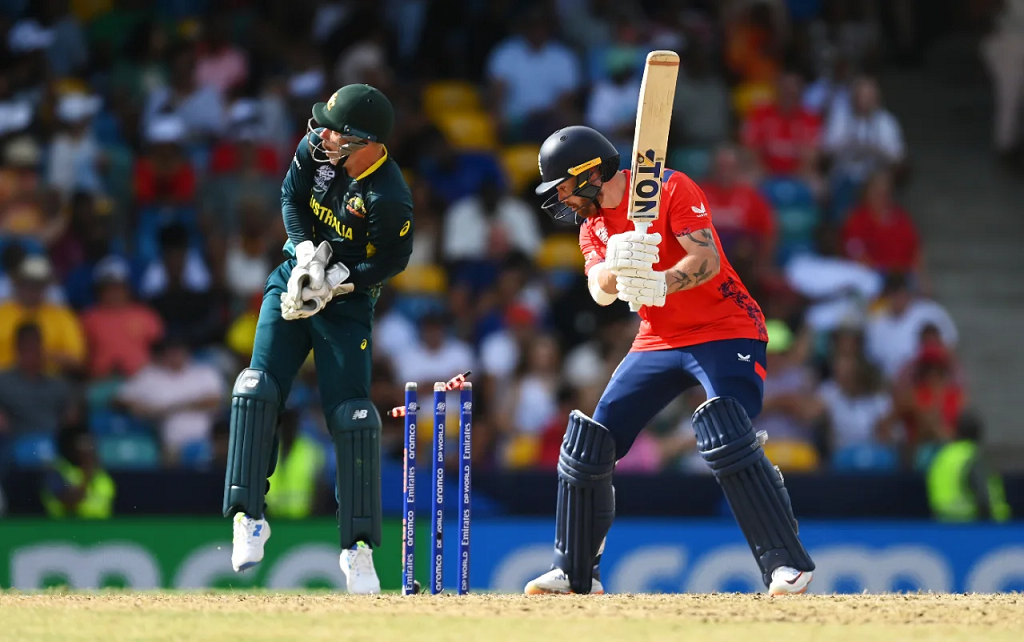
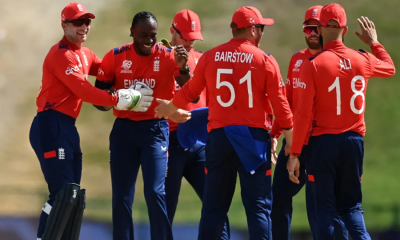
Australia outplayed England in Barbados to leave the defending champions sweating on their qualification for the Super 8s. They posted the highest score of the T20 World Cup to date after David Warner and Travis Head blitzed 70 runs in the first five overs, before Adam Zampa made the difference in England’s lacklustre run chase.
The result is not terminal for England’s title defence, but they have one point from their first two matches and face an anxious week ahead in Antigua. They will almost certainly need to beat both Oman (on Thursday) and Namibia (on Saturday), but even then would likely have to rely on net run rate to qualify for the second round ahead of Scotland.
The dimensions played a major role at Kensington Oval: one square boundary was nine metres shorter than the other, measured at just 58m. Australia targeted it, almost immediately. Will Jacks, surprisingly given the second over, conceded three sixes in his first four balls, all flying over the shorter leg-side boundary; Mark Wood’s first over from the same end also cost 22.
Australia’s total relied on cameos throughout their batting line-up rather than one substantial innings. Warner, likely facing England for the final time in international cricket, top-scored with 39 but everyone in their top five reached at least 28; Matthew Wade’s 10-ball 17 not out was another useful contribution from No. 7, taking Australia past 200.
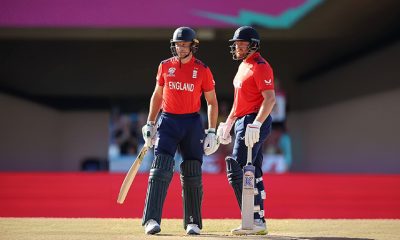
England, by contrast, fell away badly after Zampa accounted for both of their openers – Jos Buttler and Phil Salt – inside his first 11 balls. They were 73 for 0 after seven overs but only managed 92 for 6 in the following 13, their middle order failing to adjust to a dry pitch quickly enough against a clinical Australian attack.
Wood took over from Jacks at the same end and his first over was equally as expensive: he tried to tuck Warner up and bowl to his sweepers, but instead fed his strengths and was cracked over the short side for three more sixes and a four. Moeen broke through when a ball skidded under Warner’s bottom edge, but only after conceding two fours and a six in his second over.
Jofra Archer was the quickest England bowler to adjust to the conditions, using his slower balls and dragging his length back, and could celebrate a first international wicket in Barbados when his offcutter burst through Head and hit middle and off stumps. Even still, Australia’s 74 for 2 was their highest powerplay at a men’s T20 World Cup.England started to drag things back when the field spread, though Mitchell Marsh continued to find the boundary. He nailed a pull over midwicket and onto the solar panels on the roof of a stand off Adil Rashid, and swung Archer over the leg-side boundary after the mid-innings drinks break.
Glenn Maxwell’s 28 off 25 was his joint-highest T20 score since February but he and Marsh fell within four balls of one another: Marsh was stumped by Buttler at the second attempt off Livingstone’s legspin, and Maxwell picked out deep midwicket off Rashid. At 142 for 4 in the 15th over, Australia needed a strong finish.
But Marcus Stoinis, Tim David and Wade ensured they reached 200 with regular boundaries at the back end and England became ragged in the field: Rashid threw his hands up in frustration when Stoinis picked up four from a toe-ended reverse-sweep, Archer and Jonny Bairstow leaving the ball to one another at point and backward point.
England’s openers looked to maximise the powerplay, with Buttler using his feet to target Josh Hazlewood and Salt launching a 106-metre six off his Kolkata Knight Riders team-mate Mitchell Starc. The seventh over, Starc’s third, then cost 19: Head caught Salt at deep third but while stepping on the boundary, and Buttler picked off a six then a four.
But on a dry surface, Zampa was the key bowler and struck with his first ball, which crashed into the top of Salt’s off stump as he looked to create room to cut. In Zampa’s second over, Buttler swung him down the ground for six but then reverse-swept straight to Pat Cummins at point, leaving 109 required off the final 10 overs.
Will Jacks cracked one boundary off Cummins but then picked out Starc at long-off, who took an excellent diving catch off Stoinis, and Bairstow looked short on rhythm throughout his 13-ball 7. Moeen briefly threatened something special, hitting three sixes in a Maxwell over, but the required rate proved insurmountable.
Brief scores:
Australia 201 for 7 in 20 overs (David Warner 39, Mitchell Marsh 35, Travis Head 34, Marcus Stoinis 30, Glenn Maxwell 28; Moeen Ali 1-18, Joffra Archer 1-28, Adil Rashid 1-41, Chris Jordan 2-44, Liam Livingstone 1-44) beat England 165 for 6 in 20 overs (Phil Salt 37, Jos Buttler 42, Moeen Ali 25, Harry Brook 20*; Pat Cummins 2-23, Adam Zampa 2-28, Josh Hazelwood 1-28, ) by 36 runs
[Cricinfo]







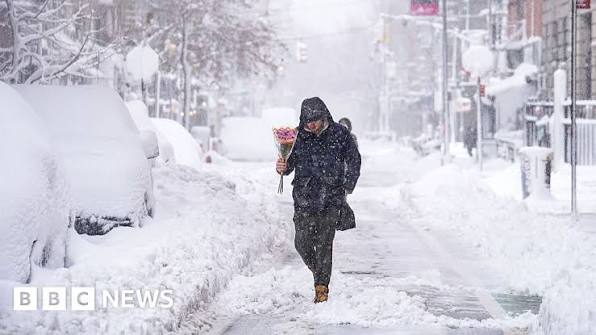
A major storm hit the US east coast on Monday, bringing record-breaking snow that caused disruptions for millions and thousands of flight cancellations.
Parts of Rhode Island and Massachusetts have seen nearly 37in (94cm) of snowfall, with more than 19in in New York City’s Central Park, the National Weather Service (NWS) said.
Weather warnings stretched from North Carolina to northern Maine, with some in place further north in parts of eastern Canada.
More than 600,000 properties on the US east coast endured power outages, while the Boston Globe – a major US newspaper – said it will not go to print for the first time in its 153-year history due to the storm.
(BBC)
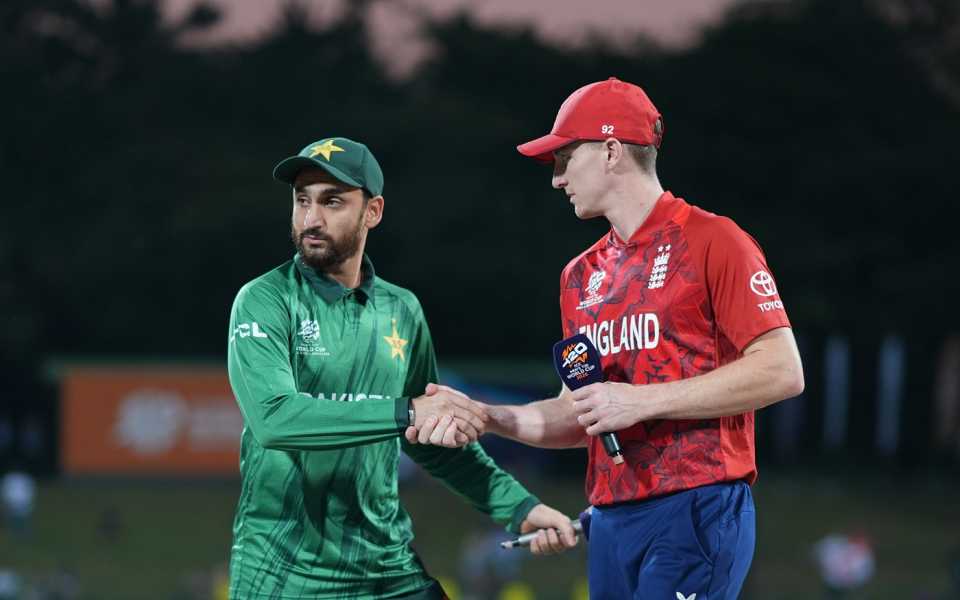
Pakistan have recalled Shaheen Shah Afridi for their Super Eight fixture against England in Pallekle at the expense of Faheem Ashraf, and will bat first after Salman Agha won the toss on a fresh pitch.
Afridi’s nine overs at the T20 World Cup have cost 101 runs and he has been left out for consecutive matches after Pakistan’s heavy defeat to India in Colombo, including their no-result against New Zealand to start the Super Eight stage. But he has been recalled to face England, perhaps due to their top order’s perceived vulnerability against left-arm seam.
Ashraf rescued Pakistan in their opening group-stage match against the Netherlands, hitting 29 not out off 11 balls to secure a three-wicket win. But he has only bowled two overs in the tournament and has been batting down the order.
“It looks like a good pitch,” Agha said at the toss. “We want to put up an above-par score and defend that total.”
England will qualify for the semi-finals if they win either of their remaining Super Eight fixtures, but Brook said that he would rather get the job done this evening than face a must-win match against New Zealand on Friday. “That would be lovely, wouldn’t it? But you never know in T20 cricket, it’s such a fickle game,” he said.
Brook said that he would have chosen to bat first if he had won the toss, but expects a better surface than the one that England played on at Pallekele two days ago in their low-scoring win over Sri Lanka. “Hopefully, it’s going to be a little bit better,” he said. “We haven’t had our perfect game yet. Hopefully, it’s just around the corner.”
England have picked the same team for the fifth consecutive match at this World Cup, and have carded their batting line-up in the same order despite some calls for Brook to be promoted from No. 5.
The fixture is a rematch of the 2022 T20 World Cup final, which England won by five wickets at the MCG, and there are nine survivors across the two teams.
England: Phil Salt, Jos Buttler (wk), Jacob Bethell, Tom Banton, Harry Brook (capt), Sam Curran, Will Jacks, Jamie Overton, Liam Dawson, Jofra Archer, Adil Rashid.
Pakistan: Sahibzada Farhan, Saim Ayub, Salman Agha (capt), Babar Azam, Fakhar Zaman, Shadab Khan, Usman Khan (wk), Mohammad Nawaz, Shaheen Shah Afridi, Salman Mirza, Usman Tariq.
(Cricinfo)

During an operation conducted in the dark hours of 22 Feb 26, the Sri Lanka Navy seized an Indian fishing boat and apprehended twelve (12) Indian fishermen while they were poaching in Sri Lankan waters, in the sea area south of Mannar.
The seized boat and the Indian fishermen were handed over to the Fisheries Inspector of Dikovita for onward legal proceedings.

More than 5,000 flights cancelled as US east coast digs out of record snow

Pakistan bat vs unchanged England with Afridi back

Navy seize an Indian fishing boat poaching in Mannar seas

Fair weather will prevail except for showers in the Southern province and in Rathnapura, Monaragala and Kaluthara districts after 2.00 p.m

Families of those sentenced to death for killing MP Atukorale seek AKD’s intervention

OPV leaves Baltimore, expected in Colombo in May

‘Dates have the highest sugar content to fight Coronavirus’

Sunday Island 27 December – Headlines

#SundayIsland 17th December – Headlines

Sunday Island – 28th March

Sunday Island Headlines – 21 March

Sunday Island – 21st February – Headlines
-

 Features3 days ago
Why does the state threaten Its people with yet another anti-terror law?
-

 Features3 days ago
Victor Melder turns 90: Railwayman and bibliophile extraordinary
-

 Features3 days ago
Reconciliation, Mood of the Nation and the NPP Government
-

 Features2 days ago
LOVEABLE BUT LETHAL: When four-legged stars remind us of a silent killer
-
 Features3 days ago
Victor, the Friend of the Foreign Press
-
 Latest News4 days ago
New Zealand meet familiar opponents Pakistan at spin-friendly Premadasa
-

 Latest News4 days ago
Tariffs ruling is major blow to Trump’s second-term agenda
-

 Latest News4 days ago
ECB push back at Pakistan ‘shadow-ban’ reports ahead of Hundred auction