
Latest News
At least 155 killed in Tanzania as heavy rains pound East Africa


Flooding and landslides in Tanzania caused by weeks of heavy rain have killed 155 people and injured 236 others, the country’s prime minister has said, as intense downpours continue across East Africa.
Prime Minister Kassim Majaliwa told Parliament that the El Nino climate pattern has worsened the ongoing rainy season, causing the flooding and destroying roads, bridges and railways. “The heavy El Nino rains, accompanied by strong winds, floods and landslides in various parts of the country, have caused significant damage,” Majaliwa told Parliament on Thursday.
El Nino is a naturally occurring climate pattern typically associated with increased heat worldwide, as well as drought and heavy rains.
The devastating effects of the rains were “primarily due to environmental degradation”, Majaliwa added, blaming deforestation, unsustainable farming practices such as “slash and burn” agriculture and unregulated livestock grazing.
More than 200,000 people and 51,000 households were affected by the rains, the prime minister noted. Flooded schools were closed and emergency services were rescuing people marooned by the floodwaters.
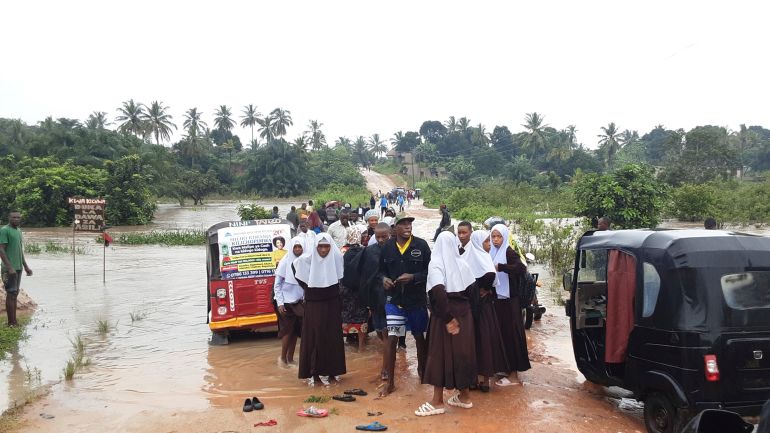 Schoolchildren are stranded due to a damaged River Zingiziwa bridge in Dar es Salaam, Tanzania (Aljazeera)
Majaliwa warned those living in low-lying areas to move to higher ground and urged district officials to ensure that provisions meant for those whose homes were washed away go to those in need of the supplies.
On April 14, the government said a total of 58 people, including children, had been killed in rains and floods since the beginning of the month.
The East African region has been pounded by heavier-than-usual rainfall during the current rainy season, with flooding also reported in neighbouring Burundi and Kenya.
In Kenya, 35 people were reported dead as of Monday, and the number was expected to increase as flooding continues across the country
Some parts of the capital, Nairobi, remained underwater on Thursday, and Kenyans were warned to stay alert, with the forecast for more heavy rains across the country in coming days.
In the Mathare neighbourhood in the capital, at least four bodies were retrieved from flooded houses on Wednesday. Local media reported that more bodies were retrieved from the Mathare River.

Kenyan President William Ruto chaired a multi-agency flood response meeting on Thursday and directed the National Youth Service to provide land for people in flood-affected areas.
Deputy President Rigathi Gachagua told a press briefing that people affected by the floods would be given food and other goods, while those living in the most vulnerable areas would be relocated.
In Burundi, around 96,000 people were displaced by months of relentless rains, the United Nations and the government said earlier this month.
The UN Office for the Coordination of Humanitarian Affairs (OCHA) said in an update this week that in Somalia, the “Gu” rains (from April to June) were intensifying, with flash floods reported since April 19.
Uganda has also suffered heavy storms that have caused riverbanks to burst, with two fatalities confirmed and several hundred villagers displaced.
(Aljazeera)










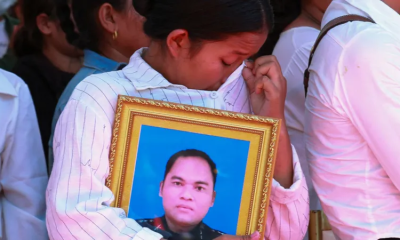


An estimated 550,000 people took part in demonstrations across France today to protest against teaching conditions in schools, rising fuel prices and the cost of living.
Marches were largely peaceful and took place in several major French cities, including Paris, where 110,000 people attended.
“We just want to study, we just want a future” one student taking part in the protest in the capital told BBC News, while another said they were ” just trying to make things change”.
But French Interior Minister Laurent Nunez said some groups “at the margins of these protests” caused the situation to “degenerate”.
According to the French Prime Minister Sébastien Lecornu, 1200 people were arrested. Officials also reported looting in cities such as Marseille, where masked 8ntruders also entered the city hall. In Lyon, the tourist office was set on fire and shops were damaged.
French President Emmanuel Macron said any vandals and looters would be “prosecuted and punished”, while Jean-Luc Mélenchon, the leader of left-wing party La France Insoumise, said demonstrations had been calmly mobilised.
Meanwhile, firefighters are continuing to battle a blaze at Limoges City Hall after a reported break-in and arson inside the 19th-century building during protests there.
(BBC)

A large fire near a Canadian military base in Alberta has killed and injured some people, the defence minister said, without confirming the number of casualties.
The Canadian Armed Forces were working with local authorities to manage the fire and were looking into what caused it, David McGuinty said, describing the situation as “very, very active and delicate”.
Canada’s Prime Minister Mark Carney said on X that a “serious incident creating a major fire” had occurred, adding his “thoughts are with all the brave women and men affected”.
Canadian Forces Base Wainwright, where the fire broke out, is one of the country’s busiest military training bases.
The blaze “spread rapidly due to high winds” and had torn through the fences of the base, the Municipal District of Wainwright said.
McGuinty told reporters he “cannot recall an incident like this in recent memory”.
It is unclear when the fire broke out, but the district first posted about the incident at about 17:30 local time.
Local authorities have urged residents to avoid the area and give all emergency vehicles right of way.
(BBC)

The Asian Youth Games gold medallist who has run sub four minutes previously returned a time of 3:55.97 seconds to become the first athlete in his age category at these championships to run the distance under four minutes.
Achintha who has a personal best of 3:53.05 from last year was representing Prince College Ratnapura today.
In another impressive 1,500 m feat Tharushi Abhisheka of Lyceum International School, Wattala established a new meet record in the Under-20 Girls’ 1,500m as she returned a time of 4:34.59 seconds to win.
By the end of the second day of the meet seven new meet records had been established.
D. V. C. de Soysa (of Galewela Central College) Under-16 Boys’ Discus Throw – 55.83m.
D. G. Lahiru Achintha (of Ratnapura Kumara Vidyalaya) Under-18 Boys’ 1,500m – 3:55.97 secs.
W. P. Nethula Induwara (Rahula College, Matara) Under-14 Boys’ 100m – 11.70 seconds
K. V. R. Gayesha (Ira Handa Kotuwa Wewa Maha Vidyalaya, Polonnaruwa) Under-16 Girls’ High Jump – 1.70m
H. M. D. S. Herath (Maris Stella College, Thimbirigaskatuwa) Under-20 Boys’ Long Jump – 7.65m
P. M. Amaya Semindi (Vijitha Central College, Dikwella) Under-14 Girls’ High Jump – 1.58m

Record 1,600 students take Russian Classical Ballet examination in Sri Lanka

Half a million people join protests in France, but some turn violent

Deadly fire breaks out at Canada military base

Showers or thundershowers will occur in most parts of the island after 1.00 p.m.

Buddhist hierarchy demands prison perks for monk convicts

Debate on NCM against Speaker postponed indefinitely

‘Dates have the highest sugar content to fight Coronavirus’

Sunday Island 27 December – Headlines

#SundayIsland 17th December – Headlines

Sunday Island – 28th March

Sunday Island Headlines – 21 March

Sunday Island – 21st February – Headlines
-

 Latest News5 days ago
Nissanka’s return headlines Sri Lanka’s Test squad against Pakistan
-

 Latest News7 days ago
Farhan and Sadaqat help Pakistan seal series in style
-

 Features7 days ago
Intake 16: 45 years of duty and honour
-

 News7 days ago
Malwathu Chapter issues statement on talks with President over Gnanasara Thera’s robes
-

 News7 days ago
CP alleges NPP has taken the blame for illegal US sanctions on Iranian vessels
-

 News5 days ago
Sri Lanka, India caught in US-Iran ship crisis
-

 Opinion7 days ago
How long can Sri Lanka remain silent on its demographic crisis?
-

 Latest News5 days ago
Kusal Mendis’ unbeaten 87 hands Sri Lanka consolation win