
Features
Astrology, Astronomy And Reason.

Dr. Upatissa Pethiyagoda
If not for its huge impact on our people, Astrology could be dismissed as a harmless indulgence.
It is popularly understood as being based on the precise Science of Astronomy. The main manifestation that impacts on us is the Horoscope on which many things depend. Three key factors are considered in their casting and use. These are (i) Time of birth (ii) Positions of the planets at that moment and (iii) The interpretation of the resulting Chart. There are inexactitudes regarding all three.
Time of Birth.
How does one define Birth? Is it the time of emergence of the head, the whole body or the severance of the placenta? Or, could it be the moment of conception? How precise need the timepiece be, and was it calibrated for accuracy and is it GMT or time at location?
Planetary positions at that moment.
One assumes that the cosmic space is divided into twelve to represent the twelve “Houses”. The Sun and Moon although strictly not planets, are also positioned on the chart. Is there a justification for considering only our Solar system from among the 30,000,000 or so Galaxies thought to exist? Since even a small error in recording time, may allow the drift from one House to another, there must be very clear boundaries and light must travel in a straight line through cosmic distances. Does light “bend” and what has Relativity Theory to say?
In determining Zodiac signs, there appear to be different systems. For example in “Western” style, the intervals between relate to dates of each month. For example the governing sign for all born between the 21 of January and 20 February would be same. Those from 21 February to 20 March belong to another and so on. “Eastern” systems are more complex with a single day possibly covering several signs. How to select which system or reconciling one with the other would be complex and puzzling.
One is given to understand that some countries (including ours) possess their individual horoscopes. How are they determined? Obviously they cannot be according to their believed or uncertain times of creation. Are our earth centered times and dates of relevance to other planets as well?
Whatever the system, there are embarrassing features. With a World population of seven billion, if one considers a likely degree of symmetry, one twelfth or approximately 585 million, come under the same sign and therefore should have similar futures. It is quite amusing to see the foretelling of the day’s predictions in newspapers with their repetitive or ambiguous words, and wonderment that newspapers see fit to use valuable column space and newsprint for the purpose! I have tested this for a week under my Zodiacal sign and the predictions were striking in their repetition day to day and their ambiguity and inanity! Amuse yourself for a week for predictions under your sign before writing to the Editor to use this column space for something less useless !
The Chart and its interpretation.
In casting a horoscope based on the foregoing, a two- dimensional chart is drawn, assigning position to each of nine “grahas”. It is in the interpretation that the most problems arise. The readings rely on existing treatises (Panchanga Litha) and on the skill of the reader – there supposedly being “good” readers and “not so good” ones. Coincidence of some predictions and events, is insufficient as proof.
What particular positions or associations of planets mean are most complicated. Does planetary influence depend on mass or distance (as they would, if they relate to Gravity)? How do planetary positions offset or augment each other’s influences? Only those skilled in the art of Astrology could venture answers to these and many other questions. Astrology relies greatly on its antiquity and on local traditions.
On balance, a reasonable conclusion is that Astrology cannot justly claim legitimacy from a link to Astronomy, mathematics or other Sciences. It must seek inspiration from elsewhere. If not for its impact on many – especially the poor, disadvantaged and gullible, it could be dismissed as a harmless diversion.
The previous President, (among others) was so reliant on the occult, that we were possibly in imminent danger of installing an “Astrologer Royal”. Fortunately, a dramatically “misread” electoral outcome has helped to save us from such a predicament. Nonetheless, Talismans, bracelets, miniature maces, conch shells, gem-studded rings and similar amulets are very much in fashion. Many people may even be intimidated into purchasing such embellishments rather than court predicted disaster.
When a Nation begins to rely on Auspicious Times, Lucky Directions and other “Feng Shui” type ones (which I am told, declare among other things, that if you leave you toilet lid open, wealth will be flushed away from you!), we begin to look rather silly. Each occasion, mainly the New Year ordains the times for each (lighting of the hearth, and the colour of clothes to be worn, the time for the first meal etc.) The Nonagathe is claimed to be the time of orbit of the transit of the Sun from one “House” to the next. Anointing the head with oil in the New Year is almost a State Duty. All of these solemn observances do not match with the claim that even the Nations’ Cabinet is selected “scientifically”. It also challenges the relevance of so much effort being expended on Education in the Sciences.
One of the most harmful uses of the Horoscope is in matters matrimonial. Glance at the Sunday Matrimonial columns, and you will be amazed by statements like “Copy of the Horoscope essential with the first response”, or “Those with malefics or Kethu in the seventh house need not apply”. “Both parents are professionals” indicates that education or social class does not matter. Sinhala and Tamil papers may be worse. Lots of people in other countries who have no belief (or even a copy of a horoscope) may still enjoy a happy marriage. One shudders to think how many of our youth have been denied of a chance to select a temperamentally suited partner or enjoy a happy marriage, because a suitable “horoscopic match” could not be found. Data relating to the success or otherwise of marriages with and without Zodiacal assistance, would be revealing.
When poor people in distress seek some remedy, they are ready clients for soothsayers who recommend various practices including expensive “Poojas” and other costly rituals. This amounts to at least intimidation or exploitation, possibly even fraud.
If anyone takes refuge in the Supernatural, it is certainly a matter of individual choice. But when important persons do so repeatedly, at State expense and poor people are intimidated to engage in expensive rituals, under threat of deadly outcomes, it is quite another matter, bordering on the criminal. Are for instance, our home-grown deities inferior to those exotics, as to warrant political panjandrums repeatedly visiting overseas shrines with “good” anecdotal reputations?
When otherwise sane people believe that the Gods could be appeased by dashing coconuts (to curse their opponents) or a basket of fruits, it is time for a “reality check” by their Psychologist.
It is not my intention to stir discord but to stimulate discussion (or even demolition) by a reasoned debate, in addition to falsification or ignorance displayed by this plunge into an unfamiliar area.
In any event, I stand to be corrected (hopefully) in civil language.


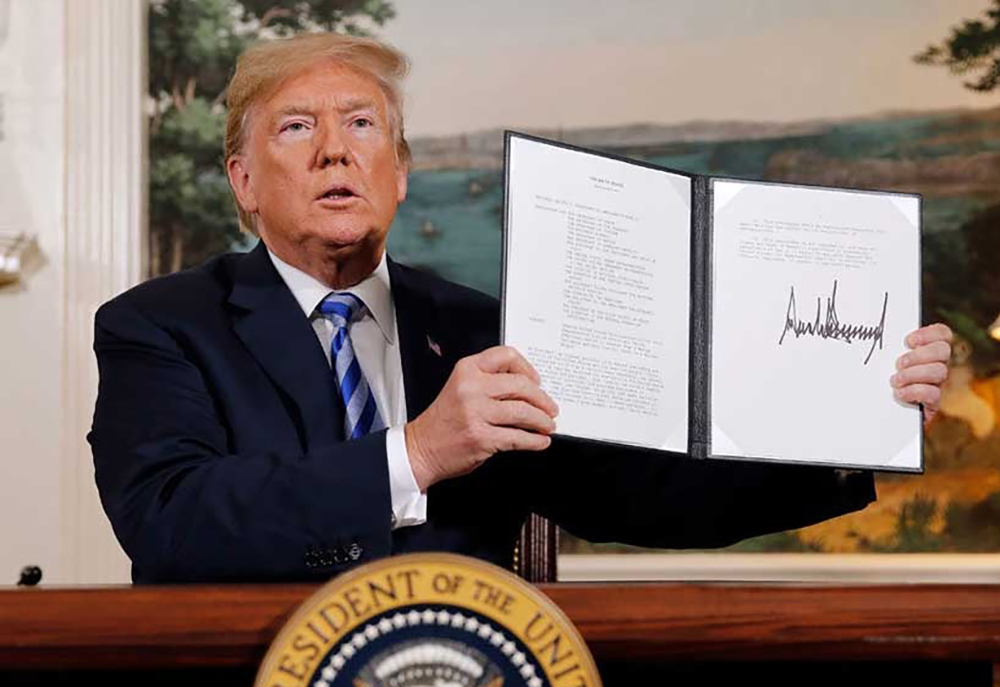
Trump is full of surprises; he is both leader and entertainer. Nearly nine hours into a long flight, a journey that had to U-turn over technical issues and embark on a new flight, Trump came straight to the Davos stage and spoke for nearly two hours without a sip of water. What he spoke about in Davos is another issue, but the way he stands and talks is unique in this 79-year-old man who is defining the world for the worse. Now Trump comes up with the Board of Peace, a ticket to membership that demands a one-billion-dollar entrance fee for permanent participation. It works, for how long nobody knows, but as long as Trump is there it might. Look at how many Muslim-majority and wealthy countries accepted: Saudi Arabia, Turkey, Egypt, Jordan, Qatar, Pakistan, Indonesia, and the United Arab Emirates are ready to be on board. Around 25–30 countries reportedly have already expressed the willingness to join.
The most interesting question, and one rarely asked by those who speak about Donald J. Trump, is how much he has earned during the first year of his second term. Liberal Democrats, authoritarian socialists, non-aligned misled-path walkers hail and hate him, but few look at the financial outcome of his politics. His wealth has increased by about three billion dollars, largely due to the crypto economy, which is why he pardoned the founder of Binance, the China-born Changpeng Zhao. “To be rich like hell,” is what Trump wanted. To fault line liberal democracy, Trump is the perfect example. What Trump is doing — dismantling the old façade of liberal democracy at the very moment it can no longer survive — is, in a way, a greater contribution to the West. But I still respect the West, because the West still has a handful of genuine scholars who do not dare to look in the mirror and accept the havoc their leaders created in the name of humanity.
Democracy in the Arab world was dismantled by the West. You may be surprised, but that is the fact. Elizabeth Thompson of American University, in her book How the West Stole Democracy from the Arabs, meticulously details how democracy was stolen from the Arabs. “No ruler, no matter how exalted, stood above the will of the nation,” she quotes Arab constitutional writing, adding that “the people are the source of all authority.” These are not the words of European revolutionaries, nor of post-war liberal philosophers; they were spoken, written and enacted in Syria in 1919–1920 by Arab parliamentarians, Islamic reformers and constitutionalists who believed democracy to be a universal right, not a Western possession. Members of the Syrian Arab Congress in Damascus, the elected assembly that drafted a democratic constitution declaring popular sovereignty — were dissolved by French colonial forces. That was the past; now, with the Board of Peace, the old remnants return in a new form.
Trump got one thing very clear among many others: Western liberal ideology is nothing but sophisticated doublespeak dressed in various forms. They go to West Asia, which they named the Middle East, and bomb Arabs; then they go to Myanmar and other places to protect Muslims from Buddhists. They go to Africa to “contribute” to livelihoods, while generations of people were ripped from their homeland, taken as slaves and sold.
How can Gramsci, whose 135th birth anniversary fell this week on 22 January, help us escape the present social-political quagmire? Gramsci was writing in prison under Mussolini’s fascist regime. He produced a body of work that is neither a manifesto nor a programme, but a theory of power that understands domination not only as coercion but as culture, civil society and the way people perceive their world. In the Prison Notebooks he wrote, “The crisis consists precisely in the fact that the old world is dying and the new cannot be born; in this interregnum a great variety of morbid phenomena appear.” This is not a metaphor. Gramsci was identifying the structural limbo that occurs when foundational certainties collapse but no viable alternative has yet emerged.
The relevance of this insight today cannot be overstated. We are living through overlapping crises: environmental collapse, fragmentation of political consensus, erosion of trust in institutions, the acceleration of automation and algorithmic governance that replaces judgment with calculation, and the rise of leaders who treat geopolitics as purely transactional. Slavoj Žižek, in his column last year, reminded us that the crisis is not temporary. The assumption that history’s forward momentum will automatically yield a better future is a dangerous delusion. Instead, the present is a battlefield where what we thought would be the new may itself contain the seeds of degeneration. Trump’s Board of Peace, with its one-billion-dollar gatekeeping model, embodies this condition: it claims to address global violence yet operates on transactional logic, prioritizing wealth over justice and promising reconstruction without clear mechanisms of accountability or inclusion beyond those with money.
Gramsci’s critique helps us see this for what it is: not a corrective to global disorder, but a reenactment of elite domination under a new mechanism. Gramsci did not believe domination could be maintained by force alone; he argued that in advanced societies power rests on gaining “the consent and the active participation of the great masses,” and that domination is sustained by “the intellectual and moral leadership” that turns the ruling class’s values into common sense. It is not coercion alone that sustains capitalism, but ideological consensus embedded in everyday institutions — family, education, media — that make the existing order appear normal and inevitable. Trump’s Board of Peace plays directly into this mode: styled as a peace-building institution, it gains legitimacy through performance and symbolic endorsement by diverse member states, while the deeper structures of inequality and global power imbalance remain untouched.
Worse, the Board’s structure, with contributions determining permanence, mimics the logic of a marketplace for geopolitical influence. It turns peace into a commodity, something to be purchased rather than fought for through sustained collective action addressing the root causes of conflict. But this is exactly what today’s democracies are doing behind the scenes while preaching rules-based order on the stage. In Gramsci’s terms, this is transformismo — the absorption of dissent into frameworks that neutralize radical content and preserve the status quo under new branding.
If we are to extract a path out of this impasse, we must recognize that the current quagmire is more than political theatre or the result of a flawed leader. It arises from a deeper collapse of hegemonic frameworks that once allowed societies to function with coherence. The old liberal order, with its faith in institutions and incremental reform, has lost its capacity to command loyalty. The new order struggling to be born has not yet articulated a compelling vision that unifies disparate struggles — ecological, economic, racial, cultural — into a coherent project of emancipation rather than fragmentation.
To confront Trump’s phenomenon as a portal — as Žižek suggests, a threshold through which history may either proceed to annihilation or re-emerge in a radically different form — is to grasp Gramsci’s insistence that politics is a struggle for meaning and direction, not merely for offices or policies. A Gramscian approach would not waste energy on denunciation alone; it would engage in building counter-hegemony — alternative institutions, discourses, and practices that lay the groundwork for new popular consent. It would link ecological justice to economic democracy, it would affirm the agency of ordinary people rather than treating them as passive subjects, and it would reject the commodification of peace.
Gramsci’s maxim “pessimism of the intellect, optimism of the will” captures this attitude precisely: clear-eyed recognition of how deep and persistent the crisis is, coupled with an unflinching commitment to action. In an age where AI and algorithmic governance threaten to redefine humanity’s relation to decision-making, where legitimacy is increasingly measured by currency flows rather than human welfare, Gramsci offers not a simple answer but a framework to understand why the old certainties have crumbled and how the new might still be forged through collective effort. The problem is not the lack of theory or insight; it is the absence of a political subject capable of turning analysis into a sustained force for transformation. Without a new form of organized will, the interregnum will continue, and the world will remain trapped between the decay of the old and the absence of the new.
by Nilantha Ilangamuwa ✍️
Designed by the victors and led by the US, its institutions — from the United Nations system to Bretton Woods — were shaped to preserve western strategic and economic primacy. Yet despite their self-serving elements, these arrangements helped maintain a degree of global stability, predictability and prosperity for nearly eight decades. That order is now under strain.
This was evident even at Davos, where US President Donald Trump — despite deep differences with most western allies — framed western power and prosperity as the product of a shared and “very special” culture, which he argued must be defended and strengthened. The emphasis on cultural inheritance, rather than shared rules or institutions, underscored how far the language of the old order has shifted.
As China’s rise accelerates and Russia grows more assertive, the US appears increasingly sceptical of the very system it once championed. Convinced that multilateral institutions constrain American freedom of action, and that allies have grown complacent under the security umbrella, Washington has begun to prioritise disruption over adaptation — seeking to reassert supremacy before its relative advantage diminishes further.
What remains unclear is what vision, if any, the US has for a successor order. Beyond a narrowly transactional pursuit of advantage, there is little articulation of a coherent alternative framework capable of delivering stability in a multipolar world.
The emerging great powers have not yet filled this void. India and China, despite their growing global weight and civilisational depth, have largely responded tactically to the erosion of the old order rather than advancing a compelling new one. Much of their diplomacy has focused on navigating uncertainty, rather than shaping the terms of a future settlement. Traditional middle powers — Japan, Germany, Australia, Canada and others — have also tended to react rather than lead. Even legacy great powers such as the United Kingdom and France, though still relevant, appear constrained by alliance dependencies and domestic pressures.
st Asia, countries such as Saudi Arabia and the UAE have begun to pursue more autonomous foreign policies, redefining their regional and global roles. The broader pattern is unmistakable. The international system is drifting toward fragmentation and narrow transactionalism, with diminishing regard for shared norms or institutional restraint.
Recent precedents in global diplomacy suggest a future in which arrangements are episodic and power-driven. Long before Thucydides articulated this logic in western political thought, the Mahabharata warned that in an era of rupture, “the strong devour the weak like fish in water” unless a higher order is maintained. Absent such an order, the result is a world closer to Mad Max than to any sustainable model of global governance.
It is precisely this danger that Canadian Prime Minister Mark Carney alluded to in his speech at Davos on Wednesday. Warning that “if great powers abandon even the pretense of rules and values for the unhindered pursuit of their power and interests, the gains from transactionalism will become harder to replicate,” Carney articulated a concern shared by many middle powers. His remarks underscored a simple truth: Unrestrained power politics ultimately undermine even those who believe they benefit from them.
Carney’s intervention also highlights a larger opportunity. The next phase of the global order is unlikely to be shaped by a single hegemon. Instead, it will require a coalition — particularly of middle powers — that have a shared interest in stability, openness and predictability, and the credibility to engage across ideological and geopolitical divides. For many middle powers, the question now is not whether the old order is fraying, but who has the credibility and reach to help shape what comes next.
This is where India’s role becomes pivotal. India today is no longer merely a balancing power. It is increasingly recognised as a great power in its own right, with strong relations across Europe, the Indo-Pacific, West Asia, Africa and Latin America, and a demonstrated ability to mobilise the Global South. While India’s relationship with Canada has experienced periodic strains, there is now space for recalibration within a broader convergence among middle powers concerned about the direction of the international system.
One available platform is India’s current chairmanship of BRICS — if approached with care. While often viewed through the prism of great-power rivalry, BRICS also brings together diverse emerging and middle powers with a shared interest in reforming, rather than dismantling, global governance. Used judiciously, it could complement existing institutions by helping articulate principles for a more inclusive and functional order.
More broadly, India is uniquely placed to convene an initial core group of like-minded States — middle powers, and possibly some open-minded great powers — to begin a serious conversation about what a new global order should look like. This would not be an exercise in bloc-building or institutional replacement, but an effort to restore legitimacy, balance and purpose to international cooperation. Such an endeavour will require political confidence and the willingness to step into uncharted territory. History suggests that moments of transition reward those prepared to invest early in ideas and institutions, rather than merely adapt to outcomes shaped by others.
The challenge today is not to replicate Bretton Woods or San Francisco, but to reimagine their spirit for a multipolar age — one in which power is diffused, interdependence unavoidable, and legitimacy indispensable. In a world drifting toward fragmentation, India has the credibility, relationships and confidence to help anchor that effort — if it chooses to lead.
(The Hindustan Times)
(Milinda Moragoda is a former Cabinet Minister and diplomat from Sri Lanka and founder of the Pathfinder Foundation, a strategic affairs think tank. this article can read on
https://shorturl.at/HV2Kr and please contact via email@milinda.org)
by Milinda Moragoda ✍️
For many middle powers, the question now is not whether the old order is fraying,
but who has the credibility and reach to help shape what comes next
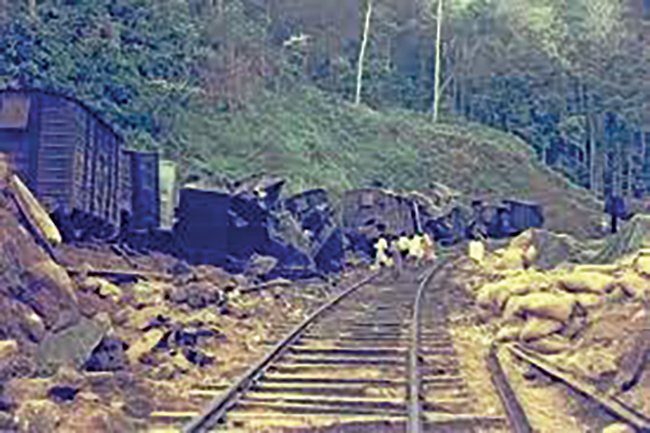
Back in 1964, I was working as DMO at Mirigama Government Hospital when a major derailment of the Talaimannar/Colombo train occurred at the railway crossing in Wilwatte, near the DMO’s quarters. The first major derailment, according to records, took place in Katukurunda on March 12, 1928, when there was a head-on collision between two fast-moving trains near Katukurunda, resulting in the deaths of 28 people.
Please permit me to provide details concerning the regrettable single train derailment involving the Talaimannar Colombo train, which occurred in October 1964 at the Wilwatte railway crossing in Mirigama.
This is the first time I’m openly sharing what happened on that heartbreaking morning, as I share the story of the doctor who cared for all the victims. The Health Minister, the Health Department, and our community truly valued my efforts.
By that time, I had qualified with the Primary FRCS and gained valuable surgical experience as a registrar at the General Hospital in Colombo. I was hopeful to move to the UK to pursue the final FRCS degree and further training. Sadly, all scholarships were halted by Hon. Felix Dias Bandaranaike, the finance minister in the Bandaranaike government in 1961.
Consequently, I was transferred to Mirigama as the District Medical Officer in 1964. While training as an emerging surgeon without completing the final fellowship in the United Kingdom, I established an operating theatre in one of the hospital’s large rooms. A colleague at the Central Medical Stores in Maradana assisted me in acquiring all necessary equipment for the operating theatre, unofficially. Subsequently, I commenced performing minor surgeries under spinal anaesthesia and local anaesthesia. Fortunately, I was privileged to have a theatre-trained nursing sister and an attendant trainee at the General Hospital in Colombo.
Therefore, I was prepared to respond to any accidental injuries. I possessed a substantial stock of plaster of Paris rolls for treating fractures, and all suture material for cuts.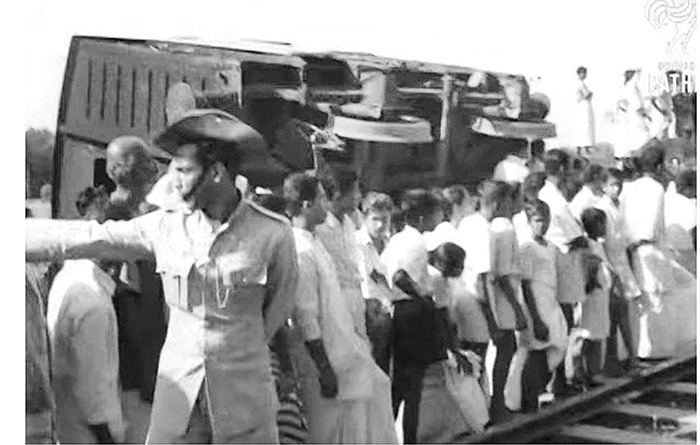
I was thoroughly prepared for any surgical mishaps, enabling me to manage even the most significant accidental incidents.
On Saturday, October 17, 1964, the day of the train derailment at the railway crossing at Wilwatte, Mirigama, along the Main railway line near Mirigama, my house officer, Janzse, called me at my quarters and said, “Sir, please come promptly; numerous casualties have been admitted to the hospital following the derailment.”
I asked him whether it was an April Fool’s stunt. He said, ” No, Sir, quite seriously.
I promptly proceeded to the hospital and directly accessed the operating theatre, preparing to attend to the casualties.
Meanwhile, I received a call from the site informing me that a girl was trapped on a railway wagon wheel and may require amputation of her limb to mobilise her at the location along the railway line where she was entrapped.
My theatre staff transported the surgical equipment to the site. The girl was still breathing and was in shock. A saline infusion was administered, and under local anaesthesia, I successfully performed the limb amputation and transported her to the hospital with my staff.
On inquiring, she was an apothecary student going to Colombo for the final examination to qualify as an apothecary.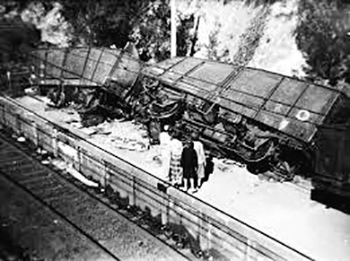
Although records indicate that over forty passengers perished immediately, I recollect that the number was 26.
Over a hundred casualties, and potentially a greater number, necessitate suturing of deep lacerations, stabilisation of fractures, application of plaster, and other associated medical interventions.
No patient was transferred to Colombo for treatment. All casualties received care at this base hospital.
All the daily newspapers and other mass media commended the staff team for their commendable work and the attentive care provided to all casualties, satisfying their needs.
The following morning, the Honourable Minister of Health, Mr M. D. H. Jayawardena, and the Director of Health Services, accompanied by his staff, arrived at the hospital.
I did the rounds with the official team, bed by bed, explaining their injuries to the minister and director.
Casualties expressed their commendation to the hospital staff for the care they received.
The Honourable Minister engaged me privately at the conclusion of the rounds. He stated, “Doctor, you have been instrumental in our success, and the public is exceedingly appreciative, with no criticism. As a token of gratitude, may I inquire how I may assist you in return?”
I got the chance to tell him that I am waiting for a scholarship to proceed to the UK for my Fellowship and further training.
Within one month, the government granted me a scholarship to undertake my fellowship in the United Kingdom, and I subsequently travelled to the UK in 1965.
On the third day following the incident, Mr Don Rampala, the General Manager of Railways, accompanied by his deputy, Mr Raja Gopal, visited the hospital. A conference was held at which Mr Gopal explained and demonstrated the circumstances of the derailment using empty matchboxes.
He explained that an empty wagon was situated amid the passenger compartments. At the curve along the railway line at Wilwatte, the engine driver applied the brakes to decelerate, as Mirigama Railway Station was only a quarter of a mile distant.
The vacant wagon was lifted and transported through the air. All passenger compartments behind the wagon derailed, whereas the engine and the frontcompartments proceeded towards the station without the engine driver noticing the mishap.
After this major accident, I was privileged to be invited by the General Manager of the railways for official functions until I left Mirigama.
The press revealed my identity as the “Wilwatte Hero”.
This document presents my account of the Wilwatte historic train derailment, as I distinctly recall it.
Recalled by Dr Harold Gunatillake to serve the global Sri Lankan community with dedication. ✍️

Three arrested with narcotics valued at Rs123 million at BIA

Navy intercepts 02 narcotics-laden trawlers with 11 suspects in southern seas

Indonesian Naval Ship ‘KRI SULTAN ISKANDAR MUDA – 367’ departs island

U19 World Cup: Japan defeat Tanzania by nine wickets

U19 World Cup: Ambrish’s four-fer powers India to third straight win

Josh Hoey breaks world 800m short track record with 1:42.50 in Boston

‘Dates have the highest sugar content to fight Coronavirus’

Sunday Island 27 December – Headlines

#SundayIsland 17th December – Headlines

Sunday Island – 28th March

Sunday Island Headlines – 21 March

Sunday Island – 21st February – Headlines
-
 Features7 days ago
Extended mind thesis:A Buddhist perspective
-
 Business23 hours ago
ComBank advances ForwardTogether agenda with event on sustainable business transformation
-
 Opinion6 days ago
American rulers’ hatred for Venezuela and its leaders
-
 Opinion4 days ago
Remembering Cedric, who helped neutralise LTTE terrorism
-
 Business4 days ago
CORALL Conservation Trust Fund – a historic first for SL
-
 Opinion3 days ago
A puppet show?
-
 Opinion6 days ago
History of St. Sebastian’s National Shrine Kandana
-
 Opinion23 hours ago
Conference “Microfinance and Credit Regulatory Authority Bill: Neither Here, Nor There”