
Opinion
Asking a donkey to do a dog’s homework – I

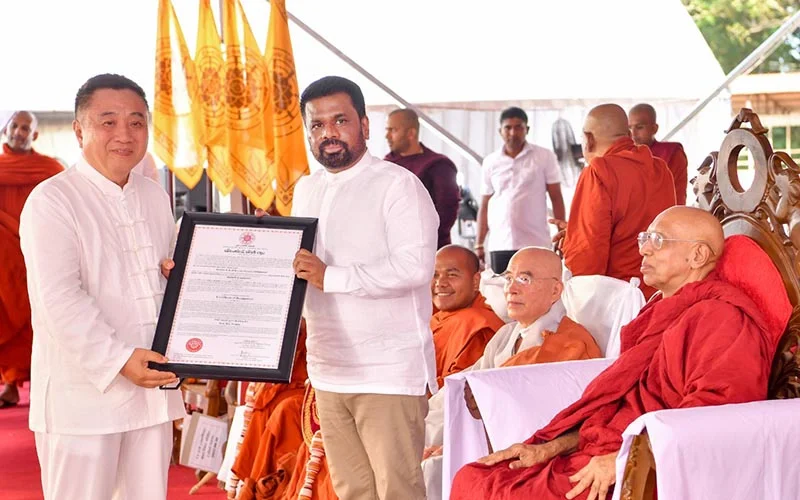
President Anura Kumara Dissanayake participated in the inauguration ceremony of the 74th Upasampada Vinaya Karmaya (Rite of Higher Ordination) of the Sri Lanka Ramanna Nikaya held at the Mahaweli Grounds in Galnewa, not far from his native village of Tambuttegama, on the afternoon of June 30, 2025. The main Upasampada rite was to be conducted at a different venue, namely, the Sri Vidyadhara Maha Pirivena in Kalawewa, Kalakarambewa from June 30 to July 8, organised by the provincial Sangha Sabhas of the North Central Province and the Upasampada Maha Utsava Committee. During his short guest speech of about twenty minutes, the president tried to explain to the distinguished gathering of the clergy and laity invited to attend the important event two principal concerns that occupied his mind: 1) his determination to overcome ‘nationalism’ (interpreted as jaativaadaya/racism) in order to create national unity among the various ethnic and religious communities, and 2) his government’s supportive role in connection with the problem of maintaining discipline within the Sangha Order as well as the issue of amending Sections 42 and 43 of the Buddhist Temporalities Ordinance as requested by the Mahanayake Theras.
According to the official President’s Office website (accessed July 7, 2025):
“President Dissanayake pointed out that certain political groups had exploited nationalism as a tool to regain power. However, he stressed that the true victims of such actions were not the politicians themselves, but the innocent children of parents from both the North and the South. He emphasized the need to reject nationalism and work diligently toward fostering national unity. While affirming that everyone has the right to act freely and democratically, The President emphasised that his administration would not permit nationalism to resurface again. If existing laws are insufficient to suppress it, he stated, they would be strengthened to defeat divisive forces. He reiterated that the goal of his government is to build a society where Sinhala, Tamil and Muslim communities can live together in peace and harmony.
“Addressing the matter of disciplinary discussions within the Sangha, President Dissanayake expressed the government’s willingness to facilitate any dialogue, provided that the Mahanayaka Theras can reach a consensus on the matter. Until then, he said, the request to amend Sections 42 and 43 of the Buddhist Temporalities Ordinance has been submitted to the Minister of Buddhasasana and is already under review by the Legal Draftsman’s Department …..”
The president was speaking in Sinhala. The two paragraphs quoted above from the English version issued by the President’s Office express what I think is the gist of his speech at that inaugural ceremony. I listened to the president’s live address in Sinhala as available on the internet and I am in a position to comment on what he actually meant to say regarding the ideas covered in the above two paragraphs from his speech.
First, let’s look at the second paragraph. It contains the incoherent phrase: “… the matter of disciplinary discussions within the Sangha….”, etc. What the president was referring to, using similarly vague vocabulary himself, was actually a Sangha katikawata. It looks like the English translator in the President’s Office (probably the same person who served during Ranil Wickremasinghe’s successor presidency) does not seem to possess any familiarity with Buddhism or any empathetic understanding of Buddhist monks that would enable him/her to supply a clear enough translation of the president’s speech in this instance. Both (the president and the translator) didn’t try to make it clear that the higher ordination rite and the Sangha katikawata are two separate things, though they, especially the president, should have known the difference between the two issues.
A Sangha katikawata is something mooted several times in the not very distant past by some members of the Sangha, but opposed by others including particularly the Mahanayake Theras (of the Malwatte and Asgiriya Chapters of Siyam Nikaya?) as Wijedasa Rajapakshe, a former Justice Minister during the Yahapalanaya years 2015-20, was heard saying in an interview some years ago. The wisdom of this opposition should be clear to anyone with some idea of what could happen to the Sangha Sasana (the Bhikkhu Order) if secular courts were to pass judgement on bhikkhu disciplinary matters that occur within the order, that could have implications outside the confines of that space. In the civil society, outside the monastic order, Buddhist monks are subject to the Roman Dutch law that operates in Sri Lanka, which is normal.
Having said that, introducing or establishing a Sangha katikawata is a complicated subject that will likely require the contribution of civil legal experts as well as specialist elderly monk preceptors. Those who call for a government sponsored katikawata expect it to give enforceability under the normal civil law to punishments like expulsion from the order imposed on monks adjudged guilty of violating vinaya rules by the Mahanayake Theras. An allegation frequently heard is that certain monk offenders ( found guilty by the hierarchy of the Sangha Order) are known to continue with their faulty behaviours with impunity, claiming protection in the name of freedom of religion and belief that is guaranteed by the Sri Lankan Constitution.
The katikawata proposed was presumably to be based on the lines of certain historical katikawatas. The best known among them (according to the author about to be mentioned) is the katikawata proclaimed by king Parakramabahu I (1153-1186). The late anthropology professor Gananath Obeysekere (in his 2017 book ‘The Doomed King’, p.159) translates the term katikawatas as ‘royal promulgations’, which, he writes ‘were mostly devoted to the punishment of dusseela (impious) monks by expulsion from the order and other kinds of punishment ….’ These punishments, however, never included executions, according to him. Obeysekere, apparently, didn’t care to take an unbiased look at Buddhism or Buddhist history and culture as a native Buddhist could or should have done. I don’t know whether he was a Buddhist or not, but his interpretation of dusseela as ‘impious’ betrays the conscious or unconscious Christian perspective that he inappropriately adopts in the context mentioned above. The Pali/Sinhala adjective dusseela in the given situation means morally and ethically wrong (because indisciplined, guilty of breaking seela, violating rules of moral conduct) in terms of tenets of bhikkhu discipline.
Though I had never been impressed by what I thought was his generally eurocentric anthropological take on Theravada Buddhism practiced in Sri Lanka as a conventional religion, that did not diminish my great respect for professor Gananath Obeysekere as a researcher and scholar of utmost intellectual probity in his chosen fields. I sincerely admire his scholarly attempt in the aforementioned book to justly exonerate the last Kandyan King, Sri Vikrama Rajasinha, from the false allegations of ‘cruelty and violence … plunder and destruction’ that the colonial British made against him while being themselves diabolically guilty of those very crimes. It must have occurred to him, or probably he had it at the back of his mind, when he was writing the book, that this criminal act of scapegoating king Sri Vikrama Rajasinha by the British colonial intruders around the beginning of the 19th century for their own villainies and depredations against their victims, is an early instance of what the Western powers are doing today to Sri Lanka that managed, at a stupendous price, to put an end to three decades of mindless Tamil separatist terrorism. Ironically, Obeysekere also mentions Anagarika Dharmapala (of whom he was not very fond of) as ‘the most passionate defender of Sri Vikrama in colonial times ….” Dharmapala is nowadays demonised as the progenitor of the alleged nationalism (jativadaya/racism) that is held to be the root cause of independent Sri Lanka’s inevitable decline. President Anura Kumara Dissanayake vowed to suppress this evil soon. (I will deal with this in the second part of this article.)
The president, in his speech at the inaugural ceremony, correctly said that dealing with disciplinary issues among the Sangha had better be left to the monks themselves. The other Buddha Sasana related issue that he touched on was the matter of amending Sections 42 and 43 of the Buddhist Temporalities Ordinance (1931), which all four Mahanayake Theras had requested of him in writing, as he mentioned. He said that this task was entrusted to Buddha Sasana Minister Hiniduma Sunil Senevi and that the matter had already been referred to the Legal Draftsman’s Department. The president’s intentions could be genuine, but it is like asking a donkey to do a dog’s homework, for Hiniduma Sunil Senevi cannot be thought to be suitably knowledgeable about Buddhism or sensitive enough to Buddhist sentiments. He cannot be specifically called ‘Buddhasasana minister’ either. Officially, he is the Minister of Buddhasasana, Religious and Cultural Affairs. In a recent Rathu Ira programme on Swarnavahini TV, Hiniduma Sunil Senevi apparently admitted that there was actually no separate ministry for Buddha Sasana, but only a department. What does it mean to appoint a person like this who doesn’t understand the importance of Article 9 that the late Dr Colvin R. de Silva, the legendary legal luminary and Marxist politician, included in the original republican constitution of 1972 that he drafted, to look after Buddha Sasana affairs? Article 9, retained in the currently operative second republican constitution of 1978, gives the foremost place to Buddhism.
To be continued
By Rohana R. Wasala



Walking through Pettah market in Colombo, I have noticed something both obvious and troubling. Shop after shop sells bags, shoes, electronics, even sarees, and yet all shops are owned and run by men. Even businesses catering exclusively to women, like jewelry stores and bridal boutiques, have men behind the counter. This is not just my observation but it’s a reality where most Sri Lankans have observed as normal. What makes this observation more important is when we examine the demographics where women population constitute approximately 52% of Sri Lanka’s population, but their representation as business owners remains significantly low. According to the Global Entrepreneurship Monitor 2023 report, Sri Lanka’s Total Early Stage Entrepreneurial Activity rate for women is just 8.2%, compared to 14.7% for men.
Despite of being the majority, women are clearly underrepresented in the entrepreneurial aspect. This mismatch between population size and economic participation create a question that why aren’t more women starting ventures? The answer is not about capability or intelligence. Rather, it’s deeply in social and cultural barriers that have been shaping women’s mindsets for generations. From childhood, many Sri Lankan girls are raised to believe that their primary role is as homemakers.
In families, schools, and even universities, the message has been same or slightly different, woman’s success is measured by how well she manages a household, not by her ability to generate income or lead a business. Financial independence is rarely taught as essential for women the way it has been for men. Over time, this messaging gets internalised. Many women grew up without ever being encouraged to think seriously about ownership, leadership, or earning their own money. These cultural influences eventually manifest as psychological barriers as well.
Years of conditioning have led many skilled women to develop what researchers call “imposter syndrome”, a persistent fear of failure and feel that they don’t deserve success kind of feeling. Even when they have the right skills and resources, self-doubt holds them back. They question whether they can run a business independently or not. Whether they will be taken seriously, whether they are making the right choice. This does not mean that women should leave their families or reject traditional roles. But lack of thinking in a confident way and make bold decisions has real consequences. Many talented women either never start a business or limit themselves to small, informal ventures that barely survive. This is not about men versus women. It’s about the economic cost of underutilising 52% of the population. If our country is genuinely serious about sustainable growth. we must build an inclusive entrepreneurial ecosystem through confidence building programs, better finance access to women, and a long term societal mindset shift. Until a young girl walking through Pettah can see herself as a future shop owner rather than just a customer, we will continue to waste our country’s greatest untapped resource.
Harinivasini Hariharasarma
Department of Entrepreneurship
University of Sri Jayewardenepura

Some essential points made to indicate its future in Power Generation
The hard facts are that:
1) Coal supplies cannot last for more than 70- 100 years more at most, with the price rising as demand exceeds supply.
2) Reactor grade Uranium is in short supply, also with the price rising. The cost is comparable to burning platinum as a fuel.
3) 440 standard Uranium reactors around the world are 25-30 years old – coming to the end of their working life and need to be replaced.
4) Climate Change is increasingly making itself felt and forecasts can only be for continuing deterioration due to existing levels of CO2 being continuously added to the atmosphere. It is important to mention the more serious problems associated with the release of methane gases – a more harmful gas than CO2 – arising from several sources.
5) Air pollution (ash, chemicals, etc.) of the atmosphere by coal-fired plants is highly dangerous for human health and should be eliminated for very good health reasons. Pollution created by India travels to Sri Lankans by the NE monsoon causing widespread lung irritations and Chinese pollution travels all around the world and affects everybody.
6) Many (thousands) of new sources of electric power generation need to be built to meet increasing demand. But the waste Plutonium 239 (the Satan Stuff) material has also to be moved around each country by lorry with police escort at each stage, as it is recovered, stored, processed and formed into blocks for long term storage. The problem of security of transport for Plutonium at each stage to prevent theft becomes an impossible nightmare.
The positive strengths to Thorium Power generation are:
1) Thorium is quite abundant on the planet – 100 times more than Uranium 238, therefore supplies will last thousands of years.
2) Cleaning or refining the Thorium is not a difficult process.
3) It is not highly radioactive having a very slow rate of isotope decay. There is little danger from radiation poisoning. It can be safely stored in the open, unaffected by rain. It is not harmful when ingested.
4) The processes involved with power generation are quite different and are a lot less complex.
5) Power units can be quite small, the size of a modern detached house. One of these can be located close to each town, thus eliminating high voltage cross-country transmission lines with their huge power losses (up to 20%).
6) Thorium is ‘fertile’ not fissile: therefore, the energy cycle has to be kick-started by a source of Neutrons, e.g., fissile material, to get it started. It is definitely not as dangerous as Uranium.
7) It is “Fail – Safe”. It has walk-away safety. If the reactor overheats, cooled drain plugs unfreeze and the liquid drains away to storage tanks below. There can be no “Chernobyl/ Fukoshima” type disasters.
8) It is not a pressurized system; it works at atmospheric pressure.
9) As long as reactor temperatures are kept around 600 oC there are little effects of corrosion in the Hastalloy metal tanks, vessels and pipe work. China, it appears, has overcome the corrosion problem at high temperatures.
10) At no stage in the whole chain of operations is there an opportunity for material to be stolen and converted and used as a weapon. The waste products have a half- life of 300 years, not the millions of years for Plutonium.
11) Production of MEDICAL ISOTOPE Bismuth 213 is available to be isolated and used to fight cancer. The nastiest cancers canbe cured with this Bismuth 213 as Targetted Alpha therapy.
12) A hydrogen generation unit can be added.
This information obtained from following YouTube film clips:
1) The Liquid Fluoride Thorium Reactor – what Fusion wanted to be…
2) An unbiased look at Molten Salt Reactors
3) LFTR Chemical Processing by Kirk Sorensen
Thorium! The Way Ahead!
Priyantha Hettige

There are three key issues regarding foreign degrees:
Recognition: Is the awarding university recognized by our UGC?
Authenticity: Is the degree genuine or bogus?
Quality: Is it a standard, credible qualification?
1. The Recognition Issue (UGC Role)
The UGC addresses the first issue. If a foreign university is listed in the Commonwealth Universities Yearbook or the International Handbook of Universities, the UGC issues a letter confirming that the university is recognized. However, it is crucial to understand that a recognized university does not automatically imply that every degree it issues is recognized.
2. The Authenticity Issue (Employer Role)
The second issue rests with the employer. It is the employer’s responsibility to send a copy of the foreign degree to the issuing university to get it authenticated. This is a straightforward verification process.
3. The Quality Assurance Gap
The third issue
—the standard and quality of the degree—has become a matter for no one. The UGC only certifies whether a foreign university is recognized; they do not assess the quality of the degree itself.
This creates a serious loophole. For example:
Does a one-year “top-up” degree meet standard criteria?
Is a degree obtained completely online considered equivalent?
Should we recognize institutions with weak invigilation, allowing students to cheat?
What about curricula that are heavy on “notional hours” but light on functional, practical knowledge?
What if the medium of instruction is English, but the graduates have no functional English proficiency?
Members of the UGC need to seriously rethink this approach. A rubber-stamp certification of a foreign university is insufficient. The current system ignores the need for strict quality assurance. When looking at the origins of some of these foreign institutions (Campuchia, Cambodia, Costa Rica, Sudan..) the intentions behind these “academic” offerings become very clear. Quality assurance is urgently needed. Foreign universities offering substandard degrees can be delisted.
M. A. Kaleel Mohammed
757@gmail.com
( Retired President of a National College of Education)

Protection of Occupants Bill: Good, Bad and Ugly

Coal scam: Will Opp. drop a sitter?

Bathiya & Santhush make a strategic bet on Colombo

Sampath Group posts record Rs 53 billion profit; assets surpass Rs 2 trillion in 2025

Aquaculturists from Sri Lanka attend special capacity-building programme in India

LOVEABLE BUT LETHAL: When four-legged stars remind us of a silent killer

‘Dates have the highest sugar content to fight Coronavirus’

Sunday Island 27 December – Headlines

#SundayIsland 17th December – Headlines

Sunday Island – 28th March

Sunday Island Headlines – 21 March

Sunday Island – 21st February – Headlines
-
 Features1 day ago
Why does the state threaten Its people with yet another anti-terror law?
-

 Features1 day ago
Victor Melder turns 90: Railwayman and bibliophile extraordinary
-
 Features24 hours ago
Reconciliation, Mood of the Nation and the NPP Government
-

 Latest News2 days ago
New Zealand meet familiar opponents Pakistan at spin-friendly Premadasa
-
 Features1 day ago
Victor, the Friend of the Foreign Press
-
 Latest News2 days ago
Tariffs ruling is major blow to Trump’s second-term agenda
-

 Latest News2 days ago
ECB push back at Pakistan ‘shadow-ban’ reports ahead of Hundred auction
-
 Features1 day ago
Barking up the wrong tree