
Latest News
Asia Cup 2025: Abhishek smashes 74 off 39 as India ease past Pakistan

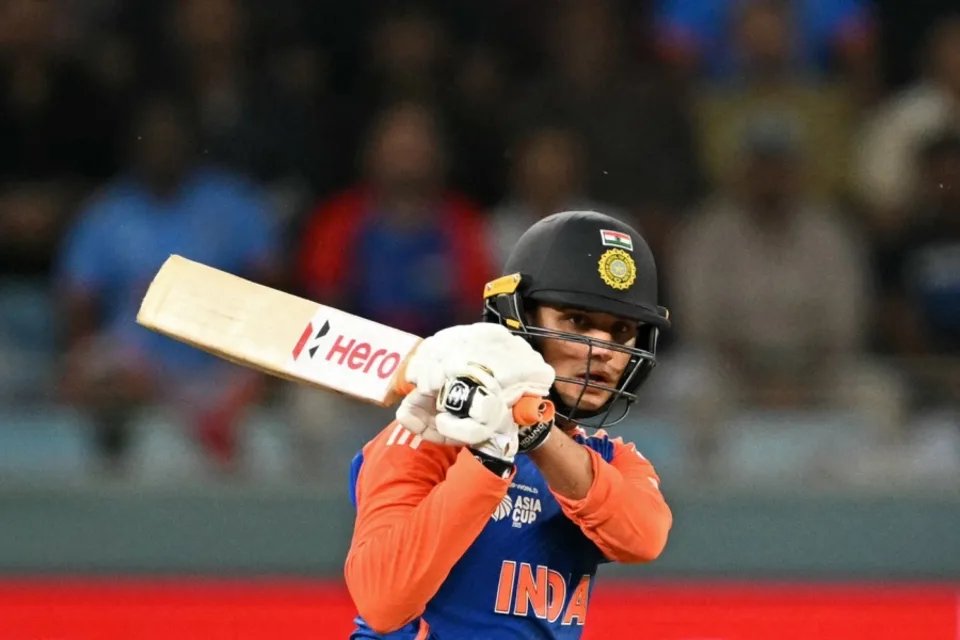
For about 10 overs, Pakistan threatened what has become rare in recent years, a memorable cricketing contest against India, but ran out of gas against the depth of India’s bowling. Still, 171 was the highest total Pakistan have ever posted batting first against India, but it ended up as all their defences against India have: in defeat, this time with seven balls to spare.
Abhishek Sharma and Shubman Gill crushed the total without ever looking in trouble, starting with a six first ball and adding 105 for the first wicket in just 59 balls, making sure the middle order didn’t have too much to do when scoring became difficult against the older ball. Gill scored 47 off 28, and Abhishek, who had dropped Sahibzada Farhan in the first over of the match, carried on to 74 off 39, and left India just 49 to get off 46 when he was dismissed.
Farhan went on to score a fifty to promise a contest but it felt like he had to play out of his skin to get there. He was also culpable in Pakistan’s slowdown, adding just 7 off 11 after reaching fifty as Pakistan went 39 legal deliveries without a boundary.
Even though the chase appeared a walk in the park, the simmering tensions between the sides rose to the surface on the odd occasion. India’s batters appeared to be extra mindful of reassuring each other as the players from the two sides engaged with each other for the first time in more than one-and-a-half matches.
India remained the cooler of the sides: Farhan wielded his bat like a gun after reaching fifty, Abhishek blew kisses after reaching his. The celebrations were indicative of the effort taken to reach the respective milestones.
Pakistan protected the struggling Saim Ayub from opening the innings, and it worked with Fakhar Zaman getting off to a flier, after which Farhan carried on. Pakistan raced away to their best powerplay against India, scoring 55 for 1. Jasprit Bumrah bowled three overs in the first six for the third straight match, and registered his costliest T20I powerplay: 34 runs.
Coming into this match, the only teams in this Asia Cup slower than Pakistan in the middle overs were Oman and UAE. Pakistan had gone at under a run a ball, but this time they managed to hit three four sixes in overs 8-10, off Kuldeep Yadav, Varun Chakravarthy and Axar Patel. The fourth six brought up Farhan’s half-century.
Having done the hard work, Pakistan slumped. The slide began against Shivam Dube, whose progress as a sixth bowler through this tournament will satisfy India immensely. Dube didn’t provide the batters any pace, stayed away from their swinging arc, and took out both Ayub and Farhan after they had put on 72 for the second wicket. The quality of Varun and Kuldeep then shone through, as they tied Pakistan down despite taking just one wicket between them. Faheem Ashraf’s unbeaten 20 off 8 added respectability to the score, but it always looked light.
It began looking even lighter when Abhishek hooked the first ball of the chase for a six. Gill and Abhishek laced the bowling, making full use of the new ball and whatever pace Shaheen Shah Afridi provided them. India’s 69 for 0 was the best powerplay of this Asia Cup, and India’s best against Pakistan.
Abhishek kept clearing the infield while Gill kept finding the gaps, and all the while they made sure they stood together whenever a confrontation threatened to materialise. It eventually came to a head with Abhishek and Rauf in each other’s face after Gill pulled the latter for a four.
Ashraf provided Pakistan the breakthrough with a ball that seamed in to bowl Gill immediately after he had taken treatment for cramps. Suryakumar Yadav then fell for a duck, but Abhishek kept striking the ball cleanly, taking down Abrar Ahmed, potentially Pakistan’s most threatening bowler. Even though Abrar finally got his wicket, Abhishek took him for 32 off 12 balls including four sixes.
India experienced a brief slowdown similar to Pakistan’s as Sanju Samson and Tilak Varma struggled to come to terms with the old ball not coming onto the bat. Samson managed just 13 off 17, but Tilak saw India through with sixes off Rauf and Afridi in the 18th and 19th overs.
Brief scores:
India 174 for 4 in 18.5 overs (Abhishek Sharma 74, Shubman Gill 47, Tilak Varma *, Sanju Samson 13; Abrar Ahmed 1-42, Harris Rauf 2-26, Faheem Ashraf 1-31) beat Pakistan 171 for 5 in 20 overs (Sahibzada Farhan 58, Fakhar Zaman 15, Saim Ayub 21, Hussain Talat 10, Mohammad Nawaz 21, Salman Agha 17*, Faheem Ashraf 20*; Hardik Pandya 1-29, Kuldeep Yadav 1-31, Shivam Dube 2-33) by six wickets
[Cricinfo]


The price of gold has risen above $5,000 (£3,659) an ounce for the first time, extending a historic rally that saw the precious metal jump by more than 60% in 2025.
It comes as tensions between the US and NATO over Greenland have added to growing concerns about financial and geopolitical uncertainty.
US President Donald Trump’s trade policies have also worried markets. On Saturday he threatened to impose a 100% tariff on Canada if it strikes a trade deal with China.
Gold and other precious metals are seen as a so-called safe-haven assets that investors buy in times of uncertainty.
Demand for gold has also been driven by a range of other factors including higher-than-usual inflation, the weak US dollar, buying by central banks around the world and as the US Federal Reserve is expected to cut interest rates again this year.
Wars in Ukraine and Gaza, as well as Washington seizing Venezuelan President Nicolás Maduro, have also helped push up the price of gold.
On Friday, silver topped $100 an ounce for the first time, building on its almost 150% rise last year.
[BBC]
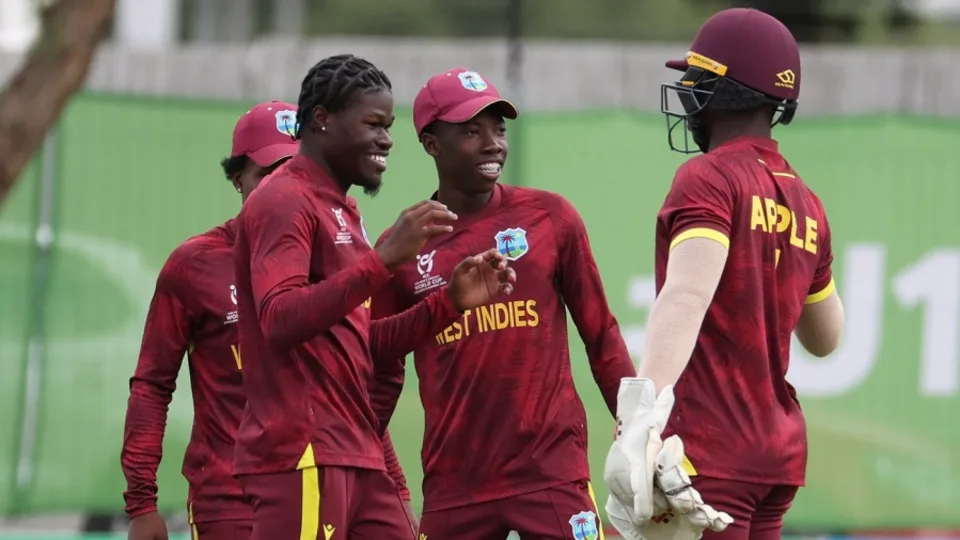
West Indies wristspinners, Micah McKenzie and Vitel Lawes, combined to take six wickets on a surface that had plenty of turn and bite to close out a rain shortned contest against Ireland. Opting to bat first, the West Indies innings had earlier been held together by keeper-batter Jewel Andrew at No. 3 – his 66 off 82 consisted of four fours and four sixes, the majority of which came in the company of Jonathan van Lange,, during their fourth-wicket partnership of 67.
Jewel departed just six overs after van Lange, in the 33rd, and the rest of the batters struggled. No one besides him managed to cross the 30-run mark. Reuben Wilson scalped up van Lange, before returning to take out two lower-order batters to finish with figures of 3 for 50, closing out the innings with West Indies bowled out for 226.
His effort, complemented by James West’s economical 2 for 24 off seven overs, gave Ireland a realistic chance at chasing down the total. West also opened the batting for Ireland and top-scored for them, hitting a 55-ball 45 that was littered with eight boundaries. By the time he was Lawes’ first victim of the innings, in the 18th over, Ireland sat at a comfortable 82 for 2.
However, the going just got worse from there: Ireland lost four wickets to McKenzie, who spun his way through the middle order. Lawes held back his best over for his final one of the match, fizzing out Oliver Riley with its first ball, and then turning the ball prodigiously against Wilson and Bruce Whaley.
Ireland were on 164 for 7 by the time they played out Lawes’ over, needing an unlikely 62 off the final ten overs. The rain had the final say when it interrupted the match and delivered the final blow to Ireland’s hopes. The DLS par score had shot way past Ireland’s total, and when no further play was possible, West Indies walked away with a convincing spin display and a 25-run win to boost their chances in the Super Sixes.
Brief scores:
West Indies Under 19s 226 in 46.5 overs (Jewel Andrew 66; Reuben Wilson 3-50, Luke Murray 2-37, James West 2-24) beat Ireland Under 19s 164 for 7 in 40 overs (James West 45; Mica McKenzie 4-36, Vitel Lawes 2-41)by 25 runs (DLS method)
[Cricinfo]
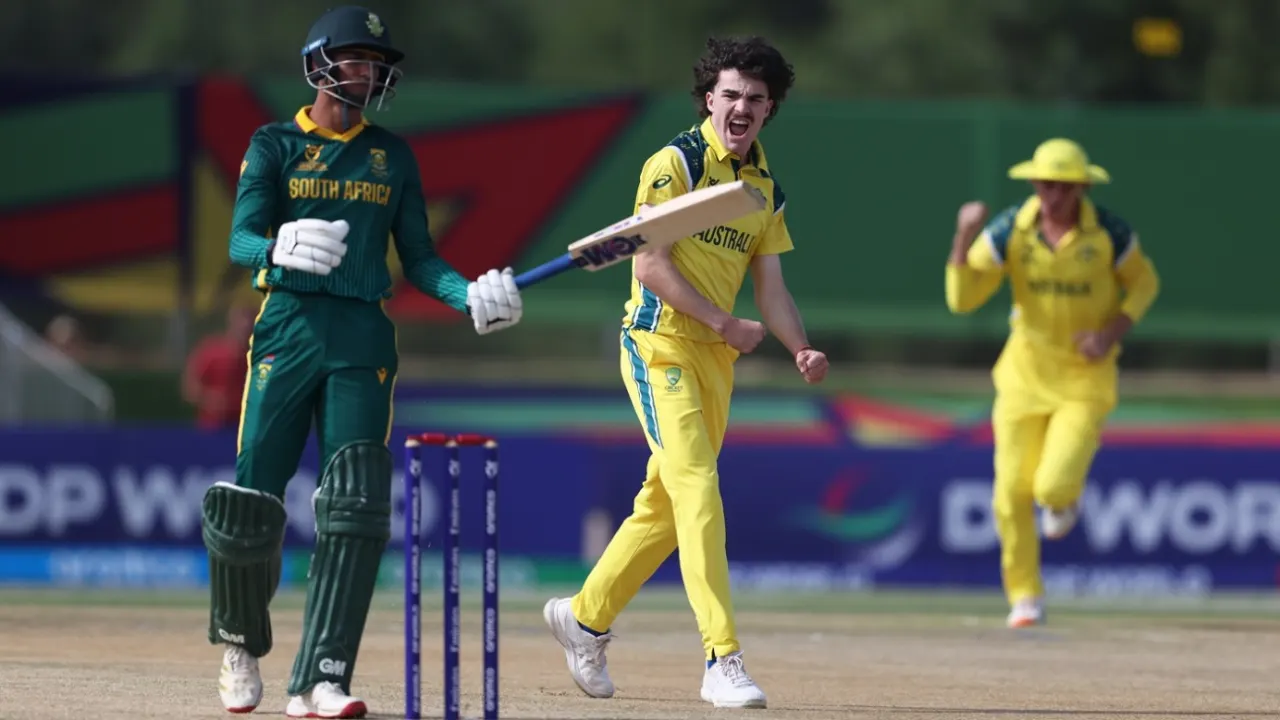
It took Australia U19s 32.5 overs, going at just around 3.5 runs an over for the majority of a belaboured chase against an excellent South Africa U-19 bowling effort. But they had that liberty after Charles Lachmond’s 3 for 29, and two wickets each from Will Byrom and Aryan Sharma, had bowled South Africa out for 118 all but ensuring the result of the match was in little doubt even at the halfway stage.
South Africa had been reduced to 37 for 4 inside the powerplay, failing to find answers against the raw pace and movement that Lachmund and Byrom found off the surface. Opener Jorich Van Schalkwyk was the sole bright spot for them, battling his way through this period and putting together a 30-run stand with Paul James, even as he was pinged on the helmet off a brutal Kasey Barton delivery.
Spinner Aryan proved to be particularly troublesome to face, as he kept spinning the ball away from the outside edge of the right-handers. He dropped two catches at point before coming into the attack, but made up for his fielding by scalping up two wickets of his own.
James kept one end steady once Schalkwyk was run out for a 26 off 55, but wickets kept falling at the other. He would eventually be the last batter out, for a 60-ball 34 .
In response, JJ Basson led a South Africa bowling attack that was incisive and economical. His spell of 3 for 41 was the highlight of a bowling effort that kept the Australia batters defensive, and also ensured that the Australia line-up lost three wickets for the first time in this tournament – in their fourth match of the tournament.
Steven Hogan never looked comfortable during his 73-ball 43, but timed short deliveries well while cutting late, and mowed down more than a third of the target by himself. He was the last Australian wicket to fall, as Basson’s third wicket. Alex Lee Young and Jayden Draper got together at the crease, and the latter smacked two fours in the 33rd over of the contest to bring it to a close.
Brief scores:
Australia 122 for 4 in 32.5 overs (Steven Hogan 43, Jayden Draper 21*, Alex Lee Young 21*; JJ Basson 3-41) beat South Africa Under 19s 118 in 32.1 overs (Paul James 34; Charles Lachmund 3-29, Will Byrom 2-16, Aryan Sharma 2-27) by six wickets
[Cricinfo]

Royal Navy of Oman Ship ‘AL SEEB’ leaves island

Gold tops $5,000 for first time ever, adding to historic rally

Showers will occur in the Northern, North-central, Eastern, North-western, Western, Sabaragamuwa and Uva provinces and in Matale, Matara, Galle and Nuwara-Eliya districts

U – 19 World Cup: Andrew, McKenzie deliver West Indies comfortable win

U – 19 World Cup: Bowlers, Hogan help Australia breeze past South Africa

Abhishek blasts 14-ball fifty to hand India unassailable 3-0 lead against New Zealand

‘Dates have the highest sugar content to fight Coronavirus’

Sunday Island 27 December – Headlines

#SundayIsland 17th December – Headlines

Sunday Island – 28th March

Sunday Island Headlines – 21 March

Sunday Island – 21st February – Headlines
-

 Business12 hours ago
ComBank, UnionPay launch SplendorPlus Card for travelers to China
-

 Business2 days ago
ComBank advances ForwardTogether agenda with event on sustainable business transformation
-

 Opinion7 days ago
American rulers’ hatred for Venezuela and its leaders
-

 Opinion5 days ago
Remembering Cedric, who helped neutralise LTTE terrorism
-

 Business5 days ago
CORALL Conservation Trust Fund – a historic first for SL
-

 Opinion4 days ago
A puppet show?
-

 Opinion2 days ago
Conference “Microfinance and Credit Regulatory Authority Bill: Neither Here, Nor There”
-

 Opinion7 days ago
History of St. Sebastian’s National Shrine Kandana