
Sports
India in driver’s seat after Ashwin, Umesh share eight wickets


Umesh Yadav and R Ashwin picked up four wickets each to put India on top despite Mominul Haque’s 84 on return. Batting first in the second Test in Mirpur, Bangladesh were 213 for 5 at one stage after tea but lost their last five wickets inside the next 14 runs to be all out for 227.Each of Bangladesh’s top seven batters reached 15 but apart from Mominul, no one could cross 26. Whenever a partnership seemed to be brewing, they lost a wicket. Five of the first six wickets featured a stand of 39 or more but the highest of them was only 48.
India were left with 14 overs to face. The play went into the extra half hour but bad light allowed only eight of those to be bowled. In that short passage, KL Rahul looked circumspect against Taskin Ahmed and Shakib Al Hasan, and finished the day on 3 not out off 30 balls. Shubman Gill was keeping him company, his unbeaten 14 off 20 comprising a six and a four.In the morning, India went in with three seamers and two spinners on a grassy pitch, replacing Kuldeep Yadav, the Player of the Match in the last game, with Jaydev Unadkat. This was Unadkat’s first Test in 12 years and only his second overall. Between his two appearances India played 118 Tests, the second-most missed games for any Test cricketer.
Umesh and Mohammed Siraj found movement with the new ball but neither really pitched it up to fully exploit the grassy pitch. That resulted in a lot of plays-and-misses but the Bangladesh openers, Zakir Hasan and Najmul Hossain Shanto, survived their spells.Bowling first change, Unadkat, the slowest of the Indian seamers, didn’t find as much movement but his higher release point fetched him extra bounce. Soon, he was bowling with four slips, a gully and a short leg, and hitting batters on the gloves regularly.
With Bangladesh on 39, Zakir decided to cut a short-of-length delivery from Unadkat, only to be done in by the extra bounce. The ball hit him on the glove and lobbed to fourth slip, giving Unadkat his maiden wicket in Test cricket.In the next over, Ashwin trapped Shanto lbw. The batter, playing for the turn, shouldered arms to a length ball that went with the arm from around the wicket and struck him on the pad. He was given out lbw on the field, and a review returned an umpire’s call verdict with ball-tracking showing the ball tickling off stump.
Coming in at No. 4, Shakib took the aerial route against Ashwin even before he had reached double digits. He first hit Ashwin inside-out over extra cover before dancing down the track later in the work to deposit him beyond deep-midwicket boundary.
Mominul and Shakib enjoyed slices of luck too. Mominul’s cut against Ashwin flew between the wicketkeeper and slip, and then in the last over before lunch, Rishabh Pant missed a difficult leg-side stumping when Shakib charged at Ashwin and the ball sneaked through his legs.
The reprieve, though, didn’t prove costly as Umesh sent Shakib back on the first ball after the break. The Bangladesh captain tried to loft him over mid-off but didn’t get the timing right and ended up offering the simplest of chances.
Mominul and Mushfiqur, starting slowly before hitting six fours in the space of ten balls, stitched together 48 for the fourth wicket before Unadkat broke the stand. Bowling around the wicket, he once again found the extra bounce, the ball taking the outside edge of Mushfiqur’s bat before settling into Pant’s gloves.
Litton Das started positively, punching Siraj for four and following it with a pulled six on the next ball. He quickly moved to 25 but failed to keep a flick off Ashwin down and was taken at short midwicket.Mominul, meanwhile, kept pressing on and ramped two more fours off Unadkat to bring up his half-century. He and Mehidy Hasan Miraz ensured Bangladesh didn’t lose another wicket before tea despite some close calls.
The pair added 41 for the sixth wicket but post tea, Mehidy felt unwell. The physio came out to check in on him, and the batter decided to continue. Umesh, though, removed him soon after, Mehidy trying to cut a ball that was too close to him and nicking it behind.
Mehidy’s wicket triggered the collapse. In his next over, Umesh got one to reverse in to trap Nurul Hasan lbw. The on-field umpire deemed it not out but India got the decision changed on review. Taskin didn’t last long either, slicing one to Siraj at point who held onto the chance after a bit of juggling. Earlier, Siraj had put down Shanto off Umesh on the first ball of the second over of the day.
All this while, Mominul was firm at one end. But he found himself in two minds against an Ashwin carrom ball. He looked to drive at it first before shouldering arms. It was too late as the ball brushed his gloves and Pant latched onto it. Ashwin wrapped up the innings two balls later when Khaled Ahmed hit a full toss straight to Unadkat at deep midwicket.
Brief scores:
India 19/0 (Shubman Gill 14*) trail Bangladesh 227 (Mominul Haque 84; Umesh Yadav 4-25, R Ashwin 4-71) by 208 runs
(Cricinfo)




Approval has been granted at the meeting of the Cabinet of Ministers held on 08.06.2026 to prepare a draft bill for restructuring Sri Lanka Cricket.
Accordingly, the Legal Draftsman has formulated Sri Lanka draft bill providing legal provisions for the administration of Sri
Lanka Cricket, control, regulation, promotion, establishment of Sri Lanka Cricket for the development and administration, through the concepts of better governance, integrity, transparency, accountability, inclusiveness and providing equal opportunities for the betterment of the cricket sport, establishment of Sri Lanka Cricket for securing the wellbeing of all participants and securing cricket from corruption and other mal practices.
Clearance of the Attorney General has been received for the said draft bill. Approval of the Cabinet of Ministers has been received for the resolution furnished by the Minister of
Youth Affairs and Sports to publish the said draft bill in the government gazette notification and thereby forward the same to the Parliament for its concurrence.
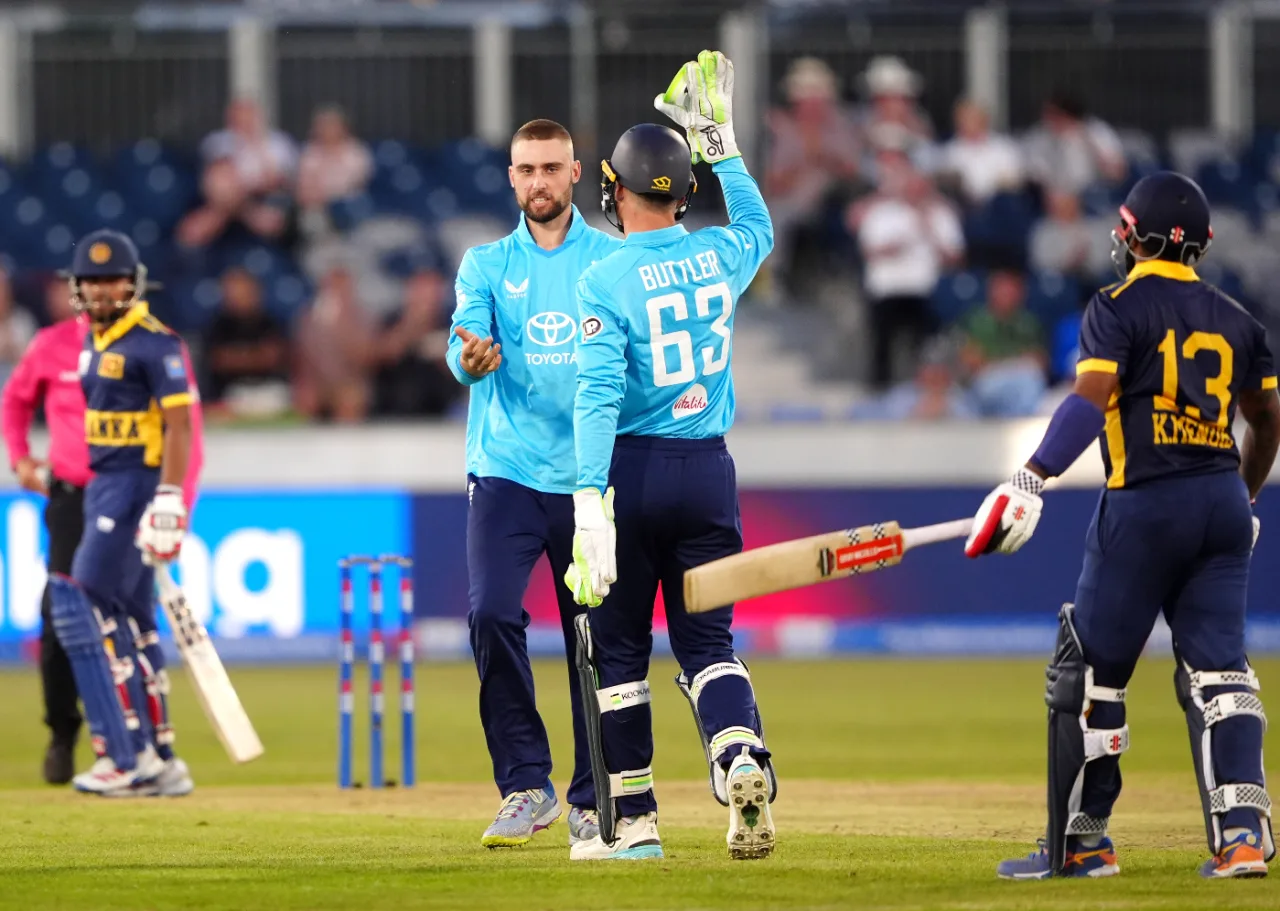
England are finally on the rise again in ODIs, after a long period of stagnation and decline. They pulled off their lowest successful defence in four years as they cruised past Sri Lanka at the Riverside in Durham, and have now won five matches out of seven since the start of this year under Harry Brook and Brendon McCullum.
The first ODI was more competitive than any of the three T20Is last week, as England wobbled against Sri Lanka’s debutant legspinner Sachindu Colombage in the middle overs. They failed to hit a six on a two-paced, end-of-season surface, and Brook – who threw his head back in frustration when he carved to deep point – was the only batter to find any real fluency.
But Sri Lanka’s run chase never got going. Captain Kusal Mendis made 42 on his return from a hamstring injury and Dunith Wellalage landed a few late blows, but their middle order went missing against Jamie Overton’s cross-seamers and Will Jack’s offbreaks. This was an unglamorous and forgettable win, but England have not had enough of those in recent years.
Jacks took three wickets in four balls to finish things off, giving him outstanding figures of 5 for 22 – the second best in an ODI by an England spinner. It meant that Adil Rashid, ruled out of the series with a hand injury, was hardly missed, and completed an impressive all-round performance by Jacks after he cracked 46 not out to drag England to 265.
England’s ODI results have tailed off sharply since they won their first World Cup under Eoin Morgan’s captaincy, with 50-over cricket slipping to the bottom of the ECB’s list of priorities. Across the six years after their 2019 triumph, they won 33 and lost 40 in ODIs and suffered humiliating group-stage exits in both the 2023 World Cup and the 2025 Champions Trophy.
They started 2026 ranked eighth in the world by the ICC, and with players and management anxious to secure automatic qualification for next year’s World Cup, but things have started to click for them. They have come from behind to win series against Sri Lanka (away) and India (home) this year, and will now target wins at Headingley and The Oval to seal a whitewash.
It has been a turbulent summer for McCullum, who lost his job as Test coach after England’s chaotic, self-sabotaging series defeat to New Zealand. But his partnership with Brook has been a revelation: England’s white-ball teams have won 10 completed games out of 11 this summer, and are finally starting to develop a clear identity.
Brook cited strike rotation and playing longer innings as two areas for England’s batters to improve before this series, and their new mentor Kevin Pietersen led a “spin masterclass” at Monday morning’s training session. They showed in this match that there is still plenty of scope to get better, stumbling against Colombage as they lost 4 for 29 in 7.5 overs through the middle.
A legspinner with an idiosyncratic action, Colombage spent last summer playing club cricket for Downham Stow in the East Anglian Premier League, but won his call-up after impressing in the recent Lanka Premier League. He was picked ahead of Wanindu Hasaranga in Chester-le-Street and made Joe Root his first victim in taking 3 for 44 on international debut.
England lost Tom Banton early to an Asitha Fernando outswinger – which trimmed the off bail – after choosing to bat, but Root started brightly. He pinged two early cover drives for four to take England to 64 for 1 after the initial powerplay, before they lost Ben Duckett lbw as he tried to sweep Wellalage’s left-arm spin.
Root had an early scare when he survived an lbw review off Colombage’s third ball, but was busy with Brook through the middle overs. They scampered between the wickets, though perhaps slightly too enthusiastically: Brook very nearly ran Root out on 42 with an optimistic single, though Colombage did for him an over later, finding just enough turn to beat the bat.
It ended a 404-run, five-innings stretch between dismissals for Root in ODIs, and when Brook miscued a charging slap to deep point off Dusmantha Chameera, it set a wobble in motion: Buttler was lbw to Colombage, Charith Asalanka’s direct hit did for Rehan Ahmed, and Overton played around a straight one from Colombage.
Jacks offered some resistance from No. 6, hitting four fours in a row off Chameera when the field came up due to Sri Lanka’s painfully slow over-rate. But the impressive Dilshan Madushanka pegged back Gus Atkinson’s off stump, and two Fernando yorkers accounted for Jofra Archer and Josh Tongue to leave Jacks stranded on 46 not out.
England’s 265 proved far more than enough. Kamindu Mendis fell tamely plinking Atkinson to midwicket, and Pathum Nissanka edged behind flashing at Tongue, while Banton held an excellent low catch at cover to get Pavan Rathnayake. Jacks had Asalanka and Mendis lbw sweeping, and Overton’s hard lengths did for Janith Liyanage.
When Rehan’s googly did for Colombage, Sri Lanka were 133 for 7 and the game was up. Wellalage smeared Archer for the game’s first six, clearing Duckett on the rope, and cracked Rehan for 4-4-6 to put a dent in the margin. But he picked out mid-on for 45 off Jacks, who finished the game by having Fernando caught at long-on then cleaning up Madushanka.
It was Jacks’s second five-wicket haul as an England player and his first since his Test debut four years ago, and he won the match award after a stellar all-round effort. He is Brook’s vice-captain for this series in Jacob Bethell’s injury-enforced absence, and is becoming an increasingly important player.
Scores:
England 265 in 48.1 overs (Joe Root 44, Harry Brook 67, Will Jacks 46*; Asitha Fernando 3-53, Sachindu Colombage 3-44, ) beat Sri Lanka 176 in 37 overs (Dunith Wellalage 45, Kusal Mendis 42; Jamie Overton 2-21, Will Jacks 5-22) by 89 runs
[Cricinfo]


Sri Lanka’s women had to settle for silver at the 2026 Asian Games after India proved far too strong in the cricket final, romping to a 147-run victory.
India produced a commanding batting display after taking first lease of the wicket, piling up 216 for three from their 20 overs before dismissing Sri Lanka for just 69 in 15.4 overs.
Smriti Mandhana laid the foundation for India’s imposing total with a sparkling 79 off 45 balls before Richa Ghosh applied the finishing touches with an unbeaten 49 off only 22 deliveries.
Sri Lanka struggled to contain the Indian batting onslaught, with Chamudi Praboda and Kavisha Dilhari claiming a wicket apiece.
Faced with a daunting target of 217, Sri Lanka needed a flying start but instead found themselves tied down by a disciplined Indian attack.
Captain Chamari Atapattu attempted to lead the resistance with 29 off 21 balls, but there was little support around her. Kaushini Nuthyangana was the only other batter to reach double figures, making 14.
Once Chamari departed, Sri Lanka’s challenge quickly faded as wickets tumbled at regular intervals.
Deepti Sharma was the pick of the Indian bowlers, returning outstanding figures of three for six, while Shafali Verma chipped in with two for three as Sri Lanka were bundled out well inside their allotted 20 overs.
The emphatic victory handed India the gold medal, while Sri Lanka ended their Asian Games campaign with silver.
Caption: Chamari Atapattu couldn’t see her side through in the cricket final of Asian Games as Sri Lanka had to settle for silver medal.

Ms. P. M. Jayadeera (Engineer) appointed Director General of Irrigation
Sri Lanka Cricket Draft Bill to be gazetted
Cabinet approves purchase of machinery for the Sri Lanka Land Development Corporation
Cabinet approval for Project to Build Secure, Skilled, and Empowered Community for families resettled at the at Kalinga Mawatha, housing scheme
Appointment of Cabinet Sub-Committee for the Organization of 79th Independence Day Commemoration
Establishment of New Management Framework for the Dr. Nevil Fernando Hospital

‘Dates have the highest sugar content to fight Coronavirus’

Sunday Island 27 December – Headlines

#SundayIsland 17th December – Headlines

Sunday Island – 28th March

Sunday Island Headlines – 21 March

Sunday Island – 21st February – Headlines
-

 News6 days ago
US embassy won’t comment on IGP’s probe into joint drug raid
-

 News4 days ago
Shanakiyan urges urgent action over reported death sentence for Lankan in Saudi Arabia
-

 News5 days ago
Bid for Basil’s extradition nears final stage: Police
-

 Business6 days ago
All-new Bolero MaXX unveiled in Sri Lanka
-

 News3 days ago
Namal Rajapaksa Buddhist gambit fails, bail denied
-

 Opinion6 days ago
A journalist who wrote across the divide
-

 Features3 days ago
Why the spelling Sri Lankan names in English vary
-

 Features3 days ago
Three bands, a new identity: Sri Lankan wolf snake recognised as distinct species