
News
As US watches on, China-Saudi relations grow in importance

By Shehab Al-Makahleh and Giorgio Cafiero
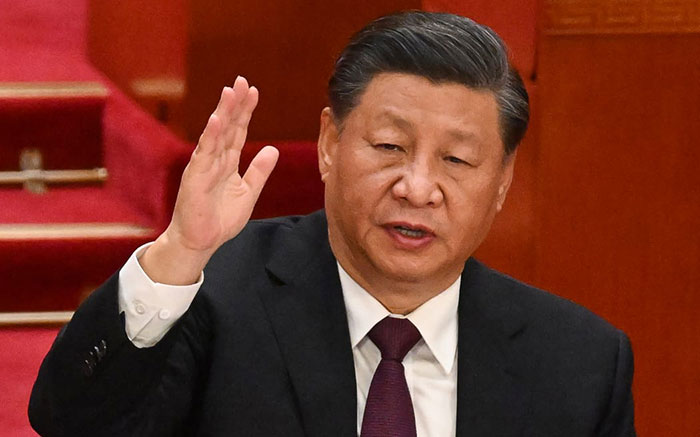
Chinese President Xi Jinping is in Riyadh for a three-day trip, underscoring the constantly growing importance of Sino-Saudi relations, and a clear message from Saudi Arabia that it will not take diktats from the United States.
Xi’s first trip to Saudi Arabia in six years gives Saudi Crown Prince and Prime Minister Mohammed bin Salman (MBS) a greater opportunity to assert his influence on the international stage as an increasingly important figure in global affairs.
This week’s meetings will mostly focus on the economic dimensions of the Sino-Saudi partnership. According to the Saudi Press Agency (SPA), the kingdom and China will sign agreements worth $29.6bn. Such agreements will add to trade, business, and investment relations between the two countries that have greatly deepened in recent years.
China is Saudi Arabia’s top crude oil market, accounting for more than 25 percent of all Saudi crude oil exports in 2021. These export earnings help the Saudi government maintain its “social bargain”, explained John Calabrese, director of the Middle East-Asia Project at the Middle East Institute, in an interview with Al Jazeera.
Additionally, these earnings are extremely important for Saudi Vision 2030 — Saudi Arabia’s grandiose economic diversification agenda, including with respect to the futuristic city of Neom, which is currently being built.If the smart city proves successful, Saudi Arabia can expect its cooperation with the Chinese to further expand in
many ways, particularly mindful of the potential for many Chinese tourists to visit Saudi resorts on the Red Sea.
“Saudi Arabia is partnering with China to accelerate the kingdom’s digitalisation of the energy sector and the digital transformation of the economy more broadly,” observed Calabrese. “China is also an important investment destination for [petroleum and natural gas company] Saudi Aramco as the latter seeks to expand its downstream activities in Asia. Cooperation in the development of hydrogen and in renewables is in its incipient stage but could blossom.”
From Beijing’s perspective, Saudi Arabia is an extremely important source of energy that greatly matters to the future of China’s economic growth.
“The Chinese need to know that Riyadh can remain a reliable producer,” Dave DesRoches, an assistant professor at the National Defense University in Washington, DC, told Al Jazeera. “Particularly now when it looks as if Iran, which Beijing has been relying on for lots of its oil … might be ramping down its ability to export as people become more concerned about Iranian export of weapons to Russia.”
US concerns
There are some signs that the bilateral partnership is expanding and taking on greater security dimensions.
“The dominant ties between China and Saudi Arabia are predicated on commercial activity. However, many global relationships and alliances, bilaterally and multilaterally, began this way and then expanded to other realms, including in the traditional defence areas,” Jonathan Panikoff, the director of the Scowcroft Middle East Security Initiative at the Atlantic Council’s Middle East Program, told Al Jazeera.
A year ago, CNN reported that Beijing supported Saudi Arabia’s indigenous ballistic missile production efforts, which is a case in point. Also, in certain niche areas, such as armed drones, the Chinese have made sales to Saudi Arabia’s weapons development, filling gaps that the US has chosen not to fill for Riyadh.
Washington has grave concerns about the defence and security aspects of the Sino-Saudi relationship. “The challenge for the US, vis-à-vis the China-Saudi relationship, is that Beijing is simply easier to work with from Riyadh’s perspective,” said Panikoff. “It views China as politically consistent, refrains from lecturing Riyadh on issues such as human rights and doesn’t have cumbersome end-user restrictions on military hardware.”
Nonetheless, China is nowhere close to replacing the US as Saudi Arabia’s defence guarantor. There are no indications that Beijing could or would attempt to do so in the foreseeable future. – Al Jazeera



More than 1,600 students sat this year’s Russian Classical Ballet Examination, the largest number ever to take part in the examination in Sri Lanka. Exams were held in Colombo from 5, to 18, October and in Galle on 10 October.
Students aged four and above came from across the island, including Colombo, Galle, Gampaha, Negombo, Matara, Kelaniya, Panadura, Wattala, Kiribathgoda, Ratnapura, Kandy, Kurunegala, Bandarawela and Badulla. They are taught by 15 dedicated teachers trained in the Vaganova method, the renowned Russian system of classical ballet training.
They were examined by Dr. Oxana Karnovich of the Moscow State Academy of Choreography, a distinguished academic and curator.
The Russian School of Ballet and Dancing was established in 2001 by Michael Ustinov, Buddhapriya Ramanayake and Mrs Chandi Aluvihare, with Mrs Galina Pleshakova as its founding instructor. Today the School is led by Director Madam Maria Popova, Counsellor of the Embassy of the Russian Federation in Sri Lanka.

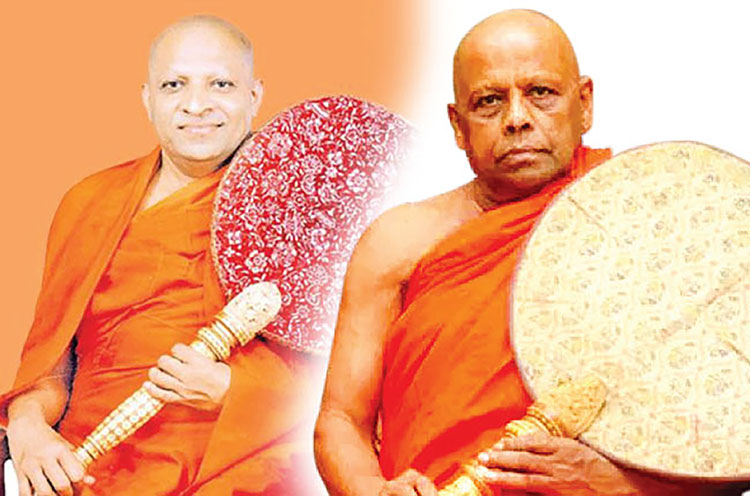
MONETABRIEF– Sri Lanka’s two most senior Buddhist chapters, Malwatte and Asgiriya, demanded special concessions for monks serving prison sentences, following the disrobing of convicted monk Ven. Galagodaatte Gnanasara in line with established procedures.
The chief prelate of the Asgiriya chapter, Most Venerable Warakagoda Sri Gnanarathana, told Prisons Commissioner Senaka Palletenna that Ven. Gnanasara, who is serving a six-year sentence for contempt of court, must be released immediately.
Prison authorities have no power to release or pardon convicts, but Palletenna told the monk in Kandy on Friday that he would convey his request to the relevant government authorities.
“There is no point in talking about this and that… The entire country has been shaken (??????? ) . He must be released,” the Asgiriya chief prelate said.
The Malwatte chief prelate, Most Venerable Thibbatuwawe Sri Siddhartha Sumangala, appeared to accept the court verdict against Ven. Gnanasara, but asked the prisons chief whether a separate section could be established for convicted monks.
Palletenna noted that a special ward for the clergy already existed at Welikada Prison.
At least 63 convicted Buddhist monks are currently incarcerated within Sri Lanka’s criminal justice system.
Meanwhile, a group of 34 Buddhist monks named in a Colombo Fort Magistrate’s Court order to vacate the vicinity of the Presidential Secretariat ended their protest and dispersed after lunch on Friday.The monks are demanding an unconditional pardon for Ven. Gnanasara, who has previously been imprisoned, making him a reconvicted prisoner.
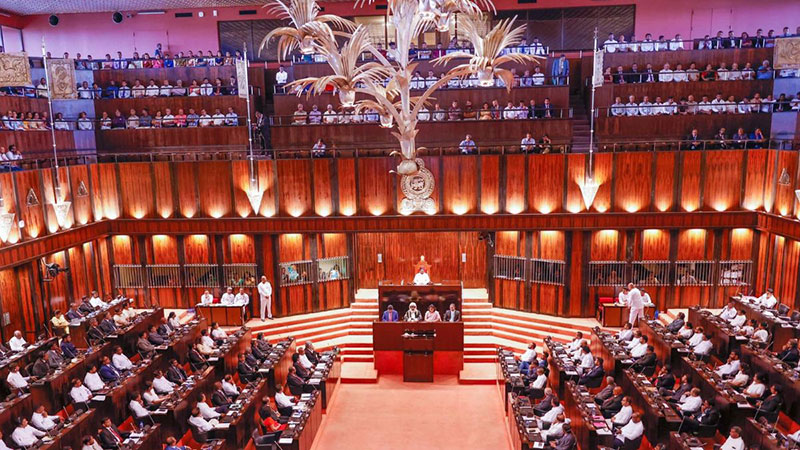
The debate on the no-confidence motion against Speaker Dr. Jagath Wickramaratne, submitted by the Samagi Jana Balawegaya (SJB), has been postponed indefinitely pending the Attorney General’s opinion on certain technical issues in the motion.
Government representatives raised the matter at a meeting of the Committee on Parliamentary Business, pointing out that several provisions of the motion required clarification and that the Attorney General’s advice should be obtained.
As obtaining the opinion would take time, the debate could not be scheduled for the next parliamentary week, parliamentary sources said.
Chief Opposition Whip Gayantha Karunatilaka said a date for the debate would be decided after the Attorney General’s advice was received.
Meanwhile, Parliament is scheduled to meet from October 20 to 23, Secretary General of Parliament Kushani Rohanadeera announced.
The parliamentary business for the week was finalised at a meeting of the Committee on Parliamentary Business held on Friday (16) under the chairmanship of Deputy Speaker Dr. Rizvie Salih.
On each sitting day, the period from 9.30 a.m. to 10 a.m. will be allocated for parliamentary business under Items 1 to 6 of Standing Order 22. Questions for Oral Answers will be taken up from 10 a.m. to 11 a.m., followed by questions under Standing Order 27(2) from 11 a.m. to 11.30 a.m.
On Tuesday, October 20, an Opposition-sponsored Adjournment Motion will be debated from 11.30 a.m. to 5.30 p.m.
On Wednesday, October 21, a resolution under the Public Debt Management Act and a Supplementary Estimate will be taken up for debate and approval from 11.30 a.m. to 5 p.m. The annual reports of five statutory institutions will subsequently be presented for approval without debate, while questions at the Adjournment Time will be taken up from 5 p.m. to 5.30 p.m.
On Thursday, October 22, the Second Reading debates on two Bills to amend the Poisons, Opium and Dangerous Drugs Ordinance (Bills Nos. 79 and 80) will be held from 11.30 a.m. to 5 p.m.
The annual reports of five statutory institutions will then be taken up for approval without debate, followed by an Opposition-sponsored Adjournment Motion from 5 p.m. to 5.30 p.m.
On Friday, October 23, the Second Reading debate on the Elimination of Rabies and Registration of Dogs Bill will be held from 11.30 a.m. to 5 p.m. A Government-sponsored Adjournment Motion will be debated during the final half-hour of the sitting.

Record 1,600 students take Russian Classical Ballet examination in Sri Lanka

Half a million people join protests in France, but some turn violent

Deadly fire breaks out at Canada military base

Showers or thundershowers will occur in most parts of the island after 1.00 p.m.

Buddhist hierarchy demands prison perks for monk convicts

Debate on NCM against Speaker postponed indefinitely

‘Dates have the highest sugar content to fight Coronavirus’

Sunday Island 27 December – Headlines

#SundayIsland 17th December – Headlines

Sunday Island – 28th March

Sunday Island Headlines – 21 March

Sunday Island – 21st February – Headlines
-

 Latest News5 days ago
Nissanka’s return headlines Sri Lanka’s Test squad against Pakistan
-

 Latest News7 days ago
Farhan and Sadaqat help Pakistan seal series in style
-

 Features7 days ago
Intake 16: 45 years of duty and honour
-

 News7 days ago
Malwathu Chapter issues statement on talks with President over Gnanasara Thera’s robes
-

 News7 days ago
CP alleges NPP has taken the blame for illegal US sanctions on Iranian vessels
-

 Opinion7 days ago
How long can Sri Lanka remain silent on its demographic crisis?
-

 News5 days ago
Sri Lanka, India caught in US-Iran ship crisis
-

 Latest News5 days ago
Kusal Mendis’ unbeaten 87 hands Sri Lanka consolation win