
News
Arms producers benefitted from Sri Lanka’s 30-year war!

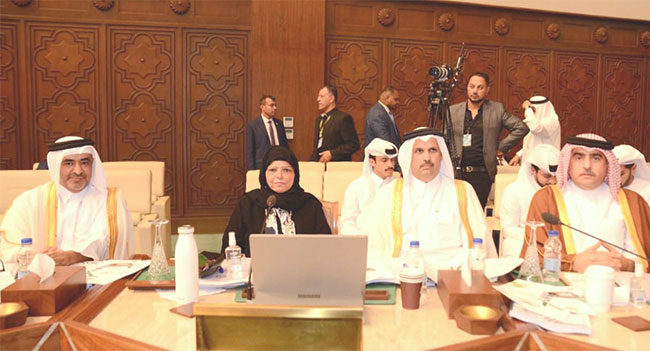
National Shoora Council Biennial Meeting
We are now begging their governments for food and fuel – Zuhair
Six to seven million Sri Lankans are reportedly undergoing tremendous hardship, for their second meal, every day. The 303 Sri Lankans who ended up in Vietnam three weeks ago, rescued by a Japanese vessel from a virtually drowning Myanmar flagged fishing boat, had one distressing message, ‘”take us anywhere but not to Sri Lanka!” This is a damning indictment upon our country. Large numbers of others are leaving the country for good. We all have a national role to play to overcome the crisis.
This was stated by former Member of Parliament, M M Zuhair, PC, who was the guest speaker at the biennial meeting of the National Shoora Consultative Council (NSC), on Sunday, presided by NSC President, T K Azoor, Attorney-at-Law. NSC is the consultative body, comprising 14 Muslim national level organisations in the country.
Speaking further, Zuhair said, the people of this country had been in search for peace and tranquility, since independence, 75 years ago, but they never found them. We neglected focusing on economic development, with dangerous consequences.
Within the first 10 years after, independence, the country was embroiled in the first notable racial riots, in 1956. In 1958, the second such riots engulfed a major part of the country. In 1962, we saw the attempted coup to topple the government, blamed on a powerful minority. In 1971, and again in 1989, the country witnessed a youth uprising, primarily from the majority community. In 1979, an uprising in the North, followed by the major islandwide 1983 July racial riots put the LTTE on top, becoming Sri Lanka’s formidable foe, aiming to establish a separatist State.
The war, launched in 1979, to suppress the uprising in the North, armed with the notorious Prevention of Terrorism Act, instead of containing terror, helped to multiply terrorism in the country. There was no dialogue between the elder brother and the younger one. The globally shamed 1983 riots laid the foundation for war. The 1984 All Party conference (APC) and the 1985 Political Parties Conference (PPC) came too late. They were mere eye wash!
Who benefitted from the war between the brothers? Arms manufacturers in the USA, USSR, Britain, France, Germany, Israel and China were the beneficiaries, though we must blame ourselves for it. The country’s wealth, savings and the dollars ended up in foreign countries for the next 30 years. Today we are pleading with those governments, with the begging bowl, for food and fuel, for the survival of our people.
With the end of the war, in 2009, we missed another golden opportunity to unite the people, at least for the sake of the country’s economic revival. The unity of the people, and the communities, was severely dented by allowing anti-minority attacks against the Christians and the Muslims. Muslims were, thereafter, more specifically targeted with wild allegations about Halal Food, Women’s attire, population canards, discriminatory birth control allegations etcetra!
All these culminated in several anti-Muslim riots, in 2014, 2017, 2018, with over 18 Mosques being attacked, prior to the reprehensible damaging of Buddha Statues, in December 2018, and the widely condemned Easter Sunday attacks of April 2019. Both these acts of Muslim violence were not aimed at toppling any elected government but, on the contrary, governments allegedly benefitted. They do not come anywhere near any act of treason, though the Easter suspects are being treated much worse.
All these came upon a community that ought to be placed first in national patriotism but for the false propaganda by vested interests in sections of the media. Historian Dr Lorna Dewaraja says that 900 years ago, during the reign of King Parakramabahu, a significant contribution, for building the Parakrama Samudra, came from the Arab descendent Muslims of Sri Lanka. Since then, the patriotic role of the Sri Lankan Muslims, in the progress and development of the country, for over a thousand years, has been recorded by Dr Dewaraja.
It is in this background that the NSC should continue to guide the community, and the country, to play this historical role at this time of distress. NSC, Zuhair said, should resist attempts to divide the majority from the minority communities. We have several issues the NSC should address, such as the proscription of some Muslim civil organisations, in violation of the constitutional protections, proposed rehabilitation without judicial determination, State interferences in Mosque administration, discriminatory restriction in importing Islamic books, North-East Merger, the proposed abolition of Quazi Courts, etc. We need to resolve these problems expeditiously.


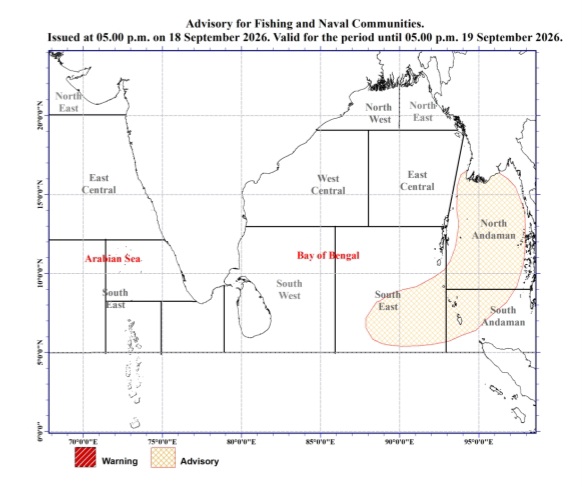
Advisory for strong winds and rough seas for Multi-day boats in the Bay of Bengal deep sea areas
Issued by the Natural Hazards Early Warning Centre
Issued at 05.00 p.m. 18 September 2026, valid for the next 24 hours.
PLEASE BE AWARE!
The atmospheric disturbance to the North of the Andaman Islands in the Bay of Bengal, is likely to develop into a low pressure area within the next 24 hours.
Due to its influence, wind speed over the Bay of Bengal sea areas will increase during the next few days starting from
tomorrow (19th).
The wind speed in the sea areas marked under the “Advisory” category on the map below will increase to 55-65 kmph at times and those sea areas will be rough or very rough at times.
Navel and fishing communities engaging the activities over this sea area are advised to be vigilant and be attentive to the future forecasts and bulletins issued by the department of Meteorology in this regards.

Text and Pic by Priyan de Silva
Director General of the Commission to Investigate Allegations of Bribery and Corruption (CIABOC) Ranga Dissanayake has questioned whether some promises contained in the National People’s Power (NPP) manifesto, A Thriving Nation – A Beautiful Life, could be fulfilled even if the government wanted to implement them.
Dissanayake raised the issue during a discussion following the release of the third biannual report on manifesto monitoring by the March 12 Movement, at the BMICH, on Wednesday.
He questioned whether the report had taken into account legal and institutional constraints affecting the implementation of certain pledges.
Citing the proposal to establish Anti-Corruption Investigation Offices in each district, Dissanayake said such offices could be established only with the agreement of CIABOC and that amendments to the Anti-Corruption Act would be necessary.
He also referred to the pledge to abolish the Executive Presidency, noting that successive governments had made similar commitments since 1994. He questioned whether there had been adequate consideration of where the powers vested in the Executive President would be transferred if the system were abolished.
On the proposal to establish a Public Prosecutor, Dissanayake questioned whether the Government intended to maintain the office alongside the Attorney General, who currently performs prosecution-related functions.
Executive Director of the Institute for Democratic Reforms and Electoral Studies (IRES) Manjula Gajanayake said Dissanayake’s remarks should be regarded as his personal views and not as Government policy.
Monitoring and Evaluation Consultants M. Thilakarajah and D.D. Mataharaarachchi presented the third-phase findings, covering January to June 2026.
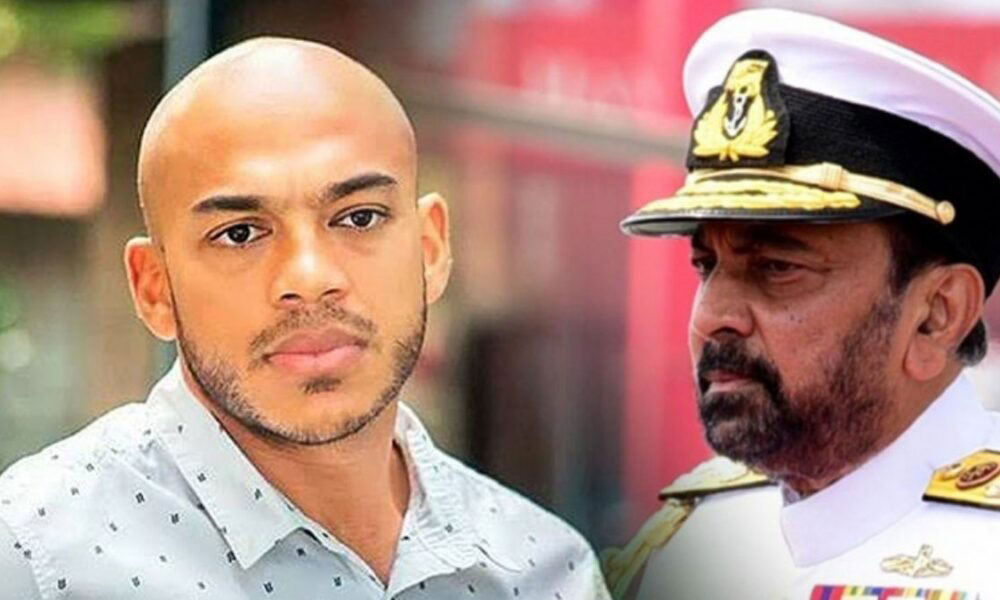
The corruption case filed by the Commission to Investigate Allegations of Bribery or Corruption (CIABOC) against former Navy Commander, Admiral of the Fleet Wasantha Karannagoda, and Yoshitha Rajapaksa was set for a pre-trial conference by the Colombo High Court.
The case was taken up before the Colombo High Court on Thursday (17), when the accused, who are currently out on bail, appeared before the court. After considering the submissions made, the court ordered that the case be called for a pre-trial conference.
The CIABOC had filed the case against the accused, alleging that a corruption offence was committed by sending Yoshitha Rajapaksa, son of former President Mahinda Rajapaksa, for training at the Royal Naval College in the United Kingdom despite him not having the required qualifications.

Advisory for strong winds and rough seas for Multi-day boats in the Bay of Bengal

Showers in the Western, Sabaragamuwa and North-western provinces and in Galle, Matara, Kandy and Nuwara-Eliya Districts

Some NPP manifesto promises may be difficult to fulfil – CIABOC DG

Yoshitha and ex-Navy chief Karannagoda’s case fixed for PTC

Court orders probe into Wimal’s rally speech

Court to rule on Dilith’s writ petition on September 30

‘Dates have the highest sugar content to fight Coronavirus’

Sunday Island 27 December – Headlines

#SundayIsland 17th December – Headlines

Sunday Island – 28th March

Sunday Island Headlines – 21 March

Sunday Island – 21st February – Headlines
-

 News7 days ago
Gnanasara Thero absconding after SC ruling
-

 Opinion6 days ago
From Galkissa (Mount Lavinia) to Tambuttegama
-

 Business7 days ago
HNB Finance strengthens Board with four independent directors
-

 News3 days ago
US embassy won’t comment on IGP’s probe into joint drug raid
-
 Sports7 days ago
Culture within cricket team worrying authorities
-

 Features6 days ago
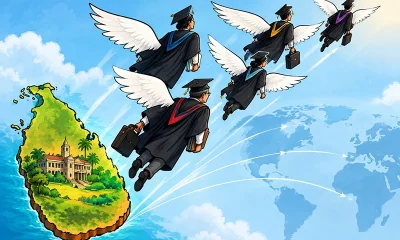
Sri Lanka’s university crisis: Brain drain and union action demand urgent reform
-
 Features5 days ago
The emptying university: why are academics leaving?
-

 News7 days ago
House to debate 22A, Judicature Bill next week