
Editorial
An elephantine shame


Saturday 8th July, 2023
Sri Lanka makes international headlines always for the wrong reasons, especially where its fauna and flora are concerned. A few weeks ago, it created a media frenzy by unveiling a plan to send its troublesome monkeys to China to prevent crop damage here. It has abandoned its monkey-export plan due to bad press and said it should not be asked to save cultivations from monkey invasions hereafter! In other words, shipping monkeys to China is the only solution it can think of.
Sri Lanka is in the news again internationally, having failed to look after a gift elephant, whose suffering has received global media attention. Muthu Raja, a Thai elephant, which was gifted to Sri Lanka, about two decades ago and taken back to Thailand recently for treatment for long-neglected health conditions, has become a social media sensation. Animal rights activists, the world over, have evinced a keen interest in its wellbeing.
Muthu Raja has become world-famous, but its predicament has tarnished Sri Lanka’s image irreparably. One can only hope that the much-publicised allegation that the poor jumbo suffered mistreatment at the hands of its custodians and handlers here will be investigated and legal action taken if it is found to be true.
A senior university don has said nobody ever requested the Faculty of Veterinary Science, University of Peradeniya, or any registered veterinarian, for that matter, to treat Muthu Raja. The chief incumbent of the temple where the ailing jumbo was kept should be made to explain his alleged failure to do so.
Animal rights groups in Thailand are reportedly mounting pressure on their government to ensure that all Thai elephants gifted to Sri Lanka are brought back home. Their demand has created quite a stir in this country though the Thai authorities have not responded to it. Whether one agrees with the Thai elephant lovers on this score or not, their concerns should be appreciated, given the plight of elephants here.
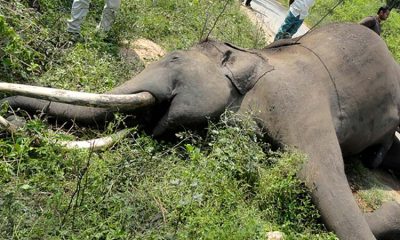
Nary a day passes in Sri Lanka without the tragic death of a wild elephant being reported, Nayanaka Ranwella, an environmentalist, has told the media. Mongabay, a non-profit conservation and environment science news platform, has reported, citing the Department of Wildlife Conservation, that 151 elephants died between 01 Jan. and 28 April 2023 in this country; of these, at least 67 deaths were due to human intervention, including shooting and electrocution. Besides, a large number of elephants die in collision with moving trains. Last year, about 433 elephants were killed, and the majority of those killings were due to the human-elephant conflict; about 147 human lives were lost in wild elephant attacks.
At this rate, Sri Lankan elephants might be extinct in a few decades. One need not be surprised if the Thai elephant lovers succeed in having their precious jumbos currently being kept here returned like Muthu Raja, and Sri Lanka comes under international pressure to send all its jumbos to other countries that can ensure their safety.










Monday 30th March, 2026
No sooner had Energy Minister Kumara Jayakody been indicted for corruption than he was released on bail last Friday. The Commission to Investigate Allegations of Bribery or Corruption (CIABOC), which filed charges against him, has alleged that in 2016, while serving as the Manager of the Procurement and Import Division of the Ceylon Fertiliser Company, he committed an act of corruption, causing a loss of Rs. 8,859,708 to the state; he influenced a procurement process related to the refurbishment of the company’s Hunupitiya warehouse to confer an undue benefit on a private contractor.
The JVP/NPP leaders have made a mockery of their much-touted commitment to good governance by shielding tainted ministers and officials. One can only hope that the government will not try to use Minister Jayakody’s indictment as a pretext to delay the parliamentary debate on the no-faith motion against him, scheduled for 10 April. It knows more than one way to shoe a horse, and has no sense of shame. It is in a dilemma over the no-faith motion against Jayakody. All MPs who defend him in Parliament will be lumped together with him. Having shielded him all along, they cannot now leave him to his fate.
In handling Minister Jayakody’s case, the CIABOC has acted faster than Iran’s hypersonic Fattah-2 missile, which travels at Mach 15. This is in sharp contrast to the manner in which it deals with Opposition politicians, their family members and cronies. They are arrested and made to languish in remand prison for months on end. The CIABOC continues to be an appendage of the government in power. The same is true of the police, who are also notorious for their partiality to the ruling party and selective efficiency. They have not arrested two ministers and a mayor involved in a forgery case. They swing into action and make arrests only when the suspects happen to be political rivals of the JVP-NPP government.
This is a country where even children are arrested and hauled up before court over minor offences. One may recall that three girls from a children’s home in Kalutara were arrested several weeks ago for breaking into a canteen and making off with some confectionery. A few years ago, a little girl was taken into custody for stealing a five-rupee coin, of all things, from a neighbour in Kalutara. The police recently arrested a person with four litres of petrol he had kept in a can for a weed-whacker to cut the grass in his garden ahead of a religious ceremony in memory of his parents. He was fined and jailed for 21 days. No such stringent action has been taken regarding the Opposition’s complaint that Minister Jayakody has caused staggering losses amounting to billions of rupees to the state through a corrupt coal procurement deal. It has been revealed that substandard coal imports have led to a huge drop in the coal-fired electricity generation at Norochcholai, and tens of thousands of litres of diesel have to be burnt daily to meet that power generation shortfall.
Legal and judicial processes have never been free from political interference in this country, and the current leaders who came to power, promising to depoliticise them are emulating previous regimes. Given this reality, one wonders whether the image of Justitia should be localised with a double-pocketed blouse over her Greco-Roman robe a la the two-pocket shirts of the ruling party leaders.
Most of those who voted for the JVP/NPP, helping bring about the 2024 regime change in the hope of creating a clean society based on equality and freedom must now be as disappointed and disillusioned as the animals that, inspired by the pigs, rebel and get rid of their owner in the Orwellian political fable, Animal Farm. Like the pigs, the incumbent rulers have made themselves ‘more equal than others’ while claiming to uphold the rule of law. They are testing the patience of the public. They are seen burning rubber in fuel-guzzling SUVs while urging the ordinary people to restrict travel and save energy.
The government is reportedly planning to launch a project to clean Beira Lake, which is stinking. A wag says it should do so expeditiously for the sake of its members rather than the public, for at this rate, their turn to swim in that polluted lake, as some SLPP politicians did in 2022, after being plunged there by angry mobs, may come sooner than expected. Politics is full of surprises.

Teachers’ trade unions are protesting against what they describe as a political witch-hunt against some of their members who did not attend a meeting chaired by Prime Minister and Minister of Education Dr. Harini Amarasuriya in Tangalle on Sunday, 15 March, 2026. Many seats in the Tangalle Municipal Council auditorium, where the meeting was held, were left empty by no-shows. The trade unions have taken exception to a letter sent by the Tangalle Zonal Education Office to the school principals in the area, asking them to explain why their staff members did not attend the aforesaid meeting. Their consternation is understandable. When the show cause letter, dated 24 March 2026, became public and got bad press, some trade unionists speculated that the government politicians might try to dissociate themselves from it. There is reason to believe that the letter at issue would not have been issued if the absence of teachers had not become a matter of concern to the government, and therefore it is unlikely that the Zonal Education Director who called for explanation from the school principals has done so unbeknownst to her superiors in the Education Ministry.
Teachers or other state workers should be free to decide whether to attend meetings, etc., held outside their regular working hours, especially during weekends, and they must not be penalised for skipping such events. In a way, the above-mentioned show cause letter can be considered a kind of comeuppance for the state-sector teachers who, together with their trade union leaders, went out of their way to bring the JVP/NPP to power. So did other state employees and their trade unions, as evident from the postal vote results in 2024. Now, it is mandatory for them to attend even unofficial meetings chaired by the ruling party politicians!
Why should government politicians travel all the way from Colombo to faraway places to chair meetings while the country is facing a crippling energy crisis, which has prompted the ruling party politicians to urge the public to reduce fuel consumption. Shouldn’t they practise what they preach?
VIP motorcades consist of dozens of vehicles, some which operate undercover, blending into traffic at present as the current leaders came to power, promising to disband VIP security divisions and do away with huge security contingents. Whenever they travel, one can see lead cars, pilot vehicles, decoy cars and many other vehicles carrying counter-assault teams. They ought to travel less and help save state funds and precious fuel these days. They must follow the energy-saving guidelines issued by the Commissioner General of Essential Services to the state sector. Almost all the meetings attended by the government leaders can be held online. State officials also have to travel long distances in official vehicles to attend the events ‘graced’ by politicians in power. Nothing usually comes of such meetings, which only help politicians wax eloquent and say very little in many words.
In Pakistan, fuel allocation for the state sector has been halved as an energy crisis management measure; 60% of the state-owned vehicles have been taken off the roads, and, most of all, fuel quotas for ministers have been abolished. Sri Lanka must adopt such austerity measures, and ensure that the politicians share in the hardships faced by the public. After all, the present-day leaders came to power, promising to use public transport. This is the best time for them to make good on their election promises, and travel with the ordinary people in crowded buses and trains. They claim to be very popular, and a research organisation would have the public believe that the approval rating of the incumbent government has increased to a whopping 65%. So, there is no reason why the ruling party politicians should hesitate to travel with hapless commuters.
About two months ago, President Anura Kumara Dissanayake went out for a constitutional with only a single security officer, in Jaffna, and the government released a video of his famous walk to gain political mileage. If the former war zone is safe for the Head of State and Commander-in-Chief to move about without heavy security, why can’t other government politicians travel in buses and trains or cycle to work? Above all, they insist in Parliament and elsewhere that the law-abiding citizens do not have to worry about frequent shooting incidents, which they describe as turf wars among drug dealers. They need not worry about their safety at all, for they say they have no underworld links. Shouldn’t they set an example to the public at least during the current fuel crisis by cancelling meetings and using public transport?

Saturday 28th March, 2026
US President Donald Trump has postponed his much-advertised plan to attack Iran’s national grid and critical energy infrastructure for 10 more days as part of his efforts to find an off-ramp with Tehran. He has asked Tehran to declare a ceasefire and come for talks on his own terms or face a series of attacks of unprecedented ferocity. One of his main conditions for negotiations has left the world puzzled; he wants Iran to abandon its nuclear programme, while insisting that he has obliterated Iran’s nuclear potential by destroying all its nuclear facilities and neutralising the threat of the nuclearisation of the Islamic state. If so, he has already achieved his goal, and there is absolutely no need for him to have negotiations with Iran on its nuclear programme, keep on pouring US taxpayers’ money into an endless war, deploy US ground troops to the region and, most of all, continue to cause more economic hardships to the rest of the world.
Trump is apparently without a specific goal or an exit strategy in the ongoing war. He is now trying to have the world believe that he has won the war, and is claiming that Tehran has allowed some oil tankers flying the Pakistan flag to sail through the Strait of Hormuz to appease him! Turning down Trump’s offer to talk, Iran has derisively said the US has been negotiating with itself. Tehran is leveraging everything possible to crank up economic pressure on the US and Israel. It has already made the world economy scream in a bid to turn international opinion against Washington and Tel Aviv. According to unverified reports, it has also threatened to go so far as to target the submarine internet cables in the Red Sea and disrupt global connectivity unless the US and Israel stop attacks. Iran has made no official statement about this issue, but it is capable of severing the undersea fibre-optic cables in case of other Gulf nations continuing to back the US in the ongoing conflict and/or its power and energy facilities coming under attack again. These undersea cables are used for global financial transactions worth trillions of dollars, international communication and data flows, cloud devices, etc., according to media reports. The White House must be under tremendous pressure from the US tech giants and other multinationals to ensure the safety of the submarine cables in the Red Sea.
Meanwhile, the latest developments on the Middle East front may have reminded Trump of former US President Dwight D. Eisenhower’s words of wisdom. An ex-Supreme Commander of the Allied Expeditionary Force in Europe during World War II, Eisenhower famously said, “Every war is going to astonish you in the way it occurred and in the way it is carried out.” While Trump is trying to have the Strait of Hormuz reopened for international navigation, the threat of another vital chokepoint in the Gulf region being closed has emerged.
The Houthis of Yemen have threatened to close the Bab el-Mandeb Strait, which connects the Red Sea to vital international shipping lanes. The geographical location of this chokepoint has made it vulnerable to Houthi attacks. The Houthis say they are ready to join the war any time. Trump and Netanyahu have already bitten off more they can chew in the Persian Gulf, and how they are going to face the emerging threat is anybody’s guess. The Houthis have a history of disrupting shipping routes.
Airstrikes alone will not help the US, Israel and its allies keep the Hormuz Strait and Bab el-Mandeb Strait open for international navigation. It will be a huge gamble for the US to send its warships and ground troops to gain control of them, for they will be within the Iranian and Houthi missile range.
There seems to be no end to threats and challenges the US and Israel are facing in their war on Iran, and they have plunged the entire world into chaos in the name of their leaders’ dreams. Unacceptable as what Iran is doing by way of retaliation may be, that is the way the cookie crumbles in military conflicts, especially in asymmetrical warfare. The US carried out atomic bomb attacks on Japan purportedly to end a war. Israel has already bombed Gaza back to the Stone Age, but continues to carry out airstrikes in that part of Palestine.
It is up to the US and Israel to make a serious effort to put the genie back into the bottle in the Persian Gulf. Other nations are suffering for no fault of theirs, and eminent economists fear that the world is heading for a global recession.

A QR code system to be introduced for agricultural lands and other sectors requiring fuel

Rickelton, Rohit, Shardul break Mumbai’s first-game jinx

Oil tops $116 a barrel as Iran accuses US of preparing invasion

Iranian attack damages Kuwait power and desalination plant, kills worker

Warm weather conditions prevailing over the island are expected to continue

Inquiry into female employee’s complaint: Retired HC Judge’s recommendations ignored

‘Dates have the highest sugar content to fight Coronavirus’

Sunday Island 27 December – Headlines

#SundayIsland 17th December – Headlines

Sunday Island – 28th March

Sunday Island Headlines – 21 March

Sunday Island – 21st February – Headlines
-

 News5 days ago
Senior citizens above 70 years to receive March allowances on Thursday (26)
-

 Features2 days ago
A World Order in Crisis: War, Power, and Resistance
-

 News3 days ago
Energy Minister indicted on corruption charges ahead of no-faith motion against him
-

 News4 days ago
US dodges question on AKD’s claim SL denied permission for military aircraft to land
-

 Business4 days ago
Dialog Unveils Dialog Play Mini with Netflix and Apple TV
-

 Sports3 days ago
SLC to hold EGM in April
-

 News5 days ago
CEB Engineers warn public to be prepared for power cuts after New Year
-

 Business6 days ago
Postponement of Sri Lanka Investment Forum 2026