
Features
Al Qaeda and ISIS will get buried if US and NATO stop invading other nations


By M M Zuhair
Former US President George Bush’s and then British Prime Minister Tony Blair’s post 9/11 ‘War on Terror’ cannot go on, without resuscitating the dying ISIS and Al-Qaida. It is these ‘terror outfits’ created and fostered primarily by the US, that give questionable legitimacy for the US, Britain and the NATO to invade and occupy third world countries.
A video clip in You-tube, Twitter and Facebook shows defeated 2008 US presidential candidate the late John McCain meeting with ISIS leader Abu Bakr Al Baghdadi in the US, in 2013, before Baghdadi launched his terror attacks in 2014. The video clip remains uncontradicted. US Senator Rand Paul had said the main aim of the terror organisation was toppling Syrian President Bashar Al Assad. In September 2014, General Thomas McInerney told Fox news that the US helped build ISIS. Al Baghdadi was reportedly with the US armed forces from 2016 to 2018 in a military base in Iraq. Until his death in 2019, Baghdadi continued to speak for the ISIS.
The role of the US in transforming Saudi engineer Osama bin Laden as the Goliath of Al Qaeda responsible for 9/11 is well known. The invasion of Afghanistan in 2001 was said to be to capture bin Laden claimed to be in hiding in Afghanistan. In 2011 the US inexplicably did not want to capture bin Laden in Pakistan and gather vital intelligence from the man whom the world was told was the supreme master mind of the terror outfit Al Qaeda. He was not captured but deliberately killed in Pakistan by US marines while the US President Obama and aides watched the execution of Osama from Washington via a special link. The US disinclination to gather intelligence of how bin Laden ran his destructive terror network and that, too, without using the internet or the mobile phone, gave the impression that this guy was bloated out of proportion by the US to justify foreign invasions. But then the war on Afghanistan continued, notwithstanding the elimination of bin Laden, for another 10 years with no convincing reason for continuing the war in Afghanistan!
The US defeat and exit from Afghanistan on August 15 must be critically watched in Sri Lanka from the perspective of the undaunted military might of the US-NATO combine seeking its next proxy war with China in our region, targeting South Asia. We need to watch which country in South Asia might get selected by the empire for the proxy war with China. However, what are some misguided long lost politicians and certain spokesmen for the Western arms industry as well as a few genuinely misguided persons, talking about? They talk of the Afghan Talibans spreading their terrorist tentacles in our neighbourhood! If that is true such attempts must not only be condemned but also be effectively prevented. But we need to remember that the Talibans have enough extremely serious economic woes, arising from 43 years of wars, to be sorted out in Afghanistan. They have damning security and economic issues that will likely cripple the country. The Taliban have no time for adventures outside their country! Indeed, there is no proof of any such Taliban or Afghan activity outside of Afghanistan, except links with Pakistan and peace talks in Qatar!
On the contrary, those spreading news of the Taliban militants becoming a threat to other countries in the region are preposterously preparing the ground, perhaps unwittingly, for legitimising the US-NATO military adventure in our region. They may be sowing the seeds, inspired by arms manufacturers! The time has come for Sri Lankans to know briefly at least, some aspects of what really happened in Afghanistan during the 20 year US rule and what would be the plight of people in our region, when and not ‘if’ the US-NATO go ahead with war mongering in our region.
The US and NATO countries designated the Taliban as ‘terrorists’. By what standard of definition do a people who resist foreign invaders become terrorists? Of course, the Taliban set up a ruthless machinery to meet the external challenge. They won over the Soviets in 1989 and the multinational Western forces by August 2021. They won, not because they were terrorists but because they had no choice but to defend their land from the enemy and, more importantly their way of life. Of course, some may not agree with the life style of the Veddas, the Red Indians, the aborigines or the Taliban! But this does not mean we support the Taliban. If we put ourselves into a possible parallel situation of the US armed forces entering Sri Lanka forcibly, as they did in Iraq and many other countries, every Sri Lankan, excluding fifth columnists, will fight the American forces to their last drop of blood. Because we fight invaders with our hands, knives, swords, axes, bows and arrows, petrol bombs and AK 47s, do we become terrorists?
Western journalists today are virtually at war to frighten the world that ‘Taliban terrorists’ together with ISIS remnants are the greatest threats to peace in the rest of Asia! They will tell peace loving Asians that those who fought the multiple foreign armed forces who came to Kabul for the laudable purpose of educating and employing Afghan women were all barbaric terrorists! They will not say, that the Talibans, successors of the Mujahideens whom the West glorified as freedom fighters were also by the same yard stick freedom fighters!
They will not tell the world that if the US, the UK and NATO stopped the unceasing wars on other countries, the ISIS and the Al-Qaida, virtually dead, could now be buried! How could they? They can leave the Afghans and the girls to the wolves as they themselves have portrayed, but will never ever abandon their own powerful merchants of war, who alone won the Afghan war, with their factories working two shifts for the past 20 years!
It was only the other day that Pope Francis, in his most welcome Easter message of 3rd April 2021 slammed these powers for spending on military adventures at a time of grave pandemic! Unfortunately, the US military –industrial complex will not listen to the Vatican. The unfortunate weakening of the faith amongst the flock has regrettably emboldened the arms industry to forget accountability and beat the war drums across the world, except North America and Europe! They put back the clock to destructive levels in every country they marched in, at least by three decades.
We need to know, for our own sake, what happened to our neighbour-Afghanistan.
Let us get to a briefing of the US governance of the Afghans from Americans themselves! International media coverage of the fall of Afghanistan, demonstrates unequivocally the struggle of Western journalists and op-ed columnists to veil the world of the ‘failed’ imperial invasions by continuously focusing on the ‘future plight of the Afghan women and girls’ whom these powers abandoned on the dangerous street overnight!
Fortunately, not all Western journalists are cribbing for their copper. Some amongst them have exposed the lies and deception perpetrated by these powers on Afghanistan, who made the Taliban what they are today. Let us hear at least one of them.
James Bovard is the author of several books, regular contributor to USA Today, New York Times, Wall Street Journal and Washington Post. He quotes George Bush from his State of the Union address made on 29th January 2002, which Bovard said frightened Americans with a bogus nuclear threat: “Our discoveries in Afghanistan confirmed our worst fears… We have found diagrams of American nuclear power plants and public water facilities in caves used by Al Qaeda-George Bush! Bovard says senior CIA and FBI officials followed up with ‘background’ briefings for the media. But this wanton lie got soon exposed! Two years later, Bush administration officials admitted that the President’s statement was completely false and that no nuclear power plant diagrams had been discovered in Afghanistan. Bovard quoted Nuclear Regulatory Commissioner Edward McGaffigan’s evidence on this falsehood at closed hearings on Capital Hill.
Bovard says that Bush’s lies on a nuclear threat from Afghanistan paved the way to his far more destructive lies regarding Iraqi chemical and biological weapons in his 2003 State of the Union address. What about Tony Blair’s canard that Saddam Hussain could strike Britain in 45 minutes. These war criminals are still at large because of the staff level complicity of the United Nations with the US and Britain. That is another subject.
Bush, in his 2002 State of the Union address evangelised his Afghan war as the greatest triumph for “women’s liberation” in modern times. Bush boasted “The mothers and daughters of Afghanistan were captives in their own homes…Today women are free” But a New York Times columnist Nicholas Kristof who visited Afghanistan, two years later, in 2004 reported that “many Afghan women are still captives in their homes… The rise of banditry and rape has had a particularly devastating effect on women. Because the roads are not safe even in daylight, girls do not dare to go to schools or their mothers to health centres”. That was under US-NATO rule in Afghanistan.
According to Bovard, “Since the start of Bush’s invasion of Afghanistan, the US military has poured money into Afghan government operations guilty of BACHA BAZI–turning young boys into sex slaves. The Pentagon ignored the abuse until a 2015 New York Times expose of American soldiers who were punished for protecting atrocities against young boys”. A 2017 Pentagon Inspector General report revealed that some US troops were “told that nothing could be done about child sexual abuse because of Afghanistan’s status as a sovereign nation (sic), that it was not a priority for the command, or that it was best to ignore the situation and to let the local police handle it.”
“Even more damning, the US military and CIA brazenly tortured Afghans, atrocities that President Bush perpetually denied even though it was reported as early as December 2002. In 2004, the Los Angeles Times reported allegations that Afghan soldiers detained by the US government had suffered “repeated beatings, immersion in cold water, electric shocks, being hung upside down and toenails being torn off.”
The result: resistance to foreign atrocities and scandalous sexual abuse grew from strength to strength!
They know only too well that Al Qaeda and ISIS can be buried if the US and NATO stop invading other countries. But the arms factories and the wars which provide fabulous enrichment to the already rich and employment to nearly a million soldiers at the likely cost of their lives will never be ended!

Reminiscences:
I was appointed Managing Director of the Ceylon Petroleum Corporation (CPC) and Chairman of the Trincomalee Petroleum Terminals Ltd (TPTL – Indian Oil Company/ Petroleum Corporation of Sri Lanka joint venture), in February 2023, by President Ranil Wickremesinghe. I served as TPTL Chairman voluntarily. TPTL controls the world-renowned oil tank farm in Trincomalee, abandoned after World War II. Several programmes were launched to repair tanks and buildings there. I enjoyed travelling to Trincomalee, staying at Navy House and monitoring the progress of the projects. Trincomalee is a beautiful place where I spent most of my time during my naval career.
My main task as MD, CPC, was to ensure an uninterrupted supply of petroleum products to the public.
With the great initiative of the then CPC Chairman, young and energetic Uvis Mohammed, and equally capable CPC staff, we were able to do our job diligently, and all problems related to petroleum products were overcome. My team and I were able to ensure that enough stocks were always available for any contingency.
The CPC made huge profits when we imported crude oil and processed it at our only refinery in Sapugaskanda, which could produce more than 50,000 barrels of refined fuel in one stream working day! (One barrel is equal to 210 litres). This huge facility encompassing about 65 acres has more than 1,200 employees and 65 storage tanks.
A huge loss the CPC was incurring due to wrong calculation of “out turn loss” when importing crude oil by ships and pumping it through Single Point Mooring Buoy (SPMB) at sea and transferring it through underwater fuel transfer lines to service tanks was detected and corrected immediately. That helped increase the CPC’s profits.
By August 2023, the CPC made a net profit of 74,000 million rupees (74 billion rupees)! The President was happy, the government was happy, the CPC Management was happy and the hard-working CPC staff were happy. I became a Managing Director of a very happy and successful State-Owned Enterprise (SOE). That was my first experience in working outside military/Foreign service.
I will be failing in my duty if I do not mention Sagala Rathnayake, then Chief of Staff to the President, for recommending me for the post of MD, CPC.
The only grievance they had was that we were not able to pay their 2023 Sinhala/Tamil New Year bonus due to a government circular. After working at CPC for six months and steering it out of trouble, I was ready to move out of CPC.
I was offered a new job as the Sri Lanka High Commissioner to Pakistan. I was delighted and my wife and son were happy. Our association with Pakistan, especially with the Pakistan Military, is very long. My son started schooling in Karachi in 1995, when I was doing the Naval War Course there. My wife Yamuna has many good friends in Pakistan. I am the first Military officer to graduate from the Karachi University in 1996 (BSc Honours in War Studies) and have a long association with the Pakistan Navy and their Special Forces. I was awarded the Nishan-e-Imtiaz (Military) medal—the highest National award by the Pakistan Presidentm in 2019m when I was Chief of Defence Staff. I am the only Sri Lankan to have been awarded this prestigious medal so far. I knew my son and myself would be able to play a quiet game of golf every morning at the picturesque Margalla Golf Club, owned by the Pakistan Navy, at the foot of Margalla hills, at Islamabad. The golf club is just a walking distance from the High Commissioner’s residence.
When I took over as Sri Lanka High Commissioner at Islamabad on 06 December 2023, I realised that a number of former Service Commanders had held that position earlier. The first Ceylonese High Commissioner to Pakistan, with a military background, was the first Army Commander General Anton Muthukumaru. He was concurrently Ambassador to Iran. Then distinguished Service Commanders, like General H W G Wijayakoon, General Gerry Silva, General Srilal Weerasooriya, Air Chief Marshal Jayalath Weerakkody, served as High Commissioners to Islamabad. I took over from Vice Admiral Mohan Wijewickrama (former Chief of Staff of Navy and Governor Eastern Province).
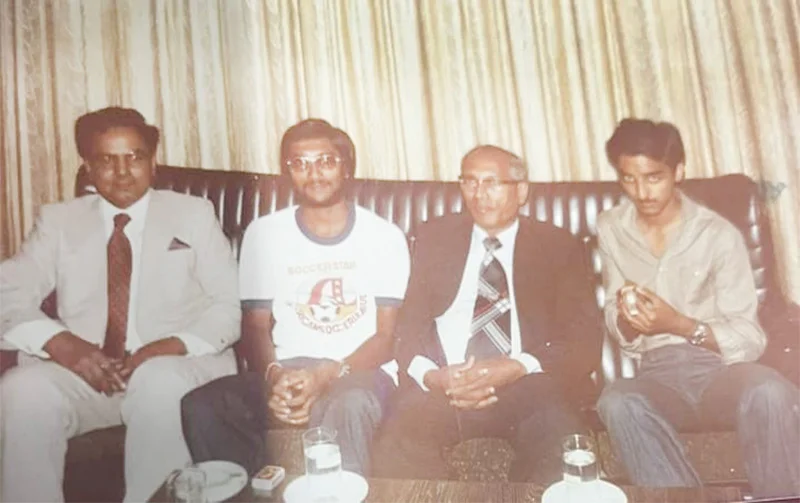
A photograph of Dr. Silva (second from right) in Brigadier
(Dr) Waquar Muzaffar’s album
One of the first visitors I received was Kawaja Hamza, a prominent Defence Correspondent in Islamabad. His request had nothing to do with Defence matters. He wanted to bring his 84-year-old father to see me; his father had his eyesight restored with corneas donated by a Sri Lankan in 1972! His eyesight is still good, but he did not know the Sri Lankan donor who gave him this most precious gift. He wanted to pay gratitude to the new Sri Lankan High Commissioner and to tell him that as a devoted Muslim, he prayed for the unknown donor every day! That reminded me of what my guru in Foreign Service, the late Foreign Minister Lakshman Kadirgamar told me when I was First Secretary/ Defence Advisor, Sri Lanka High Commission in New Delhi. That is “best diplomacy is people-to-people contacts.” This incident prompted me to research more into “Pakistan-Sri Lanka Eye Diplomacy” and what I learnt was fascinating!
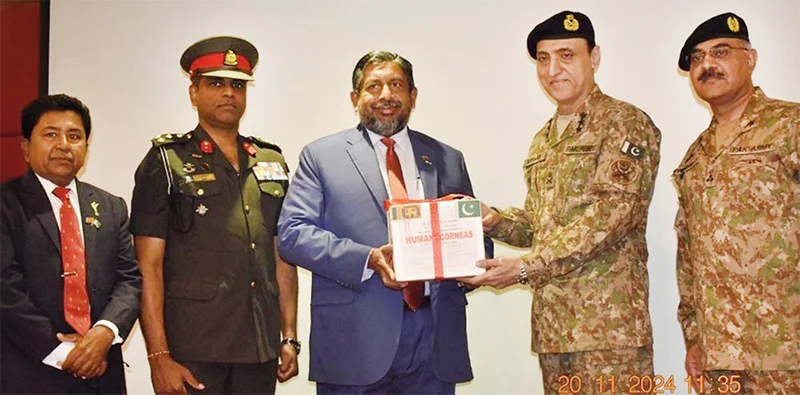
Do you know the Sri Lanka Eye Donation Society has donated more than 26,000 corneas to Pakistan, since 1964 to date! That means more than 26,000 Pakistani people see the world with SRI LANKAN EYES! The Sri Lankan Eye Donation Society has provided 100,000 eye corneas to foreign countries FREE! To be exact 101,483 eye corneas during the last 65 years! More than one fourth of these donations was to one single country- Pakistan. Recent donations (in November 2024) were made to the Pakistan Military at Armed Forces Institute of Ophthalmology (AFIO), Rawalpindi, to restore the sight of Pakistan Army personnel who suffered eye injuries due to Improvised Explosive Devices (IED) blasts. This donation was done on the 75th Anniversary of the Sri Lanka Army.
Deshabandu Dr. F. G. Hudson Silva, a distinguished old boy of Nalanda College, Colombo, started collecting eye corneas as a medical student in 1958. His first set of corneas were collected from a deceased person and were stored at his home refrigerator at Wijerama Mawatha, Colombo 7. With his wife Iranganie De Silva (nee Kularatne), he started the Sri Lanka Eye Donation Society in 1961. They persuaded Buddhists to donate their eyes upon death. This drive was hugely successful.
Their son (now in the US) was a contemporary of mine at Royal College. I pledged to donate (of course with my parents’ permission) my eyes upon my death when I was a student at Royal college in 1972 on a Poson Full Moon Poya Day. Thousands have done so.
On Vesak Full Moon Poya Day in 1964, the first eye corneas were carried in a thermos flask filled with Ice, to Singapore, by Dr Hudson Silva and his wife and a successful eye transplant surgery was performed. From that day, our eye corneas were sent to 62 different countries.
Pakistan Lions Clubs, which supported this noble gesture, built a beautiful Eye Hospital for humble people at Gulberg, Lahore, where eye surgeries are performed, and named it Dr Hudson Silva Lions Eye Hospital.
The good work has continued even after the demise of Dr Hudson Silva in 1999.
So many people have donated their eyes upon their death, including President J. R. Jayewardene, whose eye corneas were used to restore the eyesight of one Japanese and one Sri Lankan. Dr Hudson Silva became a great hero in Pakistan and he was treated with dignity and respect whenever he visited Pakistan. My friend, Brigadier (Dr) Waquar Muzaffar, the Commandant of AFIO, was able to dig into his old photographs and send me a precious photo taken in 1980, 46 years ago (when he was a medical student), with Dr Hudson Silva.
We will remember Dr and Mrs Hudson Silva with gratitude.
Bravo Zulu to Sri Lanka Eye Donation Society!
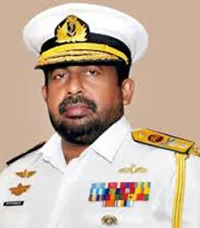 by Admiral Ravindra C Wijegunaratne
WV, RWP and Bar, RSP, VSV, USP, NI (M) (Pakistan), ndc, psn, Bsc
(Hons) (War Studies) (Karachi) MPhil (Madras)
Former Navy Commander and Former Chief of Defense Staff
Former Chairman, Trincomalee Petroleum Terminals Ltd
Former Managing Director Ceylon Petroleum Corporation
Former High Commissioner to Pakistan
Problems and solutions in plural societies like Sri Lanka’s which have deep rooted ethnic, religious and linguistic cleavages require a consciously inclusive approach. A major challenge for any government in Sri Lanka is to correctly identify the problems faced by different groups with strong identities and find solutions to them. The durability of democratic systems in divided societies depends less on electoral victories than on institutionalised inclusion, consultation, and negotiated compromise. When problems are defined only through the lens of a single political formation, even one that enjoys a large electoral mandate, such as obtained by the NPP government, the policy prescriptions derived from that diagnosis will likely overlook the experiences of communities that may remain outside the ruling party. The result could end up being resistance to those policies, uneven implementation and eventual political backlash.
A recent survey done by the National Peace Council (NPC), in Jaffna, in the North, at a focus group discussion for young people on citizen perception in the electoral process, revealed interesting developments. The results of the NPC micro survey support the findings of the national survey by Verite Research that found that government approval rating stood at 65 percent in early February 2026. A majority of the respondents in Jaffna affirm that they feel safer and more fairly treated than in the past. There is a clear improving trend to be seen in some areas, but not in all. This survey of predominantly young and educated respondents shows 78 percent saying livelihood has improved and an equal percentage feeling safe in daily life. 75 percent express satisfaction with the new government and 64 percent believe the state treats their language and culture fairly. These are not insignificant gains in a region that bore the brunt of three decades of war.
Yet the same survey reveals deep reservations that temper this optimism. Only 25 percent are satisfied with the handling of past issues. An equal percentage see no change in land and military related concerns. Most strikingly, almost 90 percent are worried about land being taken without consent for religious purposes. A significant number are uncertain whether the future will be better. These negative sentiments cannot be brushed aside as marginal. They point to unresolved structural questions relating to land rights, demilitarisation, accountability and the locus of political power. If these issues are not addressed sooner rather than later, the current stability may prove fragile. This suggests the need to build consensus with other parties to ensure long-term stability and legitimacy, and the need for partnership to address national issues.
NPP Absence
National or local level problems solving is unlikely to be successful in the longer term if it only proceeds from the thinking of one group of people even if they are the most enlightened. Problem solving requires the engagement of those from different ethno-religious, caste and political backgrounds to get a diversity of ideas and possible solutions. It does not mean getting corrupted or having to give up the good for the worse. It means testing ideas in the public sphere. Legitimacy flows not merely from winning elections but from the quality of public reasoning that precedes decision-making. The experience of successful post-conflict societies shows that long term peace and development are built through dialogue platforms where civil society organisations, political actors, business communities, and local representatives jointly define problems before negotiating policy responses.
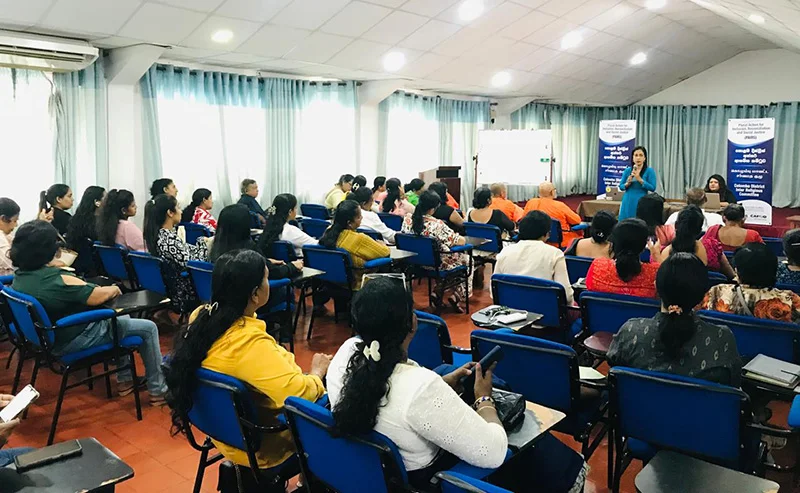
As a civil society organisation, the National Peace Council engages in a variety of public activities that focus on awareness and relationship building across communities. Participants in those activities include community leaders, religious clergy, local level government officials and grassroots political party representatives. However, along with other civil society organisations, NPC has been finding it difficult to get the participation of members of the NPP at those events. The excuse given for the absence of ruling party members is that they are too busy as they are involved in a plenitude of activities. The question is whether the ruling party members have too much on their plate or whether it is due to a reluctance to work with others.
The general belief is that those from the ruling party need to get special permission from the party hierarchy for activities organised by groups not under their control. The reluctance of the ruling party to permit its members to join the activities of other organisations may be the concern that they will get ideas that are different from those held by the party leadership. The concern may be that these different ideas will either corrupt the ruling party members or cause dissent within the ranks of the ruling party. But lasting reform in a plural society requires precisely this exposure. If 90 percent of surveyed youth in Jaffna are worried about land issues, then engaging them, rather than shielding party representatives from uncomfortable conversations, is essential for accurate problem identification.
North Star
The Leader of the Lanka Sama Samaja Party (LSSP), Prof Tissa Vitarana, who passed away last week, gave the example for national level problem solving. As a government minister he took on the challenge the protracted ethnic conflict that led to three decades of war. He set his mind on the solution and engaged with all but never veered from his conviction about what the solution would be. This was the North Star to him, said his son to me at his funeral, the direction to which the Compass (Malimawa) pointed at all times. Prof Vitarana held the view that in a diverse and plural society there was a need to devolve power and share power in a structured way between the majority community and minority communities. His example illustrates that engagement does not require ideological capitulation. It requires clarity of purpose combined with openness to dialogue.
The ethnic and religious peace that prevails today owes much to the efforts of people like Prof Vitarana and other like-minded persons and groups which, for many years, engaged as underdogs with those who were more powerful. The commitment to equality of citizenship, non-racism, non-extremism and non-discrimination, upheld by the present government, comes from this foundation. But the NPC survey suggests that symbolic recognition and improved daily safety are not enough. Respondents prioritise personal safety, truth regarding missing persons, return of land, language use and reduction of military involvement. They are also asking for jobs after graduation, local economic opportunity, protection of property rights, and tangible improvements that allow them to remain in Jaffna rather than migrate.
If solutions are to be lasting they cannot be unilaterally imposed by one party on the others. Lasting solutions cannot be unilateral solutions. They must emerge from a shared diagnosis of the country’s deepest problems and from a willingness to address the negative sentiments that persist beneath the surface of cautious optimism. Only then can progress be secured against reversal and anchored in the consent of the wider polity. Engaging with the opposition can help mitigate the hyper-confrontational and divisive political culture of the past. This means that the ruling party needs to consider not only how to protect its existing members by cloistering them from those who think differently but also expand its vision and membership by convincing others to join them in problem solving at multiple levels. This requires engagement and not avoidance or withdrawal.
by Jehan Perera
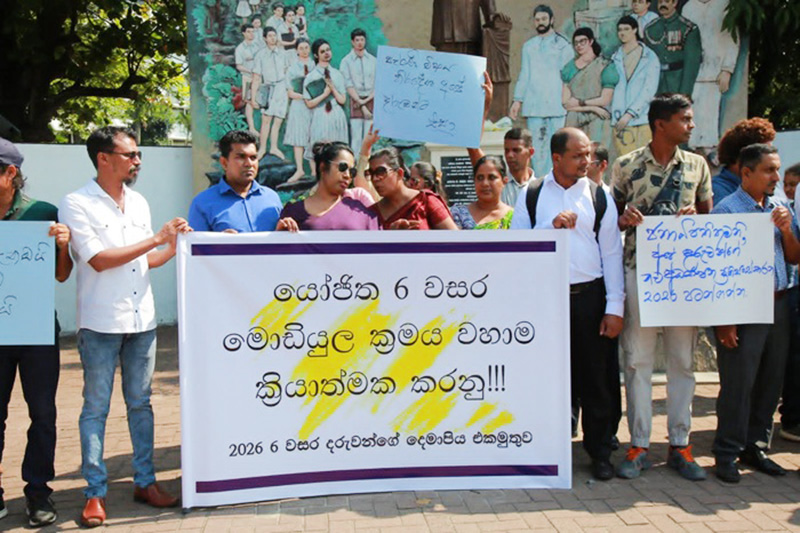
 As the debate on educational reforms rages, I find it useful to pay as much attention to the reactions they have excited as we do to the content of the reforms. Such reactions are a reflection of how education is understood in our society, and this understanding – along with the priorities it gives rise to – must necessarily be taken into account in education policy, including and especially reform. My aim in this piece, however, is to couple this public engagement with critical reflection on the historical-structural realities that structure our possibilities in the global market, and briefly discuss the role of academics in this endeavour.
Two broad reactions
The reactions to the proposed reforms can be broadly categorised into ‘pro’ and ‘anti’. I will discuss the latter first. Most of the backlash against the reforms seems to be directed at the issue of a gay dating site, accidentally being linked to the Grade 6 English module. While the importance of rigour cannot be overstated in such a process, the sheer volume of the energies concentrated on this is also indicative of how hopelessly homophobic our society is, especially its educators, including those in trade unions. These dispositions are a crucial part of the reason why educational reforms are needed in the first place. If only there was a fraction of the interest in ‘keeping up with the rest of the world’ in terms of IT, skills, and so on, in this area as well!
Then there is the opposition mounted by teachers’ trade unions and others about the process of the reforms not being very democratic, which I (and many others in higher education, as evidenced by a recent statement, available at https://island.lk/general-educational-reforms-to-what-purpose-a-statement-by-state-university-teachers/ ) fully agree with. But I earnestly hope the conversation is not usurped by those wanting to promote heteronormativity, further entrenching bigotry only education itself can save us from. With this important qualification, I, too, believe the government should open up the reform process to the public, rather than just ‘informing’ them of it.
It is unclear both as to why the process had to be behind closed doors, as well as why the government seems to be in a hurry to push the reforms through. Considering other recent developments, like the continued extension of emergency rule, tabling of the Protection of the State from Terrorism Act (PSTA), and proposing a new Authority for the protection of the Central Highlands (as is famously known, Authorities directly come under the Executive, and, therefore, further strengthen the Presidency; a reasonable question would be as to why the existing apparatus cannot be strengthened for this purpose), this appears especially suspect.
Further, according to the Secretary to the MOE Nalaka Kaluwewa: “The full framework for the [education] reforms was already in place [when the Dissanayake government took office]” (https://www.wsws.org/en/articles/2025/08/12/wxua-a12.html, citing The Morning, July 29). Given the ideological inclinations of the former Wickremesinghe government and the IMF negotiations taking place at the time, the continuation of education reforms, initiated in such a context with very little modification, leaves little doubt as to their intent: to facilitate the churning out of cheap labour for the global market (with very little cushioning from external shocks and reproducing global inequalities), while raising enough revenue in the process to service debt.
This process privileges STEM subjects, which are “considered to contribute to higher levels of ‘employability’ among their graduates … With their emphasis on transferable skills and demonstrable competency levels, STEM subjects provide tools that are well suited for the abstraction of labour required by capitalism, particularly at the global level where comparability across a wide array of labour markets matters more than ever before” (my own previous piece in this column on 29 October 2024). Humanities and Social Sciences (HSS) subjects are deprioritised as a result. However, the wisdom of an education policy that is solely focused on responding to the global market has been questioned in this column and elsewhere, both because the global market has no reason to prioritise our needs as well as because such an orientation comes at the cost of a strategy for improving the conditions within Sri Lanka, in all sectors. This is why we need a more emancipatory vision for education geared towards building a fairer society domestically where the fruits of prosperity are enjoyed by all.
The second broad reaction to the reforms is to earnestly embrace them. The reasons behind this need to be taken seriously, although it echoes the mantra of the global market. According to one parent participating in a protest against the halting of the reform process: “The world is moving forward with new inventions and technology, but here in Sri Lanka, our children are still burdened with outdated methods. Opposition politicians send their children to international schools or abroad, while ours depend on free education. Stopping these reforms is the lowest act I’ve seen as a mother” (https://www.newsfirst.lk/2026/01/17/pro-educational-reforms-protests-spread-across-sri-lanka). While it is worth mentioning that it is not only the opposition, nor in fact only politicians, who send their children to international schools and abroad, the point holds. Updating the curriculum to reflect the changing needs of a society will invariably strengthen the case for free education. However, as mentioned before, if not combined with a vision for harnessing education’s emancipatory potential for the country, such a move would simply translate into one of integrating Sri Lanka to the world market to produce cheap labour for the colonial and neocolonial masters.
According to another parent in a similar protest: “Our children were excited about lighter schoolbags and a better future. Now they are left in despair” (https://www.newsfirst.lk/2026/01/17/pro-educational-reforms-protests-spread-across-sri-lanka). Again, a valid concern, but one that seems to be completely buying into the rhetoric of the government. As many pieces in this column have already shown, even though the structure of assessments will shift from exam-heavy to more interim forms of assessment (which is very welcome), the number of modules/subjects will actually increase, pushing a greater, not lesser, workload on students.
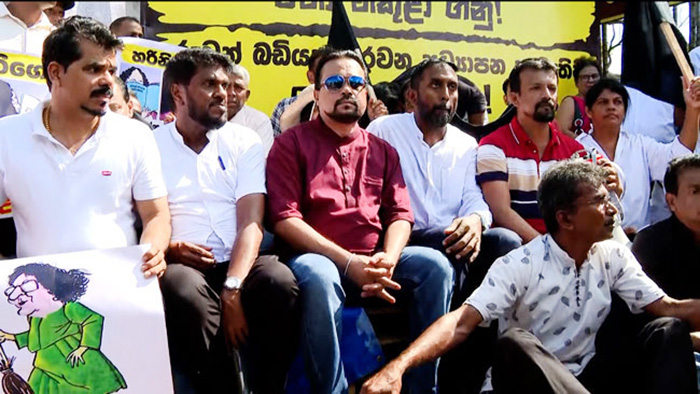
A file photo of a satyagraha against education reforms
What kind of education?
The ‘pro’ reactions outlined above stem from valid concerns, and, therefore, need to be taken seriously. Relatedly, we have to keep in mind that opening the process up to public engagement will not necessarily result in some of the outcomes, those particularly in the HSS academic community, would like to see, such as increasing the HSS component in the syllabus, changing weightages assigned to such subjects, reintroducing them to the basket of mandatory subjects, etc., because of the increasing traction of STEM subjects as a surer way to lock in a good future income.
Academics do have a role to play here, though: 1) actively engage with various groups of people to understand their rationales behind supporting or opposing the reforms; 2) reflect on how such preferences are constituted, and what they in turn contribute towards constituting (including the global and local patterns of accumulation and structures of oppression they perpetuate); 3) bring these reflections back into further conversations, enabling a mutually conditioning exchange; 4) collectively work out a plan for reforming education based on the above, preferably in an arrangement that directly informs policy. A reform process informed by such a dialectical exchange, and a system of education based on the results of these reflections, will have greater substantive value while also responding to the changing times.
Two important prerequisites for this kind of endeavour to succeed are that first, academics participate, irrespective of whether they publicly endorsed this government or not, and second, that the government responds with humility and accountability, without denial and shifting the blame on to individuals. While we cannot help the second, we can start with the first.
Conclusion
For a government that came into power riding the wave of ‘system change’, it is perhaps more important than for any other government that these reforms are done for the right reasons, not to mention following the right methods (of consultation and deliberation). For instance, developing soft skills or incorporating vocational education to the curriculum could be done either in a way that reproduces Sri Lanka’s marginality in the global economic order (which is ‘system preservation’), or lays the groundwork to develop a workforce first and foremost for the country, limited as this approach may be. An inextricable concern is what is denoted by ‘the country’ here: a few affluent groups, a majority ethno-religious category, or everyone living here? How we define ‘the country’ will centrally influence how education policy (among others) will be formulated, just as much as the quality of education influences how we – students, teachers, parents, policymakers, bureaucrats, ‘experts’ – think about such categories. That is precisely why more thought should go to education policymaking than perhaps any other sector.
(Hasini Lecamwasam is attached to the Department of Political Science, University of Peradeniya).
Kuppi is a politics and pedagogy happening on the margins of the lecture hall that parodies, subverts, and simultaneously reaffirms social hierarchies.
Sri Lanka, Zimbabwe seek momentum sustenance ahead of stiffer challenges

West Indies aim to keep up rhythm as Italy look to end on a high

Pakistan into Super Eight after Farhan ton sinks Namibia

Muscular South Africa stroll into Super Eight with all-win record

Pakistan bat first, drop Shaheen Afridi in must-win encounter against Namibia

New Bangladesh sports minister wants to fast track cases against Shakib and Mortaza

‘Dates have the highest sugar content to fight Coronavirus’

Sunday Island 27 December – Headlines

#SundayIsland 17th December – Headlines

Sunday Island – 28th March

Sunday Island Headlines – 21 March

Sunday Island – 21st February – Headlines
-
 Life style4 days ago
Marriot new GM Suranga
-

 Business3 days ago
Ministry of Brands to launch Sri Lanka’s first off-price retail destination
-
 Features4 days ago
Monks’ march, in America and Sri Lanka
-
 Opinion7 days ago
Will computers ever be intelligent?
-
 Features4 days ago
The Rise of Takaichi
-
 Features4 days ago
Wetlands of Sri Lanka:
-
 News4 days ago
Thailand to recruit 10,000 Lankans under new labour pact
-
 News4 days ago
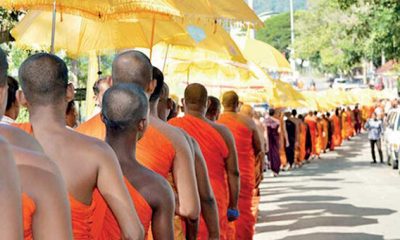
Massive Sangha confab to address alleged injustices against monks