
Latest News
AI-generated Iran war videos surge as creators use new tech to cash in


An unprecedented wave of AI-generated misinformation about the US-Israel war with Iran is being monetized by online creators with growing access to generative AI technology, experts have told BBC Verify.
Our analysis has found numerous examples of AI-generated videos and fabricated satellite imagery being used to make false and misleading claims about the conflict which have collectively amassed hundreds of millions of views online.
“The scale is truly alarming and this war has made it impossible to ignore now,” says Timothy Graham, a digital media expert at the Queensland University of Technology.
“What used to require professional video production can now be done in minutes with AI tools. The barrier to creating convincing synthetic conflict footage has essentially collapsed,” he says.
The US and Israel began launching strikes on Iran on 28 February. In response, Iran has launched drone and missile attacks on Israel, as well as multiple Gulf nations and US military assets in the region.
Many have turned to social media to search for and share the latest information and to help make sense of a fast-moving week of conflict.
The platform X announced this week it will temporarily suspend creators from its monetization programme if they post AI-generated videos of armed conflict without a label.
The scheme rewards eligible users whose posts create large numbers of views, likes, shares and comments with payments from the platform.
“It’s a notable signal that they’ve noticed that this is a big problem,” says Mahsa Alimardani, a researcher specialising in Iran at the Oxford Internet Institute.
We asked TikTok and Meta, the company of Facebook and Instagram, if they intend to take similar action, but they did not respond to our requests for comment.
A typical example of an AI-generated video that BBC Verify has tracked appears to show missiles striking the city of Tel Aviv in Israel as the sound of explosions rings out in the background.

This video has been featured in more than 300 posts which have then been shared tens of thousands of times across social media platforms.
Some X users turned to the platform’s AI chatbot Grok to confirm the video’s veracity. But in many cases seen by BBC Verify, Grok wrongly insisted that the AI-generated video was real.
Another fake video, viewed tens of millions of times, claims to show Dubai’s Burj Khalifa skyscraper in flames, while a crowd of people seem to be running towards the building.
This AI-generated footage spread widely online at a time of considerable concern from residents and tourists about the drone and missile strikes on the city.
“Fake videos like these have a detrimental impact on people’s trust in the verified information they see online and make it much harder to document real evidence,” says Alimardani.

A new feature of this conflict analysed by BBC Verify is the emergence of AI-generated satellite imagery.
We verified multiple real videos showing Iranian drone and missile strikes on the US Navy’s Fifth Fleet headquarters in Bahrain on the first day of the conflict.
A fabricated photo, shared on X by the state-linked newspaper The Tehran Times, began to spread the following day and claimed to show extensive damage to the base.
The fake appears to be based on real satellite imagery of a US naval base in Bahrain taken in February 2025, which is publicly available online.
According to Google’s SynthID watermark detector, the fake image was generated or edited with a Google AI tool.
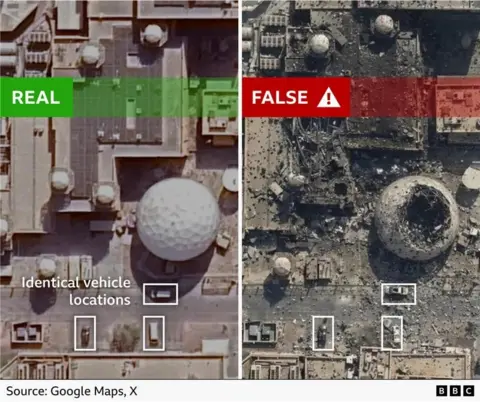
Three vehicles parked outside are also in the exact same spot in both the genuine satellite imagery and the AI picture – despite the photos allegedly having been taken a year apart.
Google’s AI tools, including its video generator Veo, are on the growing list of popular AI platforms, like OpenAI’s Sora model, Chinese AI app Seedance, and Grok which is built into X.
“The number of different tools that are now available to create a wide range of highly realistic AI manipulations is unprecedented,” says Henry Ajder, a generative AI expert.
“We have never seen these tools so available, so easy and so cheap to use,” he says.
This has led to a surge of AI-generated content online “because the pipeline onto social media can now be almost fully automated,” says Victoire Rio, executive director of the technology policy non-profit What To Fix.

X’s head of product said on Tuesday that “99%” of the accounts spreading AI-generated videos like these were trying to “game monetization” by posting content that will generate large amounts of engagement in return for payment through the app’s Creator Revenue Sharing programme.
The platform does not publish how many accounts are part of the programme, or how much money they can make.
But Graham estimates that X could pay about “eight to 12 dollars per million verified user impressions”.
“Creators have to hit five million organic impressions in three months, plus hold an X premium subscription, to be eligible,” he added.
“Once you’re in, viral AI-generated content is basically a money printer,” he says. “They’ve built the ultimate misinformation enterprise.”
X did not respond to our request for comment or our questions about the Creator Revenue Sharing programme.
Experts have told BBC Verify that while many social media companies say they are trying to change their moderation and detection systems to address the scale and speed at which AI-generated content spreads, there is no simple solution to the problem.
“The deeper issue is that engagement-driven monetisation and accurate information are fundamentally in tension, and no platform has fully resolved that tension or perhaps ever will,” says Graham.
[BBC]

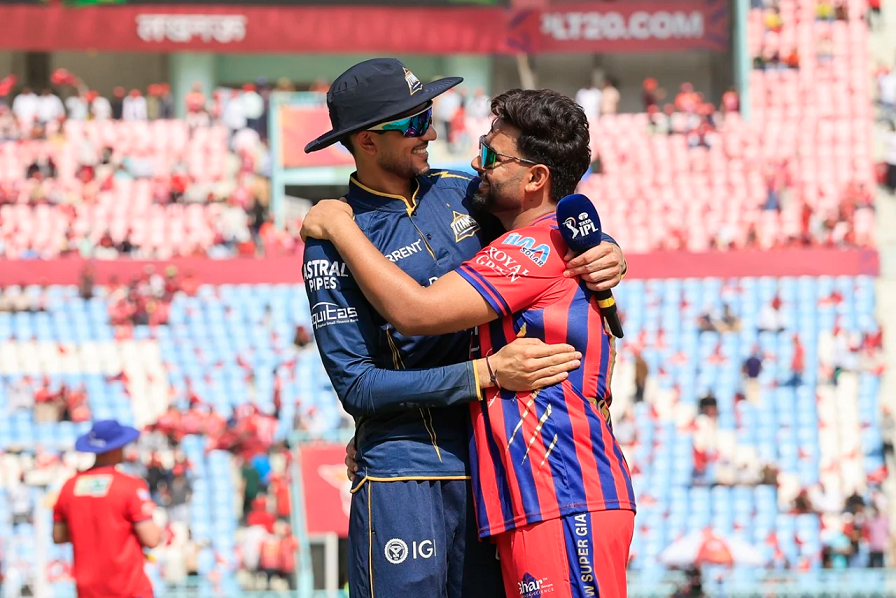
Prasidh Krishna is beginning to make a mark at IPL 2026. Three nights after his clever slower bouncer to David Miller sealed a tense last-ball win over Delhi Capitals, he followed it up with 4 for 28 – blending typical Test-match lengths with sharp pace-off variations – as Gujarat Titans made it two in two, this time edging out Lucknow Super Giants in their own backyard on Sunday.
Mohammed Siraj and Ashok Sharma were just as vital at the two ends of LSG’s innings, striking early and closing things out respectively. They played the perfect supporting acts to Prasidh’s headline-grabbing performance to restrict LSG to 164. GT captain Shubman Gill then calmly anchored the chase, scoring a half-century off 34 balls. His second-wicket stand of 84 with Jos Buttler helped them scale the target in 18.4 overs with seven wickets in hand.
The mini-battle to watch was Mohammed Shami vs Gill: India’s bowling veteran looking to force his way back into the international reckoning, up against the country’s current Test and ODI captain. Shami had set it up nicely, conceding just 10 runs off his first two overs, with enough movement to keep Gill honest.
It had all the makings of a proper contest. Until Gill consigned it to one-way traffic in the third, as he peeled off three fours and a six. That six was no ordinary hit, but a lofted hit on the up, straight over Shami’s head, eliciting an extra second’s pose to the cameras. The boundaries were pleasing too: a delectable leg glance, a stab through the covers, and a wristy flick over midwicket. This helped Gill gallop towards a half-century.
Buttler gave more than an inkling of form in the previous game when he made 52 off 27 against DC. Having come in at the fall of Sai Sudharsan’s wicket – he helped a half-tracker straight to short fine off Digvesh Rathi in the sixth- Buttler punched one through the covers off the third ball to raise GT’s fifty.
Rathi was unlucky not to have Buttler in his second over when he nicked behind, for Rishabh Pant to put down a regulation chance on 12. LSG would rue that missed opportunity as Buttler quickly took charge to dismantle the spinners, forcing Pant to turn to his faster men quickly.
In came Avesh Khan with a plan of trying to hit hard lengths but Buttler responded by hitting him for three back-to-back fours off the 12th over, and soon brought up his half-century, his 100th in T20s, off just 29 balls. By now, the chase was down to being a mere formality. He celebrated the fifty by reverse-sweeping Linde over point.
Gill fell with the target in sight, gloving a short ball behind off Prince Yadav, but Buttler stayed on to seal victory.
Kagiso Rabada began by being hit for 10 off his first two deliveries, but had Mitchell Marsh pick out mid-on to complete a fine comeback as GT struck early. This brought Rishabh Pant to the middle, and he seemed keen on taking the attack to the bowlers, but was snaffled by Siraj’s hard lengths as the ball caught the splice and lobbed to mid-off to leave LSG 45 for 2 in the fifth.
One second, Prasidh had hands on his head when Aiden Markram’s imperious flick just eluded a diving Glenn Phillips running across from deep square leg. Three balls later, he celebrated his first when Markram picked out deep midwicket perfectly. In his second over, Ayush Badoni fell in almost identical fashion as LSG slumped to 74 for 4 in the ninth.
That brought Nicholas Pooran to the middle, but this wasn’t the white-ball destroyer, but an avatar searching for form and confidence; his stroke play lacked any kind of fluency as the faster men kept tucking him up. Pooran seemed to have found a release when he hit Rashid Khan for back-to-back sixes, but that surge was all too brief with the end almost tame as he flat-batted Prasidh’s into-the-pitch delivery to Gill at mid-off. Pooran made 19 off 21.
He should’ve been run out off his third delivery when he tried to pinch a single to cover, but Ashok Sharma missed the stumps at the striker’s end despite having all three stumps to aim at from short cover. Then Mukul was hit on the helmet by a 150.2kph bouncer from Ashok.
But not long after, the trademark whip behind square that he unleashed to astonishment in Kolkata three nights ago, made an appearance, eliciting hopes of a grandstand finish. But that wasn’t to be as he got a big nick behind attempting to pull Prasidh’s slower bouncer. His 18 off 14 helped LSG nudge past 150, before Shami and Linde’s mini-cameo set up a 165-target.
Six overs in, it became increasingly evident those were at least 30-40 runs too little.
Brief scores:
Gujarat Titans 165 for 3 in 18.4 overs (Sai Sudarsan 15, Jos Buttler 60, Shubman Gill 56, Washington Sundar 21*, Rahul Tewatia 10*; Mohammed Shami 1-36, Prince Yadav 1-31, Digvesh Rathi 1-31) beat Lucknow Super Giants 164 for 8 in 20 overs (Aiden Markram 30, Mitchell Marsh 11, Rishabh Pant 18, Nicholas Pooran 19, Abdul Samad 18, Mukul Choudhary 18, George Linde 16, Mohammed Shami 12*; Mohammed Siraj 1-19, Kagiso Rabada 1-54, Ashok Sharma 2-32, Prasidh Krishna 4-28) by seven wickets
[Cricinfo]
Latest News
Heat Index at Caution level’ in the Northern, North-central, North-western, Western and Southern provinces and in Trincomalee district.

Warm Weather Advisory
Issued by the Natural Hazards Early Warning Centre
Issued at 3.30 p.m. on 12 April 2026, valid for 13 April 2026.
Heat index, the temperature felt on human body is likely to increase up to ‘Caution level’ at some places in the Northern, North-central, North-western, Western and Southern provinces and in Trincomalee district.
The Heat Index Forecast is calculated by using relative humidity and maximum temperature and this is the condition that is felt on your body. This is not the forecast of maximum temperature. It is generated by the Department of Meteorology for the next day period and prepared by using global numerical weather prediction model data.

Effect of the heat index on human body is mentioned in the above table and it is prepared on the advice of the Ministry of Health and Indigenous Medical Services.
ACTION REQUIRED
Job sites: Stay hydrated and takes breaks in the shade as often as possible.
Indoors: Check up on the elderly and the sick.
Vehicles: Never leave children unattended.
Outdoors: Limit strenuous outdoor activities, find shade and stay hydrated.
Dress: Wear lightweight and white or light-colored clothing.
Note:
In addition, please refer to advisories issued by the Disaster Preparedness & Response Division, Ministry of Health in this regard as well. For further clarifications please contact 011-7446491.

On the apparent northward relative motion of the sun, it is going to be directly over the latitudes of Sri Lanka from 05th to 15th of April in this year.
The nearest areas of Sri Lanka over which the sun is overhead today (13th) are Pesalai, Mankulam and Nedunkerny about 12:11 noon.

Prasidh, Buttler set up comfortable win for Gujarat Titans

Heat Index at Caution level’ in the Northern, North-central, North-western, Western and Southern provinces and in Trincomalee district.

Showers above 75 mm are likely at some places in the Western, Sabaragamuwa, Central, Southern and North-western provinces.

Sun directly overhead Pesalai, Mankulam and Nedunkerny about 12:11 noon

PNS TAIMUR & ASLAT arrive in Colombo

Sanju Samson and Jamie Overton deliver first points for Chennai Super Kings

‘Dates have the highest sugar content to fight Coronavirus’

Sunday Island 27 December – Headlines

#SundayIsland 17th December – Headlines

Sunday Island – 28th March

Sunday Island Headlines – 21 March

Sunday Island – 21st February – Headlines
-

 News6 days ago
Lankan-origin actress Subashini found dead in India
-

 News4 days ago
AG: Coal procurement full of irregularities
-

 News1 day ago
CEB orders temporary shutdown of large rooftop solar systems
-

 Business3 days ago
Israeli attack on Lebanon triggers local stock market volatility
-

 Business4 days ago
Hayleys Mobility introduces Premium OMODA C9 PHEV
-

 Business3 days ago
HNB Assurance marks 25 years with strategic transformation to ‘HNB Life’
-

 News6 days ago
UN Regional Director launches SL’s first Country Gender Equality Profile during official visit
-

 Sports4 days ago
DS to face St. Anthony’s in ‘Bridges of Brotherhood’ cricket encounter