
News
AI: Authorities must refrain from use of military to police protests

The Sri Lankan authorities must not impose a blanket order authorising use of force during the state of emergency that has been announced and refrain from use of the armed forces to police people’s protest, said Amnesty International following a new order empowering armed forces to maintain law and order in Colombo.
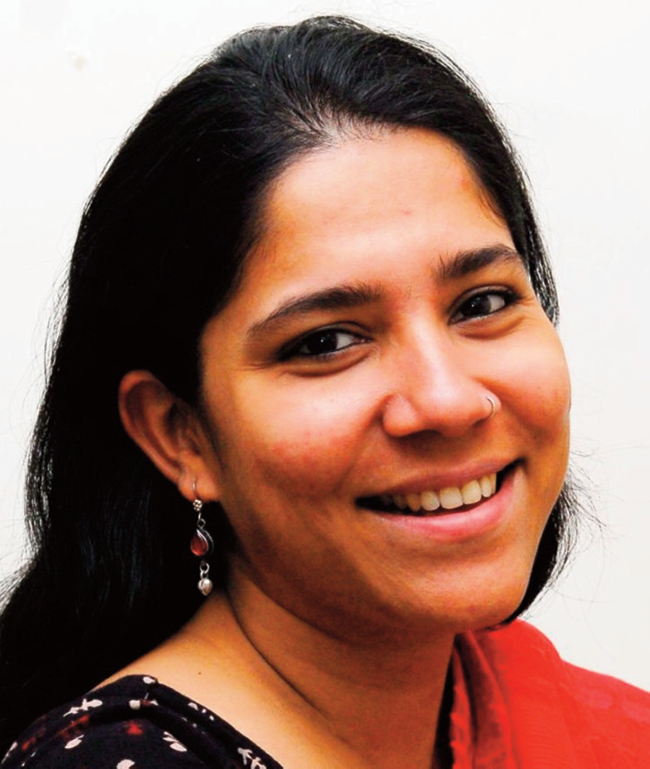
“The recent escalation of the authorities’ response to protests by calling in the armed forces, firing at protestors and excessive use of tear gas which resulted in the death of one person yesterday is deeply worrying,” said Yamini Mishra, Amnesty International’s South Asia Regional Director.
On the morning of 13 July 2022, thousands of protestors started making their way towards the Prime Minister’s office and the Parliament in Colombo. After an angry face-off, protesters breached the gates and took over the Prime Minister’s office. Amnesty International staff present at the protest location confirmed that law enforcement officers fired volleys of teargas against people, including children and journalists some of whom were seen escaping the plumes while coughing and sputtering. Dozens of protesters were injured, and one was reported dead. At Galle Face, helicopters flew low overhead, where a rolling peaceful protest site had been established three months ago in the prolonged agitation over the economic crisis in the country. At another protest near the Parliament later the same day, more than 80 people were reported to be injured and admitted to hospital.
At 3pm the Prime Minister Ranil Wickremesinghe delivered a televised address in which he said he had ordered the military to “do whatever is necessary to restore order”. On 14 July 2022, a press release was issued by the army announcing a warning that they will use force to restore law and order in the country.Any blanket order authorising use of force by armed forces is problematic even during times of emergency. The armed forces should not be involved in the policing of public assemblies, since they are trained to fight against enemies and not to protect and control civilians.
Amnesty calls upon law enforcement agencies to act with restraint to avoid further serious injury and loss of life. They may only use the minimum level of force necessary force to bring a situation under control where doing so is strictly necessary and proportionate. Even in instances where some parts of a protests turn violent, law enforcement must assess the situation on a case-by-case basis with use of force only where absolutely necessary and only against those engaged in violence. It must be strictly proportionate to the situation faced by law enforcement, which means authorities must not cause more harm than they seek to avert.
“At a time when the country is facing a dire economic crisis and protests are growing in scale, authorities must make comprehensive efforts to de-escalate the situation and focus resources on ensuring people can access essential goods and services, in line with international human rights law and standards,” said Yamini Mishra.

Latest News
Sun directly overhead Madampe, Thorayaya, Thotagamuwa, Rattota and Kalavanchikudy about 12.09 noon today (03)


The sun is going to be directly over the latitudes of Sri Lanka from 28th of August to 07th of September due to its apparent southward relative motion.
The nearest places of Sri Lanka over which the sun is overhead today (03) are Madampe, Thorayaya, Thotagamuwa, Rattota and
Kalavanchikudy about 12.09 noon.

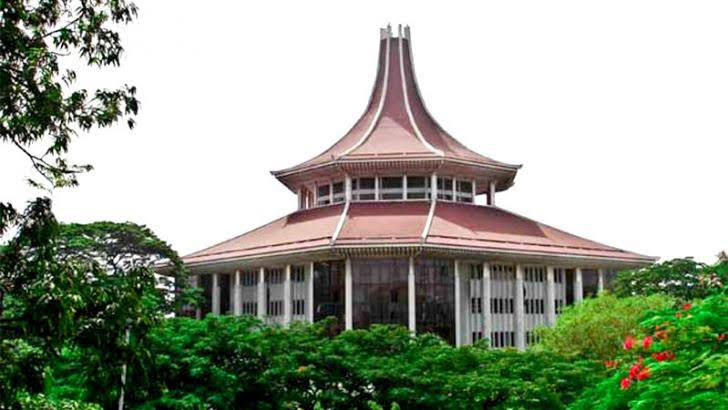
Attorney-at-Law Sugandhika Fernando, on behalf of the Vinivida Foundation, petitioned the Supreme Court yesterday (02), seeking a full bench, excluding Chief Justice Preethi Padman Surasena, to hear the petitions challenging the 22nd Amendment Bill. She also requested that the hearing be suspended immediately until the matter was fully heard and determined.
Among the respondents are Chief Justice Surasena, the first respondent, and Attorney General Parinda Ranasinghe. Justices Yasantha Kodagoda, Shiran Gooneratne, Achala Wengappuli and Priyantha Fernando have also been named as respondents.
The petitioner has sought to have quashed the decision of the first respondent to appoint a five-member bench, which she alleged was made in violation of the norms of public law. She also sought a bench comprising all Supreme Court judges, excluding those cited as respondents, to hear the special determination applications on the 22nd Amendment.
The petitioner further contended that Chief Justice Surasena, who is due to retire on December 1, 2026, would be the main beneficiary of the 22nd Amendment.
The hearing of the petitions continued for a second day yesterday (02) before a five-member Supreme Court bench comprising Chief Justice Preethi Padman Surasena and Justices Achala Wengappuli, Arjuna Obeyesekere, Sampath Abeykoon and Gihan Kulatunga.
The hearing, which commenced on Tuesday morning, continued for nearly 12 hours, until 10:30 p.m.
Solicitor General Viraj Dayaratne, appearing for the Attorney General, submitted yesterday that the Government had presented the 22nd Amendment Bill to the Constitution and the Judicature (Amendment) Bill with the objective of expanding and streamlining the country’s judicial system.
After the Solicitor General’s submissions concluded, counsel representing the petitioners requested an opportunity to respond to the Solicitor General and the intervening petitioners. However, the Chief Justice declined to allow the petitioners’ counsel to make further oral submissions, concluded the determination hearing and directed them to file written submissions instead.
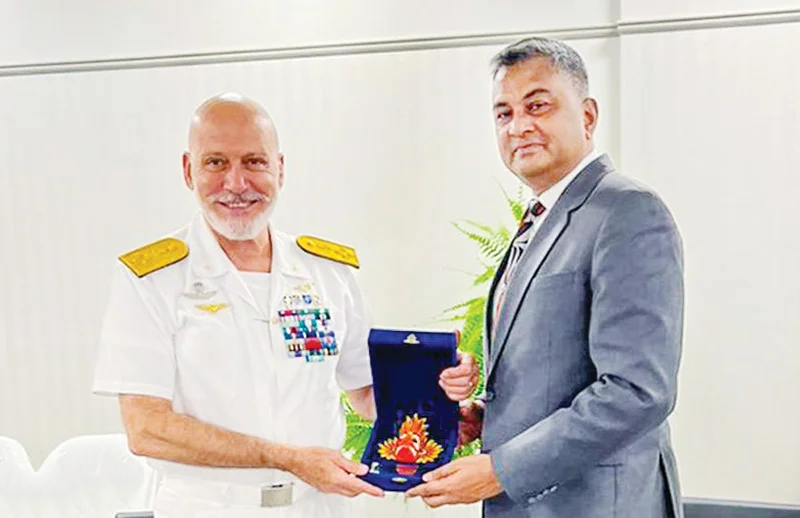
Sri Lanka has formally requested assistance from the North Atlantic Treaty Organisation (NATO).
According to a press release issued by the Defence Ministry, Defence Secretary Air Vice Marshal (retd) Sampath Thuyakontha has discussed defence cooperation with NATO, with discussions focusing on military modernisation, advanced technology, cyber capabilities and disaster response.
This was during talks between AVM Thuyakontha and NATO Military Committee Chairman Admiral Giuseppe Cavo Dragone on the sidelines of the Chiefs of Defence Conference in Victoria, Canada.
During the meeting, Secretary Thuyacontha outlined Sri Lanka’s defence requirements and areas of interest, including the modernisation of military hardware, acquisition of advanced technologies, and strengthening cyber capabilities and surveillance platforms, the Ministry of Defence said in a statement.
The two sides also discussed opportunities for greater technical cooperation, including the exchange of military personnel, expanded education and training programmes, and increased sharing of expertise and information.
Humanitarian Assistance and Disaster Relief (HADR) was also identified as an area for potential cooperation. The discussions included the exchange of expertise and the effective use of unmanned aerial vehicles (UAVs) in disaster response and related operations.
Defence Secretary Thuyacontha invited NATO to further strengthen its engagement with Sri Lanka, emphasising sustained dialogue, information sharing and practical cooperation in areas of mutual interest.

India to host inaugural Women’s Champions Trophy in February

Sun directly overhead Madampe, Thorayaya, Thotagamuwa, Rattota and Kalavanchikudy about 12.09 noon today (03)

Afternoon thundershowers in the Northern, North-central, Eastern and Uva provinces in next few days, starting from today (03).

22A: SC urged to suspend hearing, appoint full bench

Govt. seeks NATO assistance

Recent ‘Ice’ detection at the Colombo Port made on US intelligence – Embassy

‘Dates have the highest sugar content to fight Coronavirus’

Sunday Island 27 December – Headlines

#SundayIsland 17th December – Headlines

Sunday Island – 28th March

Sunday Island Headlines – 21 March

Sunday Island – 21st February – Headlines
-

 News6 days ago
Eight politicians in drug kingpin probe
-

 Features4 days ago
“Wrap Me Up in My Blazer”— A Gentlemanly Bradby Reminiscence
-

 Business6 days ago
Sri Lanka opens up: A new season of direct connectivity
-

 Features3 days ago
When Sri Lankan stories find their own voice
-

 Features6 days ago
Redefining ageing in Sri Lanka
-

 Editorial6 days ago
The toxic legacy of two lakes
-
 Business6 days ago
Jaffna Teaching Hospital secures lifeline water supply via ADB-funded Thalaiyadi sea water desalination plant
-
 Features4 days ago
JVP/NPP government as seen from outside by Lionel Bopage now domiciled in Australia