
News
AG urged to set up new mechanism to monitor HR violations

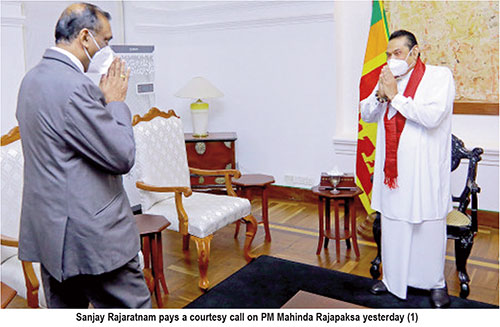
Sanjay Rajaratnam pays a courtesy call on PM Mahinda Rajapaksa yesterday (1)
The newly appointed Attorney General Sanjay Rajaratnam, PC, assumes duties at a critical time with the United Nations High Commissioner for Human Rights (UN-HCHR) having got the special mandate of the 46th session of the United Nations Human Rights Council (UN-HRC) in March this year to set up a special mechanism to monitor Sri Lanka’s alleged human rights violations and alleged war crimes during the final phase of the separatist war that ended in 2009, former PA National List MP M.M. Zuhair, PC says.
Zuhair, who served the AG’s department as a State Counsel and later as Senior State Counsel at a time it was comparatively smaller, said so in response to The Island query regarding the growing challenge on the human rights front.
Zuhair has sent us the following response to our queries: “The office of the Attorney General of Sri Lanka has a 137 year history, beginning from Sir Francis Fleming on 1st January 1884. The Attorney General carries with him unique responsibilities though the world outside sees him as exercising exclusive powers. He is the principal law officer of the State, legal adviser to the President of the Republic, the Speaker of Parliament and the executive, having specific Constitutional powers, duties and functions, advocate of the supremacy of the Constitution and the rule of law, having powers to initiate criminal proceedings and present indictments, the leader of the Bar with specified rights to be heard in all courts and defender of the State in civil proceedings. He is a member of the executive but functions independently of the executive in all legal matters, subject however to the jurisdiction of the Courts in specified issues.
The report of the High Commissioner for Human Rights has drawn special attention of the UN HRC to several significant matters relating to Sri Lanka. They include inter alia ‘reversal of Constitutional safeguards’, ‘majoritarian and exclusionary rhetoric, ‘new and exacerbated human rights concerns’, ‘impunity in emblematic cases’, etc. The UN HCHR has in the report taken a further step by requesting Member States, in addition to taking steps of referral of Sri Lanka to the International Criminal Court (ICC) to actively pursue “investigations and prosecution of international crimes committed by all parties in Sri Lanka before their own national courts, including under accepted principles of extraterritorial or universal jurisdiction” (emphasis mine).
The report also points out that “Member States can also apply targeted sanctions, such as asset freezes and travel bans against State officials and other actors credibly alleged to have committed or be responsible for grave human rights violations or abuses…” The addition of the two special procedures may be due to, the referral to ICC very likely being vetoed in the Security Council!
Another critical development is that a resolution is already before the United States Congress recommending the US to explore investigations and prosecutions pursuant to the recommendations of the UN HCHR. The proposed resolution is wide enough to pursue inter alia the two courses of actions referred to earlier at the Member State level of the US government. This would also encourage other traditional allies of the US to join hands with similar Member State level approvals, without recourse to any further UN HRC approval!
So the time has come for the new Attorney General Sanjay Rajaratnam PC to set up a special high level unit in the department to handle the man-made tsunami that will very likely rattle the country on the legal and economic fronts much sooner than the HRC process.
Amongst the matters in the UN HCHR’s list are the alleged “erosion of the judiciary and key institutions responsible for the promotion and protection of human rights; … policies that adversely affect the right to freedom of religion or belief; increased marginalization of persons belonging to the Tamil and Muslim communities; surveillance and intimidation of civil society; … arbitrary detentions”, etc.
Another matter is the need to address the undertaking given to repeal the Prevention of Terrorism (Temporary Provisions) Act (PTA) enacted in 1979 and replace same with a new law in line with accepted human rights norms. The controversial law itself provides for a maximum detention of 18 months, whereas a large number of persons arrested under the PTA over the Mawanella Buddha statue damaging case as well as over the Easter Sunday attacks have been kept in remand for over two years, in violation of the PTA’s maximum period of one and a half years, through a process arguably violative of the human rights of the suspects.
There are many persons in remand who could have been enlarged on bail with the consent of the Attorney General and against whom the alleged material is weak and insufficient for prosecution. There are still others who ought to have been discharged because they have had nothing to do with 21/4 attacks. The PTA provides in section 19, that the bail provisions of other written laws (excluding the Bail Act as provided in the Bail Act) will not be applicable only to persons convicted under the PTA. But suspects are not granted bail by Magistrates Court, in violation of the bail provisions in the Code of Criminal Procedure Act read with section 19 of the PTA itself, with Courts insisting on AG’s consent as required by another provision in the PTA, which is in conflict with section 19.
The UN HCHR could review likely human rights violations by the alleged unreasonable refusal of the Attorney General and the Courts to consent to bail in weak cases. These are areas that must be addressed forthwith by the Attorney General’s special unit to prevent officers and their families being adversely affected by Member States’ targeted actions, particularly because indictments are delayed, largely because of incomplete investigations!
Another matter that will require the immediate attention of the new Attorney General who counts over 34 years in the department is the continuing arrests of persons with alleged links to one suicide bomber or the other without any evidence of their being party to or in any way conspired, prepared, aided and/or abetted in the 21/4 attacks. Suicide bombers may have had links with persons of all communities for years before the Easter attacks. Those numbers can run into several thousands. But they do not become suspects in the 21/4 attacks by any legal yardstick merely because they had at some point crossed the future bombers. These arrests may be perceived as illegal arrests targeting the minorities.
The 48th Attorney General will certainly address the matters that come before him from the national interest perspective and not from any minoritarian angle! My interest is limited to securing justice within the rule of law for the country and for all its people.” (SF)



Opposition and SJB Leader Sajith Premadasa has alleged that the current government is attempting to suppress freedom of expression and media freedom to lead the country towards authoritarian rule.
In a video message on Thursday (25), Premadasa said that in a democratic country, the four main pillars safeguarding democracy are the legislature, the executive, the judiciary, and the independent media, but, at present, the government is using the police to violate both the democratic rights of the people and the rights of police officers themselves.
He said that the government is working to establish a police state that deprives citizens of their right to access truthful information.
“For democracy to be protected, media freedom must be safeguarded, and space must be given to independent media. Instead, the government is interfering with the independent media process, using the police to suppress and intimidate independent media,” he said.
He noted that even when independent media present their views based on reason, facts, and evidence, the government attempts to suppress them. Such actions, he said, amount to turning a democratic country into a police state. “Do not suppress the voice of the silent majority, the independent media,” he urged.
Premadasa emphasised that independent media represent the voice of the silent majority in the country and must not be suppressed.
“Media repression is a step towards authoritarian rule, and the people did not give their mandate to create an authoritarian regime or a police state. If the government attempts to abolish democratic rights, the Samagi Jana Balawegaya will stand as the opposition against it,” he said.
The Opposition Leader further alleged that the government was interfering with police independence, stating, “Political interference has undermined the independence of the police, making it impossible for them to serve impartially. Suppressing freedom of expression is an attempt to lead the country towards authoritarian rule.”
Premadasa pointed out that the media has the right to reveal the truth, and interfering with that right is a violation of the rights of 22 million citizens.

Vegetable prices at the Peliyagoda Manning Wholesale Market surged to unusually high levels yesterday (26), raising concerns among consumers as the festive season drives up demand. The situation is expected to persist over the next few days, a spokesman for the Manning Market told The Island.
He said a sharp increase in the number of buyers visiting the wholesale market, ahead of upcoming festivities, had resulted in a sudden spike in demand, prompting wholesale traders to raise prices significantly. The price hikes have affected a wide range of commonly consumed vegetables, placing additional pressure on household budgets.
According to market sources, the wholesale price of beans climbed to Rs. 1,100 per kilogram, while capsicum soared to Rs. 2,000 per kilogram. Green chillies were selling at around Rs. 1,600 per kilogram. Prices of other vegetables, including beetroot, brinjal (eggplant), tomatoes, bitter gourd, snake gourd and knolkhol, also recorded unusually high increases.
The spokesman alleged that despite the steep rise in prices, vegetable farmers have not benefited from the increases. Instead, he claimed that a group of traders, who effectively control operations at the wholesale market, are arbitrarily inflating prices to maximise profits.
He warned that if the relevant authorities fail to intervene promptly to curb these practices, vegetable prices could escalate further during the peak festive period. Such a trend, he said, would disproportionately benefit a small group of middlemen while leaving consumers to bear the brunt of higher food costs.
By Kamal Bogoda ✍️

The Hakgala National Botanical Garden, which was closed in the aftermath of Cyclone Ditwah, has been reopened to tourists from yesterday, the Ministry of Environment indicated.
The Ministry said the reopening was carried out in accordance with recommendations and guidelines issued by the National Building Research Organisation (NBRO) and the DisasterManagement Centre (DMC) after safety assessments were completed.
However, due to the identification of hazardous ground conditions, several areas, within the garden, have been temporarily restricted. These include the pond area, near the main entrance, and access roads leading towards the forest park where potential risks were observed. Warning signs have been installed to prevent visitors from entering these zones.
To ensure the safety and convenience of both local and foreign visitors, the garden’s management has introduced a special assistance programme, with staff deployed to guide and support tourists.
The Hakgala Botanical Garden was closed as a precautionary measure during the disaster situation triggered by Cyclone Ditwah. The Ministry noted that the garden has now been safely reopened, within a short period, following remedial measures and inspections, allowing visitors to resume access while maintaining necessary safety precautions.
By Sujeewa Thathsara ✍️

A few showers may occur in the Northern, Eastern and Uva provinces and in Polonnaruwa, Matale and Nuwara-Eliya districts

Sajith warns country is being dragged into authoritarian rule

Wholesale mafia blamed for unusually high vegetable prices

Cyclone-damaged Hakgala Botanical Garden reopened with safety measures

Holiday travellers generate record revenue for expressways

Another casualty from underworld warfare succumbs to his injuries

‘Dates have the highest sugar content to fight Coronavirus’

Sunday Island 27 December – Headlines

#SundayIsland 17th December – Headlines

Sunday Island – 28th March

Sunday Island Headlines – 21 March

Sunday Island – 21st February – Headlines
-

 News4 days ago
Members of Lankan Community in Washington D.C. donates to ‘Rebuilding Sri Lanka’ Flood Relief Fund
-

 News2 days ago
British MP calls on Foreign Secretary to expand sanction package against ‘Sri Lankan war criminals’
-

 Business6 days ago
Browns Investments sells luxury Maldivian resort for USD 57.5 mn.
-

 News5 days ago
Air quality deteriorating in Sri Lanka
-

 News5 days ago
Cardinal urges govt. not to weaken key socio-cultural institutions
-
 Features6 days ago
Hatton Plantations and WNPS PLANT Launch 24 km Riparian Forest Corridor
-
 Features6 days ago
Another Christmas, Another Disaster, Another Recovery Mountain to Climb
-

 Features4 days ago
General education reforms: What about language and ethnicity?