
Latest News
Aftershock frays nerves as many Venezuelans left to fend for themselves

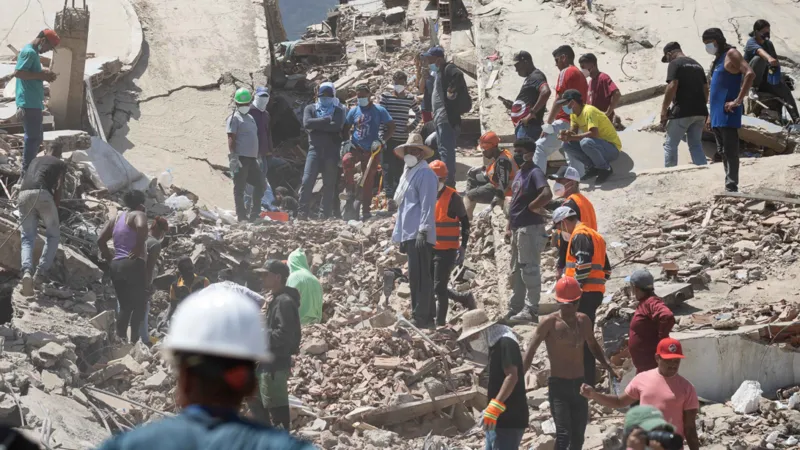
Many areas of Venezuela devastated by last week’s twin earthquakes have yet to receive significant government help, leaving residents to carry out much of the rescue effort.
In the port of La Guaira, one of the hardest-hit cities, the BBC saw people using crowbars, mallets and pickaxes to try to dig out loved ones and neighbours. Tens of thousands of people are still believed to be missing.
Early on Monday, nerves were frayed by an aftershock, although no further damage was reported.
More than 1,700 people have been killed in what Interim President Delcy Rodríguez said was the “most brutal natural catastrophe” in Venezuela’s history.
International aid has mobilised but hopes of finding survivors are fading. Overnight into Monday, a 21-year-old man became the latest person to be pulled alive after being trapped for over 100 hours.
The magnitude 7.2 and 7.5 quakes on Wednesday struck within 39 seconds of each other in the northern state of La Guaira, causing almost 800 buildings to collapse.
Monday’s aftershock again shook La Guaira and the capital Caracas and was measured at magnitude 4.6.
In nearby Catia La Mar the main search-and-rescue efforts were also still being carried out by local volunteers and international teams and there was anger at the authorities.
The BBC saw signs of the Venezuelan police and army on the streets in the worst-affected areas, but not in the rubble.
Ruben Rojas, a 32-year-old electrician who has been digging in the rubble with only gloves and a hard hat, said: “The civil protection people decided to help, but they don’t have the equipment. The government doesn’t give it. They are just like us, working with their hands.”
In La Guaira city the deployment of earth-moving equipment was patchy and sporadic, with local people working for days on a single building and the heavy machinery only arriving after it was too late.
Carolyn Zerpa, 39, was searching for her father and brother under the rubble by hand.
“You can’t really do much with just a pickaxe,” she told BBC Mundo.
Her focus has shifted from rescue to recovery, to find the remains of her family and give them a proper burial.
Zuly Marín, a La Guaira resident of 15 years, said she believed it was impossible to prepare for such a disaster but that the response had been too slow, exacerbated by Venezuela’s dire economic situation.
“I lost my niece and my brother-in-law. I think that if they [the rescuers and digging equipment] had come sooner, many people could have been saved,” she said.
In El Junquito, a mountainous area west of Caracas, residents told Reuters agency they had seen few public officials, while farmers and other residents have been providing basic supplies to the community.
“We are waiting for answers, for debris to be cleaned up, for inspections, for people who have been really affected to be helped,” resident Keily Ibarra, 33, told Reuters.
On Monday Rodríguez said more than 25,000 emergency workers, police officers and soldiers had been assisting Venezuelans affected by the earthquakes.
“Every life saved is a victory for hope,” she posted on social media platform X.
She has also announced a commission to assess the damage, to be chaired by her brother, National Assembly President Jorge Rodríguez.
Speaking on state television, she said the group would determine who could return home using a colour-coded traffic light system to classify safety. Temporary camps to house those displaced were being set up in the meantime, she added.
The rescued 21-year-old was found in the town of Caraballeda by teams from Venezuela, Mexico, and El Salvador, Salvadoran President Nayib Bukele announced on Monday.
The man, Aaron Levi Cantillo Vargas, is receiving specialised medical care, Bukele said, adding that the rescuers would “continue working with the hope of being able to save more lives”.
The UN’s resident humanitarian coordinator Gianluca Rampolla Del Tindaro said on Monday that there had been more than 500 aftershocks and that at least 2,500 structures had been affected by Wednesday’s initial quakes, most of which had fully collapsed.
The UN was obtaining 10,000 body bags as part of its rescue operation, he added, saying that a rise in the death toll was unavoidable.
“It is very sad and we truly hope that actually the number is going to be smaller than that and that’s why we are focusing now on the rescue operation,” he said.
Meanwhile more international aid has been pledged. The US has announced more than $300m (£227m) to help Venezuela – an increase from its previous commitment of $150m. “These funds will provide emergency medical care, food assistance, water and sanitation, shelter, protection, and logistics,” the US state department said.
A US frigate, the USS Fort Lauderdale, is currently positioned off the coast of La Guaira. Sailors and Marines are using landing and amphibious craft to deliver aid to the most affected coastal areas.
The Netherlands has also said it is sending a vessel carrying emergency supplies, while China has promised almost $15m in assistance.
[BBC]

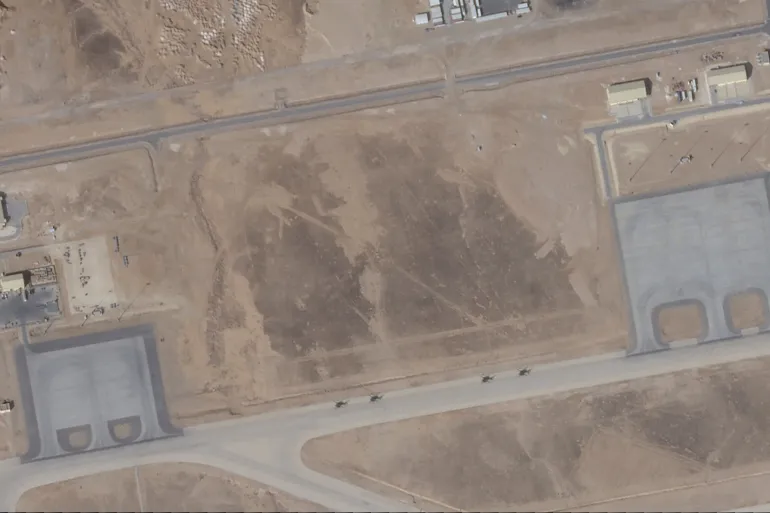
Iran says it launched missiles at two US bases in Jordan following a US attack on Larak Island in southern Iran earlier on Sunday.
In a statement reported by Iranian news agencies on Sunday, the Islamic Revolutionary Guard Corps (IRGC) said the combined missile and drone operation, which it called “Punishment of the Aggressor”, hit the King Hussein and Al Azraq bases in Jordan.
The exchange of attacks is the first flare-up in violence between the two sides since late July.
The IRGC said the strikes “destroyed the technical and repair infrastructure, as well as the enemy fighter deployment sites”, inflicting significant damage.
Jordan reported intercepting eight missiles soon after the IRGC announced the attack.
“Air defence systems intercepted eight missiles that breached the Kingdom’s airspace at dawn today, Monday,” the Jordanian military said in a statement.
No injuries were reported at either base.
“Aggression and crimes will not solve the enemy’s desperation in attempting to weaken the Islamic Republic’s control over the Strait of Hormuz, and every attack will be met with even more devastating responses,” the IRGC statement said.
Tehran had promised to retaliate for Sunday’s US attack on Larak Island.
The strikes risk renewing the military confrontation as Washington shifts from its bombing campaign to a financial pressure strategy on Tehran, and as the US-Israel war on Iran enters its seventh month.
On Monday, the US military denied that its Sunday attacks were an “act of aggression”.
[Aljazeera]
Latest News
Sun directly overhead Neriyakulam, Punewa, Kebithigollewa, Pankulam and Sinhapura at about 12.10 noon today (31)

The sun is going to be directly over the latitudes of Sri Lanka from 28th of August to 07th of September due to its apparent southward relative motion.
The nearest places of Sri Lanka over which the sun is overhead today (31) are Neriyakulam, Punewa, Kebithigollewa, Pankulam and Sinhapura about 12.10 noon.
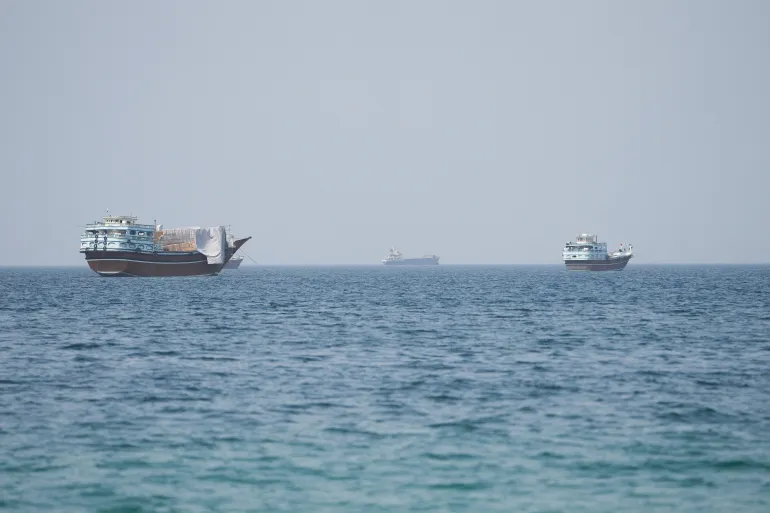
The United States has struck Larak Island in southern Iran in the first attack against the country since late July, a US official has confirmed to Al Jazeera.
Tehran vowed to retaliate for Sunday’s attack. The strikes risk renewing the military confrontation as the US shifts from the bombing campaign to a financial pressure strategy as the US-Israel war on Iran enters its seventh month
The US official said the strikes targeted launchers that were set to fire rockets carrying mines towards the Strait of Hormuz.
Iran’s Fars News Agency had reported that explosions were heard near the island. Later on Sunday, the Islamic Revolutionary Guard Corps (IRGC) confirmed the attack by the “American-Zionist enemy”, saying that it resulted in the killing and injuring of several soldiers.
“This act will be responded to by the sons of Islamic Iran and will result in punishment of the aggressor,” the IRGC said in a statement.
In a statement shared by the news agency, IRGC spokesperson Sardar Mohebi accused the US of making “a strategic and fatal mistake”, for which it will pay consequences “in both the economic and military arenas”.
In recent weeks, the US has been claiming control over the strategic waterway, saying that it is managing to get millions of barrels of oil through the strait under its military protection even as Iran blockades the waterway.
Still, attacks on ships in Hormuz have been reported almost daily, and Iran has maintained that the strait is closed.
Sunday’s strikes show that the US is still willing to use military force despite the focus on sanctions to pressure Iran to make concessions over its nuclear programme and claims of control over Hormuz
(Aljazeera)

Iran attacks US bases in Jordan after US strikes Larak Island

Showers will occur in the Western, North-western and Sabaragamuwa provinces and in Galle, Matara, Kandy and Nuwara-Eliya districts.

Sun directly overhead Neriyakulam, Punewa, Kebithigollewa, Pankulam and Sinhapura at about 12.10 noon today (31)

BASL takes exception to Justice Ganepola being denied a place in SC

Sajith challenges govt. to hold PC polls

Mahendran denies name change allegation

‘Dates have the highest sugar content to fight Coronavirus’

Sunday Island 27 December – Headlines

#SundayIsland 17th December – Headlines

Sunday Island – 28th March

Sunday Island Headlines – 21 March

Sunday Island – 21st February – Headlines
-

 News6 days ago
Missing doctor’s body found in Mahiyanganaya
-
 News6 days ago
Australia declines to release Finance Secy Suriyapperuma’s citizenship details
-

 News3 days ago
Eight politicians in drug kingpin probe
-

 News6 days ago
22A: BASL suggests CJ recuse himself from hearing petitions
-

 Features1 day ago
“Wrap Me Up in My Blazer”— A Gentlemanly Bradby Reminiscence
-

 Business3 days ago
Sri Lanka opens up: A new season of direct connectivity
-

 Features3 days ago
Redefining ageing in Sri Lanka
-
 Features5 days ago
Insights from Chieftains of Uva: Genealogy of two Kandyan Families – Part II