
Business
‘Adapt or perish: shipping liberalization reforms essential to export-led economic recovery’


While the topic of shipping liberalization has generally been the subject of frequent and heated debate in 2022, key stakeholders across Sri Lanka’s logistics and export sectors have become increasingly unified in their call for urgent liberalization of the island’s shipping industry, with shipping and freight forwarding agencies being the most immediate requirement.
These reformist sentiments were also voiced out by President Ranil Wickremesinghe at the Sri Lanka Economic Summit, when he called for systemic and sweeping reforms of the shipping and logistics reforms, in order to ensure that Colombo Port becomes the busiest in South Asia. Among the reforms now on the table is liberalization of shipping agencies.
Typically, the role of a shipping agent includes overseeing and protecting the interests of global shipping lines when their vessels dock at port. This includes ensuring that all in-port arrangements including handling of all relevant documentation are completed.
They are also responsible for loading and off-loading cargo, catering to the needs of the crew, and managing crew transfers, in addition to provisioning essential supplies, and managing all other requirements with domestic port authorities, all while ensuring maximum efficiency – a role which tends to consistently generate lucrative foreign currency revenue for shipping agents.
Those opposed to liberalization typically repeat the same arguments, namely: that the shipping industry is already liberalized except for the “insignificant” business of local shipping agents, which are currently protected from foreign ownership.
Accordingly, they claim that liberalization and opening up to domestic shipping agencies to complete or even partial foreign ownership would risk removing domestic participation in this lucrative business, without securing any significant benefits for the nation.
Conversely, proponents of liberalization have argued that such policies only protect the interest of local shipping agents, while discouraging global shipping lines from engaging with the domestic market, and blocking private sector foreign direct investment into critical infrastructure.
While both camps have been deadlocked for decades, Sri Lanka’s unprecedented economic crisis and urgent need for foreign currency inflows has re-energized arguments in favour of liberalization. Unlike previous instances, liberalization proponents believe that a positive resolution may finally be in sight.
Economic reality asserts itself
“Throughout Sri Lanka’s post-independence development, every Government has signalled their ambition to transform our nation into a regional maritime hub. However with the exception of the bold efforts of the late Hon. Mangala Samaraweera, there has never been a Government that was willing to pursue the liberalization policies necessary to facilitate such a transformation. This is no accident, but rather the result of an organised campaign by a very narrow group of entrenched interests to maintain a stifling protectionist regime.
“The only beneficiaries of such policies have been those who hold agencies with the major shipping lines. But the harsh economic reality we now face as a nation have made it impossible to justify sacrificing the interest of the nation, and the competitiveness of its exporters, exclusively for the benefit of just a few parties. Based on what the President and other key officials have stated in the lead up to Budget 2022 and subsequently, I believe that policy makers are starting to appreciate this fact,” Global Shippers’ Forum Chairman and the Chairman of the Apparel Logistics Sub-Committee of the Joint Apparel Association Forum of Sri Lanka (JAAF), Sean Van Dort explained.
During his tenure as Minister for Ports and Shipping, Samaraweera had overseen the only contemporary instance of a local agent being opened up for foreign ownership. While it was the only exception to ever be allowed, Van Dort pointed to how this partial liberalization led to approximately Rs. 14 billion of investment at the time entering the Sri Lankan economy, in one of the single largest deals to ever take place in the history of the Colombo Stock Exchange.
In its wake, he noted that the firm in question has since benefited from an expansion in the scale of its business by several orders of magnitude, making it one of the strongest performing shares on the domestic bourse.
“Foreign ownership brings numerous extremely valuable benefits, and we need not look further than the success of Expolanka, or any of the other logistics hubs that Sri Lanka is competing against to see the proof. By lifting ownership restrictions, we encourage international ship owners to get engaged and invested in Sri Lanka, and properly utilize our location to link up with their global networks. Instead we are currently treated as purely a cost center that feeds regional competitor ports that actively encourage ownership from global shipping lines. The added control that results encourages them to instead treat such ports as profit centers.
“Local shipping agents will of course, claim that we should retain ownership among locals, and instead focus on infrastructure development. But this is not a zero-sum game. We need foreign ownership and investment in order to develop our infrastructure, and our national value proposition. Regardless, these agents have been earning well for decades, yet they have failed to invest their profits back into the industry. Sadly, today Sri Lanka’s economy is in a state where there aren’t enough dollars in the system to make such investments in the first place. Even if we could, the returns would be too distant to make any meaningful impact on our current economic crisis. Liberalisation is the only way forward.” Van Dort argued.
Reaping the benefits of an open, liberalized economy starts with shipping
From a global perspective too, Sri Lanka’s unwillingness to reform risks eroding the overall competitiveness of its logistics sector as a whole, according to respected industry veteran and Shippers’ Academy International Founder, Rohan Masakorala.
“Across Asia, and particularly in the Indian Ocean, Sri Lanka remains the only country to have maintained protectionist policies for shipping agents. By contrast, acknowledged global leaders in maritime logistics like Singapore and the UAE allow for 100% ownership of shipping and freight forwarding agencies, while countries like Malaysia are over 70% open.
“Most recently, Philippines and Vietnam also announced plans to liberalize their domestic industries, while Europe, the U.S. and even China allow for foreign ship owners to open local offices. If we fail to commit to a similar path of reforms, we risk lagging even further in our development, and eventually being left behind altogether Either we reform and adapt or we perish. There are no other choices,” Masakorala cautioned.
Conversely, if the sector is opened up for foreign investment and ownership, he asserted that the sector as a whole would be forced to enhance its competitiveness, and eliminate hidden inefficiencies.
“In the past when Sri Lanka signalled any kind of intent to liberalise shipping agencies, we almost immediately got attention from some of the largest shipping lines in the world. If they have ownership of the business, they are able to own the profits, but they are also able to directly manage costs. This level of disintermediation means that there is no room for hidden costs from any middlemen. The multiplier effects for the logistics sector, and by extension, Sri Lanka’s exporters is immense, and I believe policy makers are finally starting to understand this and move in the right direction,” Masakorala said.
He added that even with foreign ownership coming in, there would still be more than enough room for local agents to compete, as evidenced by the experiences of the Singaporean logistics sector, which is home to 140 global shipping line headquarters, and still has room for over 5,000 local shipping agents.
“Meanwhile, the investments, knowledge and technology transfer infused through foreign ownership would expand the economies of scale across the Sri Lankan logistics sector, creating new niches for smaller players, and making export markets more accessible to Sri Lankan SMEs,” Masakorala stated.
With such reforms in place, he added that transhipment volumes to Sri Lanka would have room to grow, leading to more vessels calling on Sri Lanka, increasing the frequency and capacity available for freight to leave Sri Lanka’s shores, supporting greater export competitiveness.
“We cannot simply call ourselves a hub and expect to prosper. Instead of relying on protection from the Government, we have to open ourselves to the world, and compete on a global stage. Wherever Sri Lankan private sector has been given the opportunity to do so, they have always excelled.
At such a crucial juncture, Masakorala urged the Government to look at the numbers with an independent eye, and objectively evaluate how Sri Lanka’s shipping industry has performed relative to other successful maritime nations like the UAE, Singapore and India over the last forty years.
“Our policy makers cannot allow themselves to be swayed any longer by unsubstantiated stories of doom and gloom about foreign ownership taking away jobs without adding value. If they look at the data in a professional manner they will clearly see how much revenue can be earned by the state via port activity generated by foreign ship owners, and their multiplier effects across the economy, as compared with the taxes paid by mere shipping agents,”
“People who have benefited through the current controlled environment may desperately try to defend themselves, but how long can they keep recycling the same insincere claims as eye-wash? Senior politicians like President Ranil Wickremesinghe know better than anyone how markets work. That is why his Government and the late Mangala Samaraweera sought to drive reforms in 2017.
“At the time, they proposed full liberalisation, just like with insurance, banking, hotels, bunkering, terminals, and telecommunication. Today even energy is being liberalised, so if we want our location to be meaningful we need the shipping and logistics sector open for foreign ownership and greater partnership just like our neighbors India and Pakistan who liberalised the sector for greater interest of their nations,” Masakorala stated.
For the first time in decades complete liberalization of the shipping industry does seem to be on the cards, based on recent remarks made by President Wickremesinghe at multiple post-Budget forums. During these sessions, President Wickremesinghe had urged the private sector to push themselves to compete in global markets, instead of simply “putting up the flag of protection” in order to maintain their position within a deteriorating status quo.
It appears that policymakers are taking stock of this growing consensus, which could lead to an opening up of the Sri Lankan economy, in order to leverage its best assets – the ports of Colombo, Galle, Hambantota, and Trincomalee, as well as smaller ports in order to resolutely transform the nation into a true maritime and logistics hub.

By Ifham Nizam
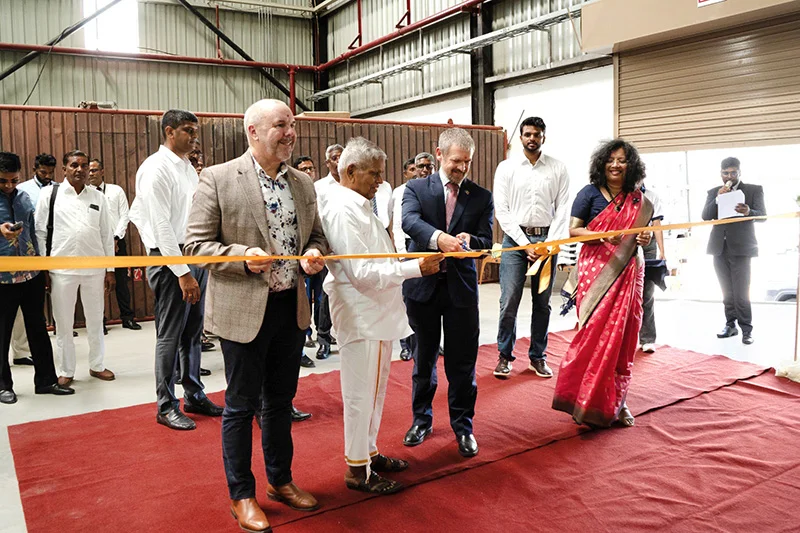
Australian High Commissioner to Sri Lanka Matthew Duckworth described Omega Traders’ latest investment in a modern dhal-processing facility as a strong example of how cross-border supply chains can translate into productive investment, local value addition and new business opportunities in Sri Lanka.
The investment, which adds a 150-metric-tonne-per-eight-hour-day processing capacity to Omega Traders’ operations, marks a significant expansion of the company’s manufacturing footprint as it celebrates 45 years in Sri Lanka’s food commodity industry.
Speaking at the inauguration of the new Lentil and Orid Dhal Processing Factory in Wattala, last Friday, H.C. Duckworth said the facility represented more than an increase in production capacity, pointing to the wider economic value created when Australian agricultural production is connected with Sri Lankan processing and distribution.
‘This facility is not operating on its own. It is part of a long supply chain and a trade partnership between Sri Lanka and Australia, Duckworth said.
His comments placed the Omega Traders’ investment within a broader commercial context: Australia brings agricultural production and established export capabilities, while Sri Lanka provides processing capacity, labour, market access and opportunities for further value addition.
The investment comes as Sri Lanka continues to look towards greater domestic processing and value-added manufacturing rather than relying solely on the import and distribution of finished commodities.
Dr. (Mrs.) Siddhika G. Senaratne, Director General/CEO of the Sri Lanka Standards Institution (SLSI), who attended the inauguration as Guest of Honour, highlighted the importance of quality assurance in food processing and the role of standards in maintaining confidence across the supply chain.
The facility is equipped with new-generation cleaning, processing, sorting and quality-control machinery, including advanced colour-sorting technology, automated systems and an in-house quality-control laboratory.
The additional capacity will support Omega Traders’ three principal Mysoor Dhal brands — Rainbow Jumbo Dhal, Komas Dhal and Rozanna Dhal — which serve different segments of the Sri Lankan market.
But the investment also has a distinctly local agricultural dimension.
Through its Orid Dhal operation, Omega Traders plans to source locally grown black matpe from Sri Lankan farmers and process it at the new facility.
That creates a domestic value chain linking farmers to industrial processing and consumers, while potentially increasing demand for locally produced agricultural commodities.
Duckworth said this type of business partnership could generate benefits for both countries.
‘Australia produces some of the world’s best agricultural products and we are very efficient and very capable at trading them. But that alone is not going to bring success to Australia. Just as building a factory like this is not going to bring success to Sri Lanka, he said.
‘It’s when we bring these entities together that our products produced in Australia can be processed in excellence here in Sri Lanka that enables this to be a success, the H.C. explained.
The investment therefore combines two complementary supply streams: imported agricultural commodities, including Australian-origin products, and locally produced black matpe for the Orid Dhal operation.
For Sri Lanka, the business significance extends beyond Omega Traders itself. Increased processing capacity creates demand for logistics, packaging, distribution, services and agricultural inputs, while supporting employment within the food-processing ecosystem.
HR-led transformation places people, culture and business performance at the heart of the organisation
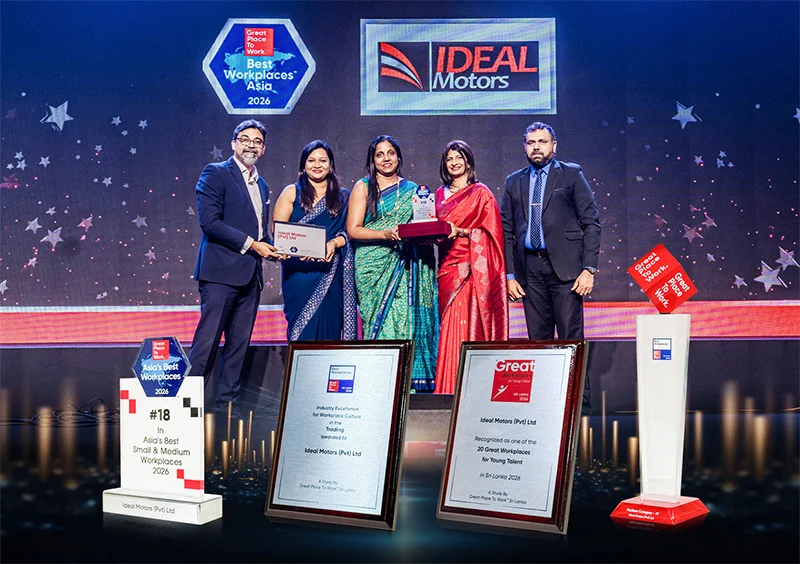
Ideal Motors (Pvt) Ltd,has achieved a significant milestone by securing multiple prestigious workplace and organisational culture accolades in 2026, reinforcing its position as an employer of choice in Sri Lanka’s automotive sector.
Among its latest achievements, Ideal Motors has been recognised as one of the 20 Great Workplaces for Young Talent in Sri Lanka 2026, ranked No. 1 and awarded the Gold Medal in the Small and Medium category of Best Workplaces™ in Sri Lanka 2026, and ranked No. 18 among Best Workplaces™ in Asia in the Medium Scale category—the highest-ranked Sri Lankan organisation in the category. The company also received Industry Excellence for Workplace Culture – Trading Industry.
The Young Talent recognition was presented at the Great Place To Work® CXO Forum 2026 held on 10 September 2026 at Cinnamon Life, Colombo. The recognition followed an evaluation of more than 100 certified organisations and highlights workplaces that create meaningful opportunities for employees under 35 to develop, contribute and grow.
At the Best Workplaces™ in Sri Lanka Awards Gala 2026, held on 11 September 2026 at Cinnamon Life, Colombo, Ideal Motors achieved another historic milestone by entering the Best Workplaces Sri Lanka list for the first time and securing the No. 1 Gold Medal in the Small and Medium category. The company also achieved No. 18 in Best Workplaces™ in Asia, reflecting the strength of its workplace culture beyond Sri Lanka.
These achievements represent more than a collection of awards. They reflect the transformation taking place within Ideal Motors, where people, culture and business performance are increasingly viewed as interconnected drivers of sustainable growth.
Over the past few years, the organisation’s HR function has evolved from a predominantly administrative role into a strategic business partner, with greater emphasis on employee experience, capability development, engagement, performance, communication, wellbeing, diversity and inclusion, and data-driven HR practices.
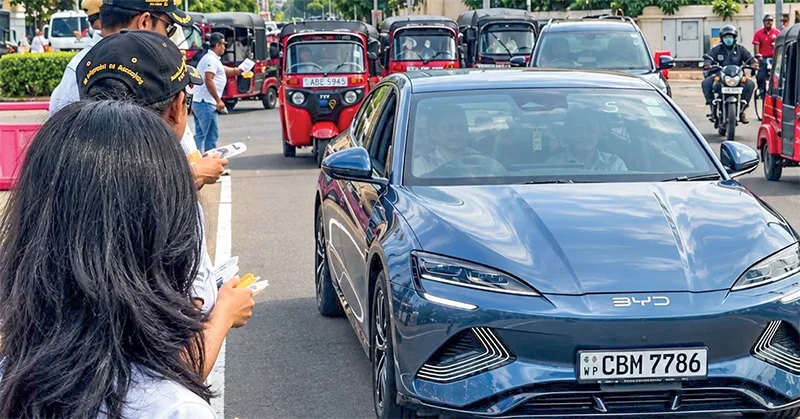
The Automobile Association of Ceylon (AAC) conducted a seat belt safety awareness programme in front of its headquarters and along Galle Face Centre Road, encouraging motorists and passengers to make seat belt use a habit on every journey.
AAC staff, working alongside officers of the Sri Lanka Police Traffic Division, distributed specially designed hanging tags and stickers to drivers. The material carries a clear reminder that seat belts protect drivers as well as passengers in both the front and rear seats.
The public awareness drive was held ahead of the requirement taking effect on 20 September 2026, under which seat belt use becomes mandatory for every occupant of a vehicle travelling on an expressway.
AAC emphasized that the regulation should be understood as a life-saving measure rather than only a legal obligation. Wearing a seat belt can help prevent occupants from being thrown inside or from a vehicle during a collision and can lessen the severity of injuries.
The Association said road safety legislation must be supported by sustained public education, visible enforcement and responsible behaviour by all road users. The participation of the Traffic Police helped the campaign reach motorists directly in a busy part of central Colombo.

High Court convicts 14 over deadly Easter bombings

Mandhana, Shafali and Ghosh lead dominant India to Asian Games gold

Fatima Sana and Umm-e-Hani secure bronze for Pakistan in Asian Games

India bat first in Asian games womens cricket final

Showers about 100mm will occur in the Western, Sabaragamuwa, Central and North-western provinces and in Galle and Matara Districts

Govt. confident of 2/3 majority despite NPP split speculation

‘Dates have the highest sugar content to fight Coronavirus’

Sunday Island 27 December – Headlines

#SundayIsland 17th December – Headlines

Sunday Island – 28th March

Sunday Island Headlines – 21 March

Sunday Island – 21st February – Headlines
-

 News6 days ago
US embassy won’t comment on IGP’s probe into joint drug raid
-

 News4 days ago
Shanakiyan urges urgent action over reported death sentence for Lankan in Saudi Arabia
-

 News5 days ago
Bid for Basil’s extradition nears final stage: Police
-

 Business6 days ago
All-new Bolero MaXX unveiled in Sri Lanka
-

 News3 days ago
Namal Rajapaksa Buddhist gambit fails, bail denied
-

 Opinion6 days ago
A journalist who wrote across the divide
-

 Editorial7 days ago
More fuel price shocks shrouded in secrecy
-

 Features3 days ago
Why the spelling Sri Lankan names in English vary