
Foreign News
Actor Gene Hackman and wife Betsy Arakawa died of natural causes one week apart


Oscar-winning actor Gene Hackman died of natural causes about a week after his wife Betsy Arakawa, who died after contracting a rare virus, a New Mexico medical investigator has said.
Hackman, 95, died at his Santa Fe home from coronary artery disease, with advanced Alzheimer’s disease a contributing factor.
Ms Arakawa, 65, died in the same house from hantavirus pulmonary syndrome (HPS), a respiratory illness caused by exposure to infected rodents. Her cause of death was listed as natural.
Authorities believe she passed away about seven days before her husband, to whom she had been married for more than 30 years. During his career, Hackman won two Academy Awards for The French Connection and Unforgiven.
It is likely that Ms Arakawa died first on 11 February, Dr Heather Jarrell of the New Mexico Medical Investigator’s Office told a news conference on Friday. She said it was “reasonable to conclude” that Hackman had died on 18 February.
Ms Arakawa’s last known movements and correspondence were on 11 February, when she was seen going to a grocery store, a CVS pharmacy and a pet store, before returning home in the early evening.
Given that Hackman was in the advanced stages of Alzheimer’s disease it is “quite possible that he was not aware that she [his wife] was deceased”, said Dr Jarrell. She told reporters she was “not aware of his normal daily functioning capability”.
Hackman had “significant heart disease, and ultimately that’s what resulted in his death”, Dr Jarrell said, adding that he had had chronic high blood pressure.
He had not eaten anything recently, but had shown no indications of dehydration, she added.
At the news conference, New Mexico Public Health Veterinarian Erin Phipps emphasised that hantavirus infections were extremely rare. HPS is transmitted through contact with rodent droppings, urine or saliva, often when contaminated dust is inhaled.
She noted that 136 cases had been reported in the state over the past 50 years, with 42% resulting in fatalities.
Dr Phipps said evidence of rodent activity had been found in some buildings on the property, though the risk inside the main house was considered “low”.
Investigators are trying to determine how Ms Arakawa contracted the illness. Hackman tested negative for hantavirus.
The couple were found in their home after neighbourhood security conducted a welfare check and saw their bodies on the ground through the window.
The remains were discovered in advanced stages of decomposition.
Hackman’s body was in a sideroom next to the kitchen, with a walking cane and a pair of sunglasses nearby, according to a search warrant affidavit.
Ms Arakawa’s body was in the bathroom, with scattered pills close to her.
Sheriff’s deputies found medication for thyroid and blood pressure treatment, along with pain reliever Tylenol, according to a court-filed inventory.
Citing privacy laws, authorities did not disclose who had been prescribed the drugs.
One of the couple’s three dogs was also found dead inside a crate near Ms Arakawa, while the other two dogs were alive.
The cause of death for the dog is yet to be determined, officials say. Dr Phipps told reporters that dogs did not get sick from hantavirus.
Initial investigations found no signs of forced entry or foul play at the couple’s $3.8m (£3m) home. Tests for carbon monoxide poisoning were negative, and no significant gas leaks were detected.
Hackman is survived by three adult children from his previous marriage
Hackman met Ms Arakawa when she was working part-time at a California gym in the mid-1980s, the New York Times has previously reported.
He won best actor Oscar for his role as Jimmy “Popeye” Doyle in William Friedkin’s 1971 thriller The French Connection, and another for best supporting actor for playing Little Bill Daggett in Clint Eastwood’s Western film Unforgiven in 1992.
A relative latecomer to Hollywood, Hackman saw his breakthrough come in his thirties, when he was nominated for an Oscar for portraying Buck Barrow in 1967’s Bonnie and Clyde – opposite Warren Beatty and Faye Dunaway – and again for I Never Sang for My Father in 1970.
Both films saw him recognised in the supporting actor category. He was also nominated for best leading actor in 1988 for playing an FBI agent in Mississippi Burning.
He played more than 100 roles during his career, including supervillain Lex Luthor in the Christopher Reeve-starring Superman movies in the 1970s and 1980s.
Hackman featured opposite many other Hollywood heavyweights including Al Pacino in 1973’s Scarecrow and Gene Wilder in 1974’s Young Frankenstein.
His last big-screen appearance came as Monroe Cole in Welcome to Mooseport in 2004, after which he stepped back from Hollywood for a quieter life in New Mexico.
[BBC]


India has shut down a medical college in Indian-administered Kashmir in an apparent capitulation to protests by right-wing Hindu groups over the admission of an overwhelming number of Muslim students into the prestigious course.
The National Medical Commission (NMC), a federal regulatory authority for medical education and practices, on January 6 revoked the recognition of Shri Mata Vaishno Devi Medical Institute (SMVDMI), located in Reasi, a mountainous district overlooking the Pir Panjal range in the Himalayas, which separates the plains of Jammu from the Kashmir valley.
Of the 50 pupils who joined the five-year bachelor’s in medicine (MBBS) programme in November, 42 were Muslims, most of them residents of Kashmir, while seven were Hindus and one was a Sikh. It was the first MBBS batch that the private college, founded by a Hindu religious charity and partly funded by the government, had launched.
Admissions to medical colleges across India, whether public or private, follow a centralised entrance examination, called the National Entrance Examination Test (NEET), conducted by the federal Ministry of Education’s National Testing Agency (NTA).
More than two million Indian students appear for NEET every year, hoping to secure one of approximately 120,000 MBBS seats. Aspirants usually prefer public colleges, where fees are lower but cutoffs for admission are high. Those who fail to meet the cutoff but meet a minimum NTA threshold join a private college.
Like Saniya Jan*, an 18-year-old resident of Kashmir’s Baramulla district, who recalls being overwhelmed with euphoria when she passed the NEET, making her eligible to study medicine. “It was a dream come true – to be a doctor,” Saniya told Al Jazeera.
When she joined a counselling session that determines which college a NEET qualifier joins, she chose SMVDMI since it was about 316km (196 miles) from her home – relatively close for students in Kashmir, who often otherwise have to travel much farther to go to college.
Saniya’s thrilled parents drove to Reasi to drop her off at the college when the academic session started in November. “My daughter has been a topper since childhood. I have three daughters, and she is the brightest. She really worked hard to get a medical seat,” Saniya’s father, Gazanfar Ahmad*, told Al Jazeera.
But things did not go as planned.

As soon as local Hindu groups found out about the religious composition of the college’s inaugural batch in November, they launched demonstrations demanding that the admission of Muslim students be scrapped. They argued that since the college was chiefly funded from the offerings of devotees at Mata Vaishno Devi Temple, a prominent Hindu shrine in Kashmir, Muslim students had “no business being there”.
The agitations continued for weeks, with demonstrators amassing every day outside the iron gates of the college and raising slogans.
Meanwhile, legislators belonging to Prime Minister Narendra Modi’s Bharatiya Janata Party (BJP) – which has been accused of pursuing anti-Muslim policies since coming to power in 2014 – even wrote petitions to Kashmir’s lieutenant governor, urging him to reserve admissions in SMVDMI only for Hindu students. The lieutenant governor is the federally appointed administrator of the disputed region.
In the days that followed, their demands escalated to seeking the closure of the college itself.
As the protests intensified, the National Medical Commission on January 6 announced that it had rescinded the college’s authorisation because it had failed to “meet the minimum standard requirements” specified by the government for medical education. The NMC claimed the college suffered from critical deficiencies in its teaching faculty, bed occupancy, patient flow in outpatient departments, libraries and operating theatres. The next day, a “letter of permission”, which authorised the college to function and run courses, was withdrawn.

But most students Al Jazeera talked to said they did not see any shortcomings in the college and that it was well-equipped to run the medical course. “I don’t think the college lacked resources,” Jahan*, a student who only gave her second name, said. “We have seen other colleges. Some of them only have one cadaver per batch, while this college has four of them. Every student got an opportunity to dissect that cadaver individually.”
Rafiq, a student who only gave his second name, said that he had cousins in sought-after government medical colleges in Srinagar, the biggest city in Indian-administered Kashmir. “Even they don’t have the kind of facilities that we had here,” he said.
Saniya’s father, Ahmad, also told Al Jazeera that when he dropped her off at the college, “everything seemed normal”.
“The college was good. The faculty was supportive. It looked like no one cared about religion inside the campus,” he said.
Zafar Choudhary, a political analyst based in Jammu, questioned how the medical regulatory body had sanctioned the college’s authorisation if there was an infrastructural deficit. “Logic dictates that their infrastructure would have only improved since the classes started. So we don’t know how these deficiencies arose all of a sudden,” he told Al Jazeera.
Choudhary said the demand of the Hindu groups was “absurd” given that selections into medical colleges in India are based on religion-neutral terms. “There is a system in place that determines it. A student is supposed to give preference, and a lot of parameters are factored in before the admission lists are announced. When students are asked for their choices, they give multiple selections rather than one. So how is it their fault?” he asked.
Al Jazeera reached out to SMVDMI’s executive head, Yashpal Sharma, via telephone for comments. He did not respond to calls or text messages. The college has issued no public statement since the revocation of its authorisation to offer medical courses.

Meanwhile, students at SMVDMI have packed their belongings and returned home.
Salim Manzoor*, another student, pointed out that Indian-administered Kashmir, a Muslim-majority region, also had a medical college where Hindu candidates are enrolled under a quota reserved for them and other communities that represent a minority in the region.
The BJP insists it never claimed that Muslim students were unwelcome at SMVDMI, but encouraged people to recognise the “legitimate sentiments” that millions of Hindu devotees felt towards the temple trust that founded it. “This college is named after Mata Vaishno Devi, and there are millions of devotees whose religious emotions are strongly attached to this shrine,” BJP’s spokesman in Kashmir, Altaf Thakur, told Al Jazeera. “The college recognition was withdrawn because NMC found several shortcomings. There’s no question of the issue being about Hindus and Muslims.”
Last week, Omar Abdullah, chief minister of Indian-administered Kashmir, announced that SMVDMI students would not be made to “suffer due to NMC’s decision” and they would be offered admissions in other colleges in the region. “These children cleared the National Entrance Examination Test, and it is our legal responsibility to adjust them. We will have supernumerary seats, so their education is not affected. It is not difficult for us to adjust all 50 students, and we will do it,” he said.
Abdullah condemned the BJP and its allied Hindu groups for their campaign against Muslims joining the college. “People generally fight for having a medical college in their midst. But here, the fight was put up to have the medical college shut. You have played with the future of the medical students of [Kashmir]. If ruining the future of students brings you happiness, then celebrate it.”
Tanvir Sadiq, a regional legislator belonging to Abdullah’s National Conference party, said that the university that the medical college is part of received more than $13m in government aid since 2017 – making all Kashmiris, and not donors to the Mata Vaishno Devi shrine – stakeholders. “This means that anyone who is lawfully domiciled in [Indian-administered Kashmir] can go and study there. In a few decades, the college would have churned out thousands of fresh medical graduates. If a lot of them are Muslims today, tomorrow they would have been Hindus as well,” he told Al Jazeera.
Nasir Khuehami, who heads the Jammu and Kashmir Students’ Association, told Al Jazeera the Hindu versus Muslim narrative threatened to “communalise” the region’s education sector. “The narrative that because the college is run by one particular community, only students from that community alone will study there, is dangerous,” he said.
He pointed out that Muslim-run universities, not just in Kashmir but across India, that were recognised as minority institutions did not “have an official policy of excluding Hindus”.
Back at her home in Baramulla, Saniya is worried about her future. “I appeared for a competitive exam, which is one of the hardest in India, and was able to get a seat at a medical college,” she told Al Jazeera.
“Now everything seems to have crashed. I came back home waiting for what decision the government will take for our future. All this happened because of our identity. They turned our merit into religion’
[Aljazeera]

As of Wednesday the Burmese democracy campaigner Aung San Suu Kyi will have spent a total of 20 years in detention in Myanmar, five of them since her government was overthrown by a military coup in February 2021.
Almost nothing is known about her state of health, or the conditions she is living in, although she is presumed to be held in a military prison in the capital Nay Pyi Taw. “For all I know she could be dead,” her son Kim Aris said last month, although a spokesman for the ruling military junta insisted she is in good health.
She has not seen her lawyers for at least two years, nor is she known to have seen anyone else except prison personnel. After the coup she was given jail sentences totaling 27 years on what are widely viewed as fabricated charges.
Yet despite her disappearance from public view, she still casts a long shadow over Myanmar.
There are repeated calls for her release, along with appeals to the generals to end their ruinous campaign against the armed opposition and negotiate an end to the civil war that has now dragged on for five years.
The military has tried to remove her once ubiquitous image, but you still see faded posters of “The Lady”, or “Amay Su”, Mother Su, as she is affectionately known, in tucked away corners. Could she still play a role in settling the conflict between the soldiers and the people of Myanmar?
After all, it has happened before. Back in 2010 the military had been in power for nearly 50 years, brutally crushed all opposition and run the economy into the ground. Just as it is doing now, it organised a general election which excluded Aung San Suu Kyi’s popular National League for Democracy, and which it ensured its own proxy party, the USDP, would win.
As with this election, which is still underway in phases, the one in 2010 was dismissed by most countries as a sham. Yet at the end of that year Aung San Suu Kyi was released, and within 18 months she had been elected an MP. By 2015 her party had won the first free election since 1960, and she was de facto leader of the country.
To the outside world it seemed an almost miraculous democratic transition, evidence perhaps that among the stony-faced generals there might be genuine reformers.
So could we see a re-run of that scenario once the junta has completed its three-stage election at the end of this month?
A lot has changed between then and now.
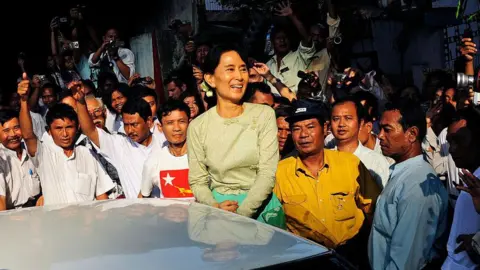
Back then there had been many years of engagement between the generals and an assortment of UN envoys, exploring ways to end their pariah status and re-engage with the rest of the world. It was a more optimistic era; the generals could see their South East Asian neighbours prospering through trade with the Western world, and they wanted an end to crippling economic sanctions.
They also sought better relations with the US as a counterbalance to their dependence on China, at a time when the Obama administration was making its celebrated “pivot” to Asia.
The top generals were still hard-line and suspicious, but there was a group of less senior officers keen to explore a political compromise.
It is not clear what finally persuaded the military leadership to open the country up, but they clearly believed their 2008 constitution, which guaranteed the armed forces one-quarter of the seats in a future parliament, would be enough, with their well-funded party, to limit Aung San Suu Kyi’s influence once she was released.
They badly underestimated her massive star power, and they underestimated how much their decades of misrule had alienated most of the population.
In the 2015 election the USDP won just over 6% of the seats in both houses of parliament. In the next election in 2020 it expected to perform much better, after five years of an NLD administration which had started with impossibly high hopes, and had inevitably disappointed many of them. But the USDP fared even worse, winning just 5% of seats in the two houses.
Even many of those who were dissatisfied with Aung San Suu Kyi’s performance in government still chose hers over the military’s party. This raised the possibility that she might eventually win enough support to change the constitution, and end the military’s privileged position.
It also ruled out the armed forces commander Min Aung Hlaing’s hopes of becoming president after his retirement. He launched his coup on 1 February 2021, the day Aung San Suu Kyi was due to inaugurate her new government.
This time there are no reformers in the ranks, and no hopes of the kind of compromise which restored democracy back in 2010. The shocking violence used to put down protests against the coup has driven many young Burmese to take up arms against the junta. Tens of thousands have been killed, tens of thousands of homes have been destroyed. Attitudes on both sides have hardened.
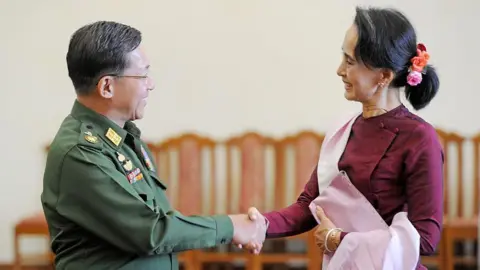
The 15 years Aung San Suu Kyi was detained after 1989, under conditions of house arrest in her lakeside family home in Yangon, were very different from the conditions she is being held in today. Her dignified, non-violent resistance won her admirers across Myanmar and around the world, and during the occasional spells of freedom the military gave her she was able to give rousing speeches from her front gate, or interviews to journalists.
Today she is invisible. Her long-held belief in non-violent struggle has been rejected by those who have joined the armed resistance, who argue that they must fight to end the military’s role in Myanmar’s political life. There is a lot more criticism of how Aung San Suu Kyi governed when she was in power than before.
Her decision to lead Myanmar’s defence against charges of genocide at the International Court of Justice over the military’s atrocities against Muslim Rohingyas in 2017 badly tarnished her saint-like international image. It had much less resonance inside Myanmar, but many younger opposition activists are now willing to condemn how she handled the Rohingya crisis.
At the age of 80, with uncertain health, it is not clear how much influence she would have, were she to be released, even if she still wants to play a central role.
And yet her long struggle against military rule made her synonymous with all the hopes of a freer, more democratic future.
There is simply no-one else of her stature in Myanmar, and for that reason alone, many would argue, she is probably still needed if the country is to chart a path out of its current deadlock.
[BBC]

About 550,000 accounts were blocked by Meta during the first days of Australia’s landmark social media ban for kids.
In December, a new law began requiring that the world’s most popular social media sites – including Instagram and Facebook – stop Australians aged under 16 from having accounts on their platforms.
The ban, which is being watched closely around the world, was justified by campaigners and the government as necessary to protect children from harmful content and algorithms.
Companies including Meta have said they agree more is needed to keep young people safe online. However they continue to argue for other measures, with some experts raising similar concerns.
“We call on the Australian government to engage with industry constructively to find a better way forward, such as incentivising all of industry to raise the standard in providing safe, privacy-preserving, age appropriate experiences online, instead of blanket bans,” Meta said in a blog update.
The company said it blocked 330,639 accounts on Instagram, 173,497 on Facebook, and 39,916 on Threads during it’s first week of compliance with the new law.
They again put the argument that age verification should happen at an app store level – something they suggested lowers the burden of compliance on both regulators and the apps themselves – and that exemptions for parental approval should be created.
“This is the only way to guarantee consistent, industry-wide protections for young people, no matter which apps they use, and to avoid the whack-a-mole effect of catching up with new apps that teens will migrate to in order to circumvent the social media ban law.”
Various governments, from the US state of Florida to the European Union, have been experimenting with limiting children’s use of social media. But, along with a higher age limit of 16, Australia is the first jurisdiction to deny an exemption for parental approval in a policy like this – making its laws the world’s strictest.
The policy is wildly popular with parents and envied by world leader, with the Tories this week pledging to follow suit if they win power at the next election, due before 2029.
However some experts have raised concerns that Australian kids can circumvent the ban with relative ease – either by tricking the technology that’s performing the age checks, or by finding other, potentially less safe, places on the net to gather.
And backed by some mental health advocates, many children have argued it robs young people of connection – particularly those from LGBTQ+, neurodivergent or rural communities – and will leave them less equipped to tackle the realities of life on the web.
(BBC)

BCB removes Nazmul Islam as head of finance committee

Another crane collapses in Thailand, killing two, after 32 die previous day

India shuts Kashmir medical college – after Muslims earned most admissions

Singapore’s opposition leader stripped of title after conviction for lying

BCB issues show cause notice to Nazmul Islam but Bangladesh players firm on boycott

From behind bars, Aung San Suu Kyi casts a long shadow over Myanmar

‘Dates have the highest sugar content to fight Coronavirus’

Sunday Island 27 December – Headlines

#SundayIsland 17th December – Headlines

Sunday Island – 28th March

Sunday Island Headlines – 21 March

Sunday Island – 21st February – Headlines
-

 Business5 days ago
Dialog and UnionPay International Join Forces to Elevate Sri Lanka’s Digital Payment Landscape
-
 News5 days ago
Sajith: Ashoka Chakra replaces Dharmachakra in Buddhism textbook
-

 Business17 hours ago
Koaloo.Fi and Stredge forge strategic partnership to offer businesses sustainable supply chain solutions
-

 Features5 days ago
The Paradox of Trump Power: Contested Authoritarian at Home, Uncontested Bully Abroad
-

 Features5 days ago
Subject:Whatever happened to (my) three million dollars?
-

 News4 days ago
Level I landslide early warnings issued to the Districts of Badulla, Kandy, Matale and Nuwara-Eliya extended
-

 Business2 days ago
New policy framework for stock market deposits seen as a boon for companies
-

 Opinion7 days ago
The minstrel monk and Rafiki, the old mandrill in The Lion King – II