
News
Activists slam Lanka’s bid to seek X-Press Pearl compensation in Singapore

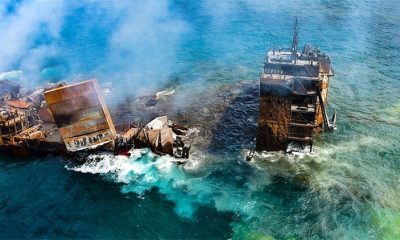
(Mongabay) Environmental activists have questioned the decision to file for compensation in Singapore instead of Sri Lanka for a 2021 ship sinking that became the worst maritime disaster in the country’s history, saying there’s less likelihood of winning adequate compensation overseas.
The Sri Lankan government is filing a lawsuit in Singapore for compensation nearly two years since the worst maritime disaster in the country’s history. But activists say it waited too long and would have stood a better chance of adequate compensation had the lawsuit been filed in Sri Lanka.
Speaking before parliament on April 25, Justice Minister Wijeyadasa Rajapakshe confirmed that the Department of the Attorney General had filed legal action before Singapore’s International Commercial Courts (SICC) to claim compensation for the extensive environmental damage caused by the burning and sinking of the Singapore-flagged freight ship the X-Press Pearl in May 2021.
“The decision to lodge the lawsuit in Singapore courts was done in consultation with a group of independent local and international lawyers as Singapore’s legal system is better equipped to handle this type of complex maritime legal battles,” Rajapakshe said.
The sinking of the fire-stricken ship, carrying tons of plastic pellets and toxic chemicals, is considered Sri Lanka’s worst maritime disaster to date. The plastic pellets, known as nurdles, fouled an extensive arc of Sri Lanka’s southwestern shore, with volunteer crews hard at work cleaning up the billions of grain-sized pellets for months on end.
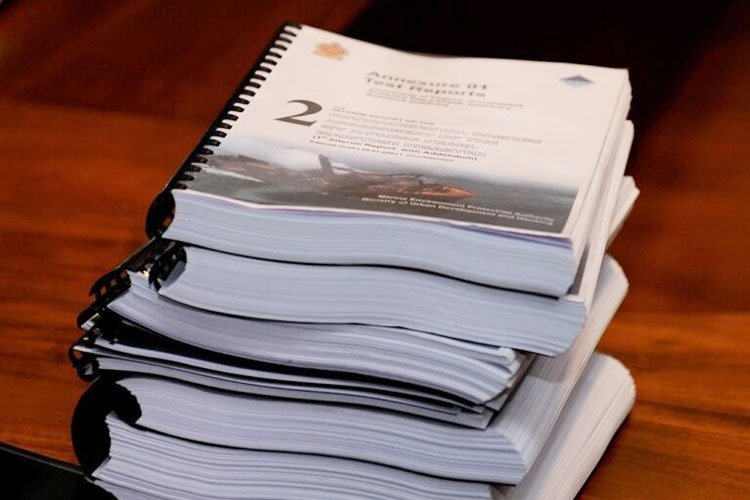
A 40-member expert committee convened by the Marine Environment Protection Authority (MEPA) to assess the environmental damage issued its second interim report in January this year, in which it put a price on the disaster: $6.4 billion.
Maritime rules require a claim for compensation to be filed within two years of the occurrence of the accident. The Singapore-flagged X-Press Pearl caught fire in Sri Lankan waters on May 20, 2021, and sank several days later. But the long wait without filing action has caused anxiety among activists, who have criticized the government for not moving fast enough.
Part of the delay was due to the complexity of the environmental assessment. There was very little baseline data for the expert committee to compare against, especially in the maritime context, which required them to assess damage scenarios over the short, mid- and long terms, said Dharshanie Lahandapura, former chair of the MEPA.
The group of experts continues to monitor the impacts of pollution caused by the disaster. The National Aquatic Resources Research and Development Agency (NARA) is also monitoring impacts to the marine environment, while the Department of Wildlife Conservation (DWC) is assessing the fallout on marine life, Lahandapura told Mongabay.
Based on the future findings, there could be more claims, given that the nurdles and other chemicals are likely to have long-lasting effects, Lahandapura said.
But waiting until just weeks before the two-year deadline “is unacceptable as the strategy should be to file it first without waiting for the outcome of the expert committee evaluation,” said Ravindranath Dabare, a lawyer and chair of the Centre for Environmental Justice (CEJ), a Colombo-based NGO.
“Within the first week of the X-Press Pearl disaster, CEJ filed the first case in local courts to push the authorities to take necessary actions, and subsequently two more cases to expedite the proceedings as the work was lagging,” Dabare told Mongabay.
The X-Press Pearl accident occurred within a few kilometers of the Colombo coast, well within Sri Lanka’s jurisdiction. That renders “the shipping company … a part of our local case and their representatives do participate in the court hearings, so there was no barrier to filing a case in Sri Lankan courts,” Dabare said.
He added the evidence is available in Sri Lanka, as are the experts who conducted the environmental damage assessment. Hiring Singapore-based lawyers will incur a higher cost, in addition to the cost of overseas travel — something Sri Lanka can ill afford as it reels from the worst economic crisis in its history, Dabare said.
“The existing Marine Environment Protection Act and the general law have provisions that enable Sri Lanka to file the lawsuit locally,” said Dan Malika Gunasekera, an expert on international maritime law.
He also noted there’s a limit to the amount of compensation that Sri Lanka can claim when lodging the case in Singapore.
“We must get the compensation from the insurer of the X-Press Pearl, who is in the United Kingdom, and on this basis, it may be better to file in the U.K. than Singapore,” Gunasekera told Mongabay.
Even then, the U.K. would also limit compensation to 19.5 million pounds ($24 million). In Sri Lanka, however, there would be no such cap.
Justice Minister Rajapakshe said the government would appoint a British lawyer to negotiate the compensation limitation set in the U.K. for the insurers. He reiterated the position that prospects for a favorable outcome are better in those overseas courts than in Sri Lanka.
Rajapakshe pointed to the case of the oil tanker New Diamond, which caught fire off Sri Lanka’s eastern coast about eight months before the X-Press Pearl incident. Three compensation claims were filed in Sri Lanka’s commercial courts in the New Diamond case, but they came up against various constraints. This, Rajapakshe said, influenced the decision to take the X-Press Pearl case before the Singapore courts.
Ayesh Ranawaka, a maritime expert and former commissioned officer with the Sri Lankan Navy, agreed that the Singapore courts represented a better chance of getting justice in the X-Press Pearl case. This doesn’t mean the local justice system is weak, he told Mongabay, just that there are too many disagreements at the local level about how to proceed.
If the Sri Lankan position is divided, the other party can take advantage of that, Ranawaka said. But when filing in Singapore, the Sri Lankan parties would at least come to a common position. They would also have international laws to fall back on, so the opportunity for justice may be higher, Ranawaka said.
As the government and activists debate what should be the correct course of action to demand compensation, it’s clear that Sri Lanka needs a clear strategy to handle these kinds of marine disasters, Ranawaka said.
“Sri Lanka needs to look beyond the X-Press Pearl incident and treat it as an eye-opener to ensure a proper maritime policy to avoid future mishaps,” he said.



The Sri Lanka Queen’s and President’s Scout Guild had their 25th Annual General Meeting with a grand celebration on Sunday, 22 March, 2026, at the National Scout Headquarters.
The Chief Guest for the occasion was Nanda Fernando, Leader Trainer and former National Training Commissioner.
The Guest of Honour for the event was Suranga Preethika Senanayake, President Scout.
Latest News
Heat Index at Caution Level in the Western, Sabaragamuwa, Southern, Eastern, North-western, Northern and North-central provinces and in Monaragala district


Warm Weather Advisory
Issued by the Natural Hazards Early Warning Centre
Issued at 3.30 p.m. on 31 March 2026, valid for 01 April 2026.
The Heat index, the temperature felt on human body is likely to increase up to ‘Caution level’ at some places in the Western, Sabaragamuwa, Southern, Eastern, North-western, Northern and North-central provinces and in Monaragala district.
The Heat Index Forecast is calculated by using relative humidity and maximum temperature and this is the condition that is felt on your body. This is not the forecast of maximum temperature. It is generated by the Department of Meteorology for the next day period and prepared by using global numerical weather prediction model data.

Effect of the heat index on human body is mentioned in the above table and it is prepared on the advice of the Ministry of Health and Indigenous Medical Services.
ACTION REQUIRED
Job sites: Stay hydrated and takes breaks in the shade as often as possible.
Indoors: Check up on the elderly and the sick.
Vehicles: Never leave children unattended.
Outdoors: Limit strenuous outdoor activities, find shade and stay hydrated.
Dress: Wear lightweight and white or light-colored clothing.
Note:
In addition, please refer to advisories issued by the Disaster Preparedness & Response Division, Ministry of Health in this regard as well. For further clarifications please contact 011-7446491.

Govt. rations stocks as imports falter
By Ifham Nizam
The government faces a looming fertiliser crisis ahead of the 2026 Yala season, with a sharp shortfall in urea threatening paddy yields and food security.
Experts have warned that the fertiliser shortage will take its toll on the yala harvest.
With just over 100,000 tonnes of fertiliser in stock by early March—barely enough for paddy cultivation alone—and more than half of expected imports either cancelled or delayed, the government has moved to ration supplies through Agrarian Service Centres, based on last year’s consumption.
Leading crop scientist Professor Buddhi Marambe has warned that while rationing is unavoidable, it will reduce productivity. “Even last season we applied below recommended levels. This year, the gap will be worse,” he said.
Authorities are prioritising paddy, followed by maize and tea, as limited stocks are stretched across crops.
However, experts estimate yields could fall by 15–20% if nutrient shortages persist—raising the risk of higher food prices in the months ahead.
The crisis has been worsened by global disruptions, including Gulf conflict affecting fertiliser shipments and precautionary export restrictions by key suppliers, such as China.
Although the Government is pursuing deals with countries like Russia, supplies remain uncertain.
With global urea prices surging and production costs rising, smallholder farmers are expected to be the hardest hit.
“This is a wake-up call,” Prof. Marambe said, urging urgent steps to build buffer stocks and strengthen Sri Lanka’s long-term food security strategy.

Grand celebration of 25th AGM of the Scout Guild

SLIIT Business School students address child labour through research

FOUNDATION.LK and The Asia Foundation launch national “Cyber Hygiene” course in Sri Lanka

More value, more choice, and more lifestyle benefits with every cedit card transaction

Havelock City Mall brings the spirit of the village to the city

Amelia Kerr hits 139-ball 179* as New Zealand pull off record chase to level series

‘Dates have the highest sugar content to fight Coronavirus’

Sunday Island 27 December – Headlines

#SundayIsland 17th December – Headlines

Sunday Island – 28th March

Sunday Island Headlines – 21 March

Sunday Island – 21st February – Headlines
-

 Features5 days ago
A World Order in Crisis: War, Power, and Resistance
-

 News6 days ago
Energy Minister indicted on corruption charges ahead of no-faith motion against him
-

 News7 days ago
US dodges question on AKD’s claim SL denied permission for military aircraft to land
-

 Business7 days ago
Dialog Unveils Dialog Play Mini with Netflix and Apple TV
-

 Sports6 days ago
SLC to hold EGM in April
-

 Opinion6 days ago
When elephants fight, it is the grass that suffers
-

 Latest News7 days ago
A strong Technical and Vocational Education and Training (TVET) system equips individuals with practical, relevant, and future-oriented skills helping to innovate responsibly towards a greener and sustainable future – PM
-

 Features6 days ago
Lest we forget