
News
ACJU scholar urges caution, balance in draft anti-terror law


A senior religious scholar attached to the All Ceylon Jamiyyathul Ulama (ACJU) has called on lawmakers to exercise “wisdom, restraint and justice” in finalising the proposed Protection of the State from Terrorism Act, 2026, warning that laws enacted in the name of security must not erode civil liberties, religious freedom, or public trust.
Sheikh Arkam Nooramith, a respected ACJU religious scholar and community guide, has issued a detailed public observation on the draft legislation, acknowledging the State’s duty to protect citizens from terrorism while stressing that national security and human rights must advance together.
“Terrorism in all its forms is a grave evil. It violates the sanctity of human life and destabilises societies,”
Nooramith said. “The State has not only the right, but the duty, to protect its people from such threats. At the same time, history—both ours and that of other nations—teaches us that laws enacted in the name of security must be crafted with wisdom, restraint, and justice.”
Concerns over broad definitions
In his observations, Nooramith cautioned that several provisions in the draft law rely on broad and ambiguous definitions, particularly those dealing with “encouragement,” “reckless dissemination,” “espousing the cause,” and acts “associated with terrorism.”
“Laws of this nature must be precise and narrowly tailored,” he noted. “A society governed by law requires that citizens clearly understand what is prohibited and why. Ambiguity can lead to inconsistent or excessive enforcement, which ultimately harms social harmony.”
As a religious scholar, Nooramith expressed particular concern over how legitimate religious discourse could be misunderstood or misapplied under expansive legal interpretations.
“Sri Lanka is a deeply religious society. Sermons, lectures, historical discussions and moral teachings are central to the spiritual lives of its people,” he said. “Even with protections for good-faith expression, there remains a real risk that speech or religious discourse may be misinterpreted when taken out of context—especially in an era of digital circulation.”
He warned that such risks are not theoretical. “They are rooted in lived experience,” he said, adding that a mature democracy must ensure that security laws do not unintentionally silence ethical, intellectual, or religious expression carried out in good faith.
The ACJU scholar also drew attention to provisions allowing the proscription of organisations, describing them as powers with “serious consequences” for association, expression, and livelihoods.
“Such authority must be exercised with strong judicial safeguards, transparent criteria and periodic independent review,” Nooramith said. “Laws gain legitimacy not merely from their intent, but from the fairness of their procedures.”
On detention, he observed that although the draft introduces more judicial oversight than previous legislation, executive-initiated detention supported by confidential material still raises concerns.
“From the perspective of justice, liberty should be restricted only under the closest judicial supervision, with a meaningful opportunity for the affected person to respond,” he emphasised.
Rejecting the notion that rights undermine security, Nooramith argued that human rights are essential to long-term national stability.
“Human rights are not obstacles to security; they are its foundation,” he said. “Societies that protect dignity, due process and fairness cultivate trust between citizens and the State. Societies that rely excessively on fear and coercion weaken that trust—sometimes irreparably.”
While welcoming the inclusion of the Human Rights Commission of Sri Lanka in oversight mechanisms, he called for its role to be further strengthened to ensure genuine independence and effectiveness.
At the same time, Nooramith acknowledged that the draft law represents a significant departure from the Prevention of Terrorism Act (PTA) of 1979, which he said caused “deep pain, fear and long-lasting grievances” across communities.
Among the positive changes he highlighted were the preamble’s commitment to constitutional rights and international human rights standards, increased judicial involvement, limits on prolonged detention, mandatory notification to next of kin and the Human Rights Commission, and explicit recognition that peaceful protest, dissent and advocacy do not constitute terrorism.
“These provisions reflect an understanding that security cannot be sustained through unchecked power,” he said. “They deserve recognition.”
Concluding his observations, Sheikh Arkam Nooramith urged lawmakers and citizens alike to learn from Sri Lanka’s past.
“Our history has taught us painful lessons about laws that, though enacted for security, became sources of fear and division,” he said. “True national security is not achieved by power alone, but by justice, trust and moral credibility. A law that protects the State must also protect the dignity of its people—all its people.”
His intervention comes amid growing public debate on the proposed legislation, as civil society groups, legal experts and religious leaders call for a balanced approach that safeguards both national security and democratic freedoms.
By Ifham Nizam ✍️


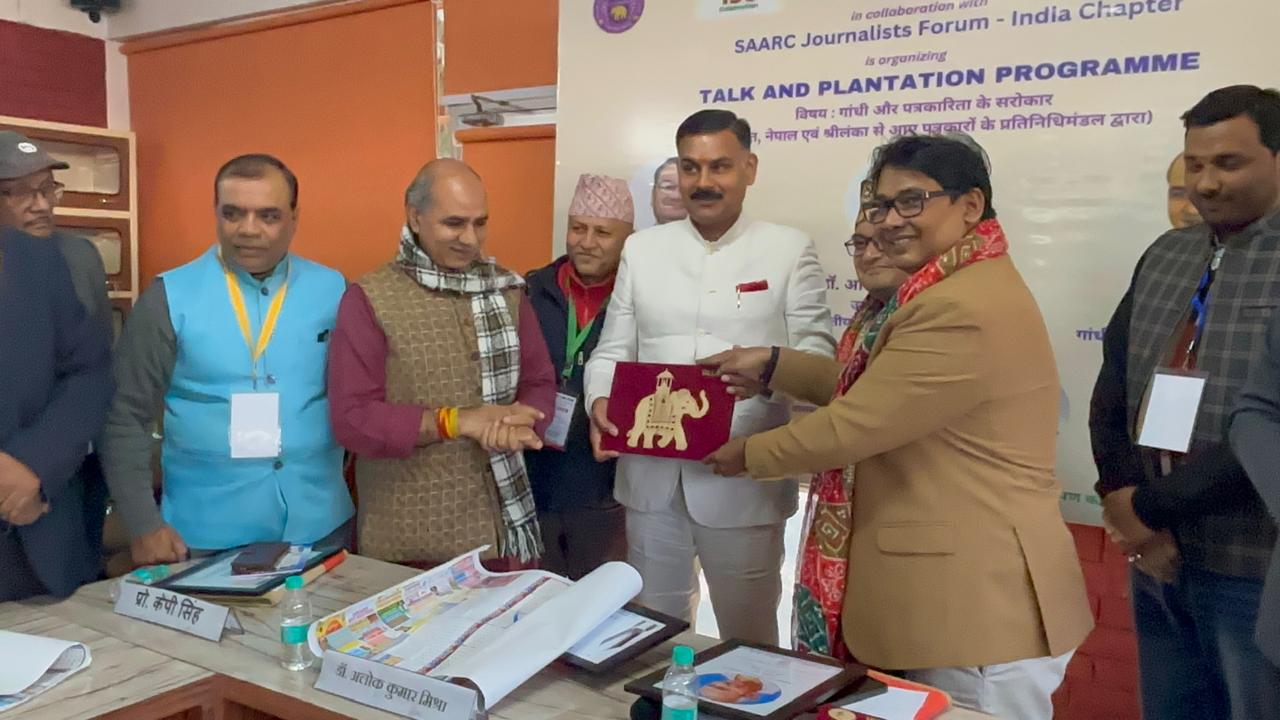
Members of the South Asian Journalists Forum have gathered at the University of New Delhi for a two day conference themed ‘Peace and Co-operation’.
Journalists from Bangladesh, Nepal, Sri Lanka and India are attending the conference hosted by the University of Delhi in collaboration with the India Chapter of SJF, and will deliberate on how the media can act as a catalyst for regional stability and mutual coexsistence.
A tree plantation campaign was also held at the Ghandi Bhawan premises of the University to mark the event and symbolize growing regional ties.
The Sri Lanka delegation is led by President of SJF’s Sri Lanka Chapter Rahul Samantha Hettiarachchi.

The Governor of the of Gujarat, Acharya Devvrat, along with the Deputy Chief Minister of Gujarat, Harsh Sanghvi, met with Prime Minister Dr. Harini Amarasuriya on Thursdy [February 05] at the Parliamentary Complex to discuss the arrangements related to the exposition of the Devnimori Sacred Relics of Lord Buddha, which have been brought to Sri Lanka under the patronage of Indian Prime Minister Narendra Modi and the Government of India.
These sacred relics of Lord Buddha were discovered during archaeological excavations conducted in the 1960s at the historic Devnimori site in Gujarat, the home state of Indian Prime Minister Narendra Modi. Until now, these relics had never been taken outside India. As a result of discussions held between President Anura Kumara Dissanayake and Indian Prime Minister Narendra Modi during his recent visit to Sri Lanka, the people of Sri Lanka have been granted this rare opportunity to venerate these sacred relics.
The exposition of the relics is being held for a period of seven days, from February 05 to February 11, at the Gangaramaya Temple in Hunupitiya, Colombo. Discussions were held between both parties regarding the arrangements related to this event.
The discussion was attended by Samar Nanda, Joint Secretary of the Indian Ministry of Culture; Dr. Satyanjal Pandey, Acting High Commissioner of India in Sri Lanka; Abhijit Halder, Director General of the International Buddhist Confederation; along with several others.
[Prime Minister’s Media Division]

The Indian Naval Ship (INS) GHARIAL made a port call in Colombo for operational turnarounds on 04 Feb 26. The Sri Lanka Navy welcomed the visiting ship in compliance with naval traditions.
Commanded by Commander Gaurav Tewari, INS GHARIAL is a vessel with a length of 124.8 meters.
During this visit, ten (10) Bailey Bridges, brought by ship, through the coordination of the High Commission of India in Sri Lanka, will be handed over to the Disaster Management Center. These bridges will provide temporary transportation links while bridges damaged across the island by adverse weather conditions are repaired.
The crew’s itinerary features scheduled goodwill activities with the Sri Lanka Navy, alongside visits to several tourist attractions across the island.

Sooryavanshi 175 makes India six-time Under-19 world champions

Mighty India meet multicultural USA in polarised World Cup

At least 31 killed, dozens wounded in Islamabad mosque blast

The SSC finally steps out of the sunshine and into the floodlights

SAARC journalists meet in New Delhi

Governor of Gujarat met with Sri Lanka PM to discuss exposition of Devnimori Relics

‘Dates have the highest sugar content to fight Coronavirus’

Sunday Island 27 December – Headlines

#SundayIsland 17th December – Headlines

Sunday Island – 28th March

Sunday Island Headlines – 21 March

Sunday Island – 21st February – Headlines
-

 Business7 days ago
Hayleys Mobility ushering in a new era of premium sustainable mobility
-

 Business4 days ago
SLIM-Kantar People’s Awards 2026 to recognise Sri Lanka’s most trusted brands and personalities
-
 Business7 days ago
Advice Lab unveils new 13,000+ sqft office, marking major expansion in financial services BPO to Australia
-
 Business7 days ago
Arpico NextGen Mattress gains recognition for innovation
-

 Business6 days ago
Altair issues over 100+ title deeds post ownership change
-

 Editorial7 days ago
Govt. provoking TUs
-

 Business6 days ago
Sri Lanka opens first country pavilion at London exhibition
-

 Business5 days ago
All set for Global Synergy Awards 2026 at Waters Edge