
News
A year after Sri Lanka unrest, Slave Island hungers

By Amal JAYASINGHE
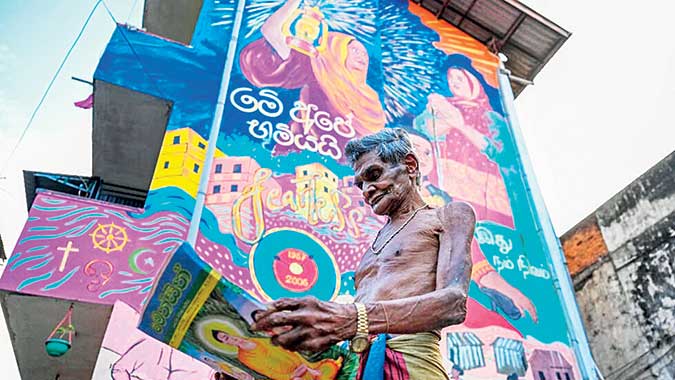
As Sri Lankans flocked to a jubilant street party celebrating their president’s ouster, retired accountant Milton Perera sat at home pondering whether his family could afford to eat the next morning.Before his dramatic toppling last year, Gotabaya Rajapaksa was blamed for an economic crisis that brought food and fuel shortages, blackouts and runaway inflation to the island nation.
But Perera told AFP at the time that with the once-loved leader out of office, the hardships his country had endured to that point would get worse.A year later, with millions of his compatriots struggling to put enough food on the table, the 75-year-old says his prediction has proved correct.
“Last year we had money, but no goods,” Perera told AFP inside his rundown government flat, a short distance from the seafront protest site where Rajapaksa’s toppling was orchestrated last year.
“Now there are goods, but we don’t have money.”
His home in Slave Island — a working-class pocket of Colombo where the Portuguese housed African slaves during the colonial period — is damp from a leaking water main.
Municipal authorities have not come around to repair it because they no longer have money for maintenance.With sunken cheeks and veins protruding from his gaunt limbs, Perera wheezes as he moves gingerly around his kitchen, the product of his chronic asthma.
Before the crisis, medication to treat his condition was provided free by public hospitals — a government programme that has now been scrapped.Two months ago Perera’s welfare payments were stopped as part of other spending cuts, meaning he is no longer able to afford an inhaler to treat his symptoms.
His family’s water and electricity bills have doubled thanks to the removal of government utility subsidies.The economic crisis had already forced Perera, his wife, his two children and their extended families to regularly skip meals when AFP first visited their home.A year later, supermarkets are again fully stocked with the kitchen staples that disappeared from the shelves during last year’s chronic shortages — but Perera’s family can’t buy them.
“We can’t afford meat, fish and eggs,” B. M. Pushpalatha, Perera’s wife, told AFP as the couple shared an unadorned meal of rice and lentils. “They are too expensive.”
Sri Lanka defaulted on its $46 billion foreign debt in April 2022 as its economy went into a tailspin unprecedented in its history as an independent nation.Petrol queues at pumping stations stretched for miles and motorists — several of whom died in queue — spent days waiting to top up their tanks.
Families had no gas to cook food, farm yields fell dramatically due to a ban on fertiliser imports, and hospitals were empty of life-saving pharmaceuticals.Months of angry protests culminated in the July 9 storming of Rajapaksa’s presidential palace, a short walk from Perera’s home, with its occupant forced into a brief but humiliating exile.
Rajapaksa’s departure did not conclude Sri Lanka’s economic woes, with inflation peaking at 70 percent in September. Petrol rationing also remains in force.His successor Ranil Wickremesinghe secured a $2.9 billion IMF bailout in March by agreeing on a tough austerity regimen to plug the country’s black hole of debt.
“Many of the decisions I have been compelled to take since assuming the presidency have been unpopular,” Wickremesinghe said in a February address to the nation.
“However, because of those decisions, today no citizen of this country will die of dehydration in oil queues. You won’t starve without gas or fertiliser.”
But the steep cuts to government spending and welfare programmes have exacerbated hardship across the country.An additional four million Sri Lankans had fallen below the poverty line since the crisis began, said Dhananath Fernando, chief executive of the Colombo-based Advocata Institute think-tank.
“That means about seven million people in a country of 22 million are earning less than 14,000 rupees ($46) a month,” he told AFP.Of those, nearly four million Sri Lankans did not have the means to adequately feed themselves, the United Nations said in June.
Fernando said the figures showed a sharp deterioration in living standards across the country in the past year with no prospect of a quick recovery.Unless the austerity measures began to bear fruit, the island risked a return to the sustained social unrest that broke out last year, he added.
“If we really fail to take Sri Lanka to a growth trajectory in the future, I’m not completely ruling it out,” Fernando said.





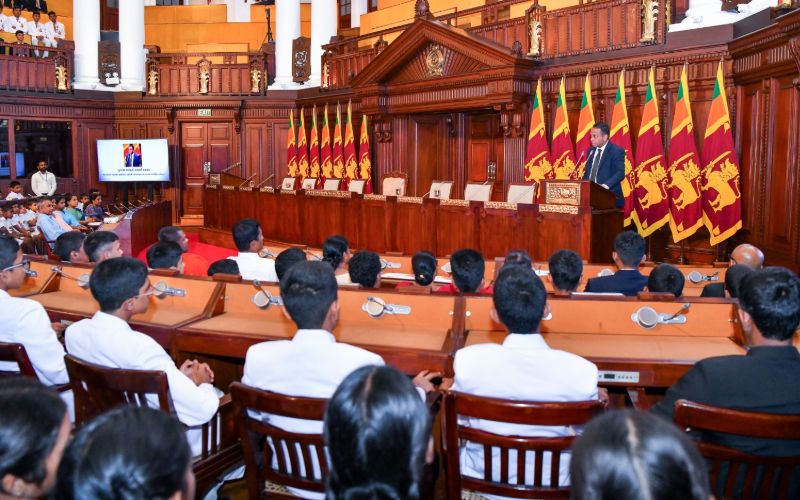
Marking the completion of two years of the ‘Vision’ Programme, students from Pinnawala Central College and Matale Siri Seevali College were given an opportunity on Thursday (24) to visit the Presidential Secretariat.
The ‘Vision’ Programme was launched for schoolchildren jointly by the Presidential Secretariat, the Ministry of Education and the Department of Communication of the Parliament of Sri Lanka.
Following a visit to the former Parliament building at the Presidential Secretariat, the students were also briefed on the history of Parliament.
The role of the President’s Fund and its importance to schoolchildren were explained by Senior Additional Secretary to the President Roshan Gamage.
The ‘Vision’ commemorative book, featuring the two-year journey of the ‘Vision’ Programme and its special activities, was also presented to the participating schools.
As part of the programme, valuable plants were also presented to the schools as a symbolic gesture underscoring the importance of environmental conservation.
Director General of Public Relations Dharmasiri Gamage, the Director and Assistant Director of the Tri-Services Security Coordination Unit, the principals and teaching staff of Pinnawala Central College and Matale Siri Seevali College, and students were among those present on the occasion.
President’s Media Division (PMD)
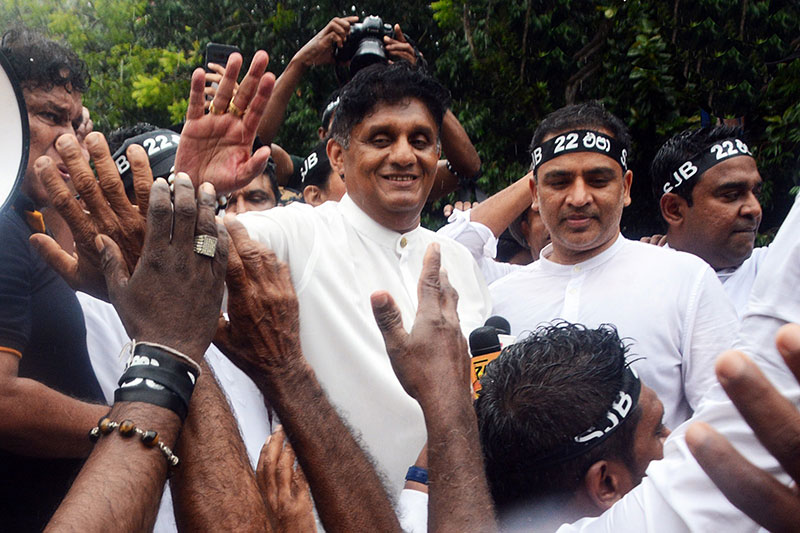
Opposition and SJB Leader Sajith Premadasa yesterday vowed that an SJB government would repeal the 22nd Amendment (22A) to the Constitution.Premadasa made the pledge while addressing thousands of SJB supporters who gathered near Parliament to protest against 22A.
Addressing the rally at Polduwa Junction, Battaramulla, Premadasa said the proposed constitutional amendment would undermine democracy and judicial independence and enable the concentration of political power in the Executive.
“Even if they pass it, under an SJB government we will scrap it,” Premadasa told the gathering, claiming that 22A was aimed at paving the way for a one-party state and placing the State under the control of a single political party.
Braving the rain, Premadasa said they had gathered there peacefully and had no intention of resorting to violence.
“We have gathered here to protect democracy,” he said, challenging the government to hold Provincial Council elections if it was confident of facing the people.
Premadasa said the SJB was prepared to work with any democratic and clean political force committed to the country’s progress and public welfare, amid ongoing discussions on cooperation among Opposition parties, including the United National Party.
Premadasa also accused groups aligned with the government of attempting to discourage people from attending the protest through statements and other measures.
SJB General Secretary Ranjith Madduma Bandara said the protest had been organised against the proposed amendment, which the party had opposed on the grounds that it could pave the way for authoritarianism.
The demonstration began around 9 a.m. at Polduwa Junction and coincided with Parliament taking up the proposed 22nd Amendment for debate. Proceedings on the Bill are scheduled to continue today (25).
The Supreme Court has determined that the proposed amendment does not require approval at a referendum and could be passed with a special majority in Parliament.
Meanwhile, traffic congestion was reported on roads surrounding Parliament and Polduwa Junction following the demonstration.
Security was also tightened in and around the Parliamentary complex, with a heavy police presence observed at Polduwa Junction and near the main entrance to Parliament.
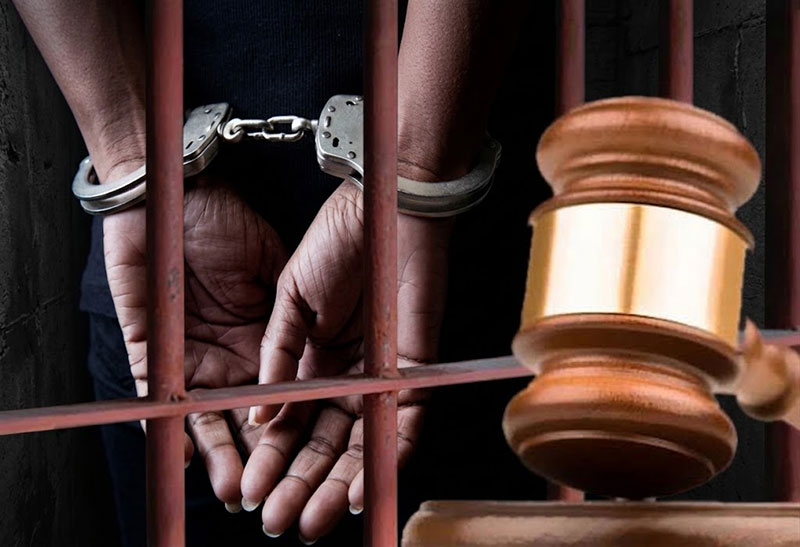
Two retired female Navy petty officers were ordered to be remanded until October 5 over their alleged involvement in the abduction and disappearance of two women in Trincomalee during the war.
Trincomalee Chief Magistrate M.S.M. Samsudeen yesterday ordered that the two suspects be remanded and directed that they be produced for an identification parade on October 5.
The suspects, residents of Chilaw and Haputale, were arrested after appearing before the CID in connection with another court case. They were subsequently produced before the Trincomalee Magistrate’s Court.
The court was informed that the investigation concerned the alleged abduction of Sasikumar Thenmoli and Mary Delsia, residents of Paalaiyootru, Trincomalee, on or around May 13, 2008.
The CID told court that information uncovered during its investigations indicated that the two women had allegedly been detained at an underground location known as the “Gun Site” at the Trincomalee Naval Base while the two suspects were serving in the Navy. The women were subsequently reported missing.
Further investigations into the alleged abduction and disappearance of the two women are continuing.

Lalit Rajbanshi, Kushal Bhurtel set up Nepal’s opening win

‘Vision’ Programme Marks Two Years

Costa Rica minister fired for unapproved meeting with Trump in US

At least 41 die as boat capsizes in DRC’s Lake Tanganyika

Showers will occur at times in the Western, Sabaragamuwa, Southern, Central and North-western provinces

Sajith vows to scrap 22A under future govt.

‘Dates have the highest sugar content to fight Coronavirus’

Sunday Island 27 December – Headlines

#SundayIsland 17th December – Headlines

Sunday Island – 28th March

Sunday Island Headlines – 21 March

Sunday Island – 21st February – Headlines
-

 News7 days ago
Shanakiyan urges urgent action over reported death sentence for Lankan in Saudi Arabia
-

 News6 days ago
Namal Rajapaksa Buddhist gambit fails, bail denied
-

 Features6 days ago
Why the spelling Sri Lankan names in English vary
-

 Features6 days ago
Three bands, a new identity: Sri Lankan wolf snake recognised as distinct species
-
 Business6 days ago
SLIIT holds largest-ever convocation
-

 News6 days ago
Vehicle prices drop by up to Rs. 1 mn, says importers’ body
-

 News6 days ago
Govt monitors reported Saudi death sentence – Foreign Ministry
-

 Business6 days ago
All-new Bolero MaXX Pik-Up unveiled in Lanka