
Opinion
A wise Christmas


Important events in the Christian calendar are to be regurlarly reviewed if they are to impact on the lives of people and communities. This is certainly true of Christmas.
Community integrity
Years ago a modest rural community did exactly this, urging a pre-Christmas probe of the events around Jesus’ birth. From the outset, the wisemen aroused curiosity. Who were these visitors? Were they Jews? No. were they Christians? Of course not. As they probed the text, the representative character of those around the baby, became starkly clear. Apart from family, the local shepherds and the stabled animals, the only others present that first Christmas, were sages from distant religious cultures.
With time, the celebration of Christmas saw a sharp reversal. The church claimed exclusive ownership of an inclusive gift and deftly excluded ‘outsiders’ from full participation.
But the Biblical version of the ‘wise outsiders’ remained. It affirmed that the birth of Jesus inspired the wise to initiate a meeting space for diverse religious cultures, notwithstanding the long and ardous journey such initiatives entail. Far from exclusion, Jesus’ birth narratives, announced the real presence of the ‘outsider’ when the ‘Word became Flesh’.
The wise recognise the gift of life as an invitation to integrate sincere explanations of life; true religion. Religion gone bad, stalls these values and distorts history.
There is more to the visit of these sages.
Empire- When Jesus was born, Palestine was forcefully occcupied by the Roman empire. Then as now, empire did not take kindly to other persons or forces that promised dignity and well being. So, when rumours of a coming Kingdom of truth, justice and peace, associated with the new born baby reached the local empire agent, a self appointed king; he had to deliver. Information on the wherabouts of the baby would be diplomatically gleaned from the visiting sages.
But the sages did not only read the stars. They also read the signs of the times. Unlike the local religious authorities who cultivated dubious relations with a brutal regime hated by the people, the wise outsiders by-pass the waiting king.
The boycott of empire; refusal to co-operate with those who take what it wills, eliminate those it dislikes and dare those bullied to retaliate, is characteristic of the wise.
Gifts of the earth
A largely unanswered question has to do with the gifts offered by the wise. What happened to these gifts of the earth? Silent records allow context and reason to speak.
News of impending threats to the most vulnerable in the family received the urgent attention of his anxious parent-carers. Then as it is now, chances of survival under oppressive regimes, lay beyond borders. As if by anticipation, resources for the journey for asylum in neighbouring Egypt, had been provided by the wise. The parent-carers quietly out smart empire and save the saviour to be.
Wise carers consider the gifts of the earth as resources for life; its protection and nourishment. But, when plundered and hoarded, resources for all, become ‘wealth’ for a few; a condition that attempts to own the seas and the stars.
Wise choices
A wise christmas requires that the sages be brought into the centre of the discourse. This is how it was meant to be. These visitors did not turn up by chance. They were sent by the wisdom of the ages to highlight wise choices.
At the centre, the sages facilitate a preview of the prophetic wisdom of the man the baby becomes.The choice to appropriate this prophetic wisdom has ever since summed up Christmas for those unable to remain neutral when neighbour and nature are violated.
Wise carers
The wisdom of the sages also throws light on the life of our nation, hard pressed by the dual crises of debt repayment and post cyclonic reconstruction. In such unrelenting circumstances, those in civil governance take on an additional role as national carers.
The most humane priority of the national carer is to ensure the protection and dignity of the most vulnerable among us, immersed in crisis before the crises. Better opportunities, monitored and sustained through conversations are to gradually enhance the humanity of these equal citizens.
Nations in economic crises are nevertheless compelled to turn to global organisations like the IMF for direction and reconstruction. Since most who have been there, seldom stand on their own feet, wise national carers may not approach the negotiating table, uncritically. The suspicion, that such organisations eventually ‘grow’ ailing nations into feeder forces for empire economics, is not unfounded.
The recent cyclone gave us a nasty taste of these realities. Repeatedly declared a natural disaster, this is not the whole truth. Empire economics which indiscriminately vandalise our earth, had already set the stage for the ravage of our land and the loss of loved ones and possessions. As always, those affected first and most, were the least among us.
Unless we learn to manouvre our dealings for recovery wisely; mindful of our responsibilities by those relegated to the margins as well as the relentles violence and greed of empire, we are likely to end up drafted collaborators of the relentless havoc against neighbour and nature.
If on the other hand the recent and previous disasters are properly assessed by competent persons, reconstruction will be seen as yet another opportunity for stabilising content and integrated life styles for all Lankans, in some harmony with what is left of our dangerously threatened eco-system. We might then even stand up to empire and its wily agents, present everywhere. Who knows?
With peace and blessings to all!
Bishop Duleep de Chickera


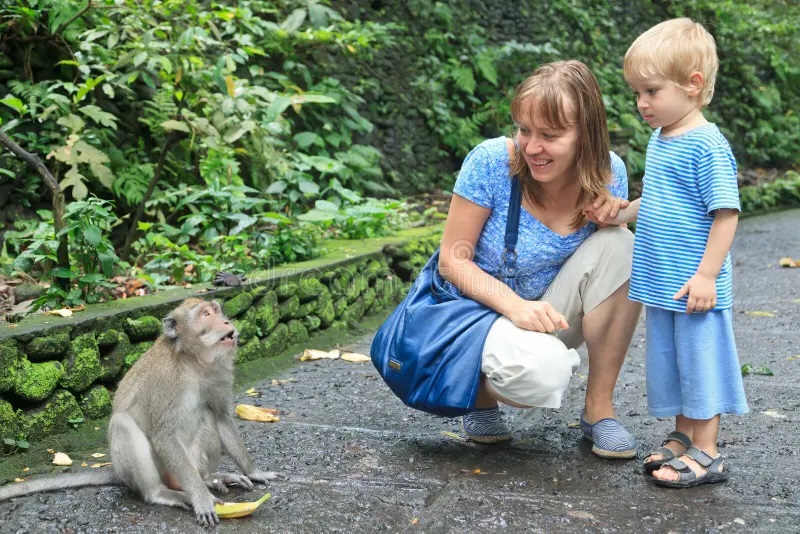
Being wildlife enthusiasts and bird watchers we took a river “safari” during a recent family trip to Bentota. We were dismayed to see that it seems to be the standard practice to feed the monkeys, I think they were the purple faced langurs, that were encountered on the river banks. Each boat that passed by stopped with boxed fruit, coconut and other odds and ends to feed them.
We managed to stop our guy from doing so but faced derision and laughter that we shouldn’t be afraid of monkeys. We tried to explain to him that this is a plague affecting Sri Lanka; elephants being fed on road sides and even in national parks, monkeys being fed from hotel balconies and apparently during river boat rides, birds being fed on hotel terraces etc.
This was met with further mockery and amused dismissal. An effort to make them understand that this was their livelihood that they were destroying it in this manner sailed over their heads. They even have a picture of a baby crocodile on the shoulders of a tourist on their billboard.
We need to consider the following:
Educate such tour operators about the importance of not interfering with the environment and the behaviour of wild animals.
Include education and training in the hotel school, and in schools in tourist resort towns about their duty and responsibility to the environment and the ecosystem on which we all depend.
If it is not already the case such operators should have licenses that should be revoked and fined if found to be engaging in such destructive acts.
Tamara Nanayakkara
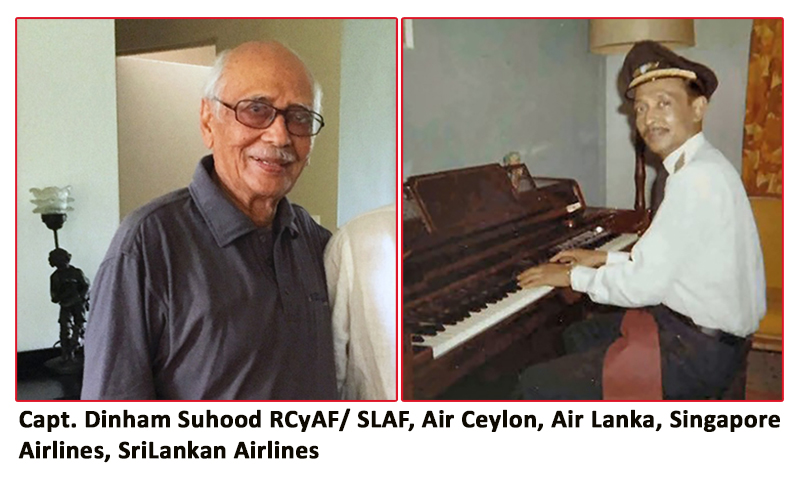
A few days ago, we heard the sad news of the passing on of Capt. Dinham Suhood. Born in 1929, he was the last surviving Air Ceylon Captain from the ‘old guard’.
He studied at St Joseph’s College, Colombo 10. He had his flying training in 1949 in Sydney, Australia and then joined Air Ceylon in late 1957. There he flew the DC3 (Dakota), HS748 (Avro), Nord 262 and the HS 121 (Trident).
I remember how he lent his large collection of ‘Airfix’ plastic aircraft models built to scale at S. Thomas’ College, exhibitions. That really inspired us schoolboys.
In 1971 he flew for a Singaporean Millionaire, a BAC One-Eleven and then later joined Air Siam where he flew Boeing B707 and the B747 before retiring and migrating to Australia in 1975.
Some of my captains had flown with him as First Officers. He was reputed to have been a true professional and always helpful to his colleagues.
He was an accomplished pianist and good dancer.
He passed on a few days short of his 97th birthday, after a brief illness.
May his soul rest in peace!
To fly west my friend is a test we must all take for a final check
Capt. Gihan A Fernando
RCyAF/ SLAF, Air Ceylon, Air Lanka, Singapore Airlines, SriLankan Airlines
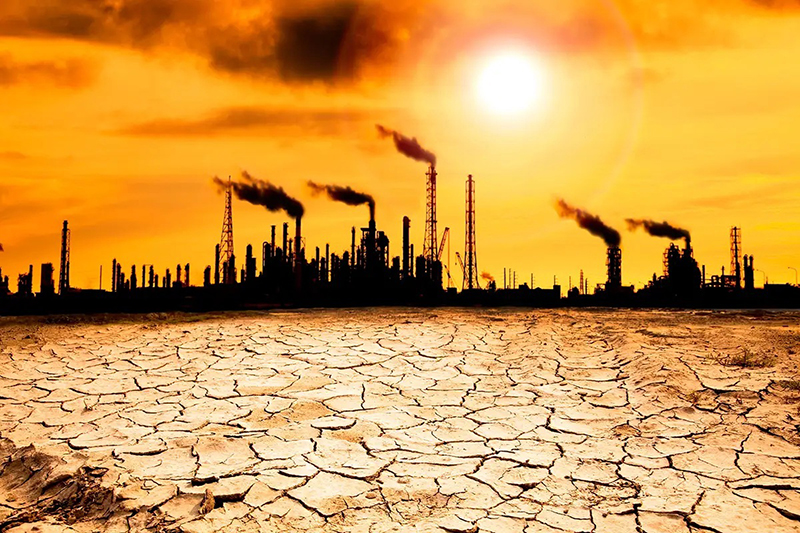
The cause of global warming, they claim, is due to ever increasing levels of CO2. This is a by-product of burning fossil fuels like oil and gas, and of course coal. Environmentalists and other ‘green’ activists are worried about rising world atmospheric levels of CO2. Now they want to stop the whole world from burning fossil fuels, especially people who use cars powered by petrol and diesel oil, because burning petrol and oil are a major source of CO2 pollution. They are bringing forward the fateful day when oil and gas are scarce and can no longer be found and we have no choice but to travel by electricity-driven cars – or go by foot. They say we must save energy now, by walking and save the planet’s atmosphere.
THE DEMON COAL
But it is coal, above all, that is hated most by the ‘green’ lobby. It is coal that is first on their list for targeting above all the other fossil fuels. The eminently logical reason is that coal is the dirtiest polluter of all. In addition to adding CO2 to the atmosphere, it pollutes the air we breathe with fine particles of ash and poisonous chemicals which also make us ill. And some claim that coal-fired power stations produce more harmful radiation than an atomic reactor.
STOP THE COAL!
Halting the use of coal for generating electricity is a priority for them. It is an action high on the Green party list.
However, no-one talks of what we can use to fill the energy gap left by coal. Some experts publicly claim that unfortunately, energy from wind or solar panels, will not be enough and cannot satisfy our demand for instant power at all times of the day or night at a reasonable price.
THE ALTERNATIVES
It seems to be a taboo to talk about energy from nuclear power, but this is misguided. Going nuclear offers tried and tested alternatives to coal. The West has got generating energy from uranium down to a fine art, but it does involve some potentially dangerous problems, which are overcome by powerful engineering designs which then must be operated safely. But an additional factor when using URANIUM is that it produces long term radioactive waste. Relocating and storage of this waste is expensive and is a big problem.
Russia in November 2020, very kindly offered to help us with this continuous generating problem by offering standard Uranium modules for generating power. They offered to handle all aspects of the fuel cycle and its disposal. In hindsight this would have been an unbelievable bargain. It can be assumed that we could have also used Russian expertise in solving the power distribution flows throughout the grid.
THORIUM
But thankfully we are blessed with a second nuclear choice – that of the mildly radioactive THORIUM, a much cheaper and safer solution to our energy needs.
News last month (January 2026) told us of how China has built a container ship that can run on Thorium for ten years without refuelling. They must have solved the corrosion problem of the main fluoride mixing container walls. China has rare earths and can use AI computers to solve their metallurgical problems – fast!
Nevertheless, Russia can equally offer Sri Lanka Thorium- powered generating stations. Here the benefits are even more obviously evident. Thorium can be a quite cheap source of energy using locally mined material plus, so importantly, the radioactive waste remains dangerous for only a few hundred years, unlike uranium waste.
Because they are relatively small, only the size of a semi-detached house, such thorium generating stations can be located near the point of use, reducing the need for UNSIGHTLY towers and power grid distribution lines.
The design and supply of standard Thorium reactor machines may be more expensive but can be obtained from Russia itself, or China – our friends in our time of need.
Priyantha Hettige

Fairly heavy showers are likely at some places in the Rathnapura, Kalutara, Galle and Matara districts

India vs Pakistan is finally here. Over to cricket now

“We Are Building a Stable, Transparent and Resilient Sri Lanka Ready for Sustainable Investment Partnerships” – PM

US military kills 3 in latest attack on boat in the Caribbean

Prez AKD congratulates BNP’s Tarique Rahman on B’desh election win

Massive Sangha confab to address alleged injustices against monks

‘Dates have the highest sugar content to fight Coronavirus’

Sunday Island 27 December – Headlines

#SundayIsland 17th December – Headlines

Sunday Island – 28th March

Sunday Island Headlines – 21 March

Sunday Island – 21st February – Headlines
-

 Business4 days ago
Autodoc 360 relocates to reinforce commitment to premium auto care
-

 Midweek Review4 days ago
A question of national pride
-
 Opinion3 days ago
Will computers ever be intelligent?
-
 Midweek Review4 days ago
Theatre and Anthropocentrism in the age of Climate Emergency
-

 Editorial6 days ago
The JRJ syndrome
-
 Opinion4 days ago
The Walk for Peace in America a Sri Lankan initiative: A startling truth hidden by govt.
-

 Foreign News6 days ago
Portugal elects Socialist Party’s Seguro as president in landslide
-
 Opinion5 days ago
Beyond 4–5% recovery: Why Sri Lanka needs a real growth strategy