
Features
A Tale of three aeroplanes

The present-day sky is crowded. Airways crisscross above continents and oceans and are severely congested with all kinds of aeroplanes carrying passengers and cargo. Then someone crashes, people die, and we say, “What a shame!” The manufacturers start defending their aeroplane, the insurance companies look for loopholes to creep through and save their bacon. Of course, there is always the ever-present ‘pilot error’ verdict to take the final blame. That is what happens in air crashes and crash causes. The dying or the surviving is seldom man-made. It is all done upstairs and has little to do with what we deduce from what we know or hear. I have seen enough of the sky and what happens in it to figure that out.
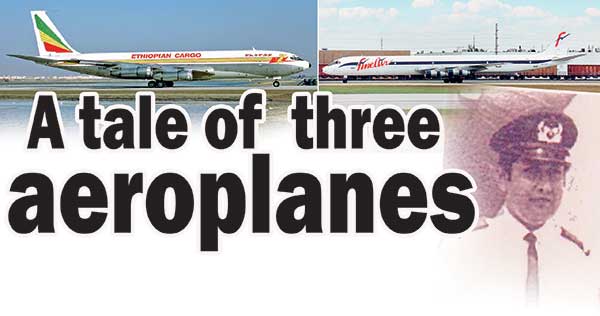
On 7 August 1997, a Fine Air DC-8-61F took off from Miami International on a direct flight to Santo Domingo. It was a cargo flight, two pilots and a Flight Engineer plus a security officer were the only occupants. The DC-8 rolled off on Runway 27 Right and eased into the azure blue Florida sky.
That’s when the trouble started. The first officer was flying, and he could not control the pitch attitude of the aeroplane, and the nose kept creeping up. The speed started bleeding off and the big cargo jet stalled and crashed 3000 ft beyond the end of the runway. It instantly killed the four people on board and also a luckless motorist who was passing on the road beyond the airfield.
 The investigation proved the DC-8 was loaded incorrectly by the cargo people and the trim settings shown were wrong.
The load sheet is given to the Captain a few minutes before the doors are closed. It shows how the aeroplane is loaded and how the centre of gravity is calculated by the load master who decides how the payload should be distributed. If he makes a mistake, and the Captain fails to notice it, no one would know that till the aeroplane rotates and the pitch attitude misbehaves. At times it could become almost impossible to fly the aeroplane.
That’s one down and two to go of the three stories.
The Ethiopian 707 cargo aeroplane was loaded and ready for takeoff in Fiumicino Airport in Rome on 19th November 1977. It was a two-sector flight, first to Asmara and then to Addis Ababa, carrying a consignment of tyres. There were five onboard, the two pilots and the Flight Engineer and two security officers.
The aeroplane was almost fully loaded with heavy cargo plus 11,000 gallons of fuel. The Captain checked the load sheet and calculated the take-off power needed and set the stabilizer trim according to the units that were displayed in the load sheet.
The 707 rolled out of Fiumicino and took off. It is not clear what happened; the theories are multiple. The 707 could not be controlled in the pitching and nosedived to a scrub bush jungle on the extended centerline of the runway.
All five people in the aircraft died. The 11,000 gallons of fuel burned the fuselage to cinders. Maybe the calculated trim was wrong or maybe the loading of the cargo was not according to centre of gravity limits. Some even said the cargo pallets may have shifted. Either way, the five people who died lost their lives in vain, perhaps due to a loading mistake.
And now I come to the third aeroplane, the one that got away.
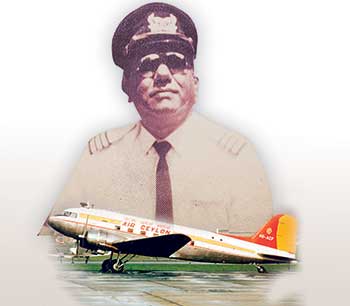
No, this I did not take from any record book; nor is it a trumped-up story from a third or fourth party. This is straight from the horse’s mouth. It was the surviving pilot who laid bare all the facts of this incredible story. Captain Jaya Seneviratne is no more, he passed away some years ago. First Officer Nihal Jayawickrema flew almost every jet aeroplane that served Sri Lanka and retired after being the Director of Flight Operations in the national carrier. I write this in honour of these two pilots. Let the truth be on record, stated as it happened so that such professional pinnacles are remembered and told and re-told for future generations.
 The year was 1971. The JVP had taken up arms to fight the ruling coalition of the Sirimavo Bandaranaike government. At the start the armed forces were ill-prepared to contain the onslaught of the youth uprising. The pendulum swung both ways and hundreds from the two sides died in vain. I better stop that sad story now before I forget my purpose and blast away at things that are best left unsaid.
Ammunition and soldiers had to be moved to fight the JVP. Road transport was difficult due to guerilla-type ambushers. The safest was by air, load an old DC-3 and fly wherever you wanted. Such was the plan when Capt. Seneviratne and F/O Jayawickrema got onboard to fly from Ratmalana to Vavuniya. They had to carry some soldiers and a lot of ammunition boxes that weighed like concrete blocks. Of course, there were no cabin crew, and strangely more passengers than seats, more like military musical chairs. The plane had to fly to Vavuniya, unload soldiers and ammo and return empty to Ratmalana. Of course, whoever ordered the flight had thrown away the rule book. There was no LOAD SHEET. This was an emergency; nobody knew how much the payload weighed and where the trim sheet centre of gravity was. The Captain was a grizzly old school veteran, and the F/O was a bright young spark, and between them they were more than capable of flying to Vavuniya and back. Passengers seated and standing, limitlessly over-loading, and with enough ammunition to make it a flying bomb if any emergency occurred, somebody sure had vapourised the rule book. Had to be somebody big!
They started engines and taxied to line up on runway 04 (heading north/east) and opened full power for the take-off. It was slow to gather speed and almost ran to the other end before the Captain gently eased the control column back and got the lumbering DC-3 to get airborne. The instant Capt. Seneviratne lifted the plane he would have known something was very wrong. The old Dakota was climbing foot by foot while the F/O retracted the gear and the flaps. The aeroplane was still not climbing, the two pilots knew they were flying a heavily over-weight aeroplane which had been loaded with total disregard for its centre of gravity.
From here onwards I am writing exactly what First Officer Jayawickrema told me. This is no fairy tale, but some clever piece of flying which was completely out of the box.
The old Dakota crawled to 1500 feet and stopped climbing. Too heavy and completely out of trim. The Captain turned left and stayed on top of the northern Bolgoda Lake and followed the waterway to Dehiwela. There they turned left and followed the snaking canal to the sea, safe from tall buildings at 1500 ft. Once they crossed the rail-track and the beach, they turned North and flew over the water parallel to the coast. Now they were safe at this low altitude and the Captain sent the First Officer to check the situation in the cabin. There were 24 seats and 38 passengers and so many ammunition boxes that were loaded on the floor at the back. The seatless passengers had conveniently sat on the iron boxes and made themselves comfortable. No wonder the Dakota was over-weight and completely out of trim. It was a minor miracle the Dakota made it to 1500 ft. The pilots decided to fly low level over the sea and head North and somewhere near Kalpitiya to turn right and make a direct track to Vavuniya.
The Captain called the leader of the soldiers and explained and requested the passengers who had no seats to bring the ammo boxes forward along the aisle and the soldiers to sit on them. This was clever thinking. Boxes and men shifted up the aisle, the aircraft was better balanced after the seatless passengers re-located. However, the crew stuck to their original plan to coast-crawl and managed to climb a little too. They flew past Negombo, Chilaw, spotted Deduru-Oya and Puttalam and reached Kalpitiya. There they turned right to track to Vauniya, flying over Wilpattu and Thanthirimalai. The fading sun was still giving enough light and they came to Vavuniya and spotted a clearing amidst the scrub bush. The runway was just a flat strip, a relic from the old second world war days where the RAF had a squadron of Hurricanes based in Vavuniya. That was all gone now and there was only a little hut and a watcher who was there to guard (I do not know from what) but perhaps to chase the cattle that strayed on to the airfield.
The DC-3 usually approached to land at 65-70 knots. But the crew knew she weighed so much more than her maximum landing weight with ammo boxes and 38 passengers. The pilots had to come much faster to land and to avoid stalling the plane. The Dakota did not have stall warning devices. Capt. Seneviratne compromised and made his approach to runway 05 at 100 knots. It would have been an extremely difficult task, an over-weight DC-3 approaching at 100 knots, on a short field of around 1500 meters. There were no guide lights or runway markings to gauge the descent path. The flare alone would have been so difficult to judge; the deck sure was stacked against the pilots, nerve-racking to say the least.
They touched down and went straight for the brakes, but the speed was too high and the runway too short. The Dakota over ran the threshold on the far end and went into a ditch that was full of mud. The nose was down, and the tail was up but no one was hurt.
Considering all factors including the part they over ran the short, unmarked runway, I think it was a brilliant piece of flying. From take-off to touch down it was all seat of the pants out of the box handling and decision-making. My humble opinion says if one was to study everything that happened and how they survived – this sure was a class act.
The soldiers disembarked carrying their ammunition and the crew followed. They inspected the Dakota and saw nothing had happened to the rugged aeroplane except some torn canvases in the tailplane. Ropes were brought and the 38 soldiers pushed and pulled the Dakota and got it out of the ditch. Her wheels were caked with mud and the wheel bays too were pretty badly soiled. Once the soldiers got the aeroplane to hard ground they turned it to face runway 23. The pilots got in and they had to do a battery start. This was tricky, but the crew knew their business. The starter rotated the prop, fuel flowed, ignitors fired, and the engine coughed and smoked as the 14 cylinders came to life. That sure is the sweetest sound from a Pratt and Whitney engine. Both engines started singing and it was all set to go; the Dakota took off on runway 23 and flew to Ratmalana.
They radioed Engineering in Ratmalana and told the Vavuniya story. The men who manned Ratmalana were a special breed.They were ‘Hammer and Spanner’ trouble-fixers who were Grand Masters of the DC-3. By the time the Dakota landed the engineers were ready with high pressure hoses to peel the mud off and also had an expert to stitch the torn tail plane canvas. Some names I remember. It is my privilege to mention them. G.V. Perera, Noel Peiris, Sath Silva, JCT, Quintus Gunasekara, Piya. I remember, the rest were equally good, but I am sad I cannot re-collect all the names.
The engineers took over the aeroplane and the pilots went home.
The following morning my friend Jayawickrema rode his bicycle and came to the airport. The DC-3 was taxiing out for take-off, on the morning flight to Jaffna.
“She looked the beauty she always was” he nostalgically murmured. “Even spruced up by her high-pressure water bath. I couldn’t believe this was the same aeroplane that made an approach at 100 knots to land at a short strip in Vavuniya and ended up in a ditch, full of mud.”
Some pilots crash and die, and some survive. The script is decided by fate that flings the dice. You win some, you lose some and if you are lucky, you live to tell the tale.
Some call it consecration; some call it God.
It is as simple as that.


“We are rather respectable in Colombo. We go to bed fairly early, and we remain there till morning. “
According to Sri Lanka’s diplomatic folklore, the late S.W. R. D. Bandaranaike uttered these words while explaining the reasons for Sri Lanka’s abstention on the UN resolution condemning the Soviet invasion of Hungary. Apparently, SWRD’s foreign ministry officials were asleep at home when the diplomatic cable seeking instructions was received from New York. In those days, there were no cell phones, Internet, or even fax or telex machines. The diplomatic cables were sent through post offices. Decoding them was a slow and time-consuming process. Thus, the government could not provide appropriate instructions to our mission in New York in time, and the Sri Lankan delegation abstained on that sensitive UN vote.
Sri Lanka’s Absence from Section 301 Consultations
But then, how does one explain Sri Lanka’s absence from the crucial bilateral consultation held in Washington by the Office of the United States Trade Representative (USTR) during March-April on “Forced Labour” under the Section 301 of the US Trade Act of 1974? Didn’t our foreign and trade ministries send appropriate instructions to Washington in time? Even if the instructions from the foreign ministry were transmitted to our embassy in Washington by pigeon carriers, there was enough time for Sri Lanka to participate in those meetings.
In March, the USTR initiated these 301 investigations on 60 trading partners, and invited all of them for confidential consultations. Out of the 60, 46 participated in these consultations. Sri Lanka was not one of them. Other countries that didn’t participate in these consultations included China, Russia, and Venezuela! In addition to that, the Section 301 Committee conducted a public hearing with interested parties on April 28 and 29. Washington-based diplomats, representatives from few trade ministries as well as representatives from many foreign trade associations and chambers participated in these hearings. Sri Lanka was once again conspicuously absent.
As a result, when the USTR published the proposed forced labour tariffs on June 2nd, Sri Lanka ended up with a 12.5% duty. Pakistani and Indonesian diplomats participated in these consultations and took appropriate follow-up measures, and managed to enter the 10% duty category. As even a threat of a modest tariff hike could disrupt supply chains and reduce competitiveness, particularly in an industry such as garments, I discussed this issue on 15 June and underscored the importance of Sri Lanka’s participation at the next hearing, which was scheduled to be held from July 7th .
Awakening from Diplomatic Slumber and AKD’s Gazette
Fortunately, Sri Lanka finally awoke from weeks of diplomatic slumber, and Ambassador Mahinda Samarasinghe participated in the public hearing on 9 July, and promised, “…. · We have agreed to the text in our negotiations with the USTR on forced labour, …. The gazette as we speak is being printed and I’m getting the gazette tomorrow morning, and the gazette will be shared with USTR as I get it“.
As promised, President Anura Kumara Dissanayake issued a gazette on 10 July banning the imports of goods produced by forced labour. These new regulations are very similar to what Pakistan and Indonesia enacted in April, after their consultations with USTR in March. Why couldn’t we do it in April? Why did we wait till the very last minute?
Challenges ahead
“War is too important to be left to generals alone,” is a famous saying attributed to former French Premier Georges Clemenceau. Similarly, monitoring our main markets is too important to be left to diplomats alone. The United States is the largest single-country market for Sri Lanka. Therefore, Sri Lankan trade chambers and associations should become more proactive in these markets and participate in these events. For example, the chairman of the Pakistani apparel exporters association participated in the April hearings. Similarly, representatives from the Indian Agricultural and Processed Food Products Export Development Authority, the Federation of Indian Chambers of Commerce and Industry, the Confederation of Indian Industry, and Reliance Industries also participated in July hearings. At an event where each speaker is given only five minutes (strictly enforced), having a number of speakers from a country is an advantage. The presence of industry representatives in these kinds of events also help them understand the market dynamics and the future challenges. This is important, particularly because there will be many more challenges with Trump’s tariffs.
With the gazette issued on 10 July, Sri Lanka has imposed a prohibition on the importation of goods produced with forced labour. Now, the challenge will be to effectively enforce the prohibition. And what are the goods produced with forced labour? The USTR list only focuses on aluminum, cotton, electronics, lithium-ion batteries, rice, and tobacco. However, according to the U.S. Department of Labour, the list is much longer. Hence, this list may change continuously during the next two years and tariffs may fluctuate once again.
So, this is definitely not the time to slumber.
(The writer, a retired public servant, can be reached at senadhiragomi@gmail.com)
by Gomi Senadhira ✍️
After the overwhelming grotesquerie of J K Rowling’s latest Cormoran Strike novel (written, I should have noted, as the others were, under the pseudonym Robert Galbraith), I thought I should return to the world of fun, and also a much shorter description since this thriller moves quickly without the layers of detail that Rowling engages in.
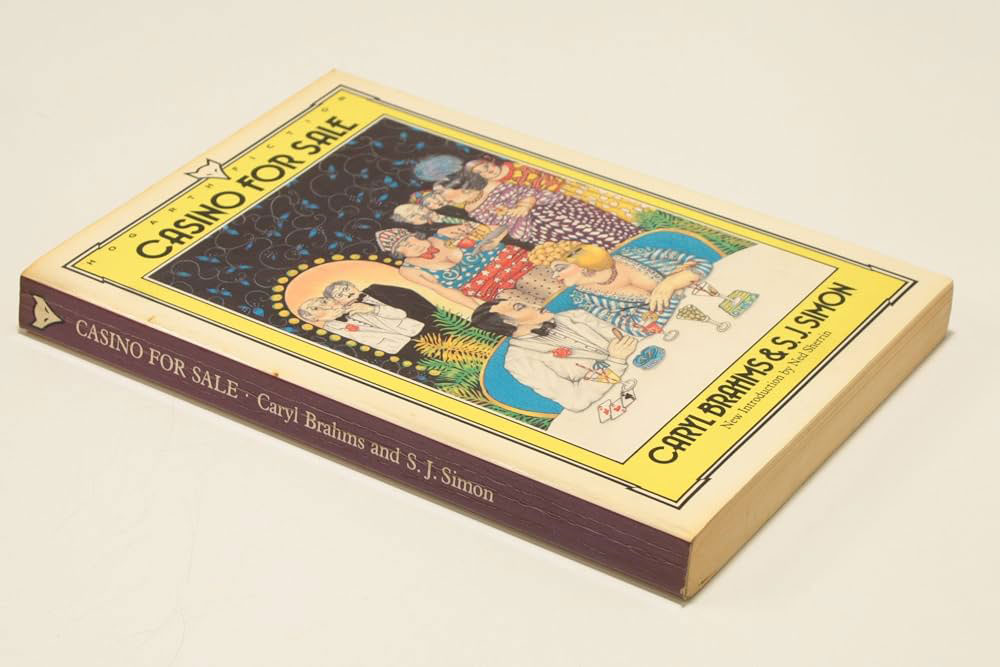
I then move to the second comic thriller by Caryl Brahms and S J Simon. This, their second story to feature Vladimir Stroganoff and Adam Quill, was Casino for Sale, as lunatic a romp as the first, though without the emphasis on the ballet that characterized A Bullet in the Ballet.
This one begins with the impresario Stroganoff buying a casino cheap from Baron Sam de Rabinovich, only to find that it was a rundown place, not the grand casino of La Bazouche, a resort on the Frenc+h Riviera, as he had initially thought. The grand one belonged to Lord Buttonhooke, and Stroganoff could not compete, until he thought of bringing the Ballet Stroganoff to the casino – which of course leads to Buttonhooke deciding to have ballet performances in his Casino too.
Stroganoff invites Quill to visit him, which Quill decides to do since he has left Scotland Yard, having come into a legacy. No one believes this, and he has to face questions as to what he did to have been sacked, with sympathy for having been found out.

Caryl and Simon
The day he arrives in La Bazouche there is a murder, of a vitriolic critic called Citrolo, in Stroganoff’s office. He had been going to write a damning review of the opening night of the ballet and Stroganoff, when he realizes Citrolo cannot be swayed, drugs him and dictates the review himself to the papers. He leaves Citrolo sleeping and finds him shot the next morning, whereupon he decides to muddy the waters and leave a suicide note and lots of other murder weapons. So much overkill, as it were, of course ensures that he is arrested.
But the excitable French detective who makes the arrest follows up his suggestion that Buttonhooke was also involved, and so the two casino owners find themselves in cells next door to each other, with the detective Gustave quite happy to provide creature comforts for a fee.
Quill decides he must investigate, and finds Gustave most cooperative, since he has a laid back attitude to work. So it is Quill that finds a notebook which makes it clear Citrolo is an accomplished blackmailer, and that there are lots of possible murderers, including Stroganoff’s croupier, who was crooked, Rabinovich, who was now working for Buttonhooke, a confidence trickster called Kurt Kukumber, whose prospectus for a dud gold mine was found in the office and Prince Alexis Artishok who was engaged in a deal to buy diamonds from the ballerina Dyra Dyrakova.
Stroganoff had been trying to get Dyrakova to dance for him, but having done so previously she had refused. But then to Stroganoff’s chagrin she agreed to dance for Buttonhooke. The clearly crooked Artishok had told Buttonhooke’s mistress Sadie Souse, who was not very bright, that Dyrakova possessed diamonds she was willing to sell cheap, and Sadie was determined to have them.
Quill meanwhile finds out that there was a secret passage to Stroganoff’s office, the obvious solution to what had begun as a locked room mystery, and that this was known by almost everyone apart from Stroganoff himself. And then Rabinovich is murdered, just after Gustave had released his two original suspects, leading him to blame Quill for having insisted on that and thus allowing them to kill again.
Soon afterwards Dyrakova arrives, and the town is full of posters announcing that she will appear in the casinos, elaborate posters for either one, since Stroganoff is determined that she will dance for him, and if she does not come willingly, he has devised a scheme to make her do so unwillingly. So, though Buttonhooke has her taken off to his yacht immediately she arrives at the station, Quill along with Arenskaya gets her into a launch and to Stroganoff’s casino, where she performs to tumultuous applause, not knowing for whom she is dancing.
When Quill asked her about the diamonds, she said she had sold them long ago, and that gave Quill the solution to the mystery. Rabinovich had known about this, and Artishok had killed him to prevent Sadie learning it from him, he had killed Citrolo who had recognized him for an accomplished card sharper, not a Russian prince at all. But before he is arrested, he gets away in a boat, and the police launch that pursues him is on the point of catching him up when it runs out of petrol.
Again, lots of excitement, and entertaining references – Gustave grows marrows – and if not quite as brilliant as its predecessor, Casino was certainly a delightful read.
 It was a few years back that a former President of Sri Lanka took it on himself to pronounce SAARC ‘dead’. Since then there have been other sections of Sri Lankan opinion that have joined the critics of SAARC and taken the solemn stance that SAARC has indeed died what may be called a natural death.
Their fatalism is understandable. SAARC has failed to meet at heads of government or state level for the past several years to take the SAARC process notably forward. Regional cooperation has more or less been only an appealing idea. No substantive concrete projects have taken off to make the idea a hard reality. ‘Inner paralysis’ seems to be SAARC’s lot. Hence the fatalism in these circles.
However, being one of the worst cash-strapped regions of the world and a teemingly populated one with people virtually left to their devices, what choices do the ‘SAARC Eight’ have other than to try their best to band together and continue with their cooperation efforts, however small they may be?
There is no escaping the mounting debt trap for many of these countries and bankrupt Sri Lanka is a glaring example, but ‘throwing in the towel’ and abandoning themselves entirely to the diktats of the strongest economies and their agencies will prove a ‘living death’ for many countries in the SAARC fold.
The gains may be meagre but giving-up on SAARC cooperation in full would prove self-defeating for the organization and South Asia. Right now, the collective intention ought to be to salvage what the region could from the tenuous cooperative efforts. Moreover, such initiatives could go some distance to generate a degree of goodwill among the Eight and help in sustaining a dialogue process.
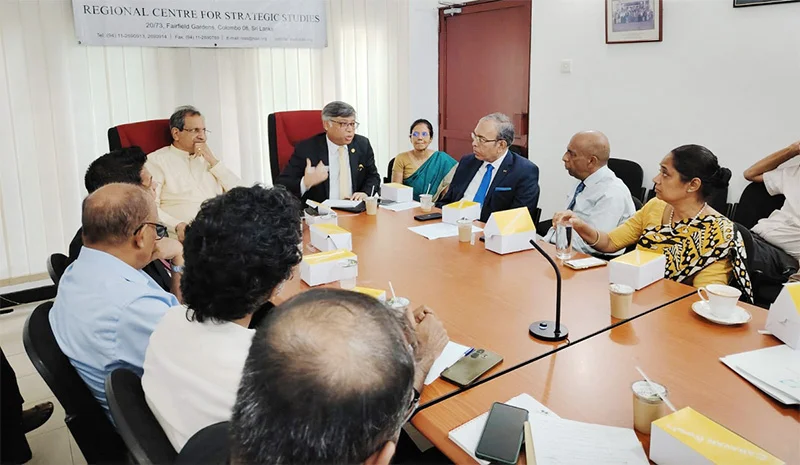
Given this backdrop it proved ‘a stich in time’ for the Regional Centre for Strategic Studies (RCSS), Colombo, to recently host the SAARC Secretary General Ambassador Md. Golam Sarwar to a round table discussion on the unifying potential of SAARC and its future possibilities, besides other related issue areas.
Held on June 24th and moderated by RCSS Executive Director and former ambassador Ravinatha Aryasinha, the forum brought together a vibrant, wide ranging audience comprising academicians, diplomats, senior public servants, civil society activists and many others. Following the presentation by Ambassador Golam Sarwar titled, ‘Reigniting SAARC: Achievements, Challenges and the Way Ahead’, a lively Q&A followed.
The above forum could be described as an act of lighting the proverbial ‘candle’ rather than ‘cursing the darkness.’ It surely is a ‘darkness’ that could be seen as daunting considering that the region’s pivotal powers, India and Pakistan, are failing to act in a spirit of accord but are engaged in bitter finger-pointing on a number of questions of vital importance to SAARC.
On the other hand, what is the rest of the region doing to bring the above sides together? It is disappointing that to date the rest of SAARC has failed to launch a major diplomatic drive to bring peace between the feuding regional heavyweights. It needs to act without delay and establish its earnestness and this effort would need to prove SAARC’s staying power in the unfolding months and even years.
In assessing SAARC’s seeming failure local opinion in particular has failed to factor in what could be described as weak leadership. Since Sheikh Mujibur Rahman of Bangladesh, the founding father of SAARC, the region has failed to produce a visionary leader who could advance the SAARC cause with charisma and drive.
Among other reasons, weak leadership accounts considerably for the faltering and stuttering status, as it were, of SAARC. Badly needed are leaders who could go the extra mile, think less of narrow national interests and work diligently towards the collective well being of the region but SAARC’s millions of ordinary people have been made to wait in vain for leaders of such stature. Instead, they have been burdened with politicians who seem to be relishing the apparently moribund state of SAARC.
Looking back, it could be said that it was the dynamic leadership factor that led to the launching of the Non-Aligned Movement and for its sustenance for a few decades. True, it could be seen in some quarters that NAM is no more, but as in the case of SAARC, the former too has been unfortunate to be burdened over the years with politicians who lack the vision and drive to unflaggingly advance the fortunes of the South. NAM and SAARC lack the dynamism and vision of leaders of the stature of Jawaharlal Nehru, for example, to give them the required guidance and intellectual depth.
The reasons are complex for there not being among us currently political leaders with the vision and the steadfast commitment to advance the legitimate interests of the South. However, it could be stated with conviction that the majority of Southern leaders have too easily caved in to the demands of the global North and its financial agencies.
These leaders have failed to see, for instance, that the largely market economy oriented Northern governments would not view with favour a centrist economic model that attaches priority to the interests of the dis-empowered publics of the South. This realization ought to have dawned on the current government in Sri Lanka, for instance, some while ago but it has no choice but to abide by IMF dictates since economic survival at present is unthinkable without the latter’s succour.
Accordingly for SAARC this should be the time for some soul-searching. Priority needs to be attached to ending the feuding between India and Pakistan since at present the material fortunes of the region hinge largely on these regional giants giving peaceful relations among them a try. This is no easy challenge to meet but some daring, visionary diplomacy needs to take hold among the rest of SAARC.
There is some sense in SAARC bringing the peoples of the region together through programs that address their best collective interests. A meeting of minds among SAARC nations could enable SAARC and its agencies to build a region-wide people’s movement for progressive political and economic change that could in turn lead to the region’s political leaders sensitizing themselves more to the neglected needs of their publics.
However, the time is ‘now’ for the initiation of these progressive changes and the voice of SAARC well wishers would need to drown out those of their critics.

Showers may occur in the Western, Sabaragamuwa and North-western provinces and in Kandy, Nuwara-Eliya, Galle and Matara districts

Dengue outbreak gallops ahead: Infections surpasses 73,455, leaving 50 dead

Evidence recorded in money laundering case against Yoshitha Rajapaksa

Former IGP C.D. Wickramaratne dies in suspected suicide

CAA sets aflatoxin limit for processed liquid milk from January 2027

Son of ex-Justice Minister further remanded till July 28

‘Dates have the highest sugar content to fight Coronavirus’

Sunday Island 27 December – Headlines

#SundayIsland 17th December – Headlines

Sunday Island – 28th March

Sunday Island Headlines – 21 March

Sunday Island – 21st February – Headlines
-
 Features6 days ago
Prison riots and politics: NPP’s biggest challenge and Sri Lanka’s biggest opportunity
-
 Features3 days ago
Dirty Money
-

 Editorial6 days ago
Much ado about crime: Fish or cut bait
-
 Features6 days ago
More on Saudi Arabia: ARAMCO and beyond
-

 News1 day ago
Money laundering case against Yoshitha, fixed for pre-trial conference
-
 Sports6 days ago
The banker who rescued Sri Lankan cricket
-
 Midweek Review3 days ago
The sordid tale of theft and tragedy at Finance Ministry
-

 Latest News4 days ago
Oil prices hit 1-month high as US-Iran attacks dim Strait of Hormuz outlook